Modern B2B buyers rarely convert after a single interaction. They click an ad, read a blog post, attend a webinar, get a follow-up email, talk to a sales rep, and then maybe convert weeks or months later. By the time a deal closes, a dozen touchpoints may have played a role. Yet most marketing teams are still working with fragmented data that shows them pieces of this journey but never the full picture.
This is the core tension driving interest in customer journey management. The discipline exists to solve exactly this problem: connecting every interaction a prospect has with your brand into a coherent, trackable story that informs real decisions. And when marketers search for solutions, Adobe is one of the first names that comes up.
Adobe has built one of the most recognized enterprise ecosystems in this space, with a suite of tools designed to handle journey orchestration, behavioral analytics, and audience unification at scale. But understanding what Adobe actually offers, where it fits, and whether it's the right path for your team requires a clearer look at what customer journey management really involves. That's exactly what this article covers.
The Discipline Behind the Buzzword: What Customer Journey Management Actually Means
Customer journey management is the practice of identifying, tracking, and optimizing every interaction a prospect or customer has with your brand across channels and time. That sounds straightforward, but the execution is where most teams hit a wall.
There's an important distinction worth making upfront: mapping a customer journey and managing one are very different things. A journey map is a static diagram. It's a useful exercise for building empathy and aligning teams around how buyers typically move through your funnel. But a map doesn't update itself when behavior changes, and it doesn't tell you which touchpoints are actually driving conversions.
Managing a customer journey, by contrast, is a live, data-driven process. It means continuously collecting behavioral data, connecting it across channels, and using those insights to make decisions in real time. Which campaigns are generating pipeline? Which sequences are accelerating deals? Which channels are contributing to revenue but getting zero credit in your last-click reports? These are the questions journey management is designed to answer.
For B2B SaaS teams specifically, this visibility is not optional. It's essential. Here's why B2B makes the problem harder than it looks.
B2B sales cycles are longer. A prospect might first encounter your brand through a paid ad and not convert for three to six months. During that time, they might interact with your content, attend a demo, go dark, resurface after a competitor comparison, and then close. Each of those interactions matters, and none of them happen in isolation.
B2B deals also involve multiple stakeholders. The person who clicked the first ad may not be the person who signs the contract. Decision-making units often include champions, economic buyers, and technical evaluators who each interact with your brand differently. Tracking only one person's journey gives you an incomplete picture of how the deal actually came together.
Finally, B2B journeys blend digital and sales-assisted touchpoints. A prospect might convert on a landing page, get handed to an SDR, go through a discovery call, and close in a CRM. That transition from digital behavior to human interaction is where most attribution systems break down. Customer journey management, done well, bridges that gap.
How Adobe Approaches Customer Journey Management
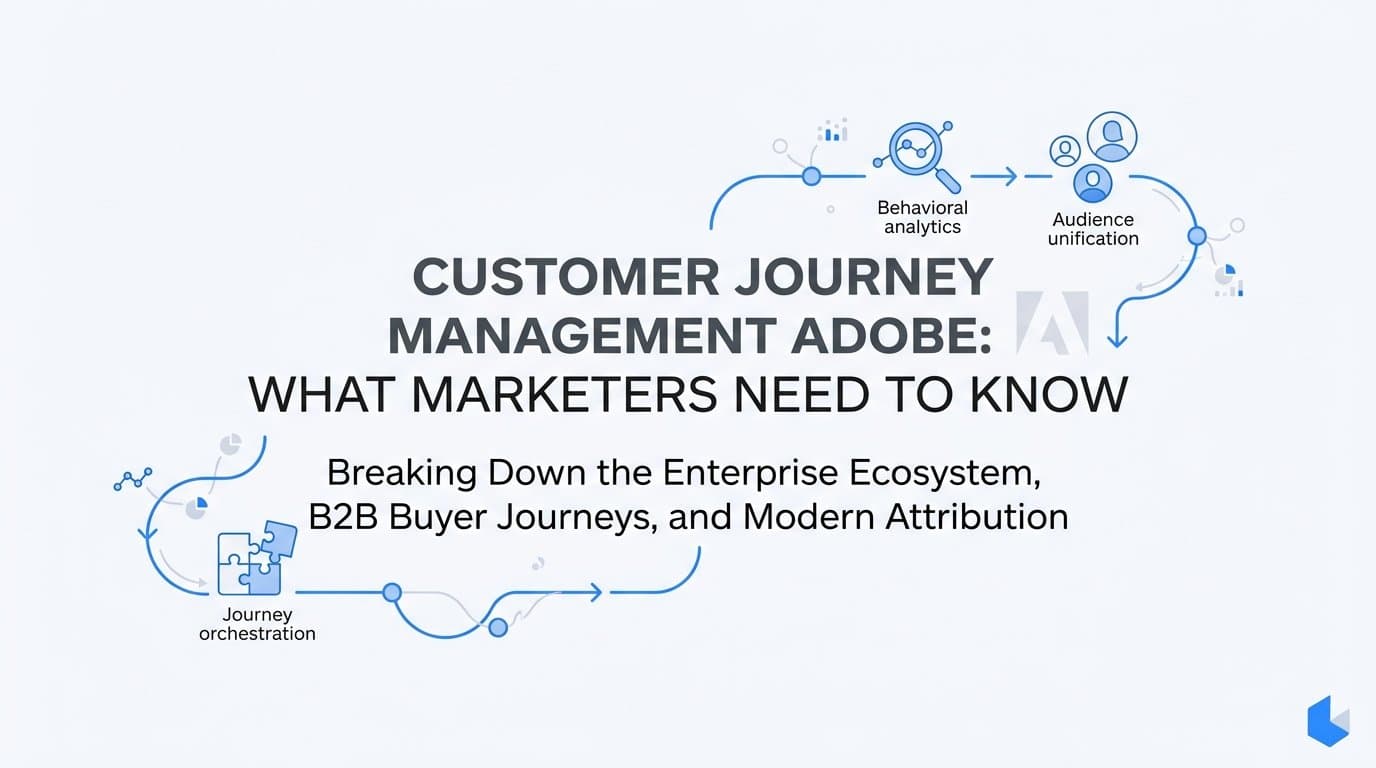
Adobe's answer to customer journey management lives within Adobe Experience Cloud, an ecosystem of interconnected products designed to handle the full scope of enterprise marketing operations. Three tools sit at the center of their journey management approach.
Adobe Journey Optimizer is built for real-time cross-channel orchestration. It allows teams to design and automate personalized experiences across email, push notifications, web, and paid channels based on customer behavior and profile data. The idea is to respond to signals in real time and deliver the right message at the right moment across the right channel.
Adobe Analytics provides the behavioral data layer. It collects and reports on how users interact with your digital properties, offering segmentation, funnel analysis, and attribution reporting. For teams that need deep visibility into on-site behavior and campaign performance, it serves as the measurement backbone of the Adobe stack.
Adobe Real-Time CDP handles audience unification and segmentation. It ingests data from multiple sources, resolves identities across devices and channels, and creates unified customer profiles that other Adobe tools can act on. The real-time component means that audience segments update dynamically as new behavioral data arrives.
Together, these tools form a powerful architecture for large organizations that need to manage complex, multi-channel customer experiences at scale. Adobe's approach is built around the idea that journey management requires a centralized data foundation, a flexible orchestration layer, and robust analytics sitting on top.
That architecture is genuinely impressive. But it comes with a context that matters for how you evaluate it.
Adobe Experience Cloud is designed for enterprise organizations. The implementation typically requires dedicated technical teams, often including data engineers, solutions architects, and platform administrators. Integrating Adobe's tools with existing CRM systems, data warehouses, and ad platforms is not a weekend project. It requires significant investment in both time and internal expertise.
This is not a criticism. It's a design reality. Adobe is built to handle the scale and complexity of large enterprises with sophisticated data infrastructure needs. For those organizations, the investment is often justified. For B2B SaaS growth teams that need accurate attribution quickly and don't have a dedicated data engineering function, the calculus looks different.
The Attribution Gap: Where Journey Data Breaks Down
Here's the uncomfortable truth about most journey management setups: collecting touchpoint data is the easy part. The harder problem is connecting those touchpoints to actual revenue outcomes.
In B2B, deals close in a CRM. The final handshake happens in Salesforce or HubSpot, often weeks or months after the first marketing interaction. But most marketing analytics tools are measuring what happens before the CRM ever gets involved. They can tell you about clicks, sessions, and form fills. They struggle to tell you which of those interactions actually contributed to a closed-won deal.
This is the attribution gap, and it shows up in several predictable ways.
Ad platform data lives in a silo. Google Ads and Meta Ads Manager each report on conversions using their own attribution logic. They count what happened inside their platforms and often take credit for the same conversions. When you add those numbers up, the total frequently exceeds what your CRM shows as actual pipeline. The data isn't lying, it's just incomplete and uncoordinated.
Last-click bias distorts the picture. Default attribution in most platforms gives full credit to the last touchpoint before conversion. If a prospect clicked a retargeting ad right before filling out a demo form, that ad gets all the credit. The blog post they read six weeks ago, the webinar they attended, and the email sequence that kept them engaged? Invisible. This creates a systematic bias toward bottom-of-funnel channels and away from the awareness and nurture activities that actually built the relationship.
Pipeline and revenue data never make it back to marketing. Even when teams have solid top-of-funnel tracking, the connection between marketing activity and downstream revenue often breaks. Marketing can see lead volume. Sales can see pipeline. Finance can see revenue. But connecting all three in a way that lets marketers say "this campaign generated this much closed revenue" is where most stacks fall short.
Multi-touch attribution is the analytical method designed to address this. Instead of giving all credit to one touchpoint, multi-touch attribution distributes credit across all the interactions in a journey. Different models do this differently: linear attribution spreads credit evenly, time-decay gives more weight to touchpoints closer to conversion, and data-driven models use algorithmic analysis to assign credit based on actual influence patterns. Each tells a different story, and the right model depends on your sales cycle and business context.
But the model itself is only as good as the data feeding it. If your journey data doesn't include CRM events, you can't do meaningful revenue attribution. If your tracking breaks at the browser level due to cookie restrictions, your touchpoint data has gaps. This is why the infrastructure underneath attribution matters as much as the model on top.
What B2B SaaS Marketers Need From a Journey Management Stack
If you're building or evaluating a journey management stack for a B2B SaaS business, the requirements look different from what a large enterprise or an e-commerce brand might need. The core needs come down to a few non-negotiables.
Server-side tracking for data accuracy. Browser-based tracking has become increasingly unreliable. Safari's Intelligent Tracking Prevention, Firefox's enhanced privacy protections, and the gradual phase-out of third-party cookies across major browsers have created significant gaps in client-side data collection. Server-side event tracking routes data through your own server before sending it to analytics and ad platforms, bypassing browser restrictions and giving you a more complete and accurate picture of user behavior. For B2B SaaS teams that need reliable attribution data, server-side tracking is no longer optional.
CRM integration to capture lead-to-revenue events. Your CRM is where the most valuable data in your marketing stack lives. Lead status changes, opportunity creation, deal stage progression, and closed-won events are all signals that should flow back into your attribution model. Without CRM integration, you're measuring marketing performance against proxy metrics like form fills rather than actual business outcomes. A proper journey management stack connects those CRM events to the marketing touchpoints that preceded them.
Ad platform connections for true ROI measurement. Your journey stack needs to pull spend data from Google Ads, Meta, LinkedIn, and other channels and connect it to pipeline and revenue data from your CRM. This is how you calculate actual return on ad spend, not the platform-reported ROAS that reflects each platform's own attribution logic, but the real revenue generated per dollar spent across your entire funnel.
Attribution models that reflect B2B buying behavior. Single-touch attribution models are not sufficient for B2B sales cycles. You need the ability to compare linear, time-decay, and data-driven models to understand which channels are contributing at different stages of the journey. The goal is not to find one "right" model but to use multiple models as lenses that reveal different aspects of how your buyers move toward a decision.
First-party data collection ties all of this together. As third-party tracking becomes less reliable, the teams that win on attribution will be the ones that have built robust first-party data infrastructure: tracking events on their own properties, capturing identity data through forms and authentication, and enriching that data with CRM and ad platform signals.
Choosing the Right Tools for Your Journey Tracking Goals
When evaluating journey management and attribution tools, the right questions to ask are more important than any feature checklist. Start here.
Does it connect ad spend to closed revenue? This is the fundamental test. If a tool can show you clicks and sessions but can't tell you which campaigns generated closed-won deals, it's not solving the attribution problem. It's just adding another dashboard.
Can it handle multi-touch attribution across channels? You need visibility into how all your channels work together, not just how each one performs in isolation. A tool that supports multiple attribution models and lets you compare them gives you a much richer understanding of your marketing mix.
Does it require a large technical team to operate? This is where the enterprise versus purpose-built distinction becomes practically relevant. Some platforms require significant technical investment to implement and maintain. Others are designed to be operational quickly without a dedicated data engineering team. Your answer to this question should be honest about your current team's capacity and expertise.
Enterprise platforms like Adobe Experience Cloud are genuinely powerful. For large organizations with complex multi-product deployments, dedicated technical resources, and the need to manage customer experiences at scale across dozens of channels, Adobe's architecture is well-suited to the job. The investment in implementation and ongoing maintenance is justified when the organizational complexity matches the platform's capabilities.
But for B2B SaaS teams that are primarily focused on understanding which campaigns are driving pipeline and revenue, a full enterprise stack is often more than what's needed. The complexity can become a barrier to insight rather than a path to it.
Purpose-built attribution platforms offer an alternative. They're designed specifically to connect ad platforms, CRM data, and website behavior into a single attribution view, without requiring a multi-month implementation or a team of data engineers. For growth-stage and mid-market B2B SaaS companies that need accurate, actionable journey data quickly, this is often the more practical path.
Cometly is built for exactly this use case. It connects your ad platforms, CRM events, and website behavior to give your team a real-time view of which channels and campaigns are actually driving revenue. With support for multi-touch attribution models, server-side tracking, and integrations with over 70 platforms, it's designed to give B2B SaaS marketers the attribution clarity they need without the overhead of an enterprise deployment.