Most marketing teams pour enormous energy into the top of the funnel. They obsess over click-through rates, cost per lead, and conversion rates from ad click to signed contract. And then, the moment a deal closes, the baton gets passed to customer success and the marketing team moves on to the next campaign.
This is a costly blind spot. Acquisition costs in B2B SaaS have been climbing for years, yet the most valuable revenue in a subscription business rarely comes from net-new logos alone. It comes from customers who stay, expand their usage, and bring others in. If your marketing team cannot see what happens after the sale, you are making budget decisions based on a fraction of the story.
The customer journey post purchase is not just a retention concern. It is a critical data layer that shapes smarter ad spend, more accurate attribution, and higher-confidence revenue forecasting. Understanding what happens after a deal closes, and connecting those outcomes back to the campaigns that drove acquisition, is one of the highest-leverage things a B2B SaaS marketing team can do right now.
This article is a practical guide for growth-minded marketers who want to understand, map, and measure the full customer journey. We will walk through what the post-purchase phase actually looks like in a SaaS context, how it connects to attribution strategy, and what it takes to build a complete picture from first ad click through renewal and expansion.
Why the Sale Is Just the Beginning of the Journey
In B2B SaaS, a closed deal is not a completed transaction. It is the start of a recurring relationship. The customer journey post purchase encompasses every touchpoint, decision, and experience a customer has after their first conversion, beginning with onboarding and extending through activation, ongoing engagement, renewal, and potential expansion into additional seats, features, or products.
This is fundamentally different from how the journey works in e-commerce or one-time purchase models. In those contexts, post-purchase activity matters for loyalty and repeat buying, but the initial transaction is complete. In SaaS, the initial contract is just a down payment on a relationship that needs to be continuously earned. Revenue is recurring, and customer lifetime value compounds over time rather than resolving in a single moment.
Think about what this means commercially. A customer who signs a $500 per month contract and stays for three years represents $18,000 in revenue. A customer who churns after two months represents $1,000. If both came from the same campaign, your attribution model almost certainly treats them identically because both converted. But they are not the same customer, and the campaign that brought them in should not receive the same credit.
This is the marketing blind spot that the post-purchase journey exposes. When attribution models only track pre-purchase touchpoints, such as the ad clicks, content views, and form fills that lead to a first conversion, teams lose visibility into a crucial dimension of campaign quality. You can see which channels drive the most leads. You cannot see which channels drive the most revenue over time.
The downstream consequences of this blind spot are significant. Marketing teams optimize toward acquisition metrics that may not correlate with retention. Budget flows toward channels that generate volume, not value. And leadership makes investment decisions based on cost per acquisition numbers that do not account for what those acquisitions actually produce after the contract is signed.
Closing this gap requires treating the customer journey post purchase as a marketing intelligence problem, not just a customer success problem. The data generated after a deal closes, product usage, renewal behavior, expansion activity, is directly relevant to how marketing should allocate spend and evaluate campaign performance.
The Core Stages of the Post-Purchase Customer Journey
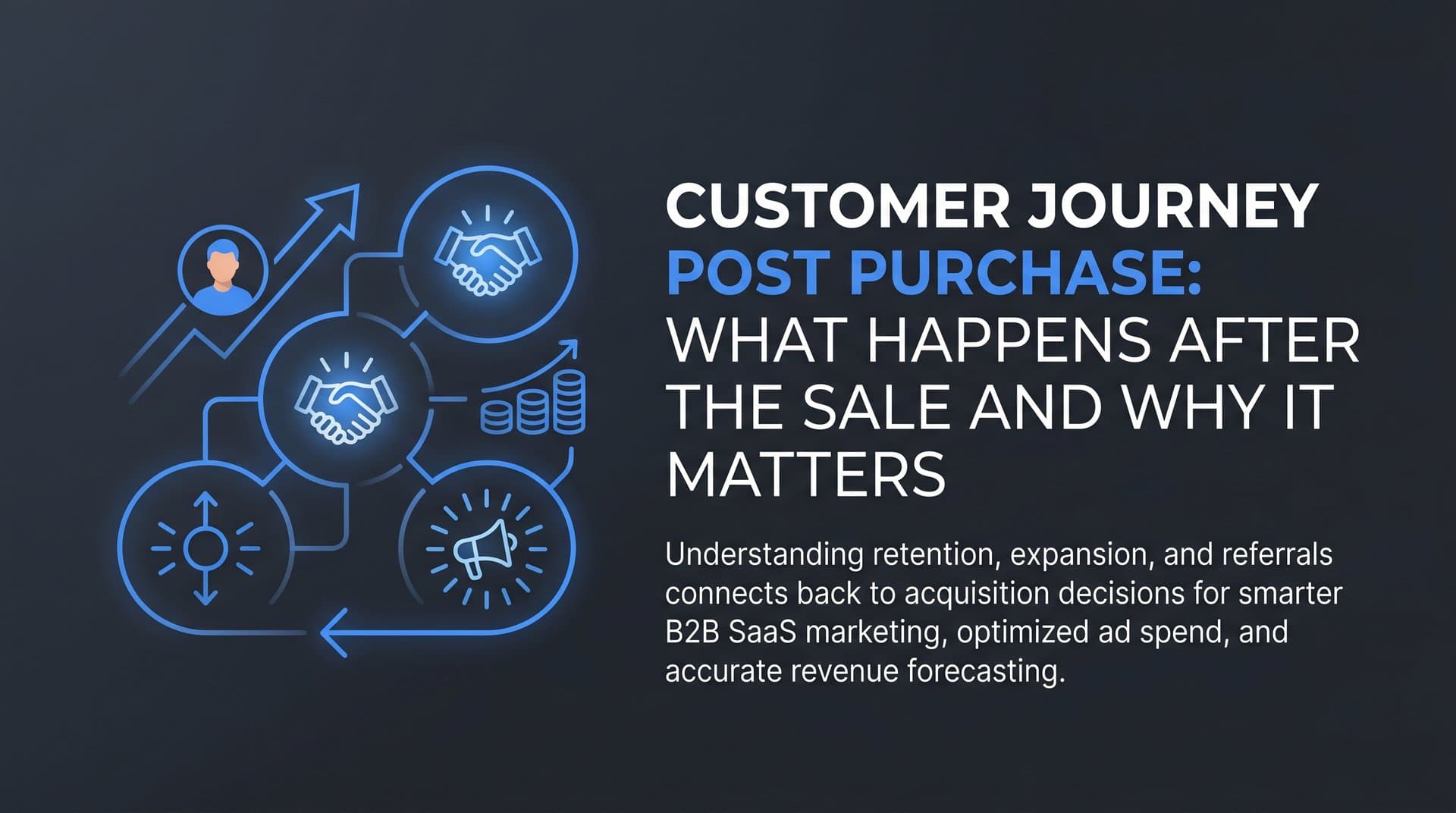
To connect post-purchase outcomes to marketing strategy, you first need a clear map of what the post-purchase journey actually looks like. In B2B SaaS, it typically moves through four distinct stages, each with its own touchpoints, signals, and commercial implications.
Onboarding and Activation: This is the period immediately following a new customer's first login or contract start. The goal is to move the customer from "signed" to "successfully using the product." Touchpoints here include welcome email sequences, in-app onboarding flows, live training sessions, and early check-ins from customer success. Activation, meaning the moment a customer experiences the product's core value for the first time, is the most critical milestone in this stage. Customers who activate quickly are significantly more likely to retain.
Ongoing Engagement and Value Realization: Once a customer is activated, the journey shifts to sustained engagement. This stage is defined by product usage patterns, feature adoption, support interactions, and the cadence of communication between the customer and your team. The key question here is whether the customer is experiencing enough value to justify renewal. Touchpoints become less structured and more behavioral: login frequency, feature usage depth, support ticket volume, and participation in community or educational resources.
Renewal Decision: In annual or multi-year contracts, the renewal decision is a discrete event. In monthly subscriptions, it is a continuous undercurrent. Either way, there is a window during which the customer is actively evaluating whether to continue. This stage involves touchpoints from both customer success teams and automated communications, including renewal reminders, executive business reviews, and ROI reporting. The signals leading into this stage, particularly product usage trends and NPS scores, often predict the outcome before any explicit conversation happens.
Expansion and Upsell Moments: Customers who have realized value are candidates for expansion, whether through additional seats, higher-tier plans, or complementary products. Expansion touchpoints often look like a hybrid of sales and customer success: usage-triggered prompts, proactive outreach when usage approaches plan limits, and targeted campaigns to existing customers about new features.
What makes these stages distinct from pre-purchase touchpoints is their source. Pre-purchase touchpoints are largely ad-driven and externally initiated. Post-purchase touchpoints are generated by product behavior, CRM events, customer success interactions, and billing systems. They live in different tools, speak different data languages, and rarely flow automatically into marketing attribution systems.
This is where post-purchase intent signals become important. A customer who has not logged in for two weeks, whose support tickets have increased, and who has not completed key onboarding steps is displaying churn risk signals. A customer who has maxed out their seat allocation and is actively using advanced features is displaying expansion readiness signals. Capturing and acting on these signals requires both a retention strategy and a data infrastructure that connects product behavior to the broader customer journey view.
How Post-Purchase Data Transforms Marketing Attribution
Here is where the strategic value of post-purchase visibility becomes concrete for marketing teams. When you can connect post-purchase outcomes back to original acquisition sources, you gain the ability to evaluate campaigns not just on lead volume or initial conversion rate, but on the quality and long-term value of the customers they produce.
Consider two paid search campaigns running simultaneously. Campaign A generates leads at a lower cost per acquisition and drives a higher volume of trial signups. Campaign B generates fewer leads at a higher cost. By traditional attribution metrics, Campaign A looks like the winner. But when you layer in post-purchase data, a different picture emerges. Customers from Campaign A churn at higher rates and rarely expand. Customers from Campaign B have higher activation rates, longer retention, and are far more likely to upgrade. Campaign B is actually generating more revenue per dollar spent, and without post-purchase visibility, you would never know.
This is revenue attribution in practice. It means tracing downstream revenue events back to the original touchpoints that initiated the customer relationship. When a customer expands their plan six months after signing, that expansion revenue should be attributable to the campaign that brought them in. When a customer renews for a second year, that renewal value should inform how marketing evaluates the channel that drove the original acquisition.
Pipeline and revenue attribution serves as the bridge between marketing activity and closed-won plus expansion revenue. It requires a tracking architecture that spans both pre- and post-purchase data, connecting ad platform events, CRM milestones, product usage signals, and billing data into a single attribution model. This is not a trivial infrastructure challenge, but it is the foundation of accurate marketing ROI measurement in a subscription business.
The practical implication is a shift in how marketing teams set optimization targets. Instead of optimizing campaigns toward early-funnel metrics like cost per lead or cost per trial signup, teams with post-purchase attribution can optimize toward metrics that reflect actual revenue outcomes, such as cost per activated customer, cost per retained customer at 90 days, or cost per dollar of expansion revenue generated.
This shift also changes how budget conversations happen at the leadership level. When marketing can demonstrate not just how many leads a channel generates but how much long-term revenue those leads produce, the conversation moves from volume-based metrics to value-based metrics. That is a fundamentally more defensible and strategically useful position for a marketing team to be in.
Mapping Post-Purchase Touchpoints for B2B SaaS Teams
Understanding the post-purchase journey conceptually is one thing. Building the operational infrastructure to track it is another. A practical starting point is a systematic framework for identifying and documenting post-purchase touchpoints across three dimensions: channel, stage, and data source.
By Channel: Post-purchase touchpoints span email (onboarding sequences, renewal reminders, expansion campaigns), in-app messaging (feature prompts, usage milestones, upgrade nudges), sales and customer success interactions (QBRs, check-in calls, renewal conversations), and support (ticket submissions, knowledge base visits, live chat). Each channel generates its own event data, often in separate tools.
By Stage: Mapping touchpoints to the stages described earlier, onboarding, engagement, renewal, and expansion, helps teams understand which touchpoints are most influential at each moment in the customer lifecycle. An onboarding email sequence matters most in the first 30 days. A renewal outreach sequence matters most in the 60 to 90 day window before contract end. Mapping by stage prevents teams from treating all post-purchase touchpoints as equivalent.
By Data Source: This dimension is where the real complexity lives. Post-purchase touchpoints are generated across CRM platforms, customer success tools like Gainsight or Totango, product analytics platforms, billing systems like Stripe, and support platforms like Intercom or Zendesk. Each of these systems holds a piece of the customer journey, but none of them holds the whole picture.
This data fragmentation is the central challenge of post-purchase attribution. Without a centralized tracking layer, building a unified view of the customer journey requires significant custom integration work, and even then, the data is often incomplete, delayed, or inconsistently structured.
Server-side tracking and CRM integrations are the technical mechanisms that make this possible at scale. Server-side tracking allows teams to capture post-purchase conversion events, such as activation milestones, renewal completions, or expansion transactions, and send them into attribution models without relying on browser-based tracking, which is increasingly unreliable due to cookie restrictions and ad blockers.
CRM integrations enable marketers to pull deal stage changes, expansion events, and renewal outcomes directly into their attribution system, linking those events back to the original acquisition touchpoints stored in the same platform. When these integrations are in place, the customer journey post purchase becomes visible as a continuous data stream rather than a collection of disconnected signals scattered across tools.
Using Post-Purchase Insights to Improve Ad Performance
One of the most powerful applications of post-purchase data is feeding it back into ad platforms to improve targeting and optimization. This is where the loop between post-purchase insights and acquisition strategy closes most directly.
Ad platforms like Meta and Google use machine learning to optimize toward the conversion signals you send them. When marketers only send early-funnel events, such as form fills, trial signups, or demo requests, the platform's algorithm learns to find more people who will complete those actions. But completing a form fill and becoming a high-LTV retained customer are not the same thing, and the algorithm has no way to distinguish between them unless you tell it.
Conversion APIs and enhanced conversions are the technical mechanism for sending downstream signals back to ad platforms. By sending post-purchase events such as product activation, 90-day retention milestones, plan expansions, or renewal completions as offline conversion events through the Conversion API, you give the platform's algorithm a richer and more commercially meaningful signal to optimize toward. This practice is sometimes called downstream event optimization or value-based optimization, and it is increasingly important as acquisition costs rise and efficiency becomes a priority.
The practical effect is that ad platforms begin to find audiences that look more like your best customers, not just your most recent converters. If the customers who activate quickly, stay long, and expand frequently share certain demographic or behavioral characteristics, the algorithm will learn to find more people like them. Without post-purchase signals, that learning loop never closes.
AI-driven attribution tools add another layer of value here. Rather than simply reporting on which channels drove conversions, they can surface patterns in post-purchase behavior that correlate with specific acquisition sources. Which campaigns consistently produce customers who activate within the first week? Which ad sets generate the highest expansion revenue at six months? Which audience segments have the lowest churn rate at 12 months? These are questions that only become answerable when post-purchase data flows into the attribution layer.
For growth teams, this creates a feedback loop that compounds over time. Better post-purchase data produces better ad platform signals, which produces higher-quality audiences, which produces better post-purchase outcomes, which produces even better signals. Teams that build this infrastructure early develop a meaningful and durable competitive advantage in acquisition efficiency.
Measuring What Matters After the Conversion
Shifting toward post-purchase attribution requires a corresponding shift in the metrics that marketing teams track and report on. The traditional marketing dashboard, built around impressions, clicks, leads, and cost per acquisition, is not designed to capture post-purchase journey health. A more complete measurement framework includes the following.
Customer Lifetime Value (LTV): The total revenue generated by a customer over their relationship with your product. LTV by acquisition source tells you which channels bring the most valuable customers, not just the most customers. This is the single most important metric for evaluating acquisition quality in a SaaS business. A thorough SaaS customer lifetime value calculation should factor in expansion revenue and churn probability by cohort.
Net Revenue Retention (NRR): The percentage of recurring revenue retained from existing customers after accounting for churn, contraction, and expansion. NRR above 100% means your existing customer base is growing even without new acquisitions. When segmented by acquisition source, NRR reveals which channels produce customers who expand and which produce customers who contract.
Time to Value (TTV): How quickly a new customer reaches their first meaningful value milestone in the product. Shorter TTV correlates with higher activation rates and better long-term retention. When TTV is tracked by acquisition source, it can reveal whether certain channels are bringing in customers who are a poor fit for the product, even if they converted at a high rate.
Product Adoption Rate: The percentage of customers actively using core product features within a defined time window. Low adoption is a leading indicator of churn. Tracking adoption by acquisition source can surface channel-level fit issues before they show up in retention numbers.
Expansion Revenue by Acquisition Source: The total upsell and seat expansion revenue generated by customers, broken down by the channel or campaign that originally acquired them. This metric directly connects marketing activity to downstream growth revenue.
Connecting these metrics to marketing dashboards requires an attribution system that spans the full customer lifecycle. When acquisition decisions are informed by retention outcomes rather than just top-of-funnel conversion rates, teams can allocate budget with much greater precision. A single source of truth for marketing and revenue data, one that spans from first ad click through renewal, enables leadership to make confident budget decisions based on actual ROI rather than proxy metrics that may or may not correlate with revenue.
Turning Post-Purchase Clarity Into a Competitive Advantage
The teams that win in B2B SaaS marketing over the next few years will not be the ones who generate the most leads. They will be the ones who understand which leads become great customers and build their entire acquisition strategy around that insight.
Tracking the full customer journey, pre- and post-purchase, creates a compounding strategic advantage. Better attribution leads to smarter budget allocation. Smarter budget allocation leads to higher-quality customer acquisition. Higher-quality acquisition leads to better retention and expansion data. And better retention and expansion data feeds back into attribution, closing the loop and making every subsequent decision more accurate.
This is the shift from volume-based marketing to value-based marketing. It requires treating post-purchase data not as a customer success asset but as a marketing intelligence asset. It requires infrastructure that connects ad platforms, CRM events, product usage data, and revenue signals into a single attribution view. And it requires a willingness to evaluate campaigns on metrics that take weeks or months to materialize rather than the immediate conversion signals that traditional dashboards prioritize.
Cometly is built for exactly this kind of full-journey attribution. It connects your ad platforms, CRM, and revenue data to track the entire customer journey in real time, from first ad click through onboarding, renewal, and expansion. With Cometly, you can see which campaigns drive high-LTV customers, send enriched conversion signals back to Meta and Google to improve ad platform optimization, and give leadership a single source of truth for marketing ROI that spans the complete customer lifecycle.
If your team is ready to stop optimizing for leads and start optimizing for long-term revenue, the first step is seeing the full picture. Get your free demo and discover how Cometly maps your complete customer journey and connects every ad dollar to pipeline and revenue.