You're running paid ads across LinkedIn, Google, and Meta. You're generating leads. The pipeline is moving. But when the quarterly review comes around and someone asks which campaigns actually drove revenue, the room goes quiet. Sound familiar?
This is the reality for most B2B SaaS marketing teams. There's investment, there's activity, and there's some version of results. But the connective tissue between the first ad impression and the closed-won deal is missing. That missing layer is the customer marketing journey, and without visibility into it, every budget decision is essentially a guess.
The customer marketing journey is the complete sequence of interactions a prospect has with your brand from the moment they first encounter you to the moment they become a paying customer and beyond. In B2B SaaS, that journey is rarely simple. It spans multiple channels, multiple stakeholders, and often multiple months. Understanding it is not just a strategic nicety. It is the prerequisite for accurate attribution, smarter ad spend, and growth that compounds over time.
This article walks through the anatomy of a modern B2B customer journey, the tracking gaps that blind most teams to what is actually happening, how attribution models map the full picture, and what modern infrastructure makes it possible to connect every touchpoint to real revenue outcomes.
The Anatomy of a Modern B2B Customer Journey
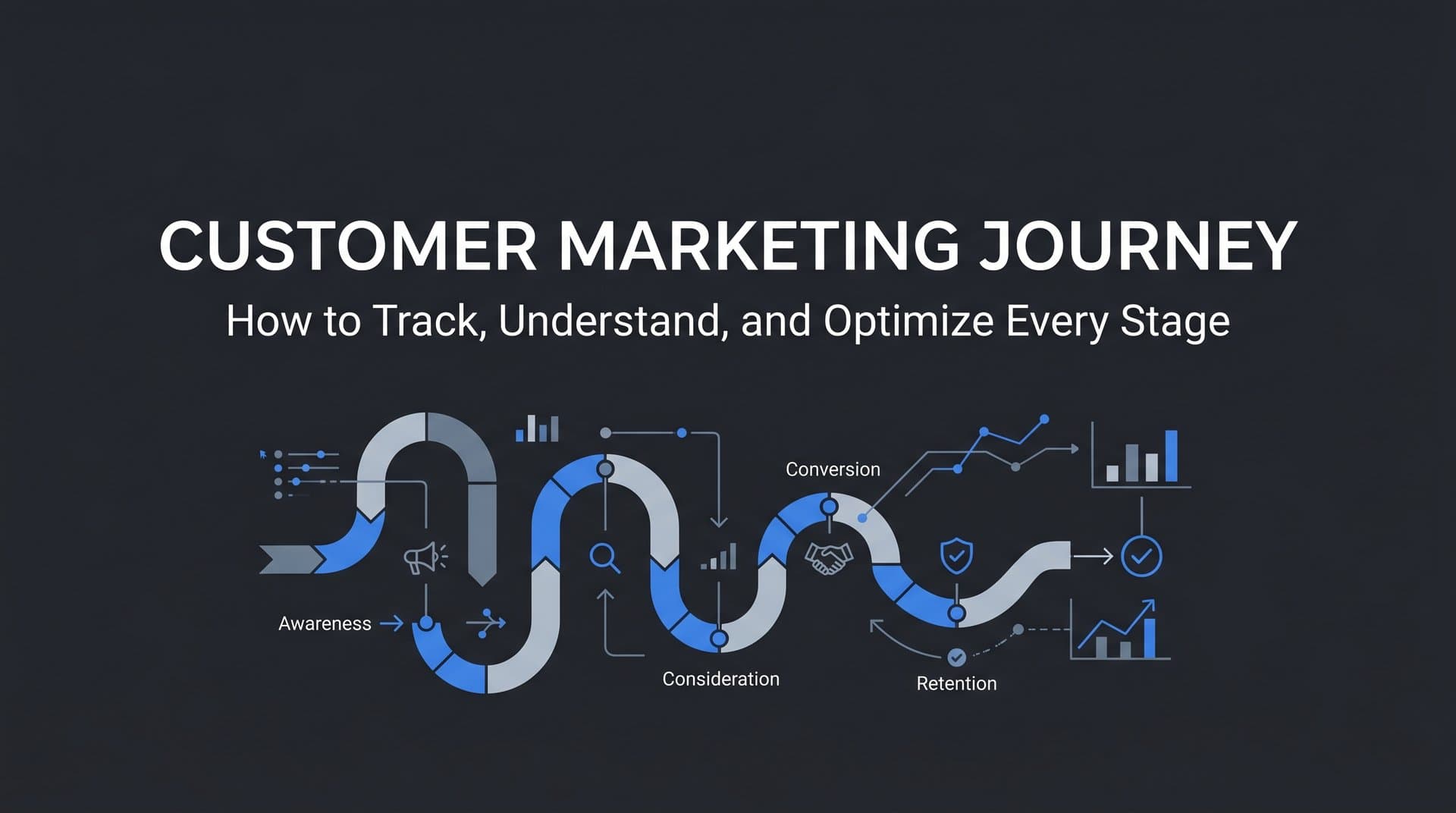
At its core, the customer marketing journey moves through four broad stages: Awareness, Consideration, Decision, and Post-Sale. Each stage maps to different buyer behaviors and different marketing activities, but in B2B SaaS, the boundaries between them are far less clean than a simple funnel diagram suggests.
Awareness: This is where a prospect first encounters your brand. They may see a LinkedIn ad, stumble onto a blog post through organic search, or hear about you from a peer. At this stage, they are not actively evaluating solutions. They are becoming aware that a problem exists and that solutions like yours are available.
Consideration: The prospect is now actively researching. They are reading comparison pages, watching demos, engaging with email sequences, and possibly attending webinars. Multiple stakeholders may be looped in at this stage, each consuming different content and arriving through different channels.
Decision: The buying group is narrowing options. They may revisit your pricing page multiple times, request a demo, or engage directly with sales. Touchpoints here are often a mix of direct outreach, retargeting ads, and bottom-of-funnel content.
Post-Sale: The journey does not end at closed-won. Onboarding experiences, expansion opportunities, and referral behaviors are all part of the full customer marketing journey and have implications for how you attribute value to the channels that brought those customers in.
What makes B2B fundamentally different from B2C is the scale of complexity at each stage. You are not marketing to one person making a quick purchase decision. You are marketing to a buying committee of multiple stakeholders, each with different priorities, different information needs, and different levels of authority. A sales cycle that spans several weeks or months means touchpoints are distributed across LinkedIn, paid search, organic content, direct email, and sales calls, often in no predictable order.
This brings up the concept of non-linear journeys. Prospects do not move neatly from Awareness to Consideration to Decision. They loop back. A prospect who attended a demo may go cold for three weeks, then re-engage after seeing a retargeting ad. Another may read five blog posts before ever clicking a paid ad. The journey is dynamic, and that dynamic nature is exactly why tracking every interaction matters. Assuming a clean funnel progression means missing the actual story of how your customers came to buy.
Where Visibility Breaks Down
Even teams with robust marketing stacks frequently lose sight of the journey partway through. The reasons are structural, and they compound over time in ways that quietly distort every decision downstream.
The first breakdown point is browser-based pixel tracking. Most teams rely on client-side pixels placed on their website to capture conversion events and send them to ad platforms. The problem is that these pixels are increasingly unreliable. Ad blockers prevent them from firing. iOS privacy updates limit cross-site tracking. Cookie deprecation trends reduce the window in which a returning visitor can be matched to their original click. The result is a growing gap between what actually happened in a customer's journey and what your ad platforms report.
The second breakdown is data silos. Ad platform data lives in Google Ads or Meta Ads Manager. Lead data lives in your CRM. Revenue data lives in Stripe or your billing system. Website behavior data lives in Google Analytics. Each of these systems captures a fragment of the journey, but they rarely talk to each other in a way that creates a unified view. A lead that came from a LinkedIn campaign three months ago and just closed in Salesforce today is rarely connected back to that original touchpoint in a way that informs future budget decisions.
The third breakdown is attribution model defaults. Most platforms default to last-click attribution, which gives 100 percent of the credit for a conversion to the final touchpoint before the conversion event. In a B2B journey with dozens of interactions spread across months, this means the LinkedIn awareness campaign that initiated the journey gets zero credit, while the branded search ad that the prospect clicked right before filling out a demo form gets all of it. Teams then cut the LinkedIn budget because it "isn't converting," not realizing it was responsible for starting the journey in the first place.
The compounding effect is significant. When journey data is incomplete, budget decisions are made on bad information. Channels that are genuinely contributing to pipeline get starved of investment. Channels that look good in last-click reports get over-indexed. Over time, this creates a feedback loop where marketing becomes less effective while appearing to optimize, because the metrics being optimized are not the ones that actually reflect revenue impact.
How Multi-Touch Attribution Maps the Full Journey
Multi-touch attribution is the practice of assigning credit to every touchpoint a prospect interacts with before converting, rather than rewarding only the first or last interaction. In the context of the customer marketing journey, it is the mechanism that turns a fragmented sequence of events into a coherent, measurable picture of marketing impact.
There are several common attribution models, and each serves a different analytical purpose depending on which part of the journey you are trying to understand.
First-Touch Attribution: All credit goes to the first interaction. This model is useful for understanding which channels initiate awareness and bring net-new prospects into the journey. If you want to know which campaigns are best at generating demand, first-touch data is a good starting point.
Last-Touch Attribution: All credit goes to the final interaction before conversion. This model reveals what closes deals, which is valuable for understanding bottom-of-funnel performance. The limitation is that it ignores everything that built the relationship up to that point.
Linear Attribution: Credit is distributed evenly across all touchpoints in the journey. This model is straightforward and gives a more balanced view of channel contribution, though it treats a blog post read in month one the same as a demo request in month three.
Data-Driven Attribution: Credit is assigned algorithmically based on actual conversion patterns in your data. This model is the most accurate but requires sufficient data volume to produce reliable weightings. It is increasingly the preferred model for teams with mature tracking infrastructure.
No single model tells the complete story. This is why data-driven marketing teams typically look across multiple models simultaneously rather than committing to one. The real value of multi-touch attribution is not in picking the right model but in having the infrastructure to see the full journey at all.
When properly implemented, multi-touch attribution reveals which channels initiate journeys, which ones nurture prospects through the middle stages where consideration happens, and which ones consistently appear in the paths of prospects who ultimately close. That complete picture is what allows teams to make confident decisions about where to invest, where to cut, and where to test.
Server-Side Tracking and the Quality of Journey Data
Understanding the customer marketing journey conceptually is one thing. Capturing clean, complete data about it is another. And increasingly, the infrastructure that makes accurate journey tracking possible is server-side tracking, not the browser-based pixels that most teams still rely on.
Client-side pixels work by loading a small piece of JavaScript in the user's browser that fires a tracking event when a specific action occurs. The problem is that this mechanism is vulnerable to everything happening in the browser environment: ad blockers, browser privacy settings, iOS restrictions, and cookie limitations all reduce the reliability of the signal. Estimates vary, but it is widely acknowledged across the industry that client-side tracking alone misses a meaningful portion of conversion events, creating gaps in the journey data that attribution models then have to work around.
Server-side tracking addresses this by moving the event-sending mechanism from the browser to your server. When a conversion occurs, your server sends the event data directly to ad platforms like Meta or Google via their Conversion APIs (Meta CAPI, Google Enhanced Conversions), bypassing the browser entirely. The result is a more complete, more accurate signal that is not subject to the same browser-level restrictions.
The deeper benefit is what becomes possible when server-side tracking is combined with first-party data enrichment. At the server level, you can match ad click data to CRM events and revenue outcomes. A prospect who clicked a LinkedIn ad, filled out a demo form, entered your CRM as a lead, moved through a sales cycle, and eventually closed as a customer can be connected across all of those events into a single, continuous thread of data. That thread is the customer marketing journey made visible and measurable from first impression to closed-won deal.
This is the data foundation that makes everything else in attribution and optimization work correctly. Without it, you are building analysis on top of incomplete inputs, and the conclusions will reflect that incompleteness.
From Lead Metrics to Pipeline and Revenue
One of the most common gaps in B2B SaaS marketing is the leap from lead-level tracking to revenue attribution. Most teams have visibility into how many leads a campaign generates. Far fewer have visibility into how many of those leads actually converted to pipeline, progressed through a sales cycle, and closed as paying customers.
This matters because lead volume and revenue quality are not the same thing. A campaign that generates a high volume of leads at a low cost per lead may look like a winner in the dashboard while producing customers with short retention, low contract values, or high churn rates. A campaign that generates fewer leads but consistently attracts prospects who become high-value, long-term customers is the one worth scaling, but you cannot see that without connecting ad data to actual revenue outcomes.
Integrating ad platform data with CRM data and revenue data, such as a Stripe integration that brings actual subscription revenue into the attribution picture, allows teams to calculate true ROI per channel, per campaign, and per ad creative across the entire customer journey. Instead of optimizing for cost per lead, you can optimize for cost per closed deal or cost per dollar of annual recurring revenue.
Pipeline velocity is a useful journey metric in this context. It measures how quickly prospects move through the journey stages from first touch to closed deal. Understanding pipeline velocity by channel or by campaign helps teams identify where the journey slows down. A channel that initiates many journeys but consistently produces slow-moving deals may indicate a mismatch between the audience being attracted and the product's ideal customer profile. A channel with fewer initiations but faster velocity may deserve more investment precisely because the prospects it brings in are better qualified.
These are the kinds of insights that become available when the customer marketing journey is tracked end to end, from the first ad impression through to revenue recorded in your billing system.
Using Journey Insights to Scale With Confidence
Once you have clean journey data connected to real revenue outcomes, the question becomes: how do you use it to make better decisions at scale?
AI-driven analysis of journey data can surface patterns that would be invisible to manual review. Which ad creatives consistently appear at the beginning of journeys that result in high-value customers? Which channels show up repeatedly in the paths of prospects who close quickly? Which combinations of touchpoints correlate with the shortest time from first impression to closed deal? These patterns exist in the data, but they require the kind of pattern recognition that AI is well suited to provide.
There is also a feedback loop dimension to this. When you feed enriched, journey-level conversion data back to ad platforms, you improve the quality of their algorithmic targeting. Meta and Google's bidding algorithms optimize toward the conversion signals you send them. If you send them lead form submissions, they optimize for lead form submissions. If you send them enriched signals that represent actual closed revenue, they optimize for the audience profiles that match your best customers. The quality of your journey data directly influences the quality of the audiences your ads reach next.
A practical framework for using journey insights to guide budget decisions looks like this:
1. Identify the channels that appear most frequently in the journeys of customers who actually closed, not just leads who entered the funnel.
2. Validate those findings with revenue attribution data to confirm that the channel contribution correlates with high-value outcomes, not just volume.
3. Scale investment in the validated channels with confidence, knowing the decision is grounded in complete journey data rather than last-click approximations.
4. Continue monitoring pipeline velocity and revenue per channel as you scale, adjusting as new patterns emerge in the data.
This is how journey tracking moves from a reporting exercise to an operational advantage.
Putting Journey Tracking Into Practice
The principles behind effective customer marketing journey tracking are consistent regardless of the tools you use. Track every touchpoint with server-side accuracy so your data is complete. Use multi-touch attribution to assign credit fairly across the journey rather than defaulting to first or last click. And connect your ad data to real revenue outcomes rather than stopping at lead volume.
It is also worth recognizing that journey tracking is not a one-time setup. It is an ongoing practice that improves as more data accumulates. Early in the process, patterns may be unclear because the sample size is small. Over time, as more complete journeys are recorded and connected to revenue outcomes, the signal gets stronger and the decisions you can make from it become more reliable.
This is where Cometly brings everything together. Cometly connects your ad platforms, CRM, and website data into a single source of truth, making the customer marketing journey visible, measurable, and actionable. With server-side conversion tracking, Conversion API integration, and native connections to platforms like Stripe, Cometly captures every touchpoint from first ad click to closed-won revenue. Its AI-driven analysis surfaces the patterns in your journey data that inform smarter budget decisions, and it feeds enriched conversion signals back to Meta and Google to improve algorithmic targeting over time.
The result is a marketing operation that knows exactly what is working, why it is working, and how to do more of it.
The Bottom Line
The customer marketing journey is the foundation of every attribution, optimization, and scaling decision your marketing team makes. Without visibility into the full journey, you are making budget decisions based on fragments of data, optimizing for metrics that do not reflect revenue, and likely cutting channels that are contributing more than they appear to be.
With complete journey visibility, every decision changes. You know which channels initiate demand. You know which ones nurture it. You know which ones close deals. You know which campaigns produce customers worth having, not just leads worth counting. And you can feed that knowledge back into your ad platforms to attract more of the right people.
Start by auditing your current tracking setup. Identify where journey data breaks down: where pixels are missing events, where CRM data is disconnected from ad data, and where revenue outcomes are invisible to your attribution model. Those gaps are where your optimization potential is hiding.
Then build toward a complete picture. Get your free demo and see how Cometly helps B2B SaaS teams track the complete customer marketing journey, connect every touchpoint to revenue, and make every marketing dollar work harder.