
You're running paid social, paid search, and email campaigns simultaneously. Conversions are coming in. But when you look at platform reporting, Meta is claiming credit, Google is claiming credit, and your email tool is claiming credit too. Add it all up and your aggregate ROAS looks incredible. The problem is, your actual revenue doesn't match the story those numbers are telling.
This is the central frustration of direct response marketing: the campaigns are designed to produce measurable, immediate results, yet the measurement itself is broken. And when measurement is broken, budget decisions are based on fiction. You scale the wrong channels, cut the wrong ones, and wonder why growth stalls despite strong-looking numbers.
Direct response attribution is the discipline that fixes this. It connects specific ads, messages, and channels to the actual actions they drive, giving you a clear, honest picture of what is working and what is not. Done right, it is the difference between scaling with confidence and burning budget on campaigns that look good on paper but produce nothing in your pipeline.
This guide walks you through everything you need to know: what direct response attribution actually is, why standard tracking consistently fails performance marketers, which attribution models fit DR campaigns best, and how to build a system that connects ad spend all the way to closed revenue. Let's get into it.
What Direct Response Attribution Actually Means
Direct response attribution is the practice of connecting a specific ad, message, or channel directly to a measurable action taken by a prospect. That action might be a form fill, a free trial signup, a demo request, or a purchase. The key word is "measurable." Unlike brand awareness campaigns, which are designed to influence perception over time, direct response campaigns are built around traceable, immediate outcomes.
Think of it this way: if you run a brand campaign and someone buys your product six months later, you might attribute some influence to that campaign. But with direct response, the expectation is tighter. You run an ad, someone clicks, they take an action, and you need to know which ad drove that action. The conversion path is shorter, the intent is higher, and the accountability is stricter.
This distinction matters because it shapes the standard you hold your attribution to. Brand awareness measurement tolerates softer signals like reach, impressions, and recall lift. Direct response attribution cannot afford that flexibility. Every dollar in a DR campaign is expected to produce a traceable result, which means your attribution system needs to capture the full conversion path with precision.
The difference between direct response attribution and general marketing attribution comes down to specificity and speed. General attribution might look at how different channels contribute to revenue over a quarter. Direct response attribution is looking at how a specific ad drove a specific action within a specific window. The funnel is shorter, the signals are clearer, and the stakes of getting it wrong are immediate rather than theoretical.
For B2B SaaS companies, this gets more nuanced. A direct response campaign might target prospects with a demo request offer. The conversion event is the demo booking. But the revenue event is the closed-won deal that happens weeks or months later. True direct response attribution in this context needs to bridge both: capturing the immediate action and eventually connecting it to the downstream revenue it generated. Most teams only track the first part, which is why their attribution picture is always incomplete.
The core goal is straightforward: know which ads and channels are actually responsible for the outcomes that matter to your business. Everything else in this guide builds toward that goal.
Why Platform-Native Reporting Misleads Performance Marketers
Every major ad platform has a built-in attribution system. And every one of them is designed, at least in part, to make that platform look as good as possible. This is not a conspiracy theory. It is just the natural result of platforms controlling their own measurement.
Meta Ads Manager defaults to a 7-day click and 1-day view attribution window. That means if someone sees your ad and converts within a day, Meta claims credit, even if they never clicked. Google Ads has its own attribution logic. When a prospect touches multiple platforms before converting, each platform may claim full credit for the same conversion. Add up the attributed conversions across all your platforms and you will often find a number that is significantly higher than your actual conversion count. This is the attribution overlap problem, and it is one of the most common sources of inflated ROAS in performance marketing accounts.
Beyond the overlap issue, platform-native reporting relies heavily on browser-based pixel tracking. And that foundation has been eroding for years. iOS privacy updates, browser cookie restrictions, and the growing use of ad blockers have all reduced the reliability of pixel-based conversion data. When a pixel cannot fire because a browser blocks it, or when a cookie is deleted before the attribution window closes, that conversion becomes invisible to the platform. Your reported conversion rate drops. Your ROAS looks worse. And you make budget decisions based on incomplete data.
The multi-touchpoint reality of even short direct response funnels compounds this problem. A prospect might see a Facebook ad on Monday, click a Google search ad on Wednesday, and convert through an email link on Friday. In a last-click model, email gets all the credit. In Meta's reporting, the Facebook ad might claim a view-through conversion. In Google's reporting, the search ad claims a click-through conversion. Three different platforms, three different stories, one actual conversion.
The result is a fragmented, contradictory picture of campaign performance. Teams end up making decisions based on whichever platform's story they find most convincing, rather than on a unified, accurate view of what actually happened. For direct response marketers who are expected to show clear ROI on every dollar spent, this is not a minor inconvenience. It is a fundamental operational problem that undermines every budget decision you make.
Solving it requires moving beyond platform-native reporting entirely and building an attribution system that sits above the platforms, captures data independently, and tells a single coherent story about your conversion paths.
Choosing the Right Attribution Model for Your DR Campaigns
Attribution models are the rules that determine how credit gets distributed across the touchpoints in a conversion path. For direct response marketers, choosing the right model is not an academic exercise. It directly affects which campaigns you scale and which you cut.
Last-click attribution gives all the credit to the final touchpoint before conversion. It is simple, easy to implement, and deeply misleading for most DR funnels. It consistently over-credits paid search and direct traffic, which tend to appear at the end of the conversion path, while ignoring the awareness and consideration touchpoints that initiated the journey. If you are running paid social to drive awareness and paid search to capture intent, last-click will make your social campaigns look useless.
First-touch attribution flips this logic, giving all the credit to the first touchpoint. This is useful for understanding which channels are generating awareness and initiating the conversion path. But it ignores everything that happens after that first interaction, which means it undervalues the channels that are actually closing conversions. It is a useful diagnostic lens, not a complete measurement system. You can learn more about how this works in our first-touch attribution model guide.
Linear attribution distributes credit equally across all touchpoints in the conversion path. It is more balanced than last-click or first-touch, but it can dilute the signal from high-impact touchpoints. If one channel is consistently driving the action that tips a prospect into converting, linear attribution will not surface that insight clearly.
Data-driven attribution is the most accurate model for complex direct response funnels. Instead of applying an arbitrary rule, it uses algorithmic analysis of actual conversion paths to assign credit proportionally based on each touchpoint's observed influence on the conversion outcome. It accounts for the reality that different touchpoints have different levels of impact, and it updates as your data evolves.
The most valuable thing you can do with attribution models is compare them side by side. When you run last-click and data-driven simultaneously and look at how credit shifts between models, you start to see which channels are initiating conversions versus closing them. A channel that looks weak under last-click might look strong under data-driven because it consistently appears at the start of paths that eventually convert. That insight changes your budget allocation entirely.
For B2B SaaS direct response campaigns, data-driven attribution combined with a clear view of the full conversion path is the standard to aim for. The funnel is long enough that single-touch models will always miss important signals, and the stakes of misattribution are high enough that accuracy is worth the investment.
Server-Side Tracking and Conversion APIs: The Technical Foundation
If attribution models are the analytical layer of your measurement system, server-side tracking is the data layer. And without a reliable data layer, even the best attribution models are working with incomplete information.
Traditional pixel-based tracking works by placing a small piece of JavaScript code on your website that fires when a user takes an action. The problem is that this code runs in the browser, which means it is subject to all the browser-level restrictions discussed earlier: ad blockers, cookie limitations, iOS privacy settings, and more. For many direct response marketers, a meaningful portion of conversions are simply not being captured by their pixels.
Server-side tracking and Conversion APIs solve this by moving the conversion signal from the browser to the server. Instead of relying on a pixel to fire in the user's browser, your server sends the conversion event directly to the ad platform. Meta's Conversion API and Google's Enhanced Conversions are the two most widely used implementations of this approach. Because the signal comes from your server rather than the user's browser, it bypasses the restrictions that cause pixel data loss.
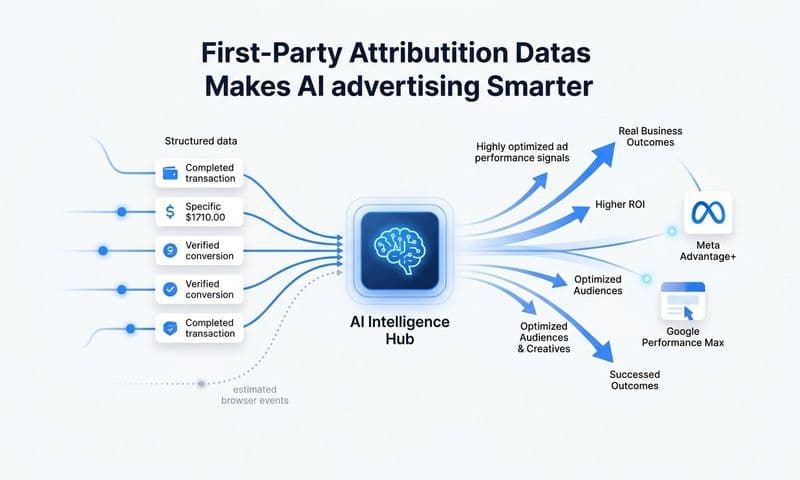
The practical impact is significant. When you implement server-side tracking alongside your existing browser pixel, you capture conversions that would otherwise be invisible. This improves your event match quality, which is the measure of how accurately the ad platform can match a conversion event back to the specific ad exposure that preceded it. Higher event match quality means better attribution accuracy and, importantly, better algorithmic optimization from the ad platform itself.
First-party data enrichment is a key part of this process. When you send conversion events from your server, you can include additional data points like email addresses, phone numbers, or customer IDs that help the platform match the conversion to a real user profile. This enriched data improves match rates and gives the platform's optimization algorithm more signal to work with.
Event deduplication is a critical technical consideration here. When you run both a browser pixel and server-side tracking simultaneously, there is a risk of sending the same conversion event twice. Without deduplication logic, this inflates your reported conversion numbers and distorts your ROAS. A well-implemented server-side setup includes deduplication rules that ensure each conversion is counted exactly once, regardless of how many signals were sent.
For direct response marketers, getting this technical foundation right is not optional. It is the prerequisite for everything else. Accurate attribution starts with complete data, and complete data in the modern privacy environment requires server-side tracking.
From Lead Attribution to Revenue Attribution
Most direct response teams measure success at the lead level. A form fill happens, the conversion fires, the campaign gets credit. This is a reasonable starting point, but it misses the most important part of the story: whether that lead actually became a paying customer.
Not all leads are created equal. A campaign that drives a high volume of form fills might look like a winner in your attribution dashboard. But if those leads have a low close rate, the actual revenue generated per dollar spent is poor. Meanwhile, a campaign that drives fewer leads but consistently attracts high-intent prospects who convert at a higher rate and generate more revenue per customer is the real winner. Lead-level attribution cannot tell you this. Revenue attribution can.
Pipeline attribution and CRM integration are what bridge this gap. When your attribution platform connects to your CRM, you can track what happens to each lead after the initial conversion event. You can see which campaigns generated leads that progressed through the pipeline, which ones generated leads that went cold, and which ones generated leads that became paying customers. This is the data that should be driving your budget decisions.
For B2B SaaS companies, this connection is particularly important. Sales cycles can span weeks or months. Multiple stakeholders are involved in purchase decisions. The demo request that came from a paid social campaign in January might not close until March. Without CRM integration in your attribution system, you will never know that the social campaign deserves credit for that deal. Understanding B2B revenue attribution in SaaS is essential for making these connections accurately.
Revenue attribution is the natural evolution of direct response attribution. It takes the same principle of connecting specific ads to specific actions and extends it all the way to closed-won deals and customer lifetime value. When you can see which ads generated customers, not just leads, you have a fundamentally different and more accurate view of campaign ROI. Budget allocation decisions become clearer, and the case for scaling high-performing campaigns becomes much easier to make.
Building a Direct Response Attribution System That Scales
Understanding the concepts is one thing. Building a system that actually implements them at scale is another. Here is what a scalable direct response attribution setup looks like in practice.
A centralized attribution platform: Platform-native reporting will always be fragmented. You need a single place where data from all your channels, including paid social, paid search, email, and organic, comes together into a unified view. This is your single source of truth for campaign performance, and it needs to sit above the individual platforms rather than inside any one of them.
Server-side tracking with Conversion API integration: As covered earlier, this is the technical foundation that ensures your conversion data is complete and accurate. Implement it across all your key conversion events and configure deduplication to prevent double-counting.
CRM integration for revenue-level attribution: Connect your attribution platform to your CRM so that lead-level conversion data can be matched to downstream pipeline and revenue outcomes. This is what transforms your attribution from a lead counter into a revenue measurement system.
A consistent UTM parameter strategy: Every paid campaign, every email link, every organic social post that you want to track needs to be tagged with consistent UTM parameters. This sounds basic, but inconsistent UTM tagging is one of the most common reasons attribution data breaks down. Build a naming convention and enforce it across your team.
Once this foundation is in place, AI-powered attribution analysis becomes a significant accelerator. Instead of manually reviewing campaign data to find patterns, AI can surface high-performing ads and campaigns faster, identify which touchpoints are driving the most influence on conversions, and flag underperformers before they drain significant budget. For direct response teams that are running multiple campaigns across multiple channels simultaneously, this kind of analysis at scale is not possible without automation.
There is also a compounding benefit to building this system well. When you feed enriched, accurate conversion data back to your ad platforms through Conversion APIs, you improve the quality of the signal those platforms use for algorithmic optimization. Better signal means better targeting. Better targeting means lower cost per acquisition over time. The direct response campaigns you run six months from now will perform better because of the data infrastructure you built today.
Platforms like Cometly are built specifically for this kind of setup. With multi-touch attribution, server-side conversion tracking, Conversion API integration, and direct CRM connectivity, Cometly gives direct response marketers a complete picture of the customer journey from the first ad click to closed revenue. The 70+ native integrations mean you can connect your entire marketing stack without custom engineering work, and the AI-powered recommendations surface the insights that matter without requiring manual analysis.
The Bottom Line on Direct Response Attribution
Direct response attribution is not a reporting feature. It is a competitive advantage. When you know exactly which ads, channels, and touchpoints are driving real conversions and real revenue, you make better budget decisions faster. You scale what works, cut what does not, and stop letting platform-native reporting tell you a story that benefits the platforms rather than your business.
The progression is logical: understand what direct response attribution actually measures, recognize why standard tracking consistently falls short, choose attribution models that reflect the reality of your conversion paths, build the technical foundation with server-side tracking and Conversion APIs, connect lead-level data to revenue-level outcomes through CRM integration, and assemble it all into a centralized system that scales with your campaigns.
Each step builds on the last. And the result is a measurement system that gives you genuine confidence in your budget decisions rather than the false confidence that comes from looking at inflated platform numbers.
For teams running performance campaigns, this is foundational work. The marketers who invest in accurate attribution now will have a structural advantage over those who are still relying on platform-native reporting and last-click defaults. The data compounds, the optimization improves, and the gap widens over time.
If you are ready to build that foundation, Cometly gives you the tools to do it. From multi-touch attribution to server-side tracking to revenue-level CRM integration, it is built to be the single source of truth for every touchpoint, channel, and conversion event in your direct response funnel. Get your free demo today and start capturing every touchpoint to maximize your conversions.