There's a persistent myth in B2B marketing circles: Facebook is for consumers, LinkedIn is for professionals, and mixing them up is a strategic mistake. It's a clean narrative, but it's not quite right.
B2B buyers don't stop being people when they leave the office. They scroll Facebook in the evening, catch up on news over the weekend, and engage with content between meetings. The decision-maker you're trying to reach on LinkedIn at $15 per click is also on Facebook, often at a fraction of the cost per impression.
That doesn't mean Facebook replaces LinkedIn or Google in your B2B stack. It means it earns a place alongside them. For B2B SaaS growth teams navigating long sales cycles, multiple stakeholders, and tight budgets, Facebook ads offer something genuinely valuable: scale, behavioral data, and targeting flexibility that can complement every other channel you're running.
The challenge is that most B2B teams either avoid Facebook entirely or run campaigns without the right structure, targeting, or measurement to make them work. This guide is designed to fix that. You'll walk away understanding how to build the right audiences, structure a full-funnel campaign, choose creative that converts, and, critically, connect your Facebook ad spend to real pipeline and revenue so you can make decisions with confidence.
Why Facebook Deserves a Seat at the B2B Marketing Table
The skepticism around Facebook for B2B is understandable. LinkedIn was built for professional networking and offers native job title and company targeting that feels purpose-built for B2B marketers. Facebook, by contrast, was built for social connection. But that framing misses something important about how B2B buying actually works.
Business decisions are made by people, and those people live on Facebook. They belong to industry groups, follow thought leaders, consume content about their professional challenges, and engage with brands they're evaluating, all within a platform they use personally. That behavioral footprint creates targeting opportunities that B2B marketers can exploit.
Facebook's audience data is rich. The platform has accumulated years of behavioral signals, interest data, and demographic information that can be used to build surprisingly precise B2B audiences. While it doesn't have LinkedIn's native professional graph, it does allow you to layer job title targeting, employer data, industry interests, and behavioral signals to approximate your ideal customer profile.
The cost efficiency argument is also real. LinkedIn's premium targeting comes with premium pricing. Facebook's lower cost per click and cost per impression means you can generate awareness and drive traffic at a scale that would be cost-prohibitive on LinkedIn alone. For B2B SaaS teams with defined ICPs and budget constraints, that math matters.
Where Facebook particularly shines in B2B is at the top and middle of the funnel. Long B2B sales cycles require consistent touchpoints over weeks or months. Facebook gives you a channel to stay visible with prospects during that evaluation period, reinforcing your brand through retargeting and keeping warm leads engaged between more direct outreach efforts.
Think of it as a complementary layer. LinkedIn captures intent in a professional context. Google captures search intent. Facebook captures attention in personal moments, and those moments are often when buyers are doing informal research, exploring options, and forming opinions about vendors they haven't yet reached out to. Being present there, with the right message, can meaningfully accelerate your pipeline.
Building the Right Audience for B2B Campaigns
Audience quality is the single biggest lever in B2B Facebook advertising. Get this right and even average creative will generate results. Get it wrong and no amount of creative polish will save your campaigns. The good news is that Facebook gives you three powerful audience-building tools that work especially well for B2B.
Custom Audiences from CRM Data: This is the most precise targeting option available on Facebook for B2B marketers. By uploading contact lists from your CRM, you can match known prospects, leads, customers, and churned accounts directly to Facebook profiles. This means you can serve targeted ads to the exact people already in your pipeline, warm up cold contacts before outreach, or exclude existing customers from acquisition campaigns. The match rate won't be perfect, but even partial matches give you a level of targeting precision that interest-based methods can't replicate.
Lookalike Audiences: Once you have a strong custom audience, lookalikes become one of the most efficient scaling tools in your arsenal. You use your best customers or highest-converting accounts as a seed audience, and Facebook finds other profiles that share similar behavioral and demographic characteristics. For B2B SaaS companies with well-defined ICP data, a lookalike built from closed-won accounts can surface new prospects who closely resemble your best customers. Start with a 1% lookalike for precision, then test broader percentages as you scale.
Interest and Behavioral Targeting: This is the broadest approach and requires the most layering to be effective for B2B. Facebook allows you to target by interests, behaviors, job titles, employers, and education. None of these signals are as clean as LinkedIn's professional data, but when combined thoughtfully, they can approximate your target persona reasonably well. For example, targeting people interested in SaaS tools, marketing analytics, and growth hacking while filtering by job titles like "marketing manager" or "VP of growth" narrows your audience toward the right professionals.
The most effective B2B Facebook campaigns typically combine all three approaches across different campaign objectives. Use interest and behavioral targeting for cold prospecting at the top of the funnel, custom audiences for retargeting and account-based campaigns in the middle, and CRM-based audiences for high-intent bottom-of-funnel pushes. This layered approach ensures your budget is reaching the right people at the right stage of their journey.
One practical note: audience sizes matter. B2B audiences on Facebook tend to be smaller than B2C audiences, and Facebook's algorithm needs enough data to optimize effectively. If your audience is too narrow, you may struggle with ad fatigue and limited delivery. If it's too broad, you'll waste budget on irrelevant impressions. Finding the right balance, typically in the range of a few hundred thousand to a few million for most B2B SaaS companies, is part of the ongoing optimization process.
Ad Formats and Creative Strategies That Work in B2B
B2B Facebook creative has a reputation for being dry, corporate, and ineffective. That reputation is earned, but it's not inevitable. The formats and approaches that work in B2B Facebook campaigns are well-established. The key is matching your creative to the audience temperature and the offer.
Lead Generation Ads: These native form ads are among the most effective formats for B2B campaigns promoting gated content, webinar registrations, or free trial sign-ups. Because the form pre-fills with the user's Facebook profile data and never leaves the platform, friction is dramatically reduced. For top-of-funnel offers like whitepapers, guides, or event registrations, lead gen ads typically outperform click-to-website campaigns on cost per lead. The tradeoff is lead quality: native form leads sometimes convert at lower rates downstream, so monitoring pipeline quality from this source is essential.
Video Ads: Video is particularly powerful for B2B SaaS because it allows you to demonstrate product value, walk through a use case, or tell a story about a problem your audience recognizes. Short-form videos that open with a sharp hook and address a specific pain point in the first few seconds tend to perform well. Video also generates valuable retargeting data: you can build audiences of people who watched 25%, 50%, or 75% of your video, creating a warm pool of engaged prospects for your next campaign layer. Understanding Facebook video ad specifications ensures your creative renders correctly across placements.
For a deeper dive, see our guide to AI short form video ads generator.
Carousel Ads: Carousels work well for showcasing multiple features, walking through a step-by-step process, or presenting different use cases to the same audience. In B2B, they're effective for product walkthroughs, comparison messaging, or telling a sequential story across multiple cards. Each card can link to a different destination, giving you flexibility in how you guide prospects through the content.
Retargeting creative deserves special attention because it should look and feel different from your cold audience creative. When someone has already visited your pricing page or watched a product video, they don't need an introduction to your brand. They need a reason to act. Retargeting creative should lean into social proof, specific feature callouts, or urgency-driven messaging. Customer testimonials, third-party review badges, and direct comparison messaging all perform well in retargeting contexts where the audience already has some familiarity with your product.
Related reading: our complete guide to AI product video ad generator.
Regardless of format, B2B Facebook creative should speak directly to a specific pain point rather than leading with product features. Decision-makers respond to messaging that reflects their reality: the pressure to prove marketing ROI, the challenge of attributing pipeline to campaigns, the frustration of disconnected data. Lead with the problem, then introduce your solution.
Structuring Your B2B Facebook Funnel From Awareness to Pipeline
Running a single Facebook campaign and hoping for pipeline is not a strategy. B2B Facebook advertising works when it's structured as a funnel, with different campaigns serving different objectives at each stage of the buyer journey. Here's how to think about each layer.
Top of Funnel: Awareness and Education
At this stage, you're reaching people who may fit your ICP but don't know your brand yet. The goal is not conversion. It's attention and education. Use broad but persona-aligned audiences built from interest and behavioral targeting, and focus on low-commitment CTAs: watching a video, reading a blog post, or downloading a free resource.
Content at this stage should address problems your audience recognizes, not pitch your product. Thought leadership content, industry insights, and educational resources build credibility and generate the engagement signals you'll use for retargeting. Keep your creative approachable and your messaging focused on the audience's challenges rather than your solution.
Middle of Funnel: Retargeting and Consideration
This is where you re-engage people who have already shown interest. Your retargeting audiences at this stage include website visitors, video viewers, lead form engagers, and anyone who has interacted with your content. These people know who you are. Now you move them toward a more direct offer.
Middle-of-funnel campaigns are where demo requests, free trial sign-ups, and case study downloads belong. Your creative should be more direct, referencing what they've already seen or done, and your CTA should reflect a higher level of intent. This is also where social proof becomes especially effective: testimonials, review site ratings, and customer success stories help prospects move from consideration to action. Understanding the full B2B SaaS marketing funnel helps you design campaigns that move buyers through each stage efficiently.
Bottom of Funnel: High-Intent Conversion
Bottom-of-funnel campaigns target your highest-intent audiences: pricing page visitors, people who started but didn't complete a sign-up, CRM contacts in active deal stages, and anyone who has requested a demo but hasn't converted. These audiences are small but valuable, and they deserve highly specific, direct-response creative.
At this stage, remove ambiguity. Your creative should have a single, clear CTA and address the specific hesitation your prospect might have. Offer a limited-time incentive, highlight a key differentiator, or use a direct message that acknowledges where they are in the decision process. Budget efficiency matters less here than conversion rate. Spend what it takes to close the loop on high-intent prospects.
Measuring What Matters: Attribution for Facebook B2B Campaigns
Here's where many B2B Facebook campaigns fall apart. The ads are well-targeted, the creative is strong, and the funnel is properly structured, but the measurement is broken. And when measurement is broken, budget decisions are made on incomplete or misleading data.
Facebook's native attribution has real limitations for B2B marketers. iOS privacy changes have significantly reduced the effectiveness of browser-based pixel tracking, meaning a meaningful portion of conversions that originated from Facebook ads are simply not being reported back to the platform. This leads to underreporting of results and misallocation of budget away from campaigns that are actually working.
Beyond signal loss, last-click attribution models are fundamentally misaligned with how B2B deals close. When a prospect first encounters your brand through a Facebook video, later clicks a Google search ad, and then converts through a direct visit, last-click attribution gives all the credit to Google. Facebook's contribution disappears from the data entirely. In B2B, where sales cycles span weeks or months and involve multiple touchpoints across multiple channels, this creates a systematically distorted view of what's driving pipeline. Facebook ads attribution models that account for the full buyer journey give a far more accurate picture of channel contribution.
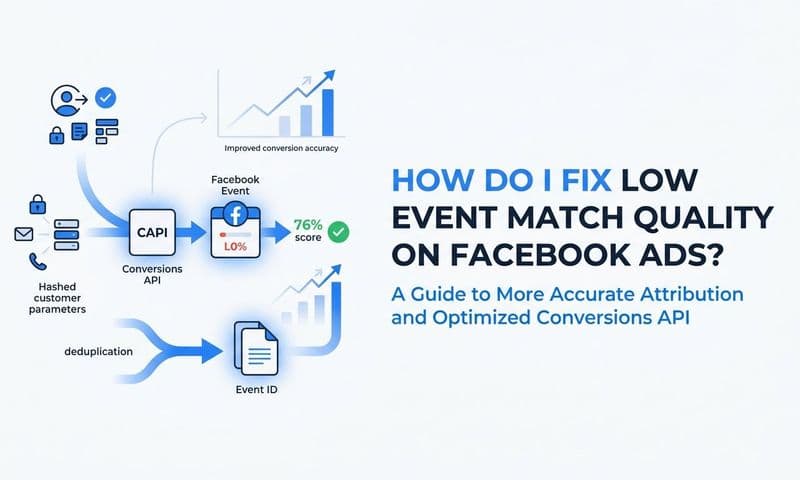
The Meta Conversion API (CAPI) addresses the signal quality problem. Instead of relying on browser-based tracking that can be blocked or degraded by privacy tools, CAPI sends conversion events directly from your server to Meta. This restores match rates, improves Facebook's ability to optimize your campaigns, and gives you more accurate reporting within the platform. For any serious B2B advertiser on Facebook, server-side tracking is no longer optional.
But CAPI alone doesn't solve the attribution problem. It improves signal quality within Facebook's ecosystem, but it doesn't connect your Facebook ad data to what happens downstream in your CRM. To understand the true contribution of Facebook to your pipeline and revenue, you need multi-touch attribution that spans the entire customer journey.
This is where a platform like Cometly becomes essential. Cometly connects your Facebook ad data to your CRM pipeline and revenue outcomes, supporting multi-touch attribution models that give appropriate credit to every touchpoint in the buyer journey. Instead of asking "how many leads did Facebook generate," you can ask "how much pipeline and closed revenue can be attributed to Facebook campaigns," and answer that question with confidence.
For B2B SaaS teams running long sales cycles, this shift from lead-based to revenue-based attribution changes everything about how you evaluate and optimize your campaigns.
Turning Facebook Ad Data Into Smarter Growth Decisions
Cost per lead is a useful starting metric, but it's a dangerous stopping point. A campaign that generates leads at low cost can still be a poor investment if those leads never convert to pipeline. Conversely, a campaign with a higher cost per lead might be generating your highest-quality accounts. Without connecting ad data to downstream outcomes, you can't tell the difference.
This is one of the most common and costly mistakes in B2B Facebook advertising. Teams optimize toward the metrics Facebook reports, which are typically impressions, clicks, and form fills, without ever validating whether those metrics correlate with revenue. The result is budget flowing toward campaigns that look good on a dashboard but contribute nothing to the business. Tracking the right Facebook marketing metrics beyond surface-level data is what separates campaigns that scale from those that stall.
The solution is building a single source of truth that connects Facebook ad spend to CRM outcomes. When you can trace a closed-won deal back to the Facebook campaign that generated the first touchpoint, or see which ad creative is consistently associated with prospects who reach late deal stages, you have the data to make real decisions. You can confidently scale campaigns that drive revenue and cut spend on campaigns that generate volume without value.
Cometly is built specifically for this use case. It connects your Facebook campaigns, along with every other ad channel you're running, to your CRM pipeline and revenue data. You get a real-time view of which campaigns, audiences, and creatives are generating actual business outcomes, not just surface metrics. And because Cometly supports server-side tracking through CAPI integration, the underlying data is more accurate than what you'd get from pixel-based measurement alone.
The AI-driven analysis layer takes this further. Rather than manually sifting through campaign data to find patterns, Cometly's AI surfaces insights about which audiences, creatives, and offers are driving the highest-quality pipeline. This accelerates iteration cycles and helps growth teams allocate budget with AI-driven precision rather than guesswork.
For B2B SaaS companies running multi-channel campaigns, this kind of intelligence is what separates teams that scale efficiently from teams that spend more to learn less. The data is there. The question is whether you have the infrastructure to use it.
Putting It All Together
Facebook ads for B2B are not a replacement for LinkedIn, Google, or any other channel in your mix. They're an addition: a high-reach, cost-efficient layer that lets you reach decision-makers in personal contexts, build brand familiarity across a long sales cycle, and retarget engaged prospects with precision.
Making it work requires more than just running ads. It requires building audiences from your CRM data, structuring campaigns across funnel stages, creating messaging that speaks to real pain points, and, most importantly, measuring performance in a way that connects ad spend to pipeline and revenue rather than stopping at lead volume.
That last piece is what most B2B teams get wrong, and it's what makes the difference between Facebook being a cost center and a genuine growth channel. When you can see which campaigns are generating closed revenue, not just form fills, you can make investment decisions with confidence.
Cometly closes that loop. It gives B2B SaaS teams the attribution clarity to run Facebook campaigns with full visibility into what's actually driving business outcomes, from the first ad impression to closed-won revenue.
If you're ready to stop guessing and start scaling with confidence, Get your free demo today and see exactly how Cometly connects your Facebook ad spend to the revenue results that matter.