

You're running paid ads, booking demos, and closing high-value deals. The pipeline is moving. Revenue is coming in. But when the leadership team asks which campaign deserves credit for that six-figure contract that just closed, the room goes quiet.
This is the central frustration of high ticket sales attribution. The tools that work beautifully for e-commerce or short-cycle SaaS subscriptions simply were not built for the reality of complex B2B deals. When a sales cycle spans three months, involves five stakeholders, and touches a dozen channels before reaching closed-won, standard attribution models give you a distorted picture at best and a dangerously misleading one at worst.
High ticket sales attribution is the discipline that connects long, multi-touch customer journeys to the marketing investments that started them. It answers the question that every growth team needs answered: not just where leads come from, but which channels and campaigns actually drive revenue. This guide is built for B2B SaaS marketing and growth teams who are done optimizing for form fills and ready to start optimizing for closed deals.
Why Standard Attribution Tools Fall Short for Complex Deals
Most attribution tools were designed with a specific buyer journey in mind: someone sees an ad, clicks through, and converts within a few days. That model works for consumer purchases and low-cost SaaS trials. It breaks down completely when you are selling a high-value B2B product with a buying committee, a multi-stage evaluation process, and a decision timeline measured in months.
The first structural problem is the attribution window. Most ad platforms default to 7-day or 30-day click windows. For high ticket B2B deals, the gap between a prospect's first ad interaction and their eventual signature can easily stretch beyond that window. When the attribution window closes before the deal does, the platform reports no conversion, and the campaign that actually started the relationship gets zero credit.
The second problem is channel fragmentation. A high ticket buyer might discover your product through a LinkedIn ad, read three blog posts over two weeks, attend a webinar, get an email sequence, take a sales call, and then come back through branded search before booking a demo. Last-click attribution gives all the credit to that final branded search. The LinkedIn campaign that created awareness in the first place is invisible in your reporting, which means it looks like a poor performer even if it initiated every meaningful deal in your pipeline.
The third problem is what gets measured. Standard pixel tracking captures surface-level events: page views, form submissions, demo requests. These are useful signals, but they are not the events that high ticket sales teams care about. Opportunity creation, pipeline stage progression, proposal sent, and closed-won are the milestones that actually reflect revenue impact. Most ad platforms never see these events because they happen inside a CRM, not on a website.
The result is a fundamental disconnect between what marketing reports and what revenue reality looks like. Teams end up optimizing for cost-per-lead metrics that have little correlation with the deals that actually close, while the campaigns doing the real work of building pipeline go underfunded because the data does not capture what they contribute. These are among the most persistent attribution challenges in marketing analytics that B2B teams face today.
Mapping the Journey High Ticket Buyers Actually Take
Before you can attribute revenue accurately, you need a clear map of how high ticket buyers actually move through your funnel. This journey is rarely linear, and it almost never matches the simplified funnel diagrams that get drawn in strategy decks.
The discovery phase is where awareness begins. A prospect encounters your brand through paid search, a LinkedIn ad, a thought leadership article, or a referral. They are not ready to buy. They are identifying that a problem exists and starting to explore the landscape. Attribution tracking here needs to capture the very first touchpoint, the channel, the campaign, the specific creative, so that when a deal eventually closes months later, you can trace it back to this moment.
The evaluation phase is where most of the journey happens. This is the longest stretch, involving retargeting campaigns, email nurture sequences, sales development outreach, product comparison research, and often multiple conversations with different members of your team. This phase can involve several people from the same buying account interacting with your marketing independently. One stakeholder might be reading your blog while another is clicking your retargeting ads and a third is responding to a sales email.
This is where account-level attribution becomes critical. If your attribution system only tracks individual leads, you will miss the full picture of how an account engages with your brand. A contact who converts on a form may not be the same person who first clicked your ad two months ago. Without account-level stitching, those interactions appear disconnected, and you lose the thread of the story.
The decision phase is where deals get made or lost. Demos, proposals, champion conversations, procurement reviews, and legal sign-offs all happen here. Most of these touchpoints are offline and invisible to pixel-based tracking. Server-side integrations and CRM event tracking are the only reliable way to capture what happens in this phase and connect it back to the marketing journey that preceded it.
Mapping this journey also reveals a useful distinction: some channels are excellent at creating awareness and generating initial interest, while others are better at accelerating deals that are already in motion. Both types of channels have real value, but they serve different strategic purposes. Understanding which channels do which job is one of the most actionable insights that proper high ticket sales attribution can deliver.
Attribution Models That Reflect How High Ticket Deals Actually Close
Not all attribution models are equally useful for high ticket B2B sales. Choosing the right model, or the right combination of models, is one of the most important decisions a growth team can make when building out their attribution strategy.
First-touch attribution assigns all credit to the channel that generated the initial interaction. For high ticket sales, this model is genuinely useful for understanding which channels are best at creating awareness and filling the top of the funnel. If you want to know which LinkedIn campaign or which piece of content first brought a prospect into your orbit, the first-touch attribution model gives you that answer. Its limitation is that it ignores everything that happened between that first interaction and the eventual close, which is often where most of the real marketing work occurs.
Last-touch attribution is the default for many platforms and the least useful model for complex sales cycles. It gives all credit to the final interaction before conversion, which in high ticket B2B contexts is often a branded search or a direct visit. This systematically undervalues the channels that built awareness and nurtured the relationship over months, leading teams to cut top-of-funnel investment that is actually driving their best deals.
Multi-touch attribution models distribute credit across all the touchpoints in a journey, and they are much better suited to high ticket sales. Linear attribution gives equal weight to every touchpoint. Time-decay attribution gives more credit to touchpoints closer to the conversion. Position-based attribution, sometimes called U-shaped or W-shaped, weights the first touch and the last touch more heavily while distributing remaining credit across the middle. Each of these models tells a different part of the story, and sophisticated teams often run multiple models in parallel to get a fuller picture.
Data-driven attribution takes a different approach entirely. Rather than applying a fixed credit distribution formula, it uses actual conversion data to determine algorithmically how much each touchpoint contributed to closed deals. For high ticket sales teams with sufficient volume, data-driven attribution is the most accurate model available because it reflects the actual patterns in your data rather than a theoretical framework. The tradeoff is that it requires enough conversion events to generate statistically meaningful patterns, which can be a challenge for teams with smaller deal volumes.
The practical recommendation for most high ticket B2B teams is to use multi-touch models for day-to-day optimization while building toward data-driven attribution as deal volume grows. The key is to stop relying on any single model as the definitive truth and instead use attribution data as one input among several when making budget decisions.
Pipeline and Revenue Attribution: The Bridge from Ads to Closed-Won
Lead-level attribution tells you which campaigns generate form fills. Pipeline and revenue attribution tell you which campaigns generate money. For high ticket sales, the gap between those two things can be enormous.
Pipeline attribution connects marketing touchpoints to CRM opportunity stages. Instead of measuring success by the number of demo requests a campaign generates, you measure it by the value of the pipeline those demos eventually become. A campaign that generates fifty leads with a ten percent opportunity conversion rate is less valuable than a campaign that generates twenty leads with a forty percent conversion rate and higher average deal values, even though it looks worse on a cost-per-lead basis.
Revenue attribution goes further by connecting closed-won deal values back to the original marketing spend. This is the calculation that growth leaders actually need: for every dollar invested in this campaign, how much revenue did it ultimately generate? True ROAS and true CAC at the campaign level, not estimates based on average conversion rates and average deal sizes, but actual revenue figures tied to actual marketing touchpoints. Understanding how SaaS revenue attribution works is essential for any B2B team trying to connect spend to outcomes.
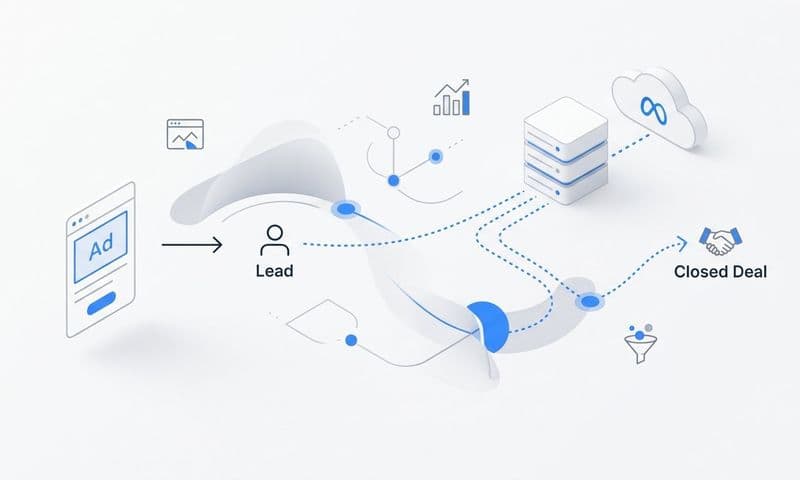
Achieving this requires integrating three data sources that typically live in separate systems. Your ad platform data contains spend, impressions, clicks, and campaign structure. Your CRM contains lead records, opportunity stages, deal values, and closed-won events. Your billing or revenue system contains actual contract values and payment data. When these three systems share a common identifier for each customer, you can trace a closed deal back through the CRM stages to the original marketing touchpoints that started the journey.
Server-side tracking is the technical foundation that makes this integration reliable. Browser-based pixels lose data to ad blockers, iOS privacy changes, and session timeouts, all of which are particularly damaging when you are trying to track journeys that span weeks or months. Server-side event tracking sends conversion data directly from your server to the ad platform, bypassing browser restrictions and maintaining data fidelity across the full journey.
Platforms like Cometly are built specifically to solve this integration challenge. By connecting ad platform data, CRM events, and revenue data into a single attribution view, Cometly gives B2B SaaS teams the pipeline and revenue attribution they need to make confident budget decisions based on what actually closes deals, not just what generates leads.
The Technical Infrastructure Behind Reliable Attribution
Getting high ticket sales attribution right is not just a strategic challenge. It is a technical one. The quality of your attribution data depends entirely on the quality of your tracking infrastructure, and there are several technical requirements that growth teams need to address to ensure their data is accurate and complete.
Server-side tracking and Conversion API integration are now essential, not optional. Meta's Conversion API and Google's Enhanced Conversions allow you to send event data directly from your server rather than relying on browser-based pixels. For high ticket sales teams tracking journeys that span multiple sessions over many weeks, this is critical. Browser restrictions, cookie expiration, and ad blockers can silently drop touchpoint data, creating gaps in the journey that make attribution unreliable. Server-side tracking closes those gaps.
First-party data enrichment ensures that lead and contact records carry consistent identifiers across every system in your stack. When a prospect clicks an ad, fills out a form, enters your CRM, progresses through pipeline stages, and eventually becomes a customer, each of those events needs to be linked by a common identifier. This typically involves a combination of UTM parameters, user IDs, email addresses, and account-level identifiers. Without this consistency, touchpoints from the same journey appear as separate, unconnected events, and your attribution model cannot stitch them together.
UTM parameter discipline is the foundational layer of any attribution system. Every paid campaign, every email, every partner link needs consistent UTM tagging that follows a naming convention your entire team understands and respects. A proper attribution tracking setup with rigorous UTM conventions is one of the most common causes of attribution data quality problems, and it is entirely preventable with the right processes in place.
Event deduplication is a technical requirement that often gets overlooked until it causes problems. When you implement both browser-side and server-side tracking, the same conversion event can be reported twice, once by the pixel and once by the server. Without deduplication logic, your conversion counts inflate, your attribution model gets distorted, and the budget decisions you make based on that data are built on a flawed foundation. Proper event configuration with unique event IDs allows ad platforms and attribution tools to recognize and discard duplicate events before they corrupt your data. Teams that want to understand how to fix attribution discrepancies in data often find that deduplication is the first place to look.
Together, these technical requirements form the infrastructure layer that makes everything else in your attribution strategy possible. Investing in this infrastructure is not a technical exercise for its own sake. It is the prerequisite for having attribution data you can actually trust when making decisions about where to invest your marketing budget.
Turning Revenue Attribution Into Confident Scaling Decisions
Attribution data is only valuable if it changes how you make decisions. Once you have pipeline and revenue attribution in place, the insights it generates should directly inform how you allocate budget, which campaigns you scale, and how you configure your ad platform optimization.
The most immediate application is calculating true ROAS and CAC at the campaign and channel level. When you can see that a particular LinkedIn campaign generated a specific amount of closed revenue over the past quarter, you can calculate its actual return on ad spend based on real revenue, not estimated value. This changes the conversation from "this campaign has a low cost per lead" to "this campaign generates profitable revenue and we should invest more in it." It also works in reverse: campaigns that look efficient on a cost-per-lead basis but never generate qualified pipeline can be identified and cut. The best marketing attribution tools for B2B SaaS make this level of campaign-level analysis accessible without requiring a dedicated data team.
Attribution data also reveals the distinction between pipeline-generating channels and deal-accelerating channels. Some campaigns are excellent at bringing new accounts into your funnel. Others are better at keeping existing prospects engaged during a long evaluation period. Both types of campaigns have value, but they require different budget frameworks and different success metrics. Revenue attribution makes this distinction visible so you can fund each type of campaign appropriately.
One of the most powerful applications of revenue-linked attribution is feeding enriched conversion data back to your ad platforms. When you send closed-won events with actual deal values back to Meta and Google through their Conversion APIs, you are giving their machine learning algorithms a much richer signal to optimize against. Instead of optimizing for form submissions, the algorithm learns to find audiences that look like your actual customers, the ones who complete a full sales cycle and become paying accounts. Over time, this improves targeting quality, reduces wasted spend, and lowers your cost per acquired customer.
Cometly is designed to make all of this actionable in a single platform. It connects your ad data, CRM events, and revenue records to give you a clear view of which campaigns drive pipeline and closed revenue. Its AI-driven insights surface which channels are performing and where budget should move, so your team spends less time pulling reports and more time acting on what the data actually shows.
Putting It All Together: From First Click to Closed Revenue
High ticket sales attribution is not a tracking problem. It is a revenue intelligence problem. When your attribution data only captures the first few steps of a months-long journey, you are making budget decisions based on an incomplete picture. And in high-value B2B sales, incomplete data leads to expensive mistakes: cutting campaigns that are quietly driving your best deals, scaling campaigns that generate lead volume without closing revenue, and optimizing for metrics that have little relationship to the outcomes that actually matter.
The solution requires the right combination of attribution models, technical infrastructure, and data integration. It means moving beyond last-click and 30-day windows to multi-touch models that reflect the full journey. It means connecting ad platform data to CRM stages and revenue events so you can see the complete picture from first impression to closed-won. And it means building the server-side tracking and first-party data infrastructure that keeps your attribution accurate as browser privacy restrictions continue to tighten.
When B2B SaaS growth teams get this right, they stop guessing about what drives revenue and start scaling with real confidence. They know which channels to invest in because they can see which ones generate pipeline and close deals. They know how to configure their ad platforms because they are feeding them revenue-linked conversion signals. And they can walk into any budget conversation with data that connects marketing spend directly to closed revenue.
Cometly is built specifically to make this possible. It connects your ad platforms, CRM, and revenue data into a single source of truth for high ticket sales attribution, giving your team the full-funnel visibility it needs to make smarter decisions at every stage of the journey.
Ready to connect every touchpoint from first ad click to closed-won deal? Get your free demo today and see how Cometly brings full-funnel attribution to your high ticket sales process.