
You're running LinkedIn campaigns, Google search ads, Meta retargeting, and a nurture email sequence. Your team is active across every channel. But when the quarterly review comes around and someone asks which channel actually drove that enterprise deal that just closed, the room goes quiet. Everyone has a different answer, and none of them are fully right.
This is the defining frustration of B2B marketing attribution. Unlike B2C, where a single person sees an ad and buys something within days, B2B deals move slowly, involve multiple stakeholders, and weave through a tangle of touchpoints before anyone signs a contract. A prospect might click a LinkedIn ad in January, read three blog posts in February, attend a webinar in March, get a cold email in April, and finally request a demo in May. Which channel gets the credit?
The honest answer is: all of them, in different ways. But most marketing teams are still operating with tools and mental models that force them to pick just one. That single-channel thinking leads to budget decisions that look logical on the surface but quietly undermine growth. You cut the channel that "didn't convert" without realizing it was responsible for half the awareness that made the other channel work.
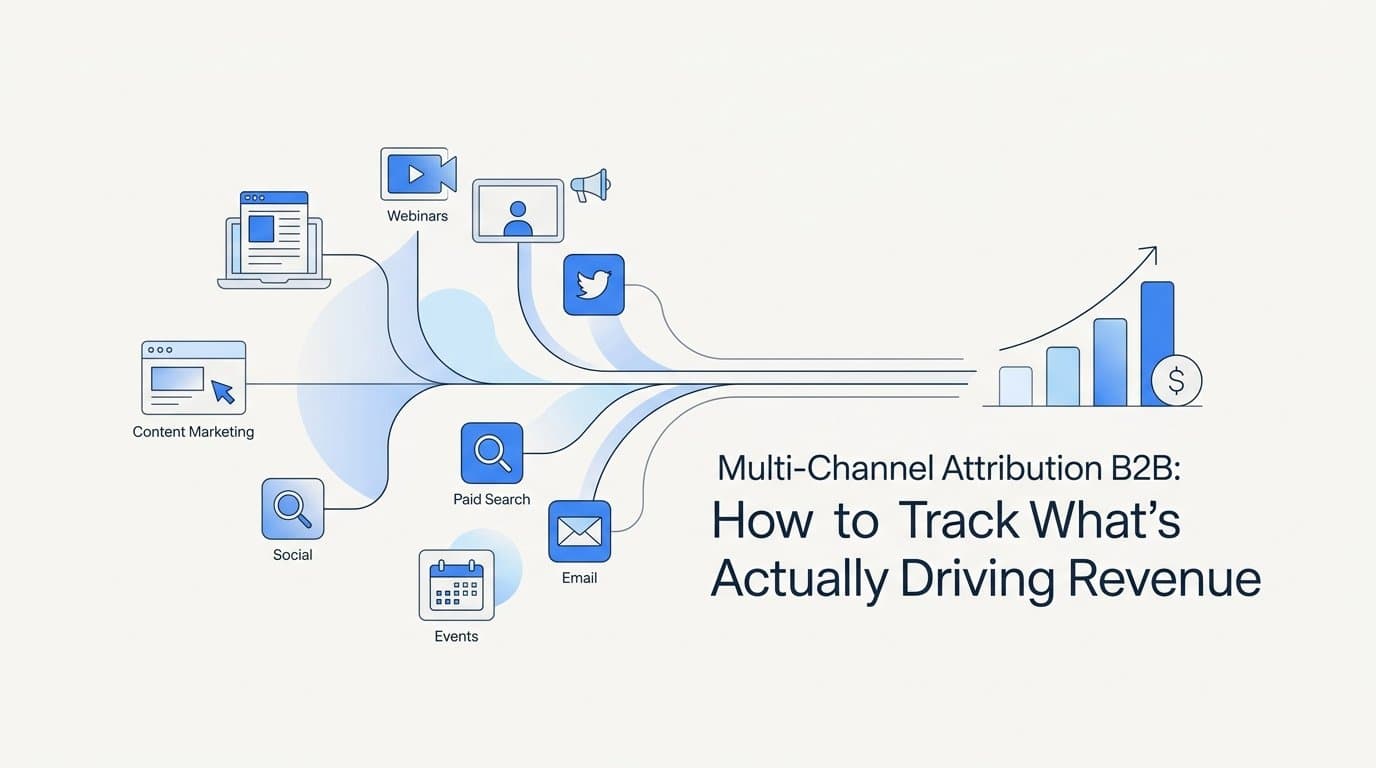
Multi-channel attribution in B2B is the discipline of mapping every touchpoint across that long, complex journey and understanding how each one contributed to pipeline and closed revenue. This guide breaks down how it works, why it matters more in B2B than anywhere else, and how to build a system that gives you real answers instead of comfortable guesses.
Why B2B Buying Journeys Break Traditional Attribution
Traditional attribution models were built for a world where one person sees an ad, clicks it, and buys something. That world still exists in B2C. In B2B, it almost never does.
A typical B2B software purchase involves multiple decision-makers: a champion who advocates internally, a manager who approves the budget, a technical evaluator who reviews the integration requirements, and sometimes a procurement team that adds weeks to the process. Each of these people may encounter your brand through completely different channels. The champion found you through a Google search. The technical evaluator read a LinkedIn post. The manager saw a retargeting ad. None of them converted individually. The deal closed because all of them eventually aligned.
When you run last-click attribution in this environment, you tell a deeply misleading story. The channel that happened to be in front of someone at the moment they filled out a demo form gets all the credit, while everything that built awareness, established trust, and moved the deal forward gets nothing. Budget follows that credit. Over time, you over-invest in bottom-of-funnel channels and starve the top and middle of the funnel that feeds them.
The gap between first ad click and closed revenue in B2B can span weeks or months, depending on deal size and complexity. During that window, a prospect might interact with paid ads, organic content, direct traffic, email sequences, sales outreach, and product trials. Each of those interactions leaves a trace, but only if you are set up to capture it. Most teams are not.
There is also a structural problem unique to B2B: conversions often happen offline or inside a CRM rather than on a website. A demo request is not a closed deal. An MQL handed to sales is not revenue. But most web-based tracking stops at the form submission and calls that a conversion. This means the attribution data your marketing team is optimizing toward may have almost no relationship to the revenue your business actually generates.
This is why B2B teams need a fundamentally different approach to attribution. Not just a better last-click model, but a framework that tracks the entire journey from first impression to closed-won deal, across every channel and every stakeholder involved in the decision.
The Attribution Models B2B Marketers Actually Use
Before you can choose the right attribution approach, you need to understand what each model actually does and where it breaks down in a B2B context.
First-touch attribution gives all credit to the very first interaction a prospect had with your brand. It is useful for understanding which channels are best at generating awareness and bringing new prospects into your funnel. The problem is that it completely ignores everything that happened between that first touchpoint and the eventual conversion, which in B2B can be a lot.
Last-touch attribution does the opposite: it credits the final interaction before conversion. This tends to favor bottom-of-funnel channels like branded search or direct traffic, because those are often where prospects land right before they convert. It tells you nothing about what built the relationship that made that final click possible.
Linear attribution distributes credit equally across every touchpoint in the journey. It is more honest than single-touch models because it acknowledges that multiple interactions mattered. The drawback is that it treats a passing display impression the same as a 30-minute product demo, which is rarely accurate.
Time-decay attribution gives more credit to touchpoints that happened closer to the conversion event. The logic is that recent interactions had more influence on the final decision. This can work reasonably well for shorter sales cycles, but in long B2B deals it can undervalue the awareness and consideration stages that set everything else in motion.
Data-driven attribution takes a different approach entirely. Instead of applying a fixed rule to distribute credit, it analyzes actual conversion patterns across your data to determine which touchpoints and sequences are most predictive of conversion. It adapts to your specific buyer behavior rather than forcing your buyers into a predetermined model. This is why data-driven attribution is increasingly preferred for B2B teams with enough conversion volume to make the analysis meaningful.
Multi-touch attribution is the broader framework that sits above all of these models. Rather than committing to a single model, multi-touch attribution allows your team to compare how different models evaluate the same set of touchpoints. You can look at first-touch to understand awareness drivers, last-touch to understand closing channels, and data-driven to understand what actually matters across the full journey. The ability to run these comparisons side by side is what makes multi-channel attribution genuinely useful for B2B budget decisions.
The goal is not to find the one true model. It is to use multiple models as lenses that reveal different aspects of how your buyers move through the funnel, so you can make better decisions about where to invest.
What Multi-Channel Attribution Actually Tracks in B2B
Understanding the models is one thing. Knowing what data those models are actually working with is another. Multi-channel attribution in B2B is only as good as the touchpoints it can see, and capturing those touchpoints requires more than a standard pixel setup.
The touchpoints that matter in a typical B2B journey include paid search ads, paid social on LinkedIn and Meta, organic search clicks, direct traffic, email sequences, content downloads, webinar registrations, retargeting exposures, demo requests, trial signups, and CRM-recorded activities like sales calls and proposal reviews. Each of these represents a moment where your brand influenced the prospect's thinking. A complete attribution picture needs all of them.
The challenge is that browser-based tracking misses a growing share of these events. Ad blockers, iOS privacy restrictions, and the ongoing deprecation of third-party cookies have made pixel-based tracking less reliable than it was a few years ago. Events that should be captured are silently dropped, creating gaps in your attribution data that you may not even know exist.
Server-side tracking addresses this directly. Instead of relying on a browser pixel to fire when a user takes an action, server-side tracking sends event data directly from your server to the ad platform or analytics tool. This bypasses browser limitations entirely and captures events that would otherwise be lost. For B2B teams, this means form submissions, trial signups, and other high-value conversion events are recorded accurately even when a user has ad blocking enabled or is on a privacy-restricted browser.
Conversion API integrations, offered by Meta, Google, and LinkedIn, extend this capability by allowing you to send enriched event data back to each platform. Instead of sending a generic "form submitted" signal, you can include data about lead quality, CRM stage, or deal value. This enriched signal improves the platform's own optimization algorithms, helping it find more of the right prospects rather than just more prospects.
First-party data enrichment is the connective tissue that makes all of this work at the identity level. When someone clicks an ad and lands on your site, they are initially anonymous. When they fill out a form, they become an identified lead in your CRM. The ability to connect that anonymous click history to the identified lead record is what allows you to attribute that ad click to the eventual deal. Without this connection, your attribution data and your revenue data live in separate worlds that never talk to each other.
Pipeline and Revenue Attribution: Connecting Ads to Closed Deals
Most marketing attribution systems stop at the lead. A form is submitted, a conversion is counted, and the channel gets credit. For B2B teams, this is where the real problem begins.
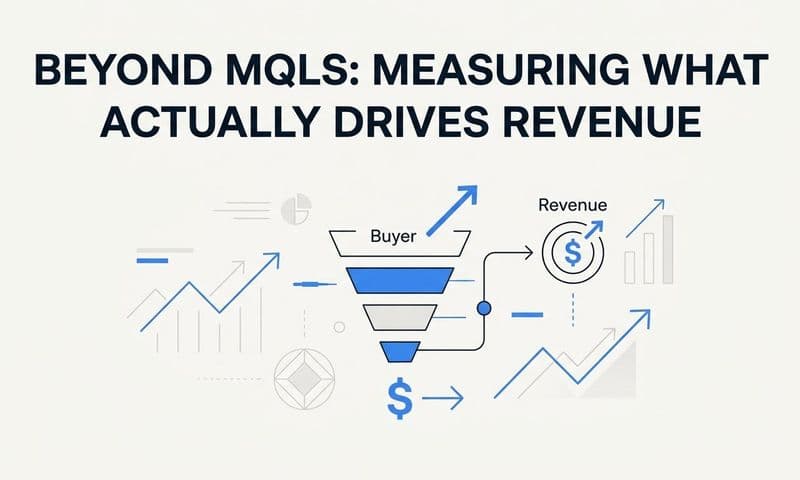
Lead attribution and revenue attribution are fundamentally different things. A channel that generates a high volume of form fills may be producing leads that never progress past the first sales call. A channel that generates fewer leads might be responsible for a disproportionate share of your closed-won deals. If you are only measuring at the lead level, you cannot see this distinction, and your budget decisions will reflect that blindness.
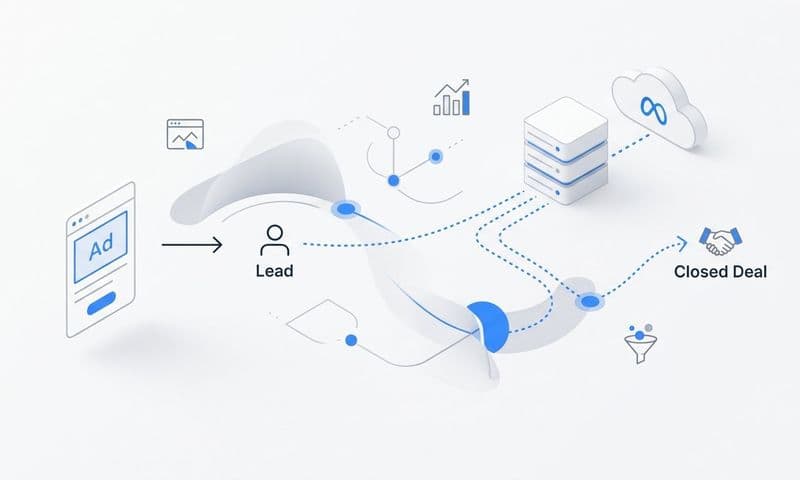
Revenue attribution connects ad data to CRM pipeline stages so you can follow each lead from its first marketing touchpoint through qualification, opportunity creation, and eventually to closed-won or closed-lost. This gives marketing teams a fundamentally different view of channel performance. Instead of asking "which channel generated the most leads," you can ask "which channel generated the most qualified pipeline" and "which channel's leads convert to revenue at the highest rate."
These are the questions that align marketing investment with business outcomes. They are also the questions that earn marketing teams credibility with finance and leadership, because the answers are expressed in pipeline and revenue rather than lead volume and cost per click.
Connecting billing or subscription data to ad attribution adds another layer of precision. For B2B SaaS companies, integrating a payment platform like Stripe with your attribution system means that actual revenue figures, not just conversion events, can be tied back to specific campaigns and channels. You can see that a particular LinkedIn campaign generated a certain amount of monthly recurring revenue, not just a certain number of demo requests. This is the level of attribution clarity that makes confident budget decisions possible.
The practical requirement for all of this is a clean integration between your ad platforms, your CRM, and your billing data. These three systems need to share a common identifier so that the journey from ad click to closed deal can be traced without gaps. This is not a trivial technical challenge, but it is the foundation of attribution that actually reflects how your business generates revenue.
Common Multi-Channel Attribution Mistakes B2B Teams Make
Even teams that understand the value of multi-channel attribution often undermine their own data by making a handful of avoidable mistakes. Here is where things most commonly go wrong.
Trusting platform-native attribution in isolation is one of the most widespread problems. Google Ads, Meta, and LinkedIn each report conversions using their own attribution windows and logic. Because each platform is measuring independently, the same conversion can be claimed by all three simultaneously. When you add up the conversions reported across platforms, the total often far exceeds the number of actual conversions your business recorded. Teams that rely on platform dashboards without a unified view end up with an inflated picture of every channel's performance and no way to reconcile the numbers.
Failing to unify data into a single source of truth compounds this problem. When your ad data lives in separate platform dashboards, your CRM data lives in Salesforce or HubSpot, and your website analytics live in Google Analytics, you are not doing attribution. You are doing channel-by-channel reporting and hoping the pieces add up. They rarely do. Evaluating channel performance without a unified data layer means you are comparing metrics that were measured differently, in different windows, with different definitions of what counts as a conversion.
Ignoring attribution window settings creates a subtler but equally damaging problem. Attribution windows define how far back in time a touchpoint can be credited for a conversion. A 7-day click window on a Meta campaign means that if someone clicks your ad and converts 10 days later, that conversion is not attributed to that ad. In B2B, where sales cycles regularly stretch across weeks or months, default attribution windows that were designed for e-commerce can cause you to dramatically undercount the contribution of channels that influence early and middle-funnel behavior.
Measuring the wrong conversion events is another common trap. If your attribution system is optimized toward form fills but your business cares about closed-won deals, you are building a machine that is very good at generating form fills, not revenue. The conversion events you track and optimize toward need to reflect the outcomes your business actually values, which in B2B usually means qualified pipeline and closed deals, not just lead volume.
Building a Multi-Channel Attribution System That Works for B2B
Knowing what to avoid is useful. Knowing how to build the right system is what actually moves the needle. Here is what a functional multi-channel attribution setup looks like for a B2B team.
The foundation is a unified attribution platform that pulls data from all your ad channels, your website, your CRM, and your billing system into a single environment. This is the single source of truth that eliminates the platform-reporting problem and gives your team one place to evaluate channel performance using consistent definitions and windows. Without this layer, everything else is guesswork.
Server-side event tracking needs to be in place to ensure that the data flowing into that platform is complete. This means implementing Conversion API connections for Meta and Google, setting up server-side events for your key conversion actions, and ensuring that high-value B2B events like demo requests, trial activations, and CRM stage progressions are being captured and sent to your attribution system reliably.
CRM integration is what elevates attribution from lead-level to revenue-level. Your attribution platform needs to receive pipeline stage updates and closed-won signals from your CRM so that marketing touchpoints can be credited not just for generating a lead but for contributing to a deal that actually closed. This integration also allows you to segment attribution data by deal size, industry, or customer segment, giving you a more granular view of which channels perform best for your highest-value customers.
AI-powered attribution analysis adds another dimension by identifying patterns that rule-based models miss. Rather than applying a fixed credit distribution, AI can analyze which channel combinations and touchpoint sequences are most predictive of conversion across your actual buyer population. This means your attribution insights adapt to how your buyers actually behave, not how a model assumes they behave. The result is smarter budget allocation based on real patterns rather than intuition.
Feeding enriched conversion data back to ad platforms closes the loop. When you send high-quality conversion signals, including CRM-enriched data about lead quality and deal value, back to Meta, Google, and LinkedIn via their Conversion APIs, you improve the platforms' own optimization algorithms. Their AI learns to find more prospects who look like your best customers, not just more prospects who look like people who fill out forms. This is how better attribution data directly improves campaign performance, not just reporting.
Platforms like Cometly are built specifically for this use case. Cometly connects your ad platforms, CRM, and billing data into a unified attribution environment, supports server-side tracking and Conversion API integration, and uses AI to surface which channels and sequences are actually driving revenue for your B2B business. It is designed to give you the single source of truth that makes confident, data-backed budget decisions possible.
The Bottom Line on Multi-Channel Attribution for B2B
The shift that multi-channel attribution demands is not just technical. It is a change in how your team thinks about marketing performance. Instead of asking which channel worked, you start asking how channels work together. Instead of optimizing for lead volume, you optimize for revenue contribution. Instead of trusting platform dashboards, you build a unified view that reflects reality.
The goal is not perfect attribution. Perfect attribution does not exist in a world of multiple stakeholders, long sales cycles, and imperfect tracking. The goal is better attribution: a system that gives your team enough clarity to make confident decisions about where to invest, what to scale, and what to cut.
B2B buyers leave a trail of touchpoints across every channel you run. The teams that learn to read that trail accurately are the ones that compound their marketing investment over time, while their competitors keep guessing and hoping last-click reports tell the truth.
If you are ready to build that system, Get your free demo of Cometly and see how a purpose-built B2B attribution platform connects every touchpoint to the pipeline and revenue that actually matter to your business.