Every B2B marketing leader has lived this scenario at some point. The team hits its MQL target for the third quarter in a row. The dashboard looks great. Then you get on a call with the sales VP, and the conversation goes sideways fast. Pipeline is thin. Close rates are down. Revenue growth is inconsistent. And sales is quietly convinced that marketing is sending them junk.
Sound familiar? You are not alone, and more importantly, you are not imagining the problem. The disconnect is real, and it is structural.
MQLs were designed for a simpler era of B2B buying. When the funnel was linear, when buyers filled out forms and waited for salespeople to educate them, and when a single decision-maker could move a deal forward, tracking lead volume made reasonable sense. That world no longer exists. Today's B2B buyers research independently across dozens of channels, involve multiple stakeholders in the decision, and often spend weeks or months in the "dark funnel" before they ever raise their hand. In that environment, a metric that counts form fills and email opens as signals of readiness is not just incomplete. It is actively misleading.
This article breaks down why MQL-centric measurement fails modern B2B teams, what better metrics look like, and how to build a measurement framework that connects your marketing activity directly to pipeline and revenue. If you are ready to stop optimizing for a number that makes marketing look good while leaving sales frustrated, this is your starting point.
Why the MQL Model Is Breaking Down
The MQL was born from a specific assumption: that buyers move through a predictable, linear funnel from awareness to consideration to decision, and that their behavior along the way can be scored into a meaningful signal of purchase intent. That assumption made sense when most B2B research happened through sales conversations and trade publications. It does not hold up when buyers are running independent Google searches, reading G2 reviews, watching YouTube demos, and comparing competitors in Slack communities before they ever touch your website.
The modern B2B buying journey is non-linear, multi-channel, and multi-stakeholder. A single deal might involve a champion who found you through organic search, a technical evaluator who saw your LinkedIn ads, a finance lead who read a third-party review, and an executive who heard about you from a peer. None of these touchpoints may trigger an MQL. The one that does might be the least important signal in the entire journey.
This creates what many B2B marketing practitioners call the volume-over-quality trap. When marketing teams are measured on MQL count, they are incentivized to maximize that number. That means leaning into high-volume, low-intent tactics: broad content syndication, gated assets with low barriers, and paid campaigns optimized for form fills rather than pipeline contribution. The MQL number goes up. The quality of what lands in sales' queue goes down.
The result is a structural incentive conflict that damages both teams. Marketing is rewarded for generating MQL volume. Sales is measured on closed deals. When those two objectives diverge, and they almost always do under an MQL framework, the relationship deteriorates. Sales starts discounting marketing's leads. Marketing starts questioning sales' follow-up speed. Both teams end up defending their own metrics instead of collaborating on shared outcomes.
The deeper problem is that MQLs create a false sense of measurement confidence. You have a number, it is going up, and it feels like progress. But if that number does not connect to pipeline, and pipeline does not connect to revenue, you are measuring activity rather than impact. And in a competitive B2B market where marketing budgets are under pressure, activity metrics are not enough to justify investment or guide strategy.
Moving beyond MQLs is not about abandoning lead tracking entirely. It is about recognizing that lead volume is a leading indicator at best, and a vanity metric at worst, unless it is tied to downstream outcomes that actually matter to the business.
The Metrics That Actually Predict Revenue
If MQLs are the wrong measure, what should B2B marketing teams be tracking instead? The short answer is: metrics that have a direct, traceable relationship to pipeline and closed-won revenue. Here are the ones that matter most.
Pipeline-Qualified Leads and Sales-Accepted Leads: These metrics shift the quality bar from marketing's internal definition of readiness to a shared standard validated by both teams. A pipeline-qualified lead is one that sales has reviewed and agreed meets the criteria for active pursuit. A sales-accepted lead goes one step further, confirming that a rep has engaged and believes there is a genuine opportunity. When marketing is measured on SALs rather than MQLs, the incentive structure changes immediately. Suddenly, generating form fills from unqualified prospects does not help your numbers. Getting the right prospects to engage does.
Opportunity Creation Rate: This metric tracks how many of marketing's leads convert into actual sales opportunities. It gives marketing a direct line of sight into how campaigns contribute to deals in motion rather than just leads in a queue. If a particular channel is generating MQLs that almost never become opportunities, that is a signal worth acting on. If a channel with lower volume is converting to opportunities at a high rate, that is where budget should flow.
Pipeline Velocity: Pipeline velocity measures how quickly deals move through the funnel, combining factors like the number of opportunities, average deal size, win rate, and sales cycle length. Marketing can influence velocity through better content at each stage, stronger account-based engagement, and campaigns that keep buying committees warm throughout a long sales cycle. Tracking this metric gives marketing a way to demonstrate impact beyond lead generation.
Revenue Attribution by Channel and Campaign: This is the most powerful metric in the set, and the hardest to build without the right infrastructure. Revenue attribution connects your ad spend and content investment to actual closed-won deals, making it possible to calculate true marketing ROI rather than cost-per-lead proxies. When you know which channels and campaigns are contributing to revenue, budget decisions become data-driven rather than intuition-driven. You stop spending on what looks good in a dashboard and start investing in what demonstrably drives deals.
Building these metrics requires tighter integration between your marketing tools, your CRM, and your ad platforms than most teams currently have. But the investment is worth it. These are the numbers that earn marketing a seat at the revenue table.
Mapping the Full Customer Journey Instead of a Single Touchpoint
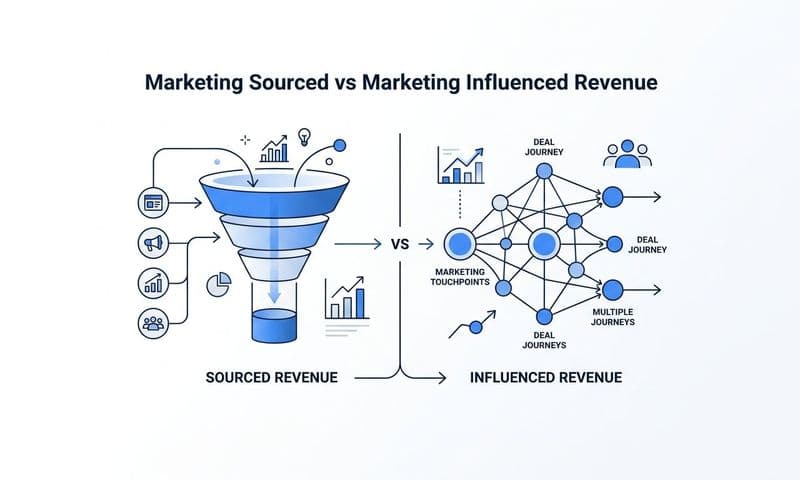
Here is the core problem with any single-touchpoint metric in B2B: it assumes that one moment in the buyer's journey is responsible for the outcome. First-touch attribution says the channel that brought someone to your site first deserves all the credit. Last-touch attribution says the final interaction before conversion gets the win. Neither model reflects how B2B buying actually works.
B2B buying journeys typically involve multiple stakeholders, many touchpoints across paid, organic, and direct channels, and weeks or months between first contact and closed deal. A prospect might click a LinkedIn ad, attend a webinar, read three blog posts, compare you on G2, watch a product demo, and then respond to a sales outreach email before becoming an opportunity. Crediting only the LinkedIn ad or only the sales email misrepresents the entire journey and leads to bad budget decisions.
Multi-touch attribution models address this by distributing credit across the entire customer journey. Rather than assigning all value to one interaction, they weight each touchpoint based on its role in moving the deal forward. This reveals which channels and campaigns influence pipeline at each stage, not just which ones happen to appear at the beginning or end of the journey.
Different models serve different purposes. Linear attribution gives equal credit to every touchpoint, which is useful for understanding overall channel contribution. Time-decay models give more credit to touchpoints closer to conversion, which makes sense for longer B2B sales cycles where late-stage content and outreach often play a decisive role. Data-driven attribution goes further, adapting dynamically based on actual conversion patterns in your data rather than applying a fixed rule. For teams with sufficient conversion volume, data-driven is the most accurate approach because it reflects your specific buyers' behavior rather than a generic assumption.
Beyond the touchpoints you can track, there is the dark funnel to consider. This refers to all the research and influence activity that happens before a prospect ever fills out a form or gets scored in your system. Organic search queries, Reddit threads, peer conversations, review site comparisons, and LinkedIn lurking all shape buying decisions without leaving a traceable signal in your CRM. You cannot track all of this directly, but you can use multi-touch attribution to understand which visible touchpoints tend to appear in journeys that convert, and you can invest in channels that show up consistently in those paths.
Touchpoint analysis also helps you understand where buying committees engage. In B2B SaaS, a single MQL from one stakeholder rarely represents the whole account's readiness. When you map journeys at the account level rather than the individual level, you start to see patterns: which roles engage first, which content resonates with technical evaluators versus executives, and which campaigns are reaching the full committee rather than just one contact. That insight is impossible to extract from a standard MQL report.
Building a Revenue-Focused Attribution Framework
Understanding why multi-touch attribution matters is one thing. Building the infrastructure to make it work is another. Here is what a practical, revenue-focused attribution framework actually requires.
A Unified Data Layer: The foundation is connecting your ad platforms, CRM, and website into a single data environment where every touchpoint from first ad click to closed-won deal is captured and linked. Right now, most B2B marketing teams are working with fragmented data: ad platform dashboards that show impressions and clicks, a CRM that shows pipeline and deals, and a web analytics tool that shows sessions and conversions. None of these talk to each other cleanly, which means attribution is either manual, incomplete, or both. A unified data layer solves this by creating a continuous thread from campaign exposure to revenue outcome.
Choosing the Right Attribution Model: Not every model fits every sales cycle. For B2B SaaS companies with longer cycles and multiple stakeholders, linear and time-decay models are practical starting points. They distribute credit across the journey rather than concentrating it at one end, which gives you a more accurate picture of how marketing activity contributes over time. As your conversion volume grows and your data matures, data-driven attribution becomes the more powerful option because it learns from your actual patterns rather than applying a fixed rule.
Server-Side Tracking and Conversion API Integration: Browser-based tracking has become increasingly unreliable. Cookie restrictions, ad blockers, and iOS privacy changes have reduced the accuracy of pixel-based conversion data, which means the signals your ad platforms receive about what is working are degraded. Server-side tracking via Conversion APIs, including Meta CAPI and Google Enhanced Conversions, sends first-party event data directly from your server to the ad platform, bypassing browser restrictions entirely. This improves signal accuracy, enables better algorithmic optimization, and ensures that your attribution data reflects real conversion activity rather than a partial, browser-filtered view.
CRM Integration as the Revenue Bridge: Your CRM is where pipeline and revenue data lives. Without a direct integration between your attribution platform and your CRM, you cannot close the loop between marketing activity and closed-won deals. This integration is what makes it possible to answer the questions that actually matter: which campaigns are generating opportunities, which channels have the highest win rates, and what is the true revenue contribution of your marketing budget.
Platforms like Cometly are purpose-built to handle this infrastructure for B2B SaaS teams. By connecting ad platforms, CRM data, and website behavior in one place, Cometly gives marketing teams a single source of truth for attribution, with real-time visibility into how every campaign contributes to pipeline and revenue.
Aligning Marketing and Sales Around Shared Revenue Goals
Even the best attribution infrastructure will not fix a misaligned organization. Technology enables measurement, but alignment requires agreement on what you are measuring and why. That means replacing the MQL handoff with something better.
Start by replacing the MQL handoff with a shared pipeline definition agreed upon by both marketing and sales leadership. This means sitting down together and defining, in specific terms, what constitutes a qualified opportunity worth pursuing. What company size, industry, and role profile qualifies? What behaviors or signals indicate genuine purchase intent? What does a good lead look like, and what does a bad one look like? When both teams agree on these criteria upfront, marketing can optimize toward generating leads that fit the profile, and sales can trust that the leads they receive are worth their time.
The next step is building a joint dashboard that surfaces the metrics both teams care about. This should include pipeline contribution by source, win rates by channel and campaign, average deal size by lead source, and revenue attribution across the full funnel. When marketing and sales are working from the same data, conversations shift from defensive ("our leads are fine, sales just does not follow up") to productive ("this channel has a high opportunity rate but a low win rate, let us figure out why"). Shared data creates shared accountability.
Finally, tie marketing budget decisions to pipeline and revenue outcomes rather than lead volume. This is the most important structural change you can make. When budget allocation is based on which channels and campaigns demonstrably drive pipeline and closed-won revenue, you stop rewarding vanity metrics and start investing in what actually works. Growth leaders who can walk into a budget conversation with clear data showing revenue contribution by channel are in a fundamentally stronger position than those who can only show MQL counts and cost-per-lead figures.
This alignment does not happen overnight. It requires ongoing communication, shared reporting cadences, and a genuine commitment from leadership on both sides to move away from siloed metrics. But the payoff is significant: a marketing and sales relationship built on shared goals, shared data, and shared accountability for revenue growth.
From MQL Obsession to Revenue Clarity
Making this shift in practice starts with an honest audit. Look at the metrics your team currently tracks and ask a simple question for each one: does this connect to revenue, or is it a proxy? MQL count, cost per MQL, and email open rates are proxies. Opportunity creation rate, pipeline velocity, and revenue attribution by channel connect to revenue. Start by identifying the gaps between what you measure today and what you need to measure to have a clear picture of marketing's impact on the business.
From there, prioritize building the data infrastructure that makes revenue-connected metrics possible. This means integrating your ad platforms with your CRM, implementing server-side tracking to ensure accurate conversion data, and choosing an attribution model that fits your sales cycle. These are not small projects, but they are the foundation on which everything else is built.
The transition also requires organizational commitment. Technology can capture the data, but it takes leadership alignment to change how teams are measured, how budgets are allocated, and how marketing and sales collaborate. Both dimensions matter equally.
This is exactly where Cometly is built to help. Cometly connects your ad spend to pipeline and revenue in real time, giving B2B SaaS marketing teams a single source of truth for attribution across every channel. With multi-touch attribution, server-side tracking, CRM integration, and an AI-powered ads manager, Cometly provides the infrastructure you need to move beyond MQL proxies and make confident, data-driven decisions at every stage of growth. From capturing every touchpoint to surfacing AI-driven recommendations on which campaigns to scale, Cometly makes the shift from MQL obsession to revenue clarity actionable rather than aspirational.
The Bottom Line
MQLs are not inherently wrong. As one signal among many, they can be useful. The problem is using them as the primary measure of marketing success in an environment where B2B buying is complex, multi-stakeholder, and deeply non-linear. When MQL count becomes the goal, marketing optimizes for the wrong things, sales loses trust in the leads they receive, and the entire organization loses visibility into what is actually driving revenue.
The path forward is clear: shift from lead volume metrics to revenue-connected metrics, build the attribution infrastructure to support that shift, and align marketing and sales around shared pipeline and revenue goals. It takes investment in both technology and organizational change, but the result is a marketing function that can demonstrate its true impact on the business and make smarter decisions about where to invest for growth.
Your next step might be auditing your current attribution setup to identify where the gaps are. It might be starting a conversation with sales leadership about a shared pipeline definition. Or it might be exploring a platform that can connect every touchpoint to revenue and give your team the clarity it needs to scale with confidence.
Ready to move beyond MQLs and connect your marketing activity directly to revenue? Get your free demo today and see how Cometly helps B2B SaaS teams track every touchpoint, attribute revenue accurately, and make data-driven decisions that drive real growth.