A prospect books a demo. Your sales team asks the usual question: "How did you hear about us?" The answer comes back: "I just heard about you." No campaign. No ad click. No UTM parameter. Just a vague sense that your company exists and solves a real problem.
Sound familiar? This is the dark funnel in action, and it happens constantly in B2B marketing. The buyer spent weeks or months forming an opinion about your product. They saw your CEO's LinkedIn post shared in a Slack community. They heard your name mentioned on a podcast. A colleague recommended you during an internal meeting. By the time they filled out your demo form, the decision was already half-made. But none of that showed up in your attribution dashboard.
This is the core tension every B2B SaaS marketer faces. Traditional analytics tools are built to track what happens after a buyer surfaces in your visible funnel. They capture clicks, sessions, and form fills. What they cannot capture is the sprawling, invisible research process that shaped the buyer's decision long before that first trackable interaction. In B2B, that invisible process often accounts for the majority of real influence.
This article breaks down what the dark funnel actually is, where it lives, why standard attribution models miss it entirely, and how to build a measurement strategy that accounts for both the visible and invisible parts of the buyer journey. If you are making budget decisions based only on what your analytics tools can see, this is a conversation worth having.
The Invisible Buyer Journey Happening Before the First Click
The dark funnel is not a new channel or a mysterious technology. It is simply the portion of the B2B buyer journey that occurs in places standard analytics tools cannot reach. Think private communities, peer conversations, podcasts, and organic social sharing. No tracking pixel can follow a buyer into a Slack workspace. No UTM parameter survives a copy-paste into a private Discord thread. No analytics platform knows that a buyer listened to a thirty-minute podcast episode where your product was discussed in depth.
What makes this particularly significant in B2B is the nature of the buying cycle itself. Enterprise and mid-market software purchases rarely involve a single decision-maker acting alone. They involve multiple stakeholders: the champion who discovered you, the manager who needs to approve budget, the technical evaluator who will assess fit, and the executive who signs off. Each of these people conducts their own independent research. Each accumulates influence from different sources. By the time any of them visit your website, they have already formed impressions that no attribution tool recorded.
This is fundamentally different from B2C buying behavior. When someone buys a pair of sneakers, the research cycle is short and often happens on trackable platforms. When a company evaluates a marketing attribution platform, the cycle can stretch across months, involve five to ten stakeholders, and draw on sources as varied as conference conversations, LinkedIn comment threads, and peer review platforms. Influence accumulates slowly and invisibly.
The visible funnel, by contrast, is everything your tools can see. Google Analytics captures page visits. Your ad platforms track clicks and conversions. Your CRM logs form submissions and email opens. These are real and important signals, but they represent the final chapter of a story that started long before. The dark funnel is all the earlier chapters.
When marketers treat the visible funnel as the complete picture, they systematically misattribute what is actually driving pipeline. Channels that create awareness and build trust over time appear to contribute nothing, because their influence is never captured in a trackable event. Meanwhile, bottom-of-funnel paid channels that capture intent get all the credit, even when that intent was created somewhere entirely different. The result is a distorted view of marketing effectiveness that leads to predictably bad budget decisions.
Where Dark Funnel Activity Actually Lives
Understanding the dark funnel requires getting specific about where it concentrates. In B2B, a handful of channels consistently drive significant influence that never shows up in attribution data.
LinkedIn organic content: LinkedIn is one of the most powerful dark funnel channels in B2B, and one of the least measurable. When a founder or marketer publishes a post that resonates, it gets shared, commented on, and discussed. But those interactions rarely generate trackable clicks back to your website. A buyer might read a thread, form a strong opinion about your brand, and then search for you directly weeks later. The LinkedIn activity that shaped their view is completely invisible to your attribution tools.
Private Slack and Discord communities: Practitioners share vendor recommendations in private communities constantly. "Has anyone used X for attribution?" is a question that gets asked and answered in hundreds of B2B Slack groups every day. The responses shape buying decisions in real time. None of it is trackable. The buyer who received a strong recommendation in a private channel will often arrive at your website through a branded search or direct visit, with no indication of what actually drove them there.
Podcasts and audio content: Podcast listeners hear about products in a context where clicking a link is not always practical or immediate. A listener might hear your product mentioned during a commute, remember the name, and search for it three days later. The podcast episode that created the awareness gets zero credit. The branded search that finally brought them to your site gets all of it.
Peer review platforms: G2, Capterra, and similar platforms are major dark funnel drivers that many B2B marketers underestimate. Buyers research extensively on these platforms before ever visiting a vendor's website. They read reviews, compare features, and form strong preferences. The vendor being evaluated has no visibility into this research process. By the time a buyer arrives at the vendor's site, their evaluation on G2 has already done substantial work in shaping their intent.
Word-of-mouth and internal champion advocacy: Perhaps the most powerful dark funnel channel is the one that happens entirely inside the buying committee. One person who knows your brand becomes an internal champion. They mention you in a meeting. They share your content in an email thread. Suddenly, three other stakeholders are aware of you and already have a positive impression. They arrive at your site with no traceable origin, and no attribution model will ever know why they converted.
Why Standard Attribution Models Miss the Dark Funnel Entirely
Attribution models are built to distribute credit among trackable events. This is both their strength and their fundamental limitation when it comes to B2B buying behavior.
Last-click attribution assigns 100% of the credit for a conversion to the final trackable touchpoint before the buyer converted. If a prospect spent three months in the dark funnel building familiarity with your brand, then clicked a Google ad and booked a demo, last-click attribution says the Google ad drove that deal. Everything that came before it is invisible. The result is that channels creating awareness and trust appear to contribute nothing, because their contribution happened in places that cannot be tracked.
First-touch attribution has the opposite problem. It assigns all credit to the first trackable interaction, ignoring everything that happened in between. In a long B2B buying cycle, the first trackable touchpoint might be a blog post a buyer stumbled across eight months before they were ready to buy. Giving that blog post 100% credit while ignoring the podcast, the G2 research, and the Slack recommendation that actually accelerated the decision is just as misleading as last-click.
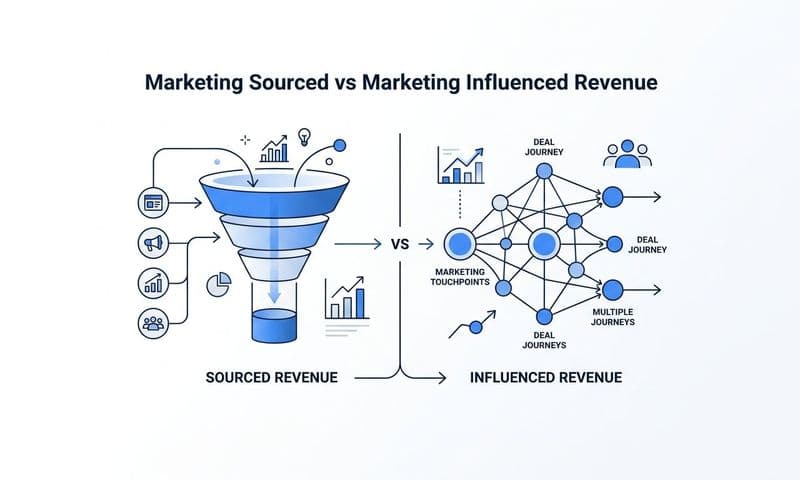
Multi-touch attribution models are more sophisticated. They distribute credit across multiple tracked touchpoints in the customer journey. Linear models spread credit evenly. Time-decay models give more weight to recent interactions. Position-based models emphasize the first and last touchpoints. These are genuinely more useful than single-touch models, but they share a critical limitation: they can only distribute credit among events that were actually tracked. Dark funnel influence remains uncredited in every multi-touch model, because there is no event to credit.
The strategic consequence of this attribution gap is significant. When B2B marketing teams make budget decisions based on what their attribution tools can see, they tend to systematically undervalue brand-building channels. Thought leadership content, community participation, organic social, and podcast appearances are hard to tie to trackable conversions. Paid search and retargeting campaigns, which capture intent that was often created elsewhere, are easy to tie to conversions. The attribution model rewards the intent-capture channels and penalizes the intent-creation channels.
Over time, this creates a reinforcing cycle. Budgets shift toward bottom-of-funnel paid channels. Brand and community investment shrinks. The pipeline of warm, dark-funnel-influenced buyers starts to dry up. Paid channel performance deteriorates because there is less pre-existing awareness to capture. Marketing leaders look at their attribution dashboards and cannot understand why performance is declining, because the data they are using to make decisions was never capturing the full picture.
The most consequential budget cuts in B2B marketing are often the ones that eliminate programs that were silently generating the most qualified pipeline. Because those programs never received attribution credit, they looked like cost centers rather than growth drivers.
Practical Strategies to Illuminate Dark Funnel Influence
The dark funnel cannot be fully measured, but it can be partially illuminated. The goal is not to make every buyer interaction trackable. The goal is to gather enough signal to make smarter decisions about where influence is actually coming from.
Self-reported attribution surveys: The most direct way to understand dark funnel influence is to ask buyers where they first heard about you. A simple post-demo or post-signup survey with a single open-ended question, "How did you first hear about us?", can reveal channels that no tracking pixel will ever capture. When you consistently see answers like "I heard you mentioned in a Slack community," "A colleague recommended you," or "I listened to a podcast episode you were on," you are getting direct evidence of dark funnel activity that your attribution dashboard will never show. This qualitative data layer is imperfect, but it is often the most honest signal you have.
Branded search volume as a proxy signal: When your dark funnel investment is working, more buyers will search for your brand by name. Branded search volume is a useful proxy metric for dark funnel momentum. If you increase your podcast appearances, LinkedIn thought leadership, and community presence over a quarter, you should expect to see a corresponding lift in branded search traffic. Monitoring this trend alongside your other marketing activity gives you a leading indicator that your dark funnel channels are building awareness, even if you cannot trace individual conversions back to them.
Direct traffic analysis: Direct traffic in your analytics platform often represents buyers who already knew your name and typed it directly into their browser. A sustained increase in direct traffic is another signal that brand familiarity is growing. Like branded search, it is a proxy rather than a precise measurement, but it is a meaningful one when tracked consistently over time.
Multi-touch attribution for the visible funnel: While multi-touch models cannot account for dark funnel influence, they do provide a significantly more complete picture of the tracked customer journey than single-touch models. Distributing credit across multiple touchpoints helps marketers understand which tracked channels are assisting conversions even when they are not the final click. This is not a solution to the dark funnel problem, but it is a necessary foundation for any serious measurement strategy.
Sales team debriefs: Your sales team hears things during discovery calls that never make it into your CRM. Buyers mention the podcast they heard you on. They reference the LinkedIn post that first put your name on their radar. Building a habit of capturing this anecdotal intelligence during sales debriefs gives your marketing team qualitative data that supplements what your attribution tools can see.
Connecting Visible Attribution Data to Dark Funnel Reality
The goal of dark funnel strategy is not to make the invisible visible. That is not achievable, and chasing it leads to over-engineered measurement frameworks that still miss the point. The goal is to triangulate between what you can measure and what you can observe, so that your budget and channel decisions reflect reality rather than just what your analytics tools can see.
This triangulation only works if the visible portion of your funnel is measured with complete accuracy. If your trackable attribution data has gaps, whether from cookie restrictions, ad blocker interference, or incomplete CRM integration, then your foundation is already compromised. You cannot layer qualitative dark funnel signals on top of unreliable quantitative data and expect to make good decisions.
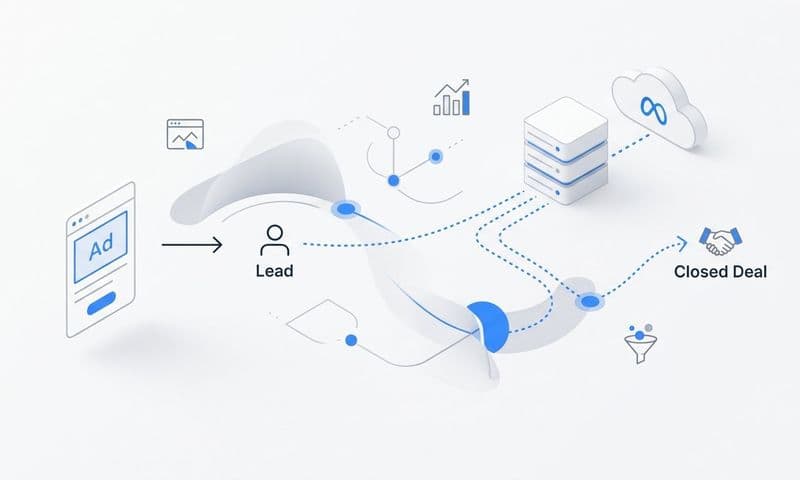
This is where a platform like Cometly becomes foundational. Cometly captures every trackable touchpoint across your ad platforms, CRM events, and website, connecting ad spend directly to pipeline and closed revenue. Server-side tracking and Conversion API integration ensure that privacy-restricted events and cookie-limited interactions are captured accurately, closing the gaps that client-side tracking leaves open. When your visible funnel data is complete and accurate, you have a reliable baseline to work from.
With that baseline in place, the self-reported survey data, branded search trends, and sales team intelligence you collect become much more actionable. You can look at a cohort of deals that closed and say: "Our attribution data shows these buyers came through paid search, but our survey data shows that most of them first heard about us through LinkedIn or a podcast. That means paid search is capturing intent that our organic presence created." This kind of triangulation is only possible when you trust your quantitative data.
Accurate pipeline and revenue attribution for the visible funnel also gives marketing leaders the credibility they need to make the case for investing in dark funnel channels. When you can demonstrate that your tracked attribution is rigorous and complete, stakeholders are more willing to accept that some portion of pipeline influence is genuinely untrackable, and that investing in channels that build dark funnel awareness is a strategic choice rather than a measurement failure.
Building a Measurement Framework That Accounts for Both Worlds
The most effective B2B marketing teams operate with a two-layer measurement framework. One layer is quantitative. The other is qualitative. Neither is sufficient alone, but together they give you a far more accurate picture of what is actually driving growth.
The quantitative layer uses multi-touch attribution software to track every measurable interaction from the first ad click through to closed revenue. This layer should capture ad platform data, CRM events, website behavior, and revenue outcomes in a single, unified view. The goal is complete accuracy for everything that can be measured. This means using server-side tracking to capture events that client-side tracking misses, integrating your CRM so that pipeline and revenue data flows back to your marketing attribution platform, and using multi-touch attribution models that distribute credit across the full tracked customer journey rather than collapsing it into a single touchpoint.
The qualitative layer captures dark funnel signals that no tracking pixel can reach. This includes post-demo surveys, sales team debrief notes, community listening, and monitoring of peer review platforms. It also includes tracking branded search volume and direct traffic trends as leading indicators of dark funnel momentum. This layer is inherently messier than the quantitative layer, but it is where some of your most valuable insights will come from.
The practical integration of these two layers looks like this: your quantitative attribution data tells you which tracked channels are driving pipeline and revenue. Your qualitative signals tell you which untracked channels are creating the awareness that makes your tracked channels perform. You use both together to allocate budget, evaluate channel performance, and make the case for investments that would look indefensible if you were only looking at last-click attribution.
Monitoring branded search volume alongside paid channel performance in a unified marketing dashboard is one of the most practical ways to operationalize this approach. When branded search is growing, your dark funnel investment is working. When it is flat or declining, your brand presence may be weakening even if your paid channels are still generating leads in the short term.
The modern B2B marketing strategy is not about choosing between measurement and brand building. It is about doing both with rigor. Measure everything that can be measured, with the highest possible accuracy. Invest intentionally in channels that build influence across the full buyer journey, even when that influence cannot be directly attributed. Stop optimizing only for what your tools can see, and start building the kind of compounding brand presence that fills your dark funnel with warm, pre-convinced buyers.
The Bottom Line on Dark Funnel Strategy
The dark funnel is not a problem to be solved with better tracking technology. It is a fundamental reality of how B2B buyers make decisions. Buyers research in private communities, form opinions from peer conversations, and arrive at your website already partially convinced by influences that no analytics platform will ever capture. The marketers who understand this will build strategies that compound over time. The ones who ignore it will keep cutting the programs that were silently driving their best pipeline.
The right approach is not to abandon measurement in favor of pure brand investment, nor to optimize exclusively for what your attribution tools can see. It is to do both with intention. Make the visible funnel as accurately measured as possible. Layer in qualitative signals to account for dark funnel influence. Use the combination to make smarter decisions about where to invest.
That starts with getting your trackable attribution right. When every ad click, CRM event, and revenue outcome is connected in a single, accurate view, you have the foundation you need to confidently invest in the channels that operate beyond measurement. Ready to see what your visible funnel is really telling you? Get your free demo and discover how Cometly connects your ad spend to pipeline and revenue with complete attribution accuracy, so you can make confident decisions about every part of your marketing strategy, tracked and untracked alike.