Every quarter, the same conversation plays out in B2B SaaS boardrooms across the industry. Leadership asks marketing to justify its budget. Marketing pulls a revenue number. Sales disputes it. Finance questions the methodology. And everyone walks away frustrated, without a clear answer to a genuinely important question: what did marketing actually drive?
The root of that frustration is almost never a lack of data. It is a lack of shared definitions. Specifically, the difference between marketing sourced revenue and marketing influenced revenue, two frameworks that measure marketing's contribution in fundamentally different ways, and that answer fundamentally different questions.
Conflating them leads to real consequences. Marketing teams get evaluated only on what they originate, which makes demand generation, content, and retargeting look like nice-to-haves rather than revenue drivers. Budget decisions get made on incomplete data. And the relationship between marketing and sales deteriorates because neither team is working from the same picture of how deals actually close.
This article is a practical guide for growth leaders who want to move past that confusion. We will break down what each metric measures, why B2B sales cycles make the distinction so important, how attribution models shape the numbers you report, and how to use both metrics together to make smarter decisions about where to invest.
Two Ways Marketing Claims Revenue (And Why Both Are Valid)
Start with the definitions, because precision here matters more than most teams realize.
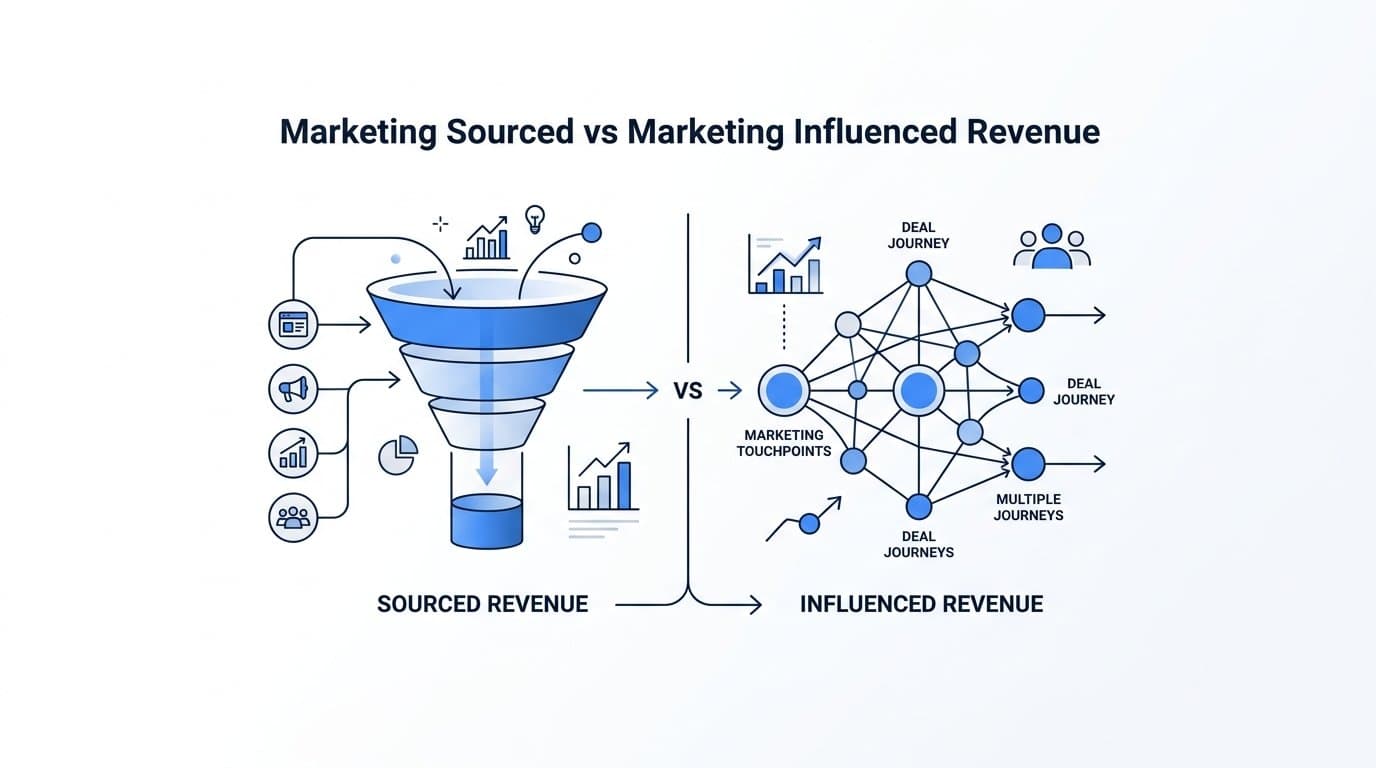
Marketing sourced revenue refers to closed-won deals where marketing was the originating source of the lead. Think of it as marketing's ownership stake in a deal from the very beginning. A prospect clicks a paid search ad, fills out a demo request form, and eventually becomes a customer. That deal is marketing sourced. The first touchpoint that brought the prospect into the pipeline came from a marketing channel, and that is what sourced revenue captures. It is most commonly tracked using first-touch attribution models, which assign 100% of the credit to the channel that initiated the relationship.
Marketing influenced revenue casts a wider net. It captures closed-won deals where marketing had at least one meaningful touchpoint at any stage of the buyer journey, regardless of who or what originated the lead. A prospect might have been cold-called by a sales development representative, but before they signed, they attended a webinar, downloaded a comparison guide, and clicked through a retargeting ad. That deal is marketing influenced, even if it is not marketing sourced. Influenced revenue is typically measured using multi-touch attribution models, which distribute credit across all touchpoints in the journey.
Here is where it gets nuanced. Both metrics tell a true story, but neither tells the complete one.
Sourced revenue is clean and defensible. It gives you a clear line from a specific marketing action to a specific revenue outcome. But in complex B2B deals, it systematically undercounts marketing's contribution. A deal that started with an outbound call but was closed with the help of a case study, a nurture sequence, and a product comparison page would show up as zero in a sourced-only view, even though marketing's assets were doing real work throughout the process.
Influenced revenue corrects for that blind spot, but it introduces its own risk. If your attribution rules are too broad, influenced revenue can balloon to the point where marketing appears to touch nearly every deal in the pipeline. That is technically possible in a world where prospects visit your website or see a retargeting ad at some point, but it does not necessarily mean those touchpoints were decisive. The quality of your influenced revenue number depends entirely on how thoughtfully you define what counts as a meaningful touch.
The takeaway: do not treat these as competing claims. Treat them as complementary lenses. Sourced revenue tells you where pipeline originates. Influenced revenue tells you how marketing shapes deals across the full journey. You need both to understand marketing's actual role in your revenue engine.
Why B2B Sales Cycles Make This Distinction Critical
In a simple transactional sale, attribution is straightforward. Someone sees an ad, clicks it, buys the product. One touchpoint, one conversion, one clear source. But that is not how B2B SaaS deals work, and the structural complexity of enterprise buying cycles is exactly why the sourced versus influenced distinction matters so much.
A typical B2B SaaS deal involves multiple stakeholders, each doing their own research across different channels and at different times. The economic buyer might read your thought leadership content. The technical evaluator might watch a product demo video and compare your documentation against competitors. The end users might engage with your onboarding email sequence before the contract is even signed. None of these touchpoints happen in a straight line, and no single attribution model captures all of them accurately.
Consider how a deal actually moves through a pipeline. A sales development representative reaches out cold to a VP of Operations. The VP agrees to a discovery call, and the deal enters the CRM with the lead source marked as outbound. By the sourced revenue definition, this is a sales-sourced deal. Marketing gets no credit at origination.
But here is what happens next. The VP shares the vendor's website with two colleagues. One of them clicks a retargeting ad and downloads a buyer's guide. Another watches a customer story video. The VP herself receives a nurture email with a competitive comparison that she forwards to her CFO. Over the next six weeks, marketing assets touch this deal repeatedly, answering objections, building confidence, and accelerating the evaluation process. When the deal closes, influenced revenue captures all of that. Sourced revenue captures none of it.
This dynamic creates a persistent organizational tension that many B2B SaaS companies never fully resolve. Sales teams point to their outbound activity as the reason pipeline exists. Marketing teams know their content and campaigns are moving deals forward but cannot prove it without the right attribution framework. Without influenced revenue data, marketing's contribution to deal acceleration and deal quality is effectively invisible.
Revenue operations teams are increasingly stepping in to standardize how both metrics are defined and reported. But the underlying challenge remains: if marketing and sales are working from different tools, different attribution windows, or different definitions of what counts as a touchpoint, the numbers will never reconcile. Aligning on methodology before reporting is not a technical nicety. It is a prerequisite for having productive conversations about budget and strategy.
The B2B sales cycle, with its length, complexity, and multi-stakeholder dynamics, is precisely the environment where a sourced-only view of marketing leaves the most value on the table.
How Attribution Models Shape What You Measure
Here is something that surprises many marketing leaders when they first encounter it: the revenue number you report is not just a function of what happened in your pipeline. It is also a function of which attribution model you apply to that pipeline. Change the model, and the number changes, sometimes dramatically, without a single deal moving.
Understanding this is essential for anyone who wants to report on marketing sourced versus marketing influenced revenue with confidence.
First-touch attribution is the cleanest proxy for sourced revenue reporting. It assigns 100% of the credit to the first channel a prospect interacted with before entering the pipeline. If that first touch was a paid search click, paid search gets full credit for the eventual closed-won deal. First-touch attribution is straightforward to implement and easy to explain to leadership, which is why it remains the most common method for reporting sourced pipeline. Its limitation is that it ignores everything that happened after that initial interaction.
Last-touch attribution takes the opposite approach, crediting the final touchpoint before conversion. It is commonly used in sales-heavy organizations where the last sales activity before close is seen as the decisive factor. The problem is that it erases marketing's role in the early and middle stages of the funnel, which is where a lot of demand generation and content investment lives.
Multi-touch attribution models are the foundation of influenced revenue reporting because they distribute credit across all touchpoints in the journey. The most common variants each reflect a different assumption about where value is created:
Linear attribution gives equal credit to every touchpoint in the journey. It is a reasonable baseline for influenced revenue reporting because it avoids over-indexing on any single interaction. The trade-off is that it treats a brief website visit the same as a product demo, which may not reflect reality.
Time-decay attribution weights touchpoints more heavily as they approach the conversion event. This model reflects the intuition that recent interactions are more influential than early ones, which makes sense in some contexts but can undervalue the awareness and education work that marketing does early in the funnel.
Position-based (U-shaped) attribution gives the most credit to the first and last touchpoints, with the remaining credit distributed across the middle. It acknowledges that the initial awareness moment and the final conversion nudge are both important, while still giving some credit to what happened in between.
Data-driven attribution uses algorithmic modeling to assign credit based on actual conversion patterns in your data. It is the most sophisticated option and increasingly available in platforms like Google Ads and advanced attribution tools. It requires significant data volume to be reliable, but when it works, it produces the most accurate picture of which touchpoints are actually driving outcomes.
The practical implication: if your team switches from first-touch to linear attribution, your marketing sourced revenue number will likely decrease while your influenced revenue number increases. Neither change reflects a real shift in performance. It reflects a change in how you are measuring the same underlying reality. This is why agreeing on attribution methodology before reporting, and being transparent about which model you are using, is non-negotiable for credible revenue attribution.
Tracking the Full Customer Journey Across Every Channel
Accurate sourced and influenced revenue reporting is only possible if you have the data to support it. And in most B2B SaaS organizations, the data problem is more significant than the methodology problem.
To measure both metrics reliably, you need three things connected in a single view: ad platform data, CRM pipeline and revenue data, and website event data. When those data sources live in separate tools that do not talk to each other, you end up with incomplete and often contradictory numbers. Marketing reports one revenue figure from their analytics platform. Sales reports a different figure from the CRM. Finance uses a third number from the billing system. None of them reconcile, and the sourced versus influenced conversation becomes a debate about whose data is right rather than a strategic discussion about what to do next.
Touchpoint tracking across every channel is the foundation of this data infrastructure. That means capturing paid channel interactions from Google Ads and Meta campaigns, organic search visits tied to specific pages, email clicks attributed to specific sequences, and direct traffic that may represent returning prospects already in the pipeline. Each of these touchpoints needs to be logged against a specific prospect record so that when a deal closes, you can reconstruct the full journey and apply your attribution model to it.
UTM parameter strategy is where many teams fall short. If your paid campaigns use consistent UTM tagging but your email campaigns do not, or if your organic content is not tracked with the same rigor as your paid channels, you will have gaps in the journey data. Those gaps mean touchpoints get dropped, and dropped touchpoints mean revenue gets misattributed or disappears from your influenced revenue totals entirely.
Server-side tracking and Conversion API integrations add another layer of data fidelity that is particularly important for B2B funnels. Browser-based tracking pixels are increasingly unreliable due to ad blockers, cookie restrictions, and browser privacy changes. When a prospect visits your pricing page from a retargeting ad but has an ad blocker installed, a pixel-only setup will miss that touchpoint. Server-side tracking captures the event at the server level before it can be blocked, ensuring it makes it into your attribution data.
Meta's Conversion API and Google's Enhanced Conversions work on the same principle: they send conversion events directly from your server to the ad platform, bypassing browser limitations. For B2B funnels where leads may convert through sales-assisted flows, offline meetings, or phone calls, these integrations are essential for ensuring that marketing's role in those conversions is captured and attributed correctly.
The bottom line is that your sourced and influenced revenue numbers are only as accurate as your tracking infrastructure. Investing in clean, connected data is not a technical project. It is a revenue accuracy project.
Using Both Metrics Together to Make Smarter Budget Decisions
Once you have both metrics defined and measured accurately, the real strategic value comes from using them together rather than treating one as more important than the other.
Think of sourced revenue and influenced revenue as serving different decision-making purposes. Sourced revenue is your efficiency metric. It tells you which channels are generating pipeline at the lowest cost and which acquisition investments are producing the highest return. When you are deciding where to scale paid media spend, sourced revenue by channel is the right lens. It answers the question: which channels are actually bringing new prospects into our pipeline?
Influenced revenue is your breadth metric. It tells you how marketing is contributing to deal velocity, win rate, and deal quality across the entire funnel, including deals that sales originated. When you are defending your overall marketing budget to leadership or making the case for mid-funnel investment, influenced revenue is the right lens. It answers the question: how much of our closed-won revenue did marketing touch and shape, even when it did not start the relationship?
The gap between the two numbers is itself a powerful signal. If your influenced revenue is significantly higher than your sourced revenue, it tells you that marketing is doing substantial mid-funnel work that would be completely invisible in a sourced-only view. That gap is the quantified value of your retargeting campaigns, your nurture sequences, your content assets, and your event marketing. It is the evidence you need to justify investment in those programs, even when they do not directly generate net-new leads.
Here is a practical decision-making framework for growth leaders:
When scaling ad spend: Look at sourced revenue by channel to identify your highest-ROI acquisition channels. Which paid channels are generating the most pipeline per dollar spent? That is where you increase investment first.
When defending marketing budget: Present influenced revenue to show the full scope of marketing's impact on closed-won deals. If your influenced revenue is two or three times your sourced revenue, that is a compelling argument that cutting marketing budget would affect far more than just new lead generation.
When evaluating content and nurture programs: Use influenced revenue by asset or channel to identify which mid-funnel touchpoints are appearing most frequently in deals that close. If a specific piece of content shows up repeatedly in the journeys of your highest-value customers, that is a signal to invest more in that format and topic area.
The teams that grow fastest are not the ones with the biggest budgets. They are the ones that understand which of their investments are actually driving revenue, and they use both sourced and influenced data to make that determination with confidence.
Putting It Into Practice With the Right Attribution Platform
Knowing the difference between sourced and influenced revenue is valuable. Having a platform that lets you measure both accurately, without stitching together data from five different tools, is what makes it actionable.
When evaluating attribution platforms for B2B SaaS, there are a few capabilities that are non-negotiable. You need multi-touch attribution across all your marketing channels, not just paid search or social, but email, organic, and direct as well. You need CRM integration that connects pipeline and revenue data to marketing touchpoints at the deal level. And you need the ability to segment deals by sourced versus influenced so you can report on both metrics from a single view rather than running separate analyses in separate tools.
Cometly is built specifically for B2B SaaS teams that need this kind of unified attribution. It connects your ad platforms, CRM events, and website behavior into a single source of truth, so you can see which channels sourced your pipeline and which channels influenced your closed-won revenue, all from one dashboard. With more than 70 native integrations, it brings together the data that typically lives in silos and makes it usable for real revenue decisions.
The pipeline and revenue attribution features connect Stripe and CRM data directly to ad performance, giving you a clear line from ad spend to closed-won deals. That means you can look at a Google Ads campaign and see not just the leads it generated, but the revenue it sourced and the revenue it influenced, with the attribution model of your choice applied consistently across all channels.
Cometly's AI-driven recommendations layer on top of that data to help you identify which channels and campaigns are performing across both sourced and influenced revenue metrics. Instead of manually cross-referencing reports, you get actionable insights about where to scale and where to pull back, based on what is actually driving revenue rather than what looks good in a surface-level dashboard.
The server-side tracking and Conversion API integrations ensure that touchpoints are not dropped due to browser limitations or ad blockers, which is critical for B2B funnels where the consideration period is long and prospects may interact across many sessions before converting. That data completeness is what makes both your sourced and influenced revenue numbers trustworthy enough to bring into a budget conversation with confidence.
The Bottom Line on Marketing Attribution
Marketing sourced revenue and marketing influenced revenue are not competing claims. They are complementary answers to different questions about marketing's role in your revenue engine.
Sourced revenue tells you where pipeline comes from. It is your evidence that specific marketing channels are generating net-new demand. Influenced revenue tells you how marketing shapes deals across the entire journey, including deals that sales originated, and how marketing investment contributes to deal velocity and win rate. You need both to have an honest, complete picture of what marketing is actually doing for your business.
The teams that grow fastest are the ones that track both metrics, understand the difference, and use that data to make confident decisions about budget allocation, channel mix, and go-to-market strategy. They do not walk into budget conversations with a single number and hope it holds up to scrutiny. They walk in with a clear story about where pipeline comes from and how marketing is shaping every deal in the funnel.
If your current attribution setup only gives you one of these views, or if you are spending more time reconciling data across tools than actually using it to make decisions, it is worth exploring what a unified attribution platform can do for your team.
Get your free demo and see how Cometly helps B2B SaaS marketing teams measure both sourced and influenced revenue accurately, so you can stop debating the numbers and start using them to grow.