Most B2B SaaS marketing teams are drowning in data but starving for insight. You can pull numbers from Google Ads, LinkedIn, HubSpot, and a dozen other tools, yet still struggle to answer the most important question: which marketing efforts are actually driving revenue?
Analyzing marketing performance is not about collecting more metrics. It is about building a system that connects ad spend to pipeline, pipeline to closed deals, and closed deals back to the campaigns that started the conversation.
This guide walks you through a practical, repeatable process for analyzing marketing performance from the ground up. Whether you are a growth marketer trying to justify budget, a demand gen lead optimizing spend across channels, or a marketing leader reporting to the board, these steps will help you move from surface-level reporting to revenue-level clarity.
By the end, you will know how to define the right metrics, unify your data sources, choose the right attribution model, and turn your analysis into decisions that scale what works and cut what does not.
Each step builds on the last, so follow them in order the first time through. Once the system is in place, you can revisit individual steps as part of your regular reporting cadence.
Step 1: Define What "Good Performance" Looks Like Before You Measure Anything
Here is a trap that catches even experienced marketing teams: jumping straight into the data before agreeing on what success actually means. You end up with a report full of numbers and no shared understanding of whether those numbers are good, bad, or somewhere in between.
Before you pull a single dashboard, align with sales and leadership on the outcomes that matter most to the business. For most B2B SaaS companies, that means focusing on pipeline generated, revenue influenced, and customer acquisition cost payback period. These are your north star metrics. Everything else exists to explain or support them.
From there, identify your supporting KPIs. These fall into two categories worth keeping separate in your mind.
Leading indicators are metrics that signal future performance. Click-through rate, MQL volume, cost per lead, and demo request rate all tell you how the top and middle of your funnel are performing right now. They are useful for day-to-day optimization but do not tell the full story on their own.
Lagging indicators are the outcomes that actually matter to the business. Closed-won revenue, pipeline generated, customer lifetime value, and CAC payback period reflect what your marketing actually produced. The challenge is that these take longer to materialize, which is why many teams over-index on leading indicators and end up optimizing for metrics that do not translate to revenue.
A strong performance framework tracks both. Leading indicators help you course-correct quickly. Lagging indicators tell you whether your strategy is working.
One critical alignment conversation to have before you start analyzing: what does a qualified conversion actually mean? If marketing counts every form fill as an MQL and sales only cares about enterprise accounts with specific characteristics, your conversion data is telling two different stories. Get that definition agreed upon and documented before you start pulling numbers.
Finally, document your targets. Analysis without a baseline is just observation. When you have agreed-upon benchmarks, every data point becomes meaningful because it tells you whether you are above, below, or on track.
Common pitfall: Analyzing performance without agreed-upon goals leads to subjective, unactionable reporting. One person looks at the same chart and sees success. Another sees underperformance. Defining "good" upfront eliminates that ambiguity.
Step 2: Unify Your Data Sources Into a Single View
Once you know what you are measuring, the next challenge is making sure you can actually measure it accurately. For most B2B SaaS teams, data is scattered across platforms that do not talk to each other naturally.
Start by listing every active data source in your marketing stack. This typically includes ad platforms like Meta, Google, LinkedIn, and possibly TikTok or YouTube. It includes your CRM, whether that is Salesforce, HubSpot, or something else. It includes your website analytics tool, your product analytics if you have a free trial or PLG motion, and your payment or billing system if you want to connect marketing data to actual revenue.
Now look at where the gaps are. The most common and most damaging gap in B2B SaaS attribution sits between ad click data and downstream CRM events. Your Google Ads dashboard can tell you how many clicks your campaign generated. Your HubSpot can tell you how many deals closed this quarter. But without a system connecting those two data sources, you cannot calculate true CAC, real ROAS, or pipeline attribution at the campaign level.
This is where platform-native reporting becomes a liability. Meta Ads Manager, Google Ads dashboards, and LinkedIn Campaign Manager all report performance in isolation. They do not know about each other. A prospect who saw a LinkedIn ad, clicked a Google search ad, and then converted via a retargeting campaign on Meta will be counted as a conversion in all three platforms. That overlap inflates reported performance and makes it nearly impossible to allocate budget accurately.
Server-side tracking and Conversion API integrations address a different but related problem. Browser-based pixels have become increasingly unreliable due to ad blockers, iOS privacy changes, and cookie restrictions. When a pixel fires on your website, there is a meaningful chance it is being blocked before it registers the event. Server-side tracking sends conversion data directly from your server to the ad platform, bypassing browser-level restrictions and capturing events that would otherwise be lost.
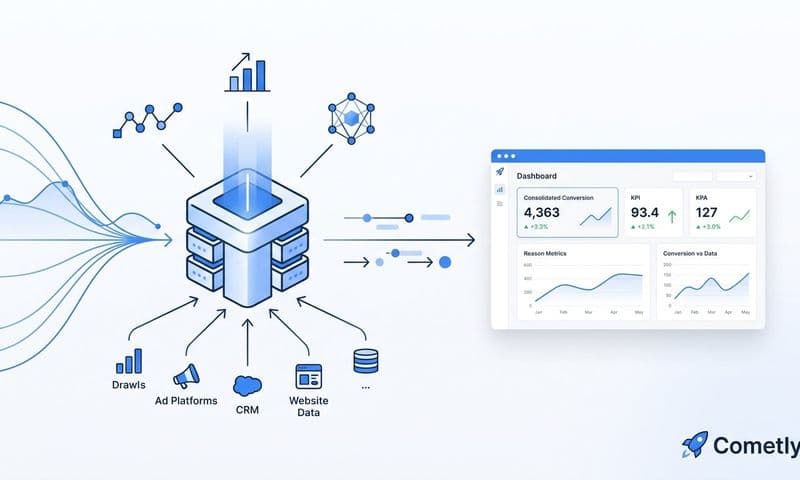
The goal of this step is to connect your ad platforms, CRM, and website tracking into one attribution system that eliminates siloed reporting across channels. When that system is working correctly, you should be able to see a single customer journey from first ad click to closed-won deal in one place.
Success indicator: You can pull up any deal in your CRM and trace it back to the specific campaigns and touchpoints that influenced it, with confidence that the data is complete and not double-counted across platforms.
Step 3: Choose the Right Attribution Model for Your Analysis Goal
Attribution models are how you assign credit for conversions across the touchpoints in a customer journey. The model you choose shapes everything about how your performance analysis reads, which channels look effective, and where you direct budget. Choosing the wrong model for the question you are trying to answer leads to systematically bad decisions.
Here is a quick breakdown of the core models and when each one is useful.
First-touch attribution gives all credit to the first touchpoint in the journey. It is useful when you want to understand which channels are best at creating awareness and introducing new prospects to your brand. If you are evaluating top-of-funnel investment, first-touch gives you a clearer picture than last-click.
Last-click attribution gives all credit to the final touchpoint before conversion. It is the default in most ad platforms and analytics tools. It is also the most misleading model for B2B SaaS companies with multi-touch journeys because it systematically undercredits every channel that contributed earlier in the process. A prospect who discovered you through a LinkedIn thought leadership post, engaged with a retargeting ad twice, and then converted via a branded Google search will give all the credit to Google. LinkedIn gets nothing.
Linear attribution distributes credit equally across every touchpoint in the journey. It is a reasonable starting point for understanding full-funnel contribution but can dilute the signal from channels that actually drove the decision.
Time decay attribution gives more credit to touchpoints that occurred closer to the conversion. This makes intuitive sense for shorter sales cycles but can undervalue awareness channels in longer B2B deals where early touchpoints planted the seed months before the deal closed.
Data-driven attribution uses machine learning to assign credit based on patterns in your actual conversion data. It is the most accurate model when you have sufficient data volume, but it requires a meaningful amount of conversion history to produce reliable results.
The key insight here is that no single model is universally correct. Match the model to the question you are trying to answer. Use first-touch to evaluate awareness campaigns. Use multi-touch models for full-funnel budget allocation. Use revenue attribution, not just lead attribution, when reporting to leadership.
This last point matters more than most teams realize. Attributing pipeline and closed revenue to your marketing efforts is fundamentally more valuable than attributing form fills. A campaign that generates fifty MQLs that never progress is less valuable than a campaign that generates ten MQLs that all become opportunities. Revenue attribution tells that story. Lead attribution does not.
Common pitfall: Picking one attribution model and never revisiting it as your channel mix evolves. If you add a new channel or shift budget significantly, the model that made sense before may no longer reflect how your customers actually buy.
Step 4: Analyze Performance at the Campaign, Channel, and Ad Level
With your goals defined, your data unified, and your attribution model selected, you are ready to actually analyze performance. The key is to work from the top down: start broad, then drill into the details.
Start at the channel level. Which channels are generating pipeline and revenue, not just clicks and leads? This is the question that separates revenue-focused marketers from traffic-focused ones. A channel that drives high click volume but zero pipeline is not a performing channel. It is a cost center.
Once you understand channel-level performance, drill down to the campaign level. Compare cost per pipeline opportunity and cost per closed deal across campaigns within each channel. Two campaigns on the same platform can have dramatically different efficiency profiles. One might generate cheap leads that never convert. Another might have a higher CPL but a much lower cost per closed deal because the audience quality is better.
Then go deeper to the ad level. Which creatives and messages are driving conversions versus just impressions and clicks? Creative fatigue is real. An ad that performed well three months ago may be delivering diminishing returns today. Ad-level analysis helps you identify what is resonating with your audience right now and what needs to be refreshed.
Consistent naming conventions make all of this possible at scale. If your campaigns are named inconsistently across platforms, segmenting performance by funnel stage, audience type, or offer becomes a manual, error-prone process. Build a naming convention that encodes the information you need for analysis, such as channel, funnel stage, audience segment, and offer type, and apply it consistently from the start.
When reviewing performance, always look at both volume metrics and efficiency metrics together. Volume metrics like leads generated and pipeline created tell you about scale. Efficiency metrics like CPL, CAC, and ROAS tell you about quality. A campaign can look great on one dimension and terrible on the other. You need both to make a sound decision. A marketing performance dashboard that surfaces both dimensions simultaneously makes this comparison far easier.
Flag underperformers early. If a campaign is generating clicks but zero pipeline after sufficient spend and time, that is a signal to pause, restructure, or redirect budget. Do not let underperformers run indefinitely because they are "still gathering data."
Step 5: Map the Full Customer Journey to Find Drop-Off Points
Performance analysis at the campaign and ad level tells you what is working. Customer journey mapping tells you why and where the process breaks down.
Start by tracing the path from first touchpoint to conversion for your highest-value customers. What channels introduced them to your brand? What content did they engage with? How many touchpoints occurred before they requested a demo or started a trial? How long did it take from first touch to closed deal?
Look at the average number of touchpoints and days to close for different segments. Enterprise deals typically involve more touchpoints, more stakeholders, and longer timelines than SMB deals. If you are treating all segments the same in your analysis, you are likely drawing conclusions that do not apply cleanly to either group.
Look for patterns across your best customers. Which channels appear most often in the early stages of the journey? Which channels show up most often right before conversion? This distinction matters for budget allocation. Early-journey channels deserve credit for creating awareness and intent even if they are not the last touch. Late-journey channels deserve credit for closing the loop even if they did not introduce the prospect.
Then look for where prospects drop off. Is it after the first ad click, suggesting a landing page or message alignment problem? Is it after a demo request, suggesting a sales handoff or qualification issue? Is it during a free trial, suggesting an onboarding or activation gap? Each drop-off point points to a different lever to pull.
Use journey data to inform where to invest more and where to fix friction. High-converting touchpoints deserve more budget and more creative iteration. High drop-off stages deserve process improvement, better content, or a different channel mix. Understanding how to measure campaign effectiveness at each stage helps you pinpoint exactly where to focus your improvement efforts.
Success indicator: You can describe a typical high-value customer journey in terms of specific channels, content types, and timing. If you can do that, you have the insight needed to replicate it intentionally.
Step 6: Turn Analysis Into Decisions and Feed Better Data Back to Ad Platforms
Analysis only creates value when it leads to action. This step is where many teams fall short. They complete a thorough performance review, identify what is working and what is not, and then fail to close the loop by actually changing their campaigns based on what they learned.
Translate your findings into three clear categories. Scale means increasing budget or effort behind campaigns, channels, or creatives that are outperforming benchmarks. Optimize means adjusting targeting, creative, landing pages, or bidding strategy for campaigns that show potential but are not yet hitting their efficiency targets. Cut means pausing or eliminating campaigns, creatives, or channels that are consistently underperforming with no clear path to improvement.
AI-driven recommendations can accelerate this process significantly. Rather than manually combing through performance data across every channel, modern attribution platforms can surface which campaigns and ads are outperforming benchmarks and flag which ones are trending in the wrong direction. AI marketing analytics tools help you prioritize where to focus your optimization effort and scale with confidence rather than guessing.
One step that is often overlooked but has a compounding impact: feeding enriched conversion data back to your ad platforms. When Meta, Google, or LinkedIn receive first-party conversion events that reflect actual pipeline and revenue, not just form fills, their algorithms can optimize toward audiences that actually convert to customers. This is what makes Conversion API integrations so valuable. You are not just improving your reporting. You are improving the quality of ad platform optimization, which reduces wasted spend and improves targeting over time.
Set a regular cadence for performance reviews so this process becomes a habit rather than a one-off exercise. Weekly reviews work well for tactical adjustments like pausing underperforming ads or shifting budget between campaigns. Monthly reviews are better suited for strategic shifts like adding or removing channels. Quarterly reviews are the right time for larger budget reallocation decisions based on marketing ROI.
Common pitfall: Completing the analysis but not closing the loop. Insight without action is just documentation. The goal is a system where analysis reliably leads to better campaigns, better data, and better results over time.
Building a Repeatable Marketing Performance System
The six steps above are not a one-time audit. They are a framework you run on a regular cadence to continuously improve how your marketing dollars translate into revenue.
Here is your quick-reference checklist to confirm the system is in place:
1. Goals defined: North star metrics and supporting KPIs are documented and aligned with sales and leadership.
2. Data unified: Ad platforms, CRM, and website tracking are connected into a single attribution system with server-side tracking in place.
3. Attribution model selected: You are using the right model for each analysis goal, with revenue attribution as your primary lens.
4. Performance analyzed: You are reviewing performance at the channel, campaign, and ad level using both volume and efficiency metrics.
5. Customer journey mapped: You understand the typical path your best customers take and where drop-off occurs.
6. Decisions made and data fed back: Findings are translated into scale, optimize, or cut decisions, and enriched conversion data is flowing back to ad platforms.
The system compounds over time. Better data leads to better decisions, which leads to better results, which generates better data. Each cycle builds on the last.
Cometly connects all six steps in one platform. From tracking every touchpoint across your ad channels and CRM to providing AI-driven recommendations to sending enriched conversion events back to Meta, Google, and more, Cometly gives B2B SaaS marketing teams the single source of truth they need to move from surface-level reporting to revenue-level clarity.
Start with Step 1 today. Even if the full system takes time to build, defining your performance benchmarks costs nothing and makes every subsequent step more valuable. The best time to build this system was when you launched your first campaign. The second best time is now.
Ready to connect your ad spend directly to pipeline and revenue? Get your free demo and see how Cometly makes every step of this framework faster, more accurate, and built for scale.