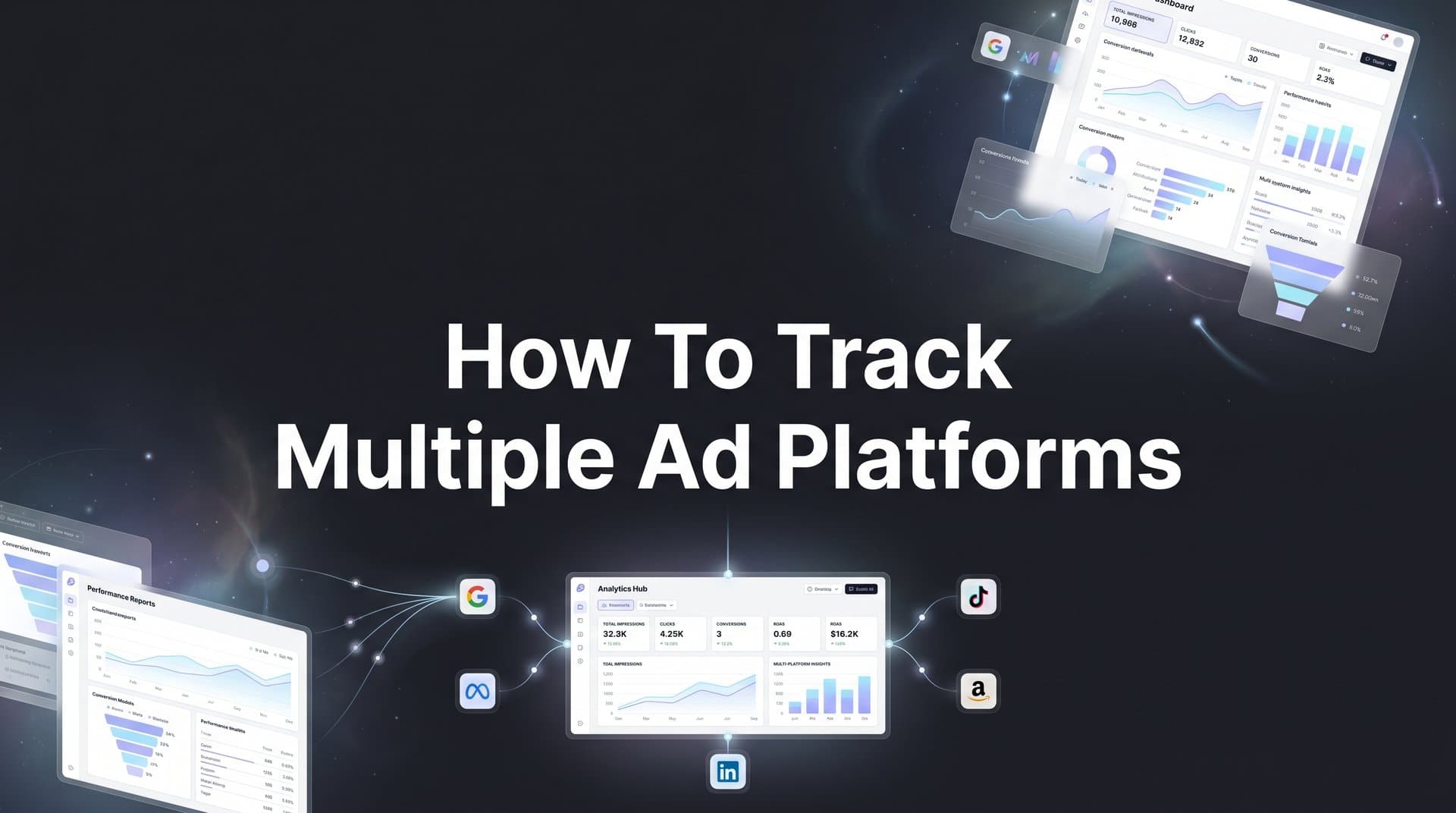
Running ads across Meta, Google, TikTok, LinkedIn, and Snapchat simultaneously creates a fragmented data problem that every growth-focused marketer eventually hits. Each platform has its own dashboard, its own attribution window, and its own version of who deserves credit for a conversion. The result is a "double counting" mess where your combined platform-reported conversions often far exceed your actual revenue.
The right tracking tool cuts through that noise. It brings all your cross-platform data into one place, assigns credit accurately, and gives you the clarity to make confident budget decisions. Here are the best tools for tracking multiple ad platforms in 2026, broken down by what each one does best.
1. Cometly
Best for: AI-powered multi-touch attribution and conversion sync across all major ad platforms
Cometly is a marketing attribution and analytics platform built to show exactly which ads and channels are driving leads and revenue across every platform you run.
 9 Best Marketing Attribution Platforms to Compare in 2026
Where This Tool Shines
Cometly's core strength is its ability to track the complete customer journey from ad click to closed revenue, then feed that enriched conversion data back to ad platforms through Conversion Sync. This matters because when Meta or Google receives better conversion signals, their algorithms optimize more effectively, improving your return on ad spend without changing a single creative.
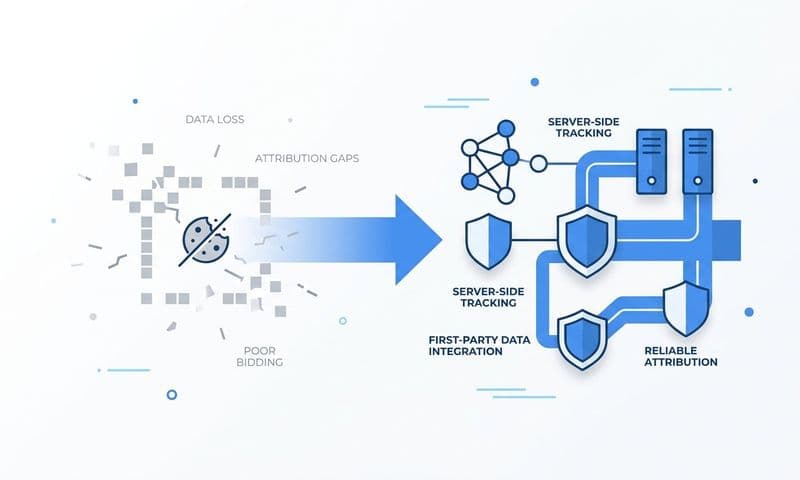
The platform also addresses one of the biggest pain points in modern tracking: browser-level limitations. With server-side tracking built in, Cometly bypasses the data loss caused by iOS privacy changes and ad blockers, giving you a more accurate picture of what is actually happening across your funnel.
Key Features
Multi-Touch Attribution: Tracks the full customer journey across Meta, Google, TikTok, Snapchat, LinkedIn, and more using multiple attribution models.
Server-Side Tracking: Captures conversion events at the server level to bypass browser restrictions and iOS tracking limitations.
Conversion Sync: Sends enriched, conversion-ready events back to ad platform algorithms to improve targeting and optimization.
AI-Powered Recommendations: Identifies top-performing ads and suggests budget allocation across channels so you can scale with confidence.
AI Chat: Lets you query your marketing data in plain language, making reporting accessible without needing a dedicated analyst.
Best For
Marketing teams and agencies running paid campaigns across multiple platforms who need accurate attribution, real-time performance visibility, and actionable AI recommendations. Especially valuable for teams frustrated by conflicting data between platform dashboards.
Pricing
Custom pricing based on ad spend volume. A demo is available on request through the Cometly website.
2. Triple Whale
Best for: Ecommerce brands on Shopify that want unified ad performance data with creative analytics
Triple Whale is an ecommerce-focused analytics and attribution platform with deep Shopify integration and a clean unified dashboard.
 9 Best Tools to Track Multiple Ad Platforms in 2026
Where This Tool Shines
Triple Whale was built with Shopify merchants in mind, and it shows. The native Shopify integration pulls in real-time revenue data so you can see exactly how your ad spend connects to actual orders, not just clicks or reported conversions. This makes it much easier to evaluate true ROAS across channels.
The creative analytics feature is a standout for teams running heavy ad volumes. It surfaces which specific creatives are driving performance, helping media buyers iterate faster without digging through platform-by-platform breakdowns.
Key Features
First-Party Pixel: Collects cross-platform behavioral data independently of native platform tracking.
Native Shopify Integration: Syncs real-time revenue and order data directly from your Shopify store.
Creative Analytics: Identifies top-performing ad creatives across platforms to guide creative strategy.
Customer Journey Mapping: Visualizes the touchpoints customers interact with before converting.
Best For
Direct-to-consumer ecommerce brands running on Shopify that want a fast, visual way to connect ad spend to revenue without building a custom data stack.
Pricing
Plans start around $100/month and scale based on revenue and the features you need.
3. Northbeam
Best for: Ecommerce brands that need flexible attribution models and media mix modeling
Northbeam is a machine-learning attribution platform designed for ecommerce brands that want granular control over how they measure channel performance.
 9 Best Cross Platform Attribution Software Tools in 2026
Where This Tool Shines
What separates Northbeam from simpler attribution tools is the flexibility it gives you in how conversions get credited. You can adjust attribution models and lookback windows to match your actual business cycle, which is critical for brands with longer consideration phases where a single 7-day click window misses the full picture.
The media mix modeling layer adds a statistical view of channel contribution that goes beyond individual click paths. This is particularly useful for planning budget allocation across channels where direct attribution is harder to measure.
Key Features
Customizable Attribution Models: Choose and adjust multi-touch models to fit how your customers actually buy.
Media Mix Modeling: Statistical modeling that estimates channel-level contribution for budget planning.
Flexible Lookback Windows: Extend or shorten attribution windows to match your sales cycle length.
Cross-Device Identity Resolution: Connects user behavior across devices and platforms for a unified view.
Best For
Ecommerce brands spending at least $50K per month on ads that need more attribution flexibility than standard tools provide, particularly those with complex multi-channel strategies.
Pricing
Custom pricing. Northbeam is generally positioned for brands with significant ad budgets, typically $50K or more per month.
4. Hyros
Best for: High-ticket offers, info products, and businesses with long or phone-based sales cycles
Hyros is an ad tracking and attribution platform built specifically for businesses where the sales process extends well beyond a single click or session.
 9 Best Attribution Tracking Software for Smarter Ad Spend in 2026
Where This Tool Shines
Most attribution tools struggle when the journey from ad click to closed sale spans weeks, involves a sales call, or runs through a complex funnel. Hyros was designed to handle exactly that. Its long-funnel tracking keeps the attribution window open long enough to connect ad spend to revenue that materializes much later in the process.
The integrated call tracking feature is particularly useful for businesses where phone conversations are part of the conversion path. You can trace a closed deal back to the specific ad that started the journey, giving you data that most platforms simply cannot provide.
Key Features
Long-Funnel Attribution: Tracks conversions across extended sales cycles spanning weeks or months.
Integrated Call Tracking: Connects phone-based sales outcomes back to originating ad touchpoints.
AI Ad Optimization: Provides recommendations for improving ad performance based on actual revenue data.
CRM and Payment Integration: Connects deeply with CRMs and payment processors to track true revenue attribution.
Best For
Coaches, consultants, info product creators, and high-ticket service businesses where the sales cycle is long, calls are involved, and standard 7-day attribution windows miss most of the actual revenue.
Pricing
Starts around $99/month with higher tiers available for larger ad spends and more advanced features.
5. Rockerbox
Best for: Omnichannel brands that need to measure both digital and offline marketing in one place
Rockerbox is a cross-channel attribution platform that combines multi-touch digital attribution with media mix modeling, covering online and offline channels together.
 9 Best Tools to Track Multiple Ad Platforms in 2026
Where This Tool Shines
Rockerbox stands out for its ability to bring offline channels like TV, direct mail, and podcasts into the same attribution framework as your digital ads. For brands that run a true omnichannel mix, this is significant. You stop guessing about what your podcast sponsorships or linear TV buys are contributing relative to your paid social spend.
The deduplication layer is also worth highlighting. Rockerbox normalizes conversion data across platforms so you are not counting the same customer twice just because Meta, Google, and TikTok each claimed credit for the same sale.
Key Features
Omnichannel Attribution: Unified measurement across digital ads, TV, direct mail, and podcast sponsorships.
Multi-Touch Plus Media Mix Modeling: Combines path-based attribution with statistical modeling in a single platform.
Deduplicated Conversion Tracking: Removes cross-platform double counting for accurate total conversion reporting.
New vs. Returning Customer Segmentation: Breaks down acquisition performance separately from retention-driven conversions.
Best For
Mid-market and enterprise brands running a mix of digital and traditional marketing who need a single source of truth that spans all channels, not just paid social and search.
Pricing
Custom pricing. Rockerbox is designed for mid-market and enterprise brands with complex marketing mixes.
6. Supermetrics
Best for: Teams that want to pull ad data into spreadsheets or BI tools for custom reporting
Supermetrics is a data pipeline tool that connects over 100 ad platforms and marketing data sources to your reporting environment of choice.
 9 Best Tools to Track Multiple Ad Platforms in 2026
Where This Tool Shines
Supermetrics does not do attribution in the traditional sense. Instead, it excels at pulling raw data from every platform you run and pushing it into Google Sheets, Looker Studio, BigQuery, Excel, or other destinations where your team already works. If you have an analyst or a reporting setup you like, Supermetrics feeds it without requiring a rebuild.
The breadth of connectors is a real advantage. With over 100 data sources supported, it is rare to run into a platform that Supermetrics cannot pull from, making it one of the most flexible options for teams with diverse channel mixes.
Key Features
100+ Data Connectors: Pulls data from all major ad platforms and dozens of additional marketing tools.
Flexible Destinations: Pushes data to Google Sheets, Looker Studio, BigQuery, Excel, and more.
Automated Refresh Schedules: Keeps your reports updated automatically without manual exports.
Custom Metric Calculations: Blend and transform data across sources to create your own performance metrics.
Best For
Marketing analysts and agencies that prefer to build their own reporting in familiar tools rather than adopting a new dashboard, and need reliable data pipelines from multiple ad platforms.
Pricing
Starts around $39/month per destination and scales based on the number of connectors and data volume you need.
7. Funnel.io
Best for: Enterprise marketing teams that need a scalable data hub with transformation and normalization
Funnel.io is an enterprise marketing data hub that automatically collects, maps, and transforms ad data from hundreds of sources before routing it to your BI tools or data warehouse.
 9 Best Ad Platform Data Sync Tools to Optimize Campaign Performance in 2026
Where This Tool Shines
Where Supermetrics is strong on breadth and simplicity, Funnel.io goes deeper on data quality. Its transformation and normalization layer lets you standardize how metrics are named and calculated across platforms before the data ever reaches your reporting tool. This is critical when you are blending data from 20 different sources and need consistency at scale.
The historical data backfill capability is also valuable for teams onboarding mid-year. Rather than starting fresh, Funnel.io can pull historical data so your reporting has continuity from day one.
Key Features
500+ Data Connectors: Covers ad platforms, CRMs, analytics tools, and more in a single hub.
Data Transformation Layer: Normalizes and maps data across sources for cross-platform consistency.
Historical Data Backfill: Pulls past data when you connect a new source so reporting is not limited to the go-live date.
Flexible Export Options: Routes clean data to any BI tool, data warehouse, or custom dashboard.
Best For
Mid-market and enterprise marketing teams with dedicated analytics resources who need a robust, scalable data foundation rather than a pre-built dashboard.
Pricing
Custom pricing. Funnel.io is positioned for mid-market and enterprise organizations with complex data needs.
8. Segment (Twilio)
Best for: SaaS and tech companies with engineering resources that want a unified event tracking infrastructure
Segment is a customer data platform that collects user events from web, mobile, and server sources and routes them to over 400 downstream tools including ad platforms and analytics.
 8 Best Attribution-Focused Platforms vs Segment: Which Approach Fits Your Marketing Stack in 2026
Where This Tool Shines
Segment operates at the infrastructure level. Instead of adding separate tracking snippets for every ad platform and analytics tool you use, you instrument once with Segment and route that data wherever it needs to go. This dramatically reduces implementation overhead and ensures consistent event data across every tool in your stack.
For teams running retargeting or lookalike campaigns, the real-time audience building feature lets you sync behavioral segments directly to ad platforms, tightening the loop between your product data and your ad targeting.
Key Features
Single Event API: Collect user events once across web, mobile, and server, then route them anywhere.
400+ Integrations: Pre-built connections to ad platforms, analytics tools, CRMs, and data warehouses.
Identity Resolution: Unifies user behavior across devices, sessions, and channels into a single profile.
Real-Time Audience Building: Syncs behavioral segments to ad platforms for targeting and suppression.
Best For
SaaS companies and tech-forward marketing teams with engineering support that want a clean, scalable event tracking foundation rather than a plug-and-play marketing tool.
Pricing
A free tier is available for smaller implementations. Paid plans start at $120/month and scale with the number of tracked users and data volume.
9. Google Analytics 4
Best for: Teams that need a free baseline for cross-channel web analytics with Google Ads integration
Google Analytics 4 is Google's free, event-based analytics platform offering cross-channel tracking, data-driven attribution, and native Google Ads integration.
Where This Tool Shines
The most obvious advantage of GA4 is the price: it is free. For teams that are just getting started with cross-platform measurement or that need a reliable baseline layer before investing in a dedicated attribution tool, GA4 provides solid cross-channel visibility at no cost.
The native Google Ads integration is tight and reliable, making it the easiest way to connect your Google campaign data to on-site behavior. The BigQuery export also opens up the raw event data for teams that want to do more advanced analysis without paying for a separate data pipeline.
Key Features
Free Cross-Channel Analytics: Tracks web and app activity across channels without any cost for the standard version.
Event-Based Data Model: Flexible event tracking that captures custom interactions beyond standard pageviews.
Data-Driven Attribution: Built-in attribution model that distributes credit across touchpoints based on observed patterns.
Native Google Ads Integration: Direct connection to Google Ads for audience sharing and campaign-level reporting.
BigQuery Export: Exports raw event data to BigQuery for advanced custom analysis.
Best For
Businesses of any size looking for a free analytics foundation, particularly those running significant Google Ads budgets who want tight native integration. Best used alongside a dedicated attribution platform for full cross-platform accuracy.
Pricing
Free for the standard version. GA4 360, the enterprise edition, is available at custom pricing for organizations needing higher data limits and SLA guarantees.
Choosing the Right Tool for Your Ad Stack
The best tool depends on what problem you are actually trying to solve. Here is a quick breakdown to help you decide.
If your priority is accurate multi-touch attribution with AI-powered recommendations across every ad platform you run, Cometly is the strongest choice. The combination of server-side tracking, Conversion Sync, and AI analysis gives you both the accuracy and the actionable insights to make smarter budget decisions in real time.
For Shopify-based ecommerce brands, Triple Whale or Northbeam are purpose-built for your environment. Triple Whale wins on simplicity and creative analytics; Northbeam wins on attribution model flexibility and media mix modeling for larger budgets.
For high-ticket or long-cycle businesses: Hyros is the right fit. Its long-funnel tracking and call attribution handle sales cycles that break standard tools.
For omnichannel enterprises: Rockerbox brings offline and online attribution together in a way that few tools can match.
For data pipeline needs: Supermetrics is the faster, more accessible option for analyst-driven teams. Funnel.io is the better choice when you need enterprise-grade data transformation and normalization at scale.
For SaaS companies with engineering support: Segment provides the cleanest event tracking infrastructure and the most flexibility for routing data to every tool in your stack.
As a free baseline: GA4 should be running regardless of what else you use. It costs nothing and provides a solid layer of cross-channel visibility, especially for Google Ads performance.
The most important thing is to stop relying solely on platform-reported data. Every major ad platform is incentivized to claim credit for as many conversions as possible. An independent attribution layer is what gives you the objective view you need to allocate budget with confidence.
Ready to stop guessing which ads are actually driving revenue? Get your free demo and see how Cometly brings all your cross-platform data together with AI-powered attribution that actually tells you what to do next.