Something changed in April 2021, and digital advertising has never been the same. Apple's iOS privacy changes didn't just tweak how ad tracking worked. They dismantled the foundational infrastructure that marketers had relied on for years. And while most teams noticed something was off, many are still running campaigns today without fully understanding the size of the blind spot in their data.
If you've watched your ROAS figures shift unexpectedly, seen attribution gaps widen between your ad platform and your CRM, or wondered why your Meta campaigns seem to be optimizing toward the wrong audiences, iOS privacy restrictions are likely a significant part of the story. The frustration is real, and it's not a platform glitch. It's a structural change in how tracking works at the operating system level.
This article is a clear, jargon-free walkthrough of what actually changed, why it hits B2B SaaS teams harder than most, and what a modern tracking infrastructure looks like in a privacy-first world. Whether you're a growth marketer trying to make sense of conflicting dashboards or a marketing leader deciding where to invest in data infrastructure, understanding the mechanics here will change how you approach every campaign going forward.
The Shift That Changed Digital Advertising Forever
Before April 2021, the digital advertising ecosystem ran on a relatively simple premise: devices and browsers left identifiable traces, ad platforms collected those traces, and attribution happened automatically in the background. Marketers didn't have to think much about the plumbing. It just worked.
The centerpiece of mobile tracking was the IDFA, Apple's Identifier for Advertisers. This device-level identifier allowed ad platforms to follow a user's journey across apps and websites, connecting an ad impression on one app to a purchase or signup on another. It was the backbone of mobile attribution, and it worked without requiring any action from the user.
App Tracking Transparency changed that completely. Introduced with iOS 14.5, ATT requires every app to explicitly ask users for permission before accessing their IDFA for cross-app tracking. The prompt is direct and unavoidable: apps must tell users they want to track them and give them the option to decline. When users opt out, the IDFA is replaced with a string of zeros, effectively making the device anonymous to ad platforms.
The impact was immediate and widespread. Ad platforms like Meta and Google lost the ability to directly observe what happened after a user clicked an ad on iOS. The attribution chain, which had previously been automatic, was broken for a significant portion of mobile traffic.
But this isn't only a mobile app problem. iOS users browsing the web on Safari are also affected through Intelligent Tracking Prevention, Apple's browser-level privacy technology that has been tightening restrictions since 2017. ITP limits the lifespan of first-party cookies set by JavaScript and blocks third-party cookies entirely. This means that even when a B2B buyer clicks a Google Search ad and lands on your website, the cookie that would have tracked that visit may expire before they return to convert days or weeks later.
Meta responded to ATT with its Aggregated Event Measurement protocol, which limits advertisers to reporting on a maximum of eight conversion events per domain, introduces reporting delays, and restricts the breakdowns available for analysis. These constraints were designed to preserve some level of measurement while respecting user privacy choices, but they fundamentally reduced the granularity and speed of conversion data that marketers had previously taken for granted.
The result is an advertising environment where a meaningful portion of conversion activity is invisible to the platforms you're paying to run your ads. That's not a temporary bug. It's the new operating reality.
How iOS Privacy Changes Break Your Attribution Data
Understanding that data is missing is one thing. Understanding exactly how it breaks your attribution is another, and the mechanics matter if you want to solve the problem correctly.
When an iOS user opts out of tracking via the ATT prompt, ad platforms lose the ability to match that user's click to any subsequent conversion event. The conversion may still happen. Your product may still get a trial signup or a demo request. But from the ad platform's perspective, that event is invisible. It never gets credited to the campaign that drove it.
This creates systematic underreporting in your ad platform dashboards. Meta Ads Manager and Google Ads both show fewer conversions than actually occurred, because they can only report on the events they can observe. For advertisers running significant iOS traffic, the gap between reported conversions and actual conversions can be substantial.
To compensate, platforms have introduced modeled conversions. These are statistical estimates, where the platform uses machine learning to infer what likely happened based on patterns from users who did consent to tracking. The idea is to fill in the gaps with probabilistic data rather than leaving them empty.
The problem with modeled conversions is that they're estimates, not observations. For B2B SaaS companies where conversion events are low volume and deal cycles are long, these models have limited signal to work with. Ecommerce businesses running thousands of daily transactions can support reasonably accurate modeling. A B2B SaaS team generating fifty demo requests a month cannot. The models don't have enough data to be reliable, and the estimates can introduce as much noise as they remove.
There's also a compounding effect that plays out over time. When ad platforms receive fewer conversion signals, their algorithmic optimization models have less to learn from. These models rely on conversion data to identify which users, audiences, and placements are most likely to convert. When that data is incomplete, the algorithms optimize toward the wrong signals, and ad delivery gradually shifts toward less valuable audiences.
This is why many teams notice that campaign performance deteriorates over time even when nothing in their targeting or creative has changed. The platform isn't making bad decisions intentionally. It's making decisions based on incomplete information, and the feedback loop keeps reinforcing those decisions.
The practical consequence is that the ROAS figures and conversion counts you see in your ad platform dashboards are not an accurate reflection of what your campaigns are actually producing. They're a partial view, filtered through whatever tracking survived the privacy restrictions. And for most teams, that partial view is what's driving budget decisions.
Why B2B SaaS Teams Feel This Pain More Than Most
Every advertiser is affected by iOS privacy changes, but B2B SaaS teams face a specific set of conditions that make the impact significantly more severe. It comes down to three structural realities of how B2B buying actually works.
The first is the length of the consideration cycle. B2B SaaS buyers rarely convert after a single touchpoint. They see an ad, visit your site, read a few blog posts, attend a webinar, get a retargeting ad weeks later, ask a colleague for a recommendation, and eventually request a demo. That journey can span weeks or months, involving multiple devices, multiple sessions, and multiple channels.
Attribution was already difficult for these long-cycle journeys before iOS privacy changes. ITP's cookie restrictions mean that a user who first encountered your brand through a paid search ad two months ago may no longer be connected to that original touchpoint by the time they convert. The attribution window that ad platforms use, often seven or thirty days, doesn't capture the full picture even when tracking is working perfectly. When iOS restrictions further fragment the data, the gaps become even larger.
The second challenge is conversion volume. B2B SaaS companies generate far fewer conversion events than ecommerce businesses. A demo request is a meaningful event. A trial signup is a meaningful event. But if you're generating a few dozen of these per month across all your paid channels, you're working with a small data set to begin with.
When iOS restrictions cause even a fraction of those conversions to go untracked, the impact on your optimization signals is disproportionate. Losing ten conversions out of ten thousand is a rounding error. Losing ten conversions out of forty is a meaningful degradation of your ability to optimize campaigns. Ad platform algorithms need a minimum volume of conversion events to train effectively, and B2B SaaS teams are often already operating near that threshold before any data loss is factored in.
The third challenge is the gap between marketing activity and revenue. In B2B SaaS, the event that actually matters, a closed-won deal, often happens weeks or months after the initial ad interaction and always outside the ad platform's reporting window. Teams rely on CRM data to close the loop between marketing spend and revenue.
But without reliable ad-level tracking connecting the initial click to the CRM record, that loop can't be closed accurately. You know a deal closed. You know marketing played a role. But which campaign, which ad, which keyword, that connection becomes guesswork. Budget decisions get made on incomplete information, and the teams best positioned to prove their impact on revenue are the ones who solve the tracking problem first.
Server-Side Tracking and the Conversion API Solution
The good news is that the industry has developed a clear technical response to iOS privacy restrictions, and it doesn't require you to choose between protecting user privacy and having accurate measurement data. Server-side tracking is the modern infrastructure that makes both possible.
Traditional pixel-based tracking works by placing a piece of JavaScript code on your website that fires in the user's browser when a conversion event occurs. The browser sends that event data to the ad platform. The problem is that browsers are increasingly hostile to this approach. ITP limits cookie lifespans, ad blockers prevent pixels from firing, and iOS restrictions mean that the identifiers needed to match events to users are often unavailable.
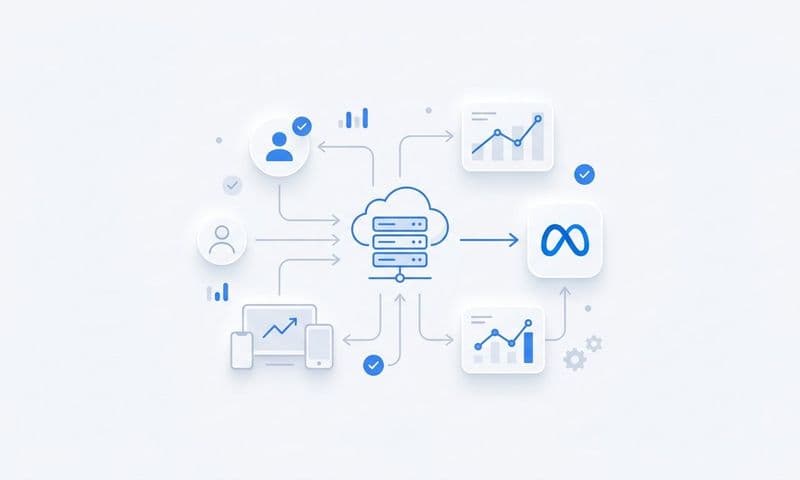
Server-side tracking takes a different approach. Instead of relying on the browser to send conversion data, your server sends the event directly to the ad platform's API. The data travels from your infrastructure to the platform's infrastructure, bypassing browser-level restrictions entirely. The browser's privacy settings don't affect a server-to-server connection.
Meta's implementation of this is called the Conversion API, or CAPI. When a user submits a demo request form on your website, your server captures that event and sends it directly to Meta's servers, along with hashed first-party data like an email address or phone number. Meta uses that hashed data to match the event against its user graph, connecting the conversion to the ad that drove it without relying on cookies or device identifiers.
Google's equivalent is called Enhanced Conversions. It works on the same principle: first-party data collected at the point of conversion is hashed and sent to Google's servers, where it's matched against logged-in Google accounts to improve conversion attribution accuracy.
It's important to understand what server-side tracking is not. It doesn't circumvent user privacy choices. It uses first-party data that users have actively provided, such as the email address they entered when requesting a demo. That data is hashed before transmission, meaning it's transformed into an irreversible string that can be used for matching but cannot be read as plain text. Users who have opted out of tracking are still protected. What server-side tracking does is ensure that the conversion events you're entitled to measure are actually measured accurately.
For B2B SaaS teams, first-party data enrichment at the point of conversion is particularly valuable. When a lead submits a form, you capture their email, company, and other identifying information. Sending that enriched, hashed signal back to Meta and Google gives the platforms far more to work with than a degraded browser cookie, improving both attribution accuracy and the quality of algorithmic targeting going forward.
Building a Tracking Stack That Works in a Privacy-First World
Server-side tracking and CAPI integration are essential components, but they're not the complete picture. A modern attribution setup for B2B SaaS requires thinking about the full data architecture, from the first ad click to closed-won revenue.
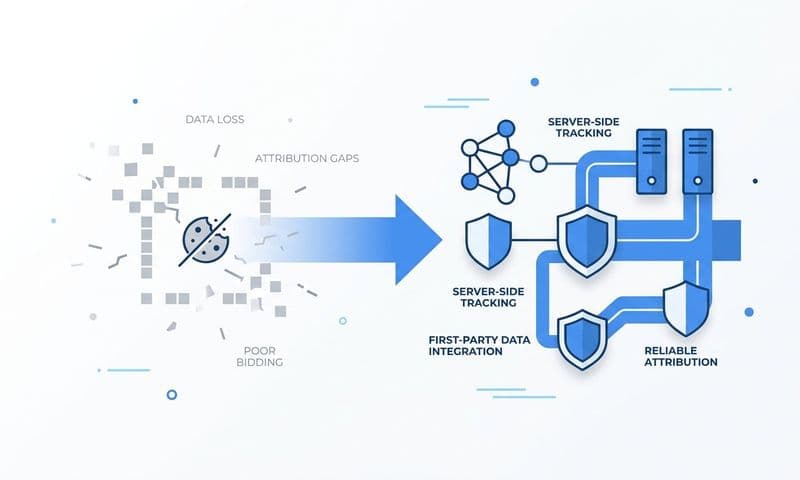
The foundation is server-side event tracking that captures conversion events reliably regardless of browser restrictions. This means implementing CAPI for Meta, Enhanced Conversions for Google, and equivalent server-side connections for any other ad platforms you're running. These connections ensure that the signals you send back to ad platforms are as complete and accurate as possible, which directly improves algorithmic optimization.
The next layer is multi-touch attribution across the full customer journey. Single-touch attribution models, which credit either the first or last interaction, were always an oversimplification. In a B2B SaaS context where buyers interact with multiple touchpoints over an extended period, they're actively misleading. A multi-touch model distributes credit across the touchpoints that contributed to a conversion, giving you a more accurate picture of which channels and campaigns are actually moving buyers through the funnel.
CRM integration is the layer that makes attribution actionable for revenue. When your attribution platform connects to your CRM, you can follow a lead from their first ad interaction through every subsequent touchpoint to the moment they become a customer. This closes the loop between marketing spend and revenue in a way that ad platform reporting never can, because ad platforms don't have visibility into what happens after the lead enters your sales process.
Here's where relying on a single ad platform's native reporting becomes a real problem. Each platform reports conversions using its own attribution model, its own attribution window, and its own data. Meta counts a conversion one way. Google counts it another. When you add them up, you're often counting the same conversion multiple times. An independent attribution layer sits above all of your ad platforms and gives you a single, consistent view of performance across every channel.
This is the concept of a single source of truth for marketing data. Rather than reconciling conflicting numbers across Meta Ads Manager, Google Ads, your CRM, and your analytics platform, you have one unified view where ad spend, conversion events, pipeline data, and closed revenue are all connected. Budget decisions made from this unified view are grounded in reality rather than platform-reported estimates. That's the difference between scaling what's actually working and scaling what looks like it's working.
Turning Privacy Constraints Into a Competitive Advantage
Here's the perspective shift that changes how you should think about iOS privacy changes: the teams that invest in first-party data infrastructure and server-side tracking now have a structural advantage over the majority of advertisers who haven't made that investment yet.
Most marketing teams are still running pixel-based tracking as their primary measurement approach, supplemented by whatever modeled data their ad platforms provide. Their campaign optimization is based on incomplete signals. Their budget decisions are based on understated conversion counts. And they don't know what they're missing because the gap is invisible from inside the ad platform dashboard.
When you implement server-side tracking and CAPI integration, you're feeding ad platform algorithms better data than your competitors are. Meta's and Google's optimization models improve when they receive more accurate, more complete conversion signals. Better signals lead to better targeting. Better targeting leads to more efficient ad delivery. The advantage compounds over time as the algorithms learn from a richer data set.
Accurate attribution across the full funnel also enables a different quality of budget decision. When you can connect specific campaigns to pipeline and closed revenue, rather than just to clicks and form fills, you can identify which channels are actually driving business outcomes. You might discover that a channel generating modest conversion volume is responsible for a disproportionate share of high-value deals. Or that a channel with impressive click-through rates rarely produces qualified pipeline. Without full-funnel attribution, those insights are invisible.
This level of clarity allows growth teams to allocate budget with confidence rather than intuition. It's the difference between scaling what looks good on a dashboard and scaling what demonstrably drives revenue. In a competitive market where every efficiency gain matters, that's a meaningful edge.
The privacy-first direction of travel is not reversing. Apple continues to strengthen its privacy protections, and other platforms are following similar trajectories. The teams building durable tracking infrastructure today are positioning themselves for an environment that will only become more privacy-constrained over time.
The Path Forward for B2B SaaS Marketers
iOS privacy changes are permanent. There is no version of the future where third-party cookies come back, where IDFA access is restored by default, or where browser-level tracking restrictions relax. The infrastructure that digital advertising was built on has been replaced, and the marketers who adapt their measurement approach to this reality will have a durable advantage over those who don't.
The path forward is clear: implement server-side tracking to capture conversion events reliably, integrate CAPI and Enhanced Conversions to send accurate first-party signals back to ad platforms, build multi-touch attribution that reflects the full B2B buying journey, and connect your ad spend to CRM data so you can measure impact on pipeline and revenue, not just clicks and form fills.
This is exactly the environment Cometly was built for. Cometly captures every touchpoint from the first ad click to closed-won deal, connecting your ad platforms, CRM, and website into a single source of truth for marketing data. With server-side conversion tracking, Conversion API integration, and AI-driven recommendations, Cometly gives B2B SaaS teams the accurate data they need to optimize campaigns, justify budgets, and scale with confidence in a privacy-first world.
If your current tracking setup was built before iOS 14.5, it was built for a world that no longer exists. The good news is that better infrastructure is available, and the teams that implement it now will be making smarter decisions with every dollar they spend on advertising.
Ready to see exactly which ads and channels are driving your pipeline and revenue? Get your free demo and start capturing every touchpoint with the accuracy your B2B SaaS growth strategy demands.