
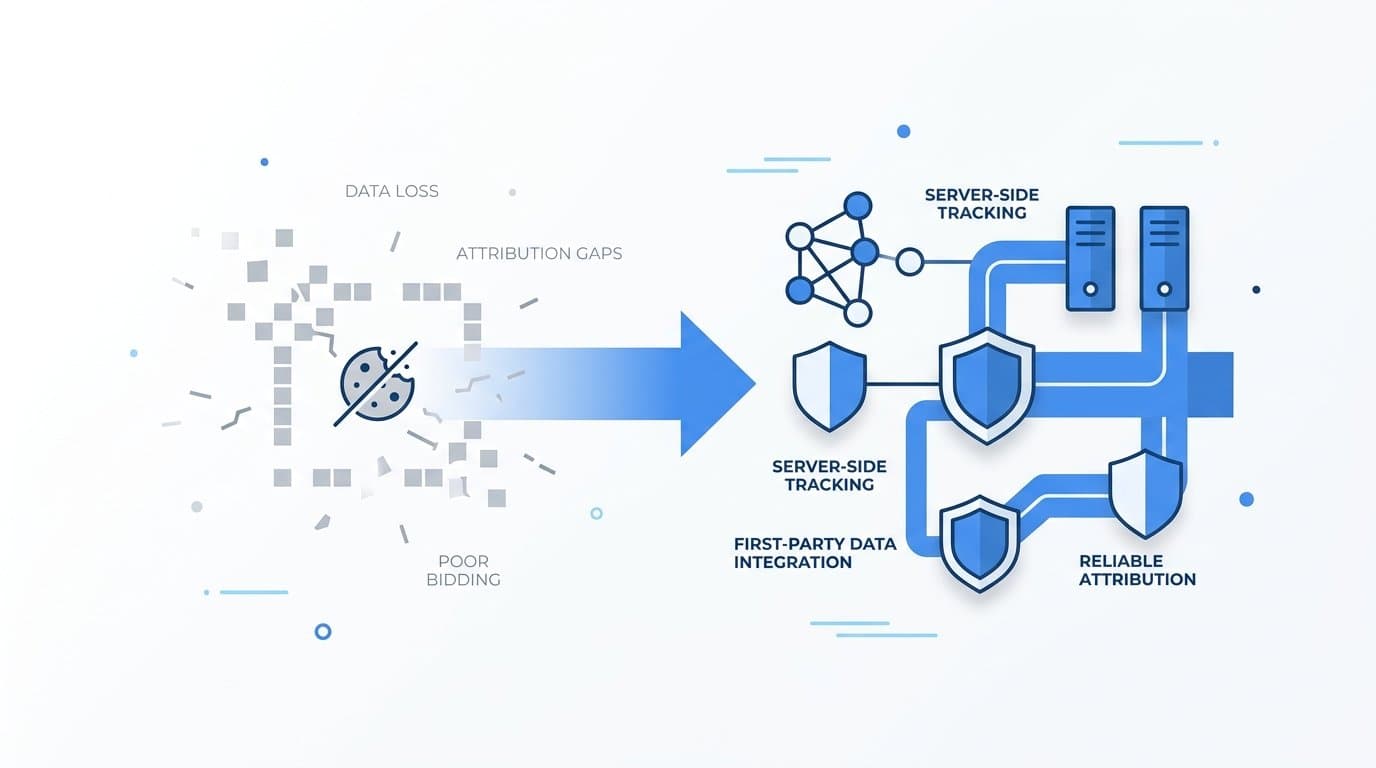
When third-party cookies disappear, pixel-based ad tracking loses the ability to follow users across sites, causing conversion data to drop, attribution to break, and ad platform algorithms to optimize on incomplete signals. In short: your reported performance numbers get worse, your bidding algorithms make worse decisions, and your budget allocation suffers, even if your actual results haven't changed at all.
The good news is that this is a solvable problem, and solutions like Cometly are built specifically for this reality. Cometly uses server-side tracking and first-party data integration to connect ad spend directly to pipeline and closed-won revenue, so your attribution stays accurate even as browser-based signals continue to erode. This article covers what actually breaks when cookies go away, why browser pixels alone can no longer be trusted, and what a modern tracking stack looks like in a cookieless environment.
The Specific Things That Break When Cookies Disappear
To understand the damage, it helps to understand what third-party cookies actually do. A third-party cookie is a small file placed in a user's browser by a domain other than the one they're visiting. Ad platforms use these cookies to recognize the same user across different websites, which is the foundation of several core advertising capabilities.
Retargeting audiences: When someone visits your pricing page and later sees your ad on another site, that's a third-party cookie at work. The ad platform recognized the user across two different domains. Without that persistent browser ID, building behavioral retargeting audiences becomes significantly harder.
Frequency capping: Ad platforms use cookies to track how many times a specific user has seen an ad. Without cookies, the same person can be shown the same ad repeatedly across a session or week, wasting budget and degrading the user experience.
View-through attribution: This model credits an ad impression even when the user didn't click it but later converted. It depends entirely on a persistent cross-site identifier. Without third-party cookies, view-through attribution becomes unreliable or disappears entirely.
Pixel-based conversion tracking: The Meta Pixel and Google Tag fire in the browser when a user takes an action, like submitting a form or reaching a thank-you page. They then send that event data back to the ad platform. The problem is that this process depends on cookies to identify the user, and both cookie restrictions and ad blockers increasingly intercept or strip that data before it reaches the platform.
Multi-touch attribution built on browser sessions: When attribution models stitch together a customer journey, they rely on session data and cookie-based identifiers to connect touchpoints across time. A user who clicked a Google ad on Monday and converted after a LinkedIn retargeting ad on Friday only shows up as a connected journey if cookies successfully tracked both events. When they don't, that journey appears fragmented, and your attribution model assigns credit incorrectly.
The downstream effect is that budget decisions get made on distorted data. Channels that appear to be underperforming may simply be underreported. Channels that look strong may be overcredited because they sit at the end of a journey the pixel could still see. Either way, you're flying partially blind.
Why Browser Pixels Alone Are No Longer Enough
Even before Google completes its cookie deprecation in Chrome, a substantial portion of web traffic already operates in a cookieless environment. Safari's Intelligent Tracking Prevention (ITP) has been blocking most third-party cookies by default for years, and Firefox's Enhanced Tracking Protection does the same. Add ad blockers into the mix, and the share of user sessions where browser pixels fire accurately and completely is smaller than most marketers assume.
ITP is particularly aggressive. Beyond blocking third-party cookies outright, it also limits the lifespan of first-party cookies set via JavaScript, reducing them to as little as one day in some cases. That means even a user who visited your site yesterday and returns today may not be recognized by a pixel-based tracking setup.
Here's where this gets directly painful for ad platform performance. Ad platforms like Meta and Google run machine learning bidding systems that optimize toward conversion signals. When those signals are incomplete because pixels are being blocked or cookies are expiring, the algorithm is training itself on a distorted dataset. It thinks certain audiences or placements aren't converting when they actually are. It bids less aggressively on the right users and more aggressively on the wrong ones.
The result shows up in your numbers in a specific way. Reported cost-per-acquisition rises because fewer conversions are being attributed to the campaigns that drove them. Reported ROAS falls for the same reason. Marketers who look at these numbers and pull back on spending are making rational decisions based on irrational data, and the channels that are actually working get defunded.
This is not a future problem. It's happening right now in most ad accounts that rely exclusively on browser pixels for conversion tracking. The gap between actual conversions and platform-reported conversions is already measurable, and it will only widen as Chrome follows Safari and Firefox in restricting cookie-based tracking.
The fix requires moving the conversion signal out of the browser entirely, which is exactly what server-side tracking does.
Server-Side Tracking and First-Party Data: The Practical Replacement
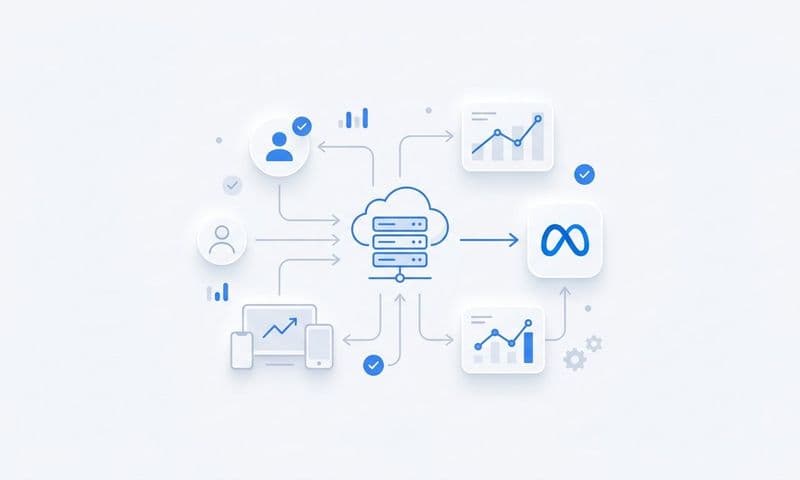
Server-side tracking works by sending conversion events directly from your server to ad platforms via their APIs, completely bypassing the browser. Instead of a pixel firing in a user's browser and hoping the signal makes it through, your server sends the event data directly to Meta, Google, or any other platform through a secure server-to-server connection. Cookies are not involved. Ad blockers cannot interfere. ITP cannot shorten the signal's lifespan.
The two most important implementations of this approach are Meta Conversions API (CAPI) and Google Enhanced Conversions. Both work on the same principle: instead of relying on a browser-stored cookie to identify the user and attribute the conversion, they use hashed first-party identifiers, such as email address, phone number, or a customer ID, to match the event to a user profile on the platform's side.
This is where first-party data becomes the foundational asset in a cookieless world. First-party data is information you collect directly from your users with their consent: CRM records, form submissions, login events, purchase history. These identifiers are durable. They don't expire after one day because a browser decided to restrict a JavaScript cookie. They exist in your database, and you can send them to ad platforms as part of a server-side event payload.
For B2B SaaS companies, this is actually a strong position to be in. Most B2B SaaS businesses already have authenticated user sessions, CRM records, and form submission data that can power server-side tracking. The infrastructure exists; it just needs to be connected properly to the ad platforms.
Cometly is built to make this connection. It implements server-side event tracking and Conversion API integration out of the box, connecting ad click data to CRM pipeline events and revenue data. When a lead comes in through a Meta ad, fills out a form, enters your CRM, and eventually closes as a customer, Cometly sends that closed-won revenue event back to Meta as a server-side conversion signal. The ad platform's algorithm now knows that campaign drove real revenue, not just a form fill, and it optimizes accordingly.
This closes the loop that browser pixels were never designed to close, especially in B2B contexts where the buying cycle spans weeks or months and the conversion that matters happens in your CRM, not on your website.
Attribution Models That Still Work in a Cookieless Environment
Not all attribution approaches are equally vulnerable to cookie deprecation. The ones that break are those built on browser sessions and cookie-based cross-site tracking. The ones that hold up are built on server-side signals and first-party identifiers.
Data-driven attribution with server-side signals: When conversion events are sent server-to-server using hashed first-party identifiers, the underlying data is reliable regardless of what's happening in the browser. Data-driven attribution models that consume these signals can still assign credit accurately across channels because the signal itself is intact.
Multi-touch attribution built on CRM touchpoints: In B2B, a buying cycle often involves multiple people, multiple channels, and multiple weeks. Last-click attribution was always a poor fit for this reality, and cookie deprecation makes it worse. Multi-touch attribution built on CRM events, rather than browser sessions, gives a more complete picture of which channels influenced a deal. When your CRM records that a contact first came through a LinkedIn ad, engaged with a Google retargeting ad, and then booked a demo through an email campaign, that journey is captured in your CRM data, not in browser cookies. It survives cookie deprecation entirely.
Pipeline and revenue attribution: This is the model that matters most for B2B SaaS, and it's the one that browser pixels were least equipped to support. Connecting ad spend to pipeline created and revenue closed requires integrating ad platform data with CRM data and, ideally, billing data. None of that requires third-party cookies. It requires a platform that can join those data sources correctly.
Cometly's multi-touch attribution compares multiple models side by side using enriched, server-side data. Marketers can see which campaigns drive pipeline and closed-won revenue, not just form fills or page visits, without relying on cookie-based session tracking. This is the attribution approach that remains accurate as browser-based tracking continues to degrade, because its foundation is your CRM and your server, not a cookie in someone's browser.
Related Questions Marketers Are Asking
Does Google still use cookies for Google Ads?
Google Ads is actively transitioning away from third-party cookies in Chrome through its Privacy Sandbox initiative. The timeline has shifted several times, but the direction is clear: third-party cookie support is being phased out. Google's recommended replacements for conversion tracking are Google Enhanced Conversions (server-side, using hashed customer data) and server-side Google Tag Manager. Advertisers who rely solely on the standard Google Tag for conversion tracking should treat server-side implementation as a priority, not a future project.
Will retargeting still work without cookies?
Yes, but the mechanism changes. Cookie-based retargeting, which identifies users by their browser history across sites, is replaced by two primary alternatives. First, first-party audience lists: uploading your CRM contacts or customer lists to ad platforms (Google Customer Match, Meta Custom Audiences) and targeting based on hashed identifiers like email. Second, contextual targeting: placing ads based on the content of the page a user is viewing rather than their behavioral history. Both approaches work without third-party cookies, but they require a clean, well-maintained first-party data strategy to be effective.
How does Meta Conversions API replace the Facebook Pixel?
The Meta Conversions API sends conversion events server-to-server, using hashed first-party identifiers such as email address, phone number, or external customer ID to match events to Meta user profiles. It does not rely on a browser cookie to identify the user or attribute the conversion. It can be used alongside the Meta Pixel (a setup Meta calls "redundant signals" to improve match rates) or as a standalone replacement. For B2B SaaS companies where conversions happen in a CRM rather than on a thank-you page, CAPI is particularly valuable because it can send downstream revenue events that the pixel was never capable of capturing.
What is the difference between cookieless tracking and privacy-safe tracking?
Cookieless tracking simply means tracking that does not rely on third-party browser cookies. It is a technical description of the method. Privacy-safe tracking goes further: it also ensures that data is collected with user consent, processed transparently, and handled in ways that align with user expectations and applicable data regulations. Server-side APIs and first-party data strategies can be cookieless, but they are only privacy-safe when paired with proper consent collection and data handling practices. The two concepts overlap but are not identical.
Building an Ad Tracking Stack That Does Not Depend on Cookies
Knowing that cookies are going away is one thing. Knowing what to actually do about it is another. Here is a practical framework for building a tracking stack that remains accurate as browser-based signals continue to erode.
Start with an audit of your current setup: Identify which conversion events in your ad platforms are reported only via browser pixel and which have a server-side backup. For most advertisers, form fills and page-based events are pixel-only, while downstream CRM events have no ad platform connection at all. The gaps where pixel-only events are most valuable to ad platform optimization, typically your highest-intent conversion events, should be your first priority to close.
Implement Conversion API integrations for every major platform you run: Meta, Google, and LinkedIn all have server-side conversion APIs. Each one should be connected to your server so that conversion events are sent directly, not through the browser. Critically, connect your CRM to these integrations so that downstream events, such as qualified leads, opportunities created, and closed-won deals, are sent back as conversion signals. Ad platforms optimize toward the signals you give them. If you only send form fills, they optimize for form fills. If you send revenue events, they optimize for revenue.
Unify your data in a single attribution platform: Running server-side tracking across multiple ad platforms still leaves you with siloed data unless you have a layer that joins it together. This is where a platform like Cometly becomes the operational center of your tracking stack. Cometly connects ad click data from every channel with CRM pipeline events and revenue data, including Stripe integration for billing events, into a single source of truth. You can see which campaigns drove which deals, compare attribution models side by side, and get AI-driven recommendations on where to scale and where to pull back.
Maintain your first-party data infrastructure: Server-side tracking is only as good as the first-party identifiers you can provide. Make sure your CRM records are clean, that email and phone data is collected consistently at key conversion points, and that your customer IDs are being passed correctly through your event payloads. This data is the durable foundation that makes server-side matching work at scale.
The shift away from cookies is not a disruption to marketing measurement. It is a correction toward more accurate, more durable measurement that was always possible but rarely implemented. The marketers who build this infrastructure now will have a significant advantage over those who wait until pixel-based reporting degrades to the point where it's impossible to ignore.
The Bottom Line on Cookieless Ad Tracking
Cookies going away does not mean ad tracking is dead. It means the tracking infrastructure needs to move server-side and rely on first-party data. The mechanics of identifying users, attributing conversions, and optimizing ad spend are all still possible. They just require a different foundation: one built on server-to-server APIs, CRM integration, and hashed first-party identifiers rather than browser-stored cookies.
Cometly is built specifically for this environment. It connects ad spend to pipeline and revenue through server-side tracking and Conversion API integration, giving B2B SaaS marketing teams a complete, accurate view of which campaigns are driving real business outcomes. As browser-based signals continue to degrade, the gap between marketers using server-side attribution and those relying on pixels will only widen.
If your current tracking setup depends on browser pixels without a server-side backup, now is the time to change that. Get your free demo and see how Cometly can give you accurate attribution before cookie deprecation fully impacts your reporting.