There's a real tension sitting at the heart of B2B SaaS marketing right now. Privacy regulations are tightening across every major market, consent requirements are growing stricter, and regulators are increasingly focused on how digital advertising data gets collected and used. At the same time, the pressure to prove ad ROI has never been higher. Marketing teams are expected to connect every dollar of spend to pipeline and revenue, justify budget decisions with data, and optimize campaigns in near real time.
GDPR didn't just add a compliance checkbox to your marketing stack. It fundamentally changed what data you can collect, how you can collect it, and what you're allowed to do with it once you have it. For marketers who built their measurement strategy around third-party cookies and browser pixels, the regulation created real gaps in attribution data that distort performance reporting and lead to poor budget decisions.
But here's the thing: GDPR compliant ad tracking isn't about tracking less. It's about tracking smarter. The marketers and growth teams who have adapted well aren't just staying legal. They're building more accurate, more durable measurement infrastructure than the teams still clinging to cookie-dependent approaches. This guide breaks down what GDPR compliant ad tracking actually means, which technical approaches satisfy both the legal requirements and the business need for accurate attribution, and how to audit and improve your current setup.
Why Ad Tracking and Privacy Regulations Are Now Inseparable
Traditional ad tracking was built on a simple premise: drop a pixel on your website, let it fire in the user's browser, and collect behavioral data across sessions and channels using third-party cookies. It worked well for years. Then GDPR arrived and made that model legally precarious for anyone targeting or monitoring EU residents.
The regulation requires a lawful basis for processing personal data before any tracking begins. For behavioral advertising, that lawful basis is almost always explicit consent. Regulators have progressively narrowed the legitimate interest argument as a basis for ad tracking, meaning the practical reality for most B2B SaaS marketers is that you need a user to actively opt in before your tracking fires. Pre-ticked boxes and implied consent don't qualify. Consent must be freely given, specific, informed, and unambiguous.
Three GDPR principles translate directly into constraints on how marketers can operate:
Lawful basis for processing: You need a valid legal reason to collect and process personal data. For ad tracking, this almost always means consent. Without it, firing a tracking pixel that collects IP addresses or device identifiers is a violation, because both of those are considered personal data under GDPR.
Data minimization: You're only permitted to collect data that is necessary for the stated purpose. This limits the scope of what a tracking implementation can capture and rules out collecting data "just in case it might be useful later."
Purpose limitation: Data collected for one stated purpose cannot be repurposed for something else without a new lawful basis. If a user consents to analytics but not advertising, you cannot use that data to feed your ad platform optimization.
The practical consequence is a consent gap. When a portion of your website visitors decline tracking, those users become invisible to your pixel-based attribution. Their touchpoints don't get recorded. Their conversions don't get attributed. If a meaningful share of your EU audience opts out, your attribution data is systematically incomplete in ways that are hard to detect from the surface.
This matters because the distortion isn't random. Certain channels, audiences, and campaign types may have higher or lower consent rates, which means your attribution data doesn't just have gaps. It has biased gaps that make some channels look worse than they actually are and others look better. Budget decisions made on that data are built on a flawed foundation.
The Core Building Blocks of GDPR Compliant Ad Tracking
Getting to a compliant and accurate tracking setup requires three foundational components working together. Each one addresses a different layer of the problem.
A Consent Management Platform (CMP): This is where compliant tracking starts. A CMP is the technical mechanism that presents users with consent choices, records their decisions, and communicates those choices to your downstream tracking tools. No tracking should fire until the CMP has confirmed that the user has consented to the relevant purpose.
Choosing and configuring a CMP correctly is not a trivial task. The consent banner needs to present genuine choices, not dark patterns designed to nudge users toward acceptance. The consent signal needs to be passed reliably to your tag manager, your analytics platform, and your ad pixels so that tracking only activates for users who have opted in. A CMP that isn't properly integrated with the rest of your stack creates a false sense of compliance while still firing tags it shouldn't.
First-party data collection: First-party data is information you collect directly from users through your own properties, with proper disclosure and consent. This includes form submissions, CRM records, product usage data, and any events triggered by authenticated users on your platform.
First-party data is the GDPR-safe alternative to third-party cookie tracking because the data relationship is direct. You know who provided the data, under what terms, and for what purpose. When you use first-party data to power attribution, you're working with a data set that has a clear lawful basis and doesn't depend on cross-site cookie tracking that regulators and browsers are actively restricting.
For B2B SaaS companies, first-party data is particularly powerful because the sales cycle is long and the conversion events that matter most, such as demo requests, trial signups, and closed-won deals, are all actions that happen within your own systems. These are events you can track directly and connect back to ad campaigns without relying on third-party cookies at all.
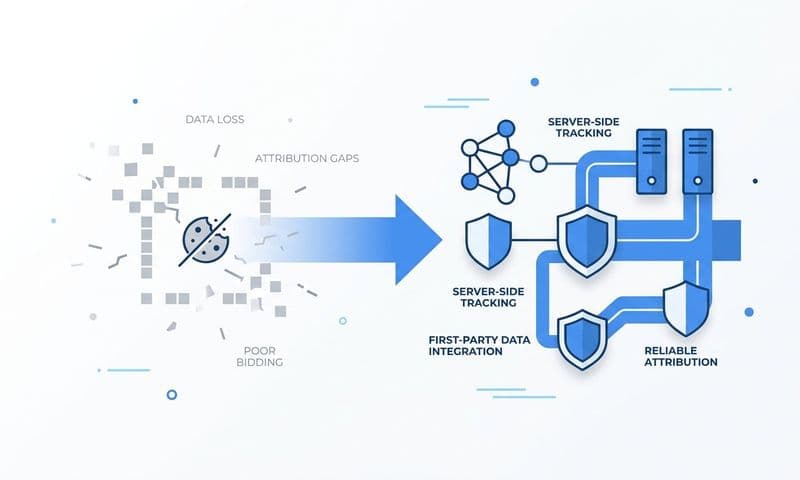
Server-side tracking: Client-side tracking, where a JavaScript pixel fires in the user's browser, is vulnerable to ad blockers, browser privacy features like Intelligent Tracking Prevention, and the consent restrictions described above. Server-side tracking moves data collection off the browser and onto a server environment you control.
When a conversion event occurs, your server receives the data and processes it before deciding what to send to which platforms. This gives you direct control over what data gets transmitted, to whom, and in what form. You can strip out unnecessary personal data before it leaves your environment, apply hashing to identifiers, and ensure that only consented events are forwarded to ad platforms. Server-side tracking doesn't bypass consent requirements, but it gives you a much more controlled and auditable way to honor them.
How Server-Side Tracking and Conversion APIs Enable Privacy-First Attribution
Conversion APIs represent the most significant technical development in privacy-first ad measurement in recent years. Meta's Conversions API and Google's Enhanced Conversions both work on the same principle: instead of relying on a browser pixel to fire when a conversion happens, you send the conversion event directly from your server to the ad platform.
This matters for GDPR compliant ad tracking in several ways. Browser pixels are subject to all the restrictions and blocking that happens in the user's browser environment. Ad blockers, browser privacy settings, and ITP can all prevent a pixel from firing even when consent has been given. Server-to-server events bypass those browser-level obstacles entirely, which means your conversion signal reaches the ad platform more reliably.
The privacy-first design of Conversion APIs also allows you to send conversion data using hashed identifiers rather than raw personal data. When a user converts, you can hash their email address using a one-way cryptographic function before sending it to Meta or Google. The ad platform uses the hashed value to match the conversion to a user in their system without you transmitting the raw email address itself. This approach significantly reduces the privacy risk of server-to-server data transfers while still providing the ad platform with the signal it needs to optimize campaigns and report conversions accurately.
It's worth being precise here: hashing reduces privacy risk and is considered a privacy-enhancing practice, but it doesn't automatically make a data transfer GDPR-compliant. You still need a lawful basis for processing the underlying data. The hashing makes the transfer more proportionate and reduces the exposure of personal data, which aligns with GDPR's data minimization principle.
One critical technical requirement when running Conversion APIs alongside browser pixels is event deduplication. If a conversion event is sent both by the browser pixel and by your server, the ad platform will count it twice unless you implement deduplication logic. This typically involves sending a unique event ID with both the browser and server events so the platform can recognize and discard the duplicate. Getting deduplication right is essential because inflated conversion counts lead to inflated ROAS figures, which corrupt your optimization signals and your reporting.
The combination of server-side tracking and Conversion APIs is the closest thing to a complete solution for maintaining attribution accuracy in a consent-restricted environment. You're not working around GDPR. You're building a measurement architecture that operates cleanly within it while recovering much of the signal quality that cookie deprecation and consent rates would otherwise erode.
Attribution Models That Work in a Consent-Restricted Environment
GDPR doesn't just affect how you collect data. It affects which attribution models can function reliably given the data you're able to collect. Understanding this is important for interpreting your attribution reports correctly and choosing the right model for your situation.
Last-click attribution is the most vulnerable to consent-rate degradation. It assigns all credit to the final touchpoint before conversion, which means it depends on correctly capturing that last interaction. When a portion of users haven't consented to tracking, some last-click events simply go missing. The result is that certain channels appear to drive fewer conversions than they actually do, and the model's output becomes less reliable as consent rates fall.
Multi-touch attribution models, such as linear, time-decay, or data-driven attribution, require a reasonably complete picture of the customer journey to function correctly. They're designed to distribute credit across multiple touchpoints, but if significant portions of the journey are invisible due to non-consent, the distribution becomes distorted. The model is working with incomplete inputs and producing outputs that reflect that incompleteness.
This is where modeled or probabilistic attribution becomes relevant. Instead of tracking every individual user's journey, modeled attribution uses aggregated signals and statistical patterns to estimate the contribution of channels and campaigns that can't be directly tracked. It fills the gaps created by non-consented users without requiring individual-level data for every conversion. This approach is more GDPR-compatible because it operates on aggregate patterns rather than individual tracking, and it produces more complete attribution insights than simply ignoring the untracked portion of your audience.
For B2B SaaS companies specifically, connecting CRM data to ad platforms is one of the most powerful ways to attribute revenue without depending on cookie-based tracking for every step of the journey. When a prospect becomes a lead, moves through pipeline stages, and eventually closes as a customer, those CRM events contain rich conversion data that can be sent back to ad platforms as offline conversions. This approach lets you attribute closed-won revenue to the campaigns that generated the original lead, even if the user's browser journey was partially invisible due to consent restrictions.
The key insight is that B2B SaaS companies have a natural advantage here. Your most valuable conversion events, the ones that actually map to revenue, happen in your CRM and your product. Those are first-party, consent-appropriate data sources that don't depend on third-party cookies. Building your attribution strategy around those events gives you a more accurate picture of what's driving revenue than any cookie-based model could provide.
Practical Steps to Audit and Improve Your Ad Tracking for GDPR
Understanding the principles is one thing. Knowing where to start with your actual tracking setup is another. A structured audit gives you a clear picture of where your current implementation stands and what needs to change.
Map all your data collection points: Start by listing every place where your website or product collects data. This includes analytics pixels, ad tracking pixels, form submissions, chat tools, session recording tools, and any third-party scripts loaded on your pages. For each one, identify what data it collects, whether it fires before or after consent is confirmed, and what the lawful basis for that collection is.
Check consent signal propagation: Verify that your CMP is correctly communicating consent choices to every downstream tool. This is a common failure point. The consent banner may work correctly, but if the signal isn't reliably passed to your tag manager or if tags are configured to fire regardless of consent status, your implementation isn't actually compliant. Test this by declining consent in your browser and checking whether tracking tags still fire.
Review data retention settings: GDPR's storage limitation principle requires that you don't retain personal data longer than necessary. For ad tracking data, this means reviewing retention settings in your analytics platform, your CRM, and any attribution tools you use. Storing raw IP addresses or device identifiers indefinitely creates compliance risk. Most platforms allow you to configure data retention periods, and setting these appropriately is a straightforward way to reduce your exposure.
Audit your Data Processing Agreements: Under GDPR, when you share personal data with a third-party tool, a Data Processing Agreement is required. This formalizes the responsibilities of each party and ensures the processor handles data in accordance with GDPR requirements. Check whether you have valid DPAs in place with your ad platforms, your attribution vendor, your analytics tools, and any other third parties that receive personal data from your tracking setup. Most major platforms publish their DPAs and make them available for acceptance through their account settings.
Evaluate your attribution vendor's compliance posture: Not all attribution tools are built with GDPR in mind. When evaluating vendors, look for clear documentation of their data handling practices, published DPAs, data residency options if you need EU data to stay within the EU, and support for server-side event collection. A vendor that can't clearly explain how they handle personal data or doesn't offer a DPA is a compliance risk, not just a technical one.
Turning Privacy Constraints Into a Measurement Advantage
Here's a reframe worth sitting with: GDPR compliance, done properly, doesn't weaken your marketing measurement. It forces you to build measurement infrastructure that is fundamentally more reliable than what most teams were using before.
Cookie-based tracking was always fragile. Third-party cookies were being blocked by Safari for years before GDPR became a major enforcement concern. Ad blockers have been degrading pixel data for even longer. Marketers who built their entire measurement strategy on client-side pixels were already working with incomplete data. They just didn't always realize it because there was no obvious signal that data was missing.
GDPR made the problem visible and urgent. And the teams that responded by investing in server-side tracking, proper consent management, and CRM-connected attribution now have something valuable: a measurement foundation built on first-party data that doesn't degrade as browsers tighten privacy controls or as regulators increase enforcement. That's a durable competitive advantage in a world where cookie signals are continuing to erode.
The companies still relying on degraded cookie signals are making budget decisions based on increasingly noisy data. The companies that have built first-party, server-side measurement infrastructure are making decisions based on cleaner, more complete attribution. Over time, that difference compounds into meaningfully better marketing performance.
AI-driven attribution tools that work with enriched, first-party event data are particularly well-positioned in this environment. When you feed an AI attribution model complete, high-quality event data from your server, your CRM, and your ad platforms, it can surface insights and optimization recommendations that a cookie-dependent model simply can't. The quality of the input data directly determines the quality of the output recommendations.
This is where platforms like Cometly are built for the current reality. By connecting ad platforms, CRM data, and server-side events into a single attribution layer, Cometly gives B2B SaaS marketing teams the complete customer journey view they need to optimize campaigns accurately, without depending on the cookie-based tracking that GDPR has made both legally risky and technically unreliable.
Building the Right Foundation for the Long Term
GDPR compliant ad tracking comes down to a clear principle: track smarter, not less. The marketers who treat privacy regulation as a forcing function to build better infrastructure come out ahead. Those who treat it as a burden to minimize end up with both compliance risk and measurement gaps.
The pillars of a modern, compliant measurement strategy are clear. A properly integrated Consent Management Platform ensures tracking only fires when it should. Server-side tracking and Conversion APIs recover signal quality that browser-based pixels lose to ad blockers, ITP, and consent restrictions. First-party data and CRM-connected attribution let you track what actually matters, the revenue events, without depending on cookies for every step. And modeled attribution fills the gaps that will always exist when some users decline tracking.
Together, these components give you attribution data that is both legally sound and more accurate than what cookie-dependent tracking was ever able to provide. That's the real opportunity inside the compliance requirement.
If you're ready to build this infrastructure for your B2B SaaS marketing team, Cometly connects every touchpoint from ad click to closed-won revenue in a single attribution platform, with server-side tracking, Conversion API integration, and AI-driven recommendations built in. Get your free demo today and start capturing every touchpoint to maximize your conversions.