Modern B2B SaaS buyers are more informed than ever before. By the time a prospect reaches out to your sales team, they have likely already read several articles, watched demos, compared alternatives, and formed strong opinions about what they need. Yet many marketing teams are still investing heavily in cold outreach, interruptive display ads, and spray-and-pray email blasts that interrupt rather than inform.
This is the core tension facing growth-focused marketers today. The tactics that dominated marketing a decade ago are delivering diminishing returns, while buyers are quietly doing their own research and gravitating toward brands that earn their attention rather than demand it.
Inbound marketing methodology offers a fundamentally different approach. Instead of pushing messages at people who did not ask for them, inbound pulls the right buyers toward your brand by delivering genuine value at every stage of their research journey. It is a framework built around how buyers actually behave, not how marketers wish they would behave.
By the end of this article, you will understand exactly how the inbound marketing methodology works, how its stages connect to drive compounding growth, and critically, how to measure whether your inbound efforts are actually generating pipeline and revenue rather than just traffic and vanity metrics.
The Philosophy Behind Inbound: Attracting Instead of Interrupting
At its core, inbound marketing methodology is a buyer-centric framework. It is built on a simple but powerful premise: create content and experiences that are genuinely useful to your target audience, and the right buyers will find their way to you. Rather than forcing your message in front of people who did not ask for it, you earn their attention by solving problems they are already trying to solve.
The contrast with traditional outbound approaches is sharp. Outbound marketing operates on an interruption model. Cold calls, unsolicited emails, banner ads, and paid placements all share the same logic: reach as many people as possible and hope some percentage respond. The problem is that buyers have become increasingly skilled at ignoring, blocking, and filtering out interruptive messages. Permission-based engagement, where a prospect actively seeks out your content because it addresses their questions, produces a fundamentally different quality of relationship from the start.
This distinction matters especially in B2B SaaS, for several reasons that make inbound particularly well-suited to the category.
First, B2B SaaS purchases involve longer sales cycles. A team evaluating a marketing analytics platform is not going to make a decision after seeing one ad. They will research the problem space, compare approaches, evaluate vendors, consult with colleagues, and often return to the same sources multiple times before engaging a sales rep. Inbound content meets them throughout this journey.
Second, B2B purchase decisions typically involve multiple stakeholders. A VP of Marketing, a Head of Revenue Operations, and a CFO may all have input on whether a platform gets approved. Each stakeholder has different questions and different concerns. A robust inbound content library can address each of these perspectives, building consensus before a sales conversation even begins.
Third, B2B SaaS buyers tend to be sophisticated. They are often practitioners themselves, and they can quickly identify when content is superficial or purely promotional. Inbound methodology demands that you produce genuinely useful material, which in turn builds credibility and trust that outbound tactics simply cannot replicate at scale.
The mindset shift required to embrace inbound is not just tactical. It is strategic. It means accepting that your job as a marketer is to serve your audience first, and that revenue follows from doing that well consistently over time.
The Four Stages of the Inbound Methodology Explained
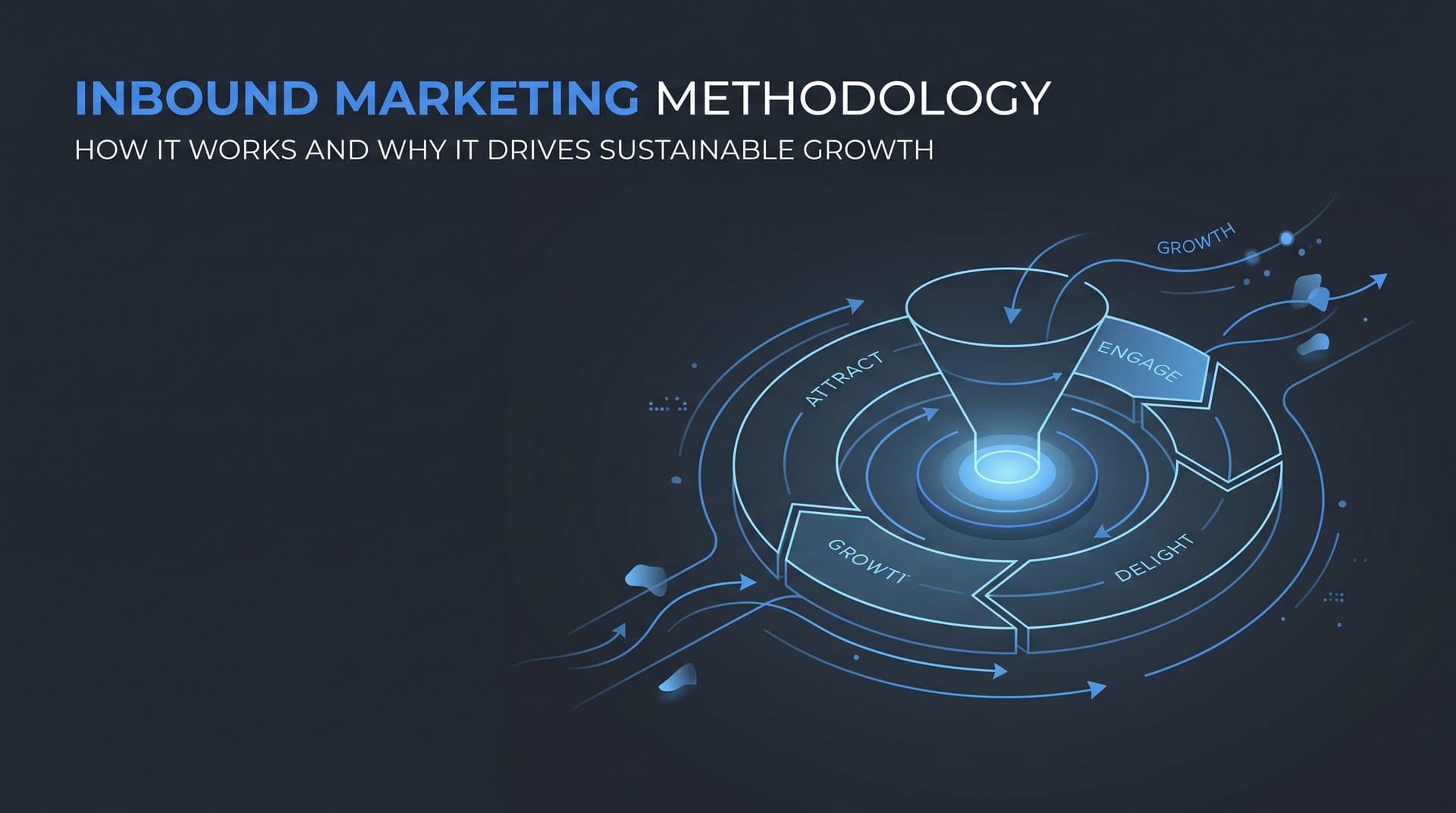
The inbound marketing methodology is typically broken down into four sequential stages: Attract, Convert, Close, and Delight. Each stage corresponds to a distinct point in the buyer journey, and each one feeds directly into the next. Skipping or underinvesting in any stage creates gaps that quietly undermine the entire system.
Attract: This is where the journey begins. The goal at this stage is to draw the right audience to your brand through content and channels they are already using. SEO-driven blog content, thought leadership articles, organic social media, and podcast appearances all serve the Attract stage. The critical word here is "right." Inbound is not about maximizing raw traffic. It is about reaching buyers who actually fit your ideal customer profile and are actively researching problems your product solves. High traffic from the wrong audience creates noise without pipeline.
Convert: Once you have attracted the right visitors, the next challenge is turning that attention into a relationship. The Convert stage is about capturing contact information and intent signals in exchange for something of genuine value. Gated assets like research reports, frameworks, or templates, along with webinar registrations, demo requests, and free trial sign-ups, all belong here. The quality of your conversion offer matters enormously. A generic "subscribe to our newsletter" prompt will underperform compared to a specific, high-value resource that directly addresses a pain point your ideal buyer is trying to solve.
Close: Not every lead is ready to buy immediately, especially in B2B SaaS where the evaluation process can span weeks or months. The Close stage is where you nurture leads from interest to decision. This involves automated email sequences that deliver relevant content based on where a prospect is in their journey, lead quality scoring to help sales prioritize outreach, and tight CRM alignment so that marketing and sales are working from the same data. The handoff between marketing and sales is often where inbound breaks down, and getting this stage right requires clear definitions of what constitutes a qualified lead and what actions should trigger a sales conversation.
Delight: The Delight stage is the most underemphasized part of the methodology, particularly in SaaS. Once a prospect becomes a customer, the inbound approach does not end. Ongoing value delivery through onboarding content, product education, customer success check-ins, and community building turns customers into advocates. In SaaS, where retention and expansion revenue are as important as new customer acquisition, the Delight stage has a direct impact on net revenue retention. More importantly, delighted customers generate referrals and word-of-mouth that feed back into the Attract stage, creating a self-reinforcing growth loop.
This circular dynamic is what makes inbound a compounding strategy rather than a linear one. Each stage strengthens the next, and over time, a well-executed inbound methodology builds momentum that becomes increasingly difficult for competitors to replicate. The brands that invest consistently in inbound over months and years develop content libraries, domain authority, and customer communities that function as durable competitive advantages.
Core Channels and Tactics That Power Each Stage
Understanding the four stages conceptually is one thing. Knowing which specific channels and tactics to deploy at each stage is where strategy becomes execution.
At the Attract stage, the primary engine is organic search. SEO-driven blog content that targets the keywords your ideal buyers are actively searching creates a steady stream of qualified visitors without ongoing paid media costs. Thought leadership content, including in-depth guides, original frameworks, and expert opinion pieces, builds brand authority and earns backlinks that compound your organic visibility over time. LinkedIn content and niche community participation also belong here for B2B SaaS teams, particularly when your buyers are active in professional networks.
At the Convert stage, the focus shifts to offers and on-site conversion. Gated assets such as detailed playbooks, benchmark reports, or templates give visitors a compelling reason to share their contact information. Webinars and virtual events work well here because they attract buyers who are actively engaged with a topic rather than passively browsing. Demo requests and free trial sign-ups are the highest-intent conversion points and should be prominently featured throughout your content, not buried at the bottom of a page.
At the Close stage, email sequences and lead scoring do the heavy lifting. Automated nurture sequences that deliver relevant content based on a lead's behavior and funnel stage keep your brand top of mind during the evaluation period. Lead scoring models that weigh engagement signals, such as pages visited, content downloaded, and emails opened, help sales teams focus their energy on the prospects most likely to convert.
One important nuance worth addressing: paid channels can absolutely complement inbound without contradicting the methodology. Paid search and paid social are powerful amplifiers for inbound content, especially at the Attract and Convert stages. The key distinction is that the ad experience should lead to genuinely useful content rather than a hard-sell landing page. A paid ad that drives traffic to a substantive blog post or a high-value gated asset is entirely consistent with inbound principles. An ad that drives directly to a generic "request a quote" page is not.
Throughout all of this, your company website functions as the central hub where every inbound channel converges. This makes on-site conversion rate optimization a critical but often overlooked component of the methodology. You can attract thousands of qualified visitors, but if your site is slow, confusing, or fails to communicate clear value quickly, the investment in content and distribution is wasted. Site speed, clear messaging hierarchy, prominent calls to action, and intuitive navigation all directly affect how much of your inbound traffic actually converts into leads.
Why Measuring Inbound Requires More Than Traffic and Leads
Here is where many inbound programs stall. Teams invest months building out content, optimizing for search, and generating leads, and then report success based on metrics like page views, organic sessions, and form fills. These numbers feel meaningful, but they do not answer the question that actually matters to a SaaS leadership team: is inbound generating revenue?
Surface-level metrics are insufficient for a straightforward reason. In B2B SaaS, the journey from first content interaction to closed deal often spans weeks or months and involves multiple touchpoints across different channels. A buyer might read three blog posts, attend a webinar, download a framework, and then receive a follow-up email from sales before finally signing a contract. If you are only measuring page views and form fills, you are measuring activity, not impact.
Last-click attribution, the default model in many analytics tools, makes this problem worse. It assigns all credit for a conversion to the final touchpoint before a form fill or purchase, systematically undervaluing the earlier inbound content that initiated the relationship and built the trust that made the eventual sale possible. This creates a distorted picture where paid channels appear to drive all the value while organic content appears to contribute almost nothing, even when the opposite is closer to the truth.
Multi-touch attribution is the mechanism that corrects for this. By distributing credit across multiple touchpoints in the buyer journey, multi-touch models provide a far more accurate picture of how inbound content actually contributes to pipeline and revenue. Different models, including linear, time-decay, and data-driven attribution, each offer different perspectives on how to weight touchpoints, and the right choice depends on your sales cycle length and the typical number of interactions before a deal closes.
A complete inbound measurement framework tracks the full customer journey from first content interaction through CRM stages to closed-won revenue. This means connecting your content analytics to your lead tracking system, your lead tracking system to your CRM, and your CRM to your revenue data. When these systems are connected, you can answer questions like: which blog posts are most likely to appear in the journeys of customers who eventually close? Which webinar topics attract buyers who convert at the highest rate? Which inbound channels are generating pipeline, and which are generating traffic that never converts?
This level of visibility is what separates inbound teams that scale from those that stall. Without it, investment decisions are based on gut instinct and vanity metrics. With it, every dollar of content and distribution budget can be directed toward the activities that are demonstrably generating revenue.
Connecting Inbound Performance to Pipeline and Revenue
Attribution data is what transforms inbound marketing from a brand-building exercise into a revenue-generating machine. When you can see which specific content pieces, channels, and campaigns appear in the journeys of customers who actually close, you stop guessing about what is working and start making decisions based on evidence.
Think about what this visibility makes possible. You can identify which blog posts consistently appear in the journeys of high-value customers and prioritize producing more content on those topics. You can see which conversion offers attract leads who eventually close versus leads who never engage with sales. You can determine which inbound channels are contributing to pipeline at a rate that justifies their investment, and which are generating volume without revenue impact.
Conversion analytics play a specific role here. Beyond knowing which channels drive the most leads, you need to understand where prospects are dropping out of the funnel. A high-performing Attract stage that generates significant organic traffic means nothing if the Convert stage is leaking. Similarly, strong lead generation numbers are misleading if the Close stage reveals that most of those leads are low-quality and never progress through the CRM. Funnel conversion rate analysis by channel and content type helps you identify the specific friction points that are costing you pipeline.
This is where platforms like Cometly provide direct value for inbound-focused B2B SaaS teams. Cometly connects ad platform data, CRM events, and website behavior into a single unified view, giving marketing teams visibility into which inbound channels are driving real pipeline rather than just traffic. Instead of toggling between your analytics platform, your ad accounts, and your CRM and trying to manually reconcile the data, you get a single source of truth that shows the complete customer journey from first content interaction to closed-won revenue.
Cometly's multi-touch attribution capabilities are particularly relevant for inbound teams because they capture the early touchpoints, such as an organic blog visit or a webinar attendance, that last-click models routinely miss. When those early touchpoints are visible and credited appropriately, the true ROI of inbound content becomes clear. This is what gives marketing leaders the confidence to make the case for continued inbound investment and to scale the channels that are actually generating revenue.
Building an Inbound Strategy That Scales
Before you can scale inbound, you need to get the foundations right. Three elements are non-negotiable.
A defined ideal customer profile: Inbound only works if the content you create is specifically designed for the buyers you want to attract. A vague target audience produces vague content that attracts vague leads. Your ideal customer profile should define the company characteristics, job titles, pain points, and buying triggers that describe your best-fit customers. Every content decision should trace back to this profile.
A keyword and topic strategy aligned to buyer intent: Not all search traffic is equal. Keywords that reflect active buying intent, such as searches comparing solutions or seeking implementation guidance, attract buyers who are further along in their decision process and more likely to convert. Your content strategy should map topics to specific stages of the buyer journey, ensuring you have material that addresses awareness-level questions, consideration-level comparisons, and decision-level evaluations.
A lead tracking system that captures source data accurately: If you cannot reliably trace a lead back to the content or channel that first brought them to your brand, you cannot measure inbound performance accurately. UTM parameters, server-side tracking, and CRM integration are the technical foundations that make attribution possible. Getting this infrastructure in place before scaling content production ensures you are building measurement capability alongside reach.
Once the foundations are in place, the ongoing optimization loop is straightforward in principle, though it requires discipline in practice. Publish content aligned to your keyword and topic strategy. Measure touchpoint performance using multi-touch attribution. Identify which content pieces and channels are contributing to pipeline and revenue. Double down on high-performers by producing more content on those topics and investing more in those channels. Cut or deprioritize what is not contributing to pipeline, regardless of how well it performs on surface-level metrics.
This loop, executed consistently over time, is what produces the compounding returns that make inbound a sustainable growth engine rather than a short-term campaign.
The Bottom Line on Inbound Marketing Methodology
Inbound marketing methodology works because it aligns with how modern B2B buyers actually make decisions. They research independently, consult multiple sources, and form strong preferences before ever engaging a sales team. Brands that earn their trust through genuinely useful content at every stage of that journey win deals that interruptive outbound tactics would never have reached.
But the methodology only delivers compounding ROI when teams can measure every touchpoint from first content interaction to closed revenue. The gap between teams doing inbound and teams scaling with inbound is almost always a measurement gap. Without multi-touch attribution connecting early content engagement to downstream pipeline, inbound looks like a cost center. With it, inbound becomes one of the most defensible revenue drivers in your marketing mix.
The teams that scale are the ones that combine strong content execution with rigorous attribution measurement, so they always know which inbound investments are generating real business impact and can allocate budget accordingly.
Ready to see exactly which inbound touchpoints are driving your pipeline and revenue? Discover how Cometly connects your ad data, CRM events, and website behavior into a single attribution view so you can make smarter decisions about every inbound investment. Get your free demo today and start capturing every touchpoint to maximize your conversions.