
Picture this: your marketing team just wrapped a strong quarter. The dashboard looks great. Cost per conversion is down, volume is up, and your top campaign is showing a healthy return on ad spend. So you scale it. You double the budget, expand the audiences, and brief the team on what's working.
Then the pipeline review happens. Deals aren't closing. Revenue is flat. The sales team hasn't seen a meaningful uptick in qualified opportunities. And suddenly, the numbers that felt so reassuring start to look like a different kind of problem entirely.
This scenario plays out across B2B SaaS marketing teams more often than most leaders want to admit. The issue is not effort or strategy. It is data. Specifically, it is the growing gap between what ad platforms report and what actually drives revenue in your business. That gap is not just an analytics inconvenience. It is a direct, ongoing financial drain that compounds quietly over every campaign cycle.
Most marketing teams are making budget decisions every day based on data they cannot fully trust. Ad platforms have structural incentives to report performance favorably. Browser-based tracking is increasingly unreliable. Attribution models default to last-click in a world where B2B buyers interact with your brand across weeks and multiple touchpoints before ever filling out a form.
The result is a system where budget flows toward the loudest signal rather than the most accurate one. And when you optimize toward the wrong signal long enough, the financial damage becomes real and significant.
This article breaks down exactly how bad ad data costs money, where the breakdowns happen in B2B SaaS specifically, and what accurate attribution actually looks like when it is built to support real business decisions.
The Hidden Cost of Trusting the Wrong Numbers
Here is the thing about bad data: it rarely announces itself. You do not wake up to an alert that says "your conversion tracking is inflated." Instead, you see numbers that look plausible, campaigns that seem to be performing, and reports that confirm what you hoped was true. The cost stays invisible until the business results fail to match the marketing story.
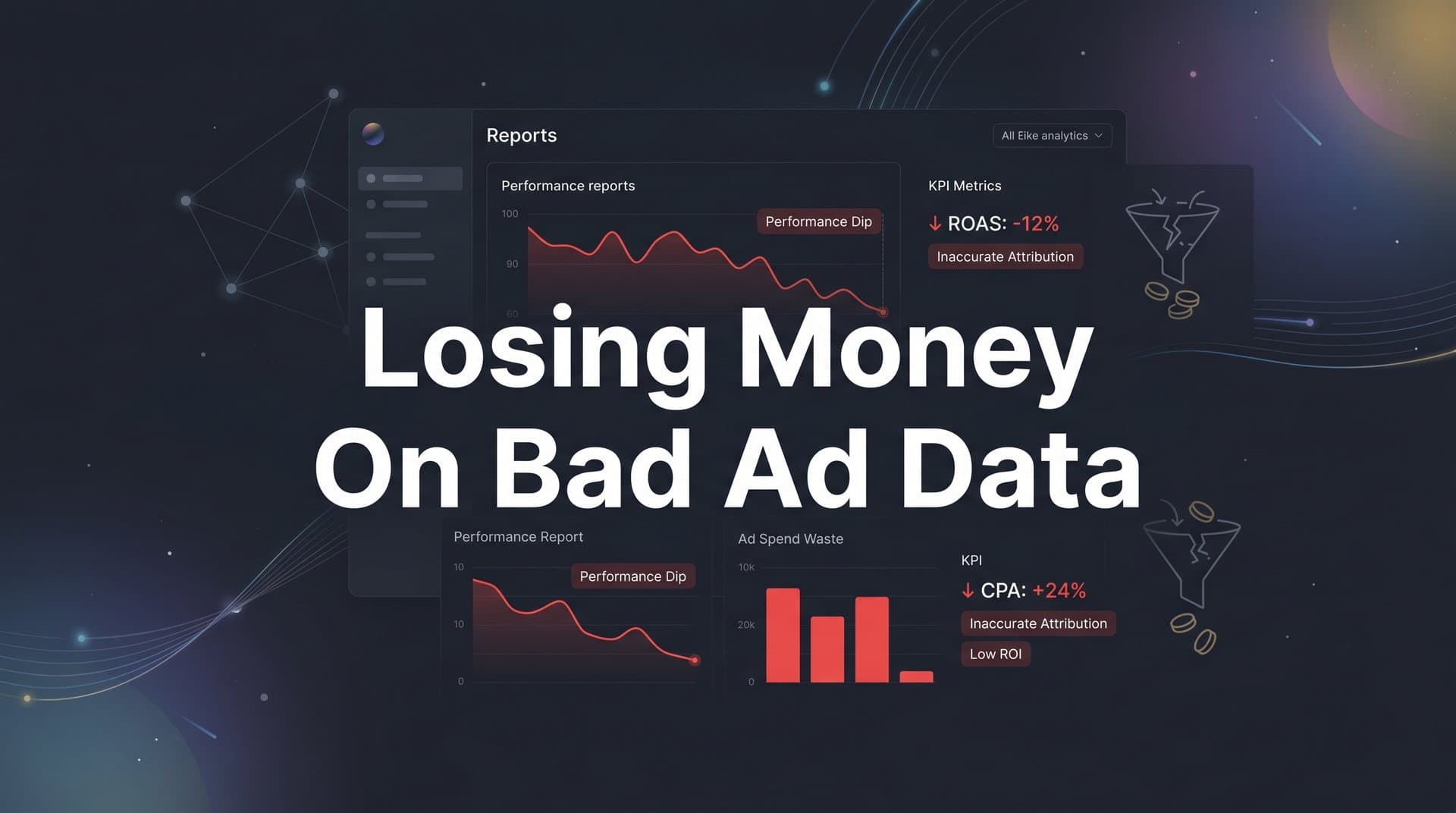
Ad platforms like Meta and Google are built to optimize for their own reported conversions. That is not a conspiracy. It is just how they are designed. But it creates a structural problem for advertisers. View-through attribution windows can assign credit to an ad that someone saw but never clicked. Cross-device matching can count the same conversion multiple times. Duplicate pixel events fire when tracking is misconfigured. All of these inflate the conversion counts you see in your dashboard.
When you make budget decisions based on those inflated numbers, you are essentially rewarding channels and campaigns for performance they did not actually deliver. You increase spend on what looks like a winner, reduce spend on what looks like a loser, and repeat the cycle. Over time, this creates a compounding misallocation problem.
The damage is not always dramatic in any single sprint. A campaign that over-reports by a meaningful margin might look like a strong performer for weeks before the disconnect becomes obvious. But across a quarter of budget decisions, each one slightly off because the underlying data is slightly wrong, the cumulative financial impact becomes significant.
There is also a subtler cost that is harder to quantify but just as real: the opportunity cost of not knowing what is actually working. When you cannot trust your data, you cannot confidently scale what is genuinely driving pipeline. You end up in a defensive posture, running experiments that should not need to be experiments, and hesitating on decisions that should be straightforward.
Budget naturally flows toward the loudest signal rather than the most accurate one. Channels that generate high volumes of trackable events get protected and scaled, even when those events do not translate to revenue. Channels that do critical but harder-to-measure work, like nurturing prospects over a long sales cycle, get cut because the marketing analytics data does not capture their contribution.
This is why losing money on bad ad data is not just an analytics problem. It is a decision problem. Every allocation decision, every scale or cut, is only as good as the information behind it. And when that information is systematically flawed, the financial consequences follow.
Where Ad Data Breaks Down in B2B SaaS
Understanding where tracking fails is the first step toward fixing it. In B2B SaaS specifically, there are three distinct layers where data breaks down, and they compound each other in ways that make the problem worse than any single issue would be on its own.
Browser-side pixel tracking is losing reliability fast. The traditional approach to conversion tracking relies on a JavaScript pixel that fires in a user's browser when they complete a desired action. This approach worked reasonably well for years, but the environment it depends on has changed significantly. Apple's iOS privacy updates introduced App Tracking Transparency, which limits cross-app data collection. Ad blockers are widely used, particularly among the technical and professional audiences that B2B SaaS companies often target. And the ongoing deprecation of third-party cookies is further eroding the infrastructure that browser-based tracking was built on.
The practical result is that a meaningful portion of conversion events simply never get recorded. A prospect clicks your ad, navigates to your site, and completes a form, but if their browser blocks the pixel or their privacy settings prevent the cookie from being set, that conversion is invisible to your ad platform. You are not just seeing incomplete data. You are making decisions based on a systematically undercounted picture of what is actually happening.
Last-click attribution ignores how B2B buyers actually behave. Despite being widely recognized as inadequate, last-click attribution remains the default in many ad platforms. It assigns full conversion credit to the final touchpoint before a lead converts, which sounds logical until you consider how B2B buying actually works.
A typical B2B SaaS prospect might encounter a LinkedIn thought leadership post, click a retargeting ad, read a blog article, attend a webinar, and then convert on a branded search weeks later. Under last-click attribution, the branded search gets all the credit. The LinkedIn post, the retargeting ad, the blog, and the webinar get nothing. If you use that data to guide budget decisions, you will cut the channels that were doing the actual persuasion work and over-invest in the channel that just happened to be last.
Disconnected tools create fragmented, incomplete views. Most B2B SaaS marketing stacks involve at least three separate data environments: ad platforms like Meta and Google, a CRM like Salesforce or HubSpot, and website analytics. Each of these systems tracks different events, uses different identifiers, and operates on different data models. When they are not connected, you cannot trace a lead from the first ad click through to closed-won revenue.
This fragmentation means that even if your pixel tracking is working perfectly and your attribution model is reasonable, you still cannot answer the question that matters most: which campaigns are actually generating revenue? You can see leads. You can see conversions. But the connection between marketing activity and business outcomes remains broken. Solving this requires a deliberate marketing data integration strategy that unifies these separate systems.
How Misattribution Distorts Budget Decisions
Data inaccuracies do not just create measurement errors. They systematically distort the budget decisions that follow from them, and the distortions tend to move in a predictable direction: away from what is actually working and toward what is easiest to measure.
Consider what happens when a channel captures last-touch credit for conversions it did not actually drive. The numbers look strong. Cost per conversion is low, volume is high, and the platform reports a solid return on ad spend. In a budget review, this channel gets protected or expanded. Meanwhile, the upper-funnel campaigns that were doing critical awareness and nurturing work, the ones that created the conditions for that final conversion, show weak direct conversion numbers and get cut.
This is one of the most common and costly patterns in B2B SaaS marketing. Teams eliminate the campaigns that are actually building pipeline because those campaigns do not get credit for it. Then they wonder why, a few months later, their lower-funnel performance starts to decline. The pipeline was running on the momentum created by campaigns that no longer exist.
Misattribution also creates false confidence in low-quality lead sources. A channel that generates high volumes of leads but low-quality pipeline can look excellent in ad platform reporting. The conversion events are real. The cost per lead is attractive. But if those leads are not converting to opportunities or revenue, the channel is not performing. It is just generating activity that looks like performance.
Without revenue data connected to your attribution, you cannot see this distinction. You protect and scale the channel because the numbers say to. The sales team receives a flood of leads that go nowhere, and the disconnect between marketing metrics and business outcomes grows wider.
Over time, teams optimize toward metrics that ad platforms can measure easily rather than the metrics that actually matter. Cost per click, cost per lead, and platform-reported ROAS are all measurable and reportable. Pipeline generated, deal velocity, and closed revenue require connecting systems that are often not connected. So teams default to what they can measure, and the budget follows those metrics rather than the business outcomes they are supposed to represent.
The compounding effect is significant. Each budget cycle, decisions are made on slightly wrong data. Resources shift toward channels that look strong but underdeliver. Channels that do real work but are hard to measure get underfunded. The gap between marketing activity and business results widens, and the team spends more time defending their numbers than improving their outcomes. Understanding how to fix attribution discrepancies is often the turning point that breaks this cycle.
What Accurate Ad Tracking Actually Requires
Fixing the data problem is not about finding a single tool or flipping a switch. It requires addressing the three layers where tracking breaks down: the signal quality getting to ad platforms, the completeness of first-party data collection, and the connection between ad activity and revenue outcomes.
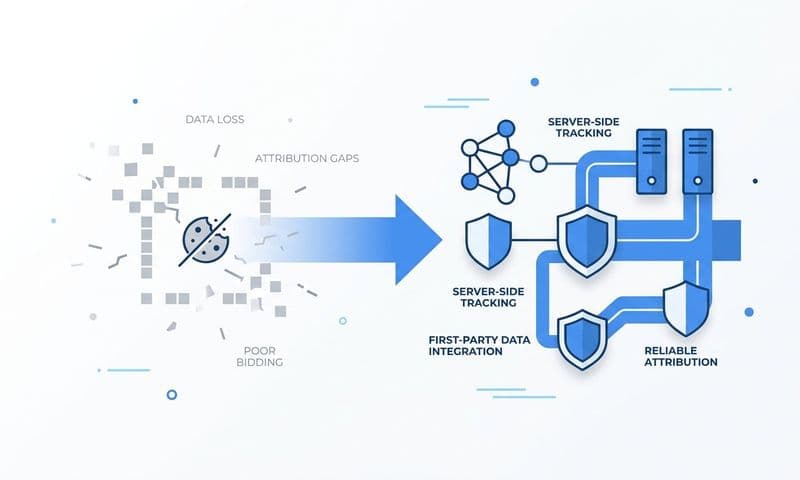
Server-side tracking via Conversion APIs. The most direct solution to the browser reliability problem is moving event tracking from the client side to the server side. Meta's Conversion API (CAPI) and Google's Enhanced Conversions both allow you to send event data directly from your server to the ad platform, bypassing the browser entirely. This means ad blockers, privacy settings, and cookie limitations do not interrupt the signal.
Server-side tracking delivers cleaner, more complete conversion data to the platforms that use it for optimization. When Meta or Google receives better signal about which users are actually converting, their algorithms can optimize more effectively, which improves campaign performance beyond just fixing the measurement problem. Better data going in means better targeting and bidding decisions coming out. Teams looking to recover lost signal should also explore Facebook tracking software options that support server-side event collection.
First-party data collection at the point of conversion. As third-party cookies continue to disappear, the durability of your tracking depends increasingly on first-party identifiers: email addresses, user IDs, and other data points that your users provide directly. Capturing these at the point of conversion, and using them to stitch together the customer journey across sessions and devices, is what makes attribution sustainable over time.
First-party data also enables more accurate matching when sending events to ad platforms. When you pass a hashed email address alongside a conversion event, the platform can match that event to a real user profile with much higher confidence than a cookie-based match. This improves both measurement accuracy and the quality of the optimization signal you are sending back to the platform. A well-executed first-party data strategy is the foundation that makes all downstream attribution more reliable.
Connecting ad data to CRM and revenue outcomes. The third and most important piece is closing the attribution loop between marketing activity and business results. This means connecting your ad platform data to your CRM so that you can see not just which campaigns generated leads, but which campaigns generated opportunities, which influenced deals, and which ultimately contributed to closed revenue.
This connection is what allows you to answer the questions that actually drive budget decisions. Not "which campaign had the lowest cost per lead?" but "which campaign generated the most pipeline?" Not "which channel drove the most conversions?" but "which channel influenced the deals that actually closed?" Without this connection, you are measuring activity rather than outcomes, and the financial decisions that follow will reflect that gap.
Choosing the Right Attribution Model for Your Buying Cycle
Even with clean tracking infrastructure in place, you still need to decide how to distribute credit across the touchpoints in a customer journey. Attribution models are the frameworks that answer that question, and different models tell meaningfully different stories about what is driving results.
Understanding what each model shows is the starting point. First-touch attribution assigns all credit to the first interaction a prospect had with your brand. It is useful for understanding where awareness begins and which channels are most effective at bringing new prospects into your funnel. Last-click attribution assigns all credit to the final touchpoint before conversion. It is useful for understanding what closes decisions, but it systematically undervalues everything that happened earlier in the journey. Multi-touch attribution models, including linear, time-decay, and position-based variants, distribute credit across multiple touchpoints in different ways, each reflecting a different assumption about how influence works across a buying cycle.
For B2B SaaS with longer sales cycles and multiple decision-makers, multi-touch attribution is typically the most actionable framework. A prospect who interacts with your brand five times before converting did not make that decision at the last touchpoint alone. The awareness built by earlier interactions, the consideration driven by mid-funnel content, and the trust established through multiple engagements all contributed. Multi-touch models capture that distributed influence in a way that single-touch models cannot.
The practical implication is that multi-touch attribution tends to reveal the value of upper-funnel and mid-funnel activity that last-click models systematically ignore. When you can see that a LinkedIn campaign is consistently appearing in the early stages of journeys that eventually convert, you have a much stronger basis for protecting that spend than you would with last-click data alone.
The goal, however, is not to find one perfect model and rely on it exclusively. Different models answer different questions, and the most sophisticated marketing teams use them comparatively. Running first-touch and multi-touch models side by side reveals which channels are doing awareness work versus conversion work. That comparative view is what enables genuinely smart allocation decisions, because it shows you the full shape of your customer journey rather than just one slice of it.
Attribution models are analytical tools, not verdicts. They help you ask better questions about your data. The value comes from using them consistently and comparatively, not from treating any single model as the definitive truth. Pairing these models with data-driven attribution approaches can further sharpen how credit is assigned across complex B2B journeys.
Turning Clean Data Into Confident Ad Spend Decisions
Clean tracking infrastructure and the right attribution models are the foundation. But the goal is not just to have better data. It is to make better decisions faster, with more confidence and less reconciliation work slowing you down.
The biggest operational challenge for most marketing teams is not that they lack data. It is that their data lives in too many places. Ad platform dashboards, CRM reports, spreadsheet exports, and website analytics all tell partial stories that someone has to manually stitch together. That reconciliation work is slow, error-prone, and often incomplete. By the time the picture is assembled, the campaign cycle has moved on and the decisions are already made.
A single source of truth for marketing data solves this at the operational level. When ad spend, lead data, CRM events, and revenue are connected in one platform, the reconciliation work disappears. Teams can see the complete picture in real time, which means decisions can be made when they matter rather than after the fact. The ability to act on accurate data quickly is itself a competitive advantage. Building this capability starts with understanding how to improve data-driven decision making at the operational level.
AI-powered analysis of clean, complete data surfaces patterns that manual reporting consistently misses. Which ad creative is driving the highest-quality leads, not just the most leads? Which channels are influencing deal velocity, not just top-of-funnel volume? Where would budget reallocation have the most impact on pipeline, not just on conversion counts? These are the questions that move the business, and they require both clean data and intelligent analysis to answer reliably.
This is exactly where Cometly is built to help. Cometly connects ad platforms, CRM data, and revenue signals in real time, giving B2B SaaS marketing teams the accurate, complete picture they need to make confident budget decisions. With multi-touch attribution, server-side conversion tracking, and direct revenue integration, Cometly closes the loop between ad spend and business outcomes. AI-driven recommendations surface what is actually working across every channel, so teams can scale with confidence rather than guesswork. And with 70+ native integrations, it fits into the stack you already use without requiring a rebuild from scratch.
The Bottom Line on Bad Ad Data
Losing money on bad ad data is not a data problem at its core. It is a decision problem. Every budget allocation, every campaign scale, and every channel cut is only as good as the information behind it. When that information is systematically flawed, because of browser tracking limitations, last-click defaults, or disconnected tools, the financial consequences compound quietly across every campaign cycle.
The path forward requires three things working together: server-side event collection to capture clean, complete conversion signals; multi-touch attribution to reflect how B2B buyers actually move through the funnel; and revenue integration to connect marketing activity to the business outcomes that actually matter. None of these alone is sufficient. Together, they create the accurate, complete picture that confident ad spend decisions require.
Teams that invest in accurate attribution stop guessing about what is working and start compounding their ad ROI. They protect the campaigns that build pipeline, cut the channels that generate volume but not revenue, and scale with the kind of confidence that only comes from trusting your data.
If your team is ready to stop making budget decisions based on numbers you cannot fully trust, explore how Cometly provides the complete attribution infrastructure B2B SaaS marketing teams need. Get your free demo today and start capturing every touchpoint to maximize your conversions.