

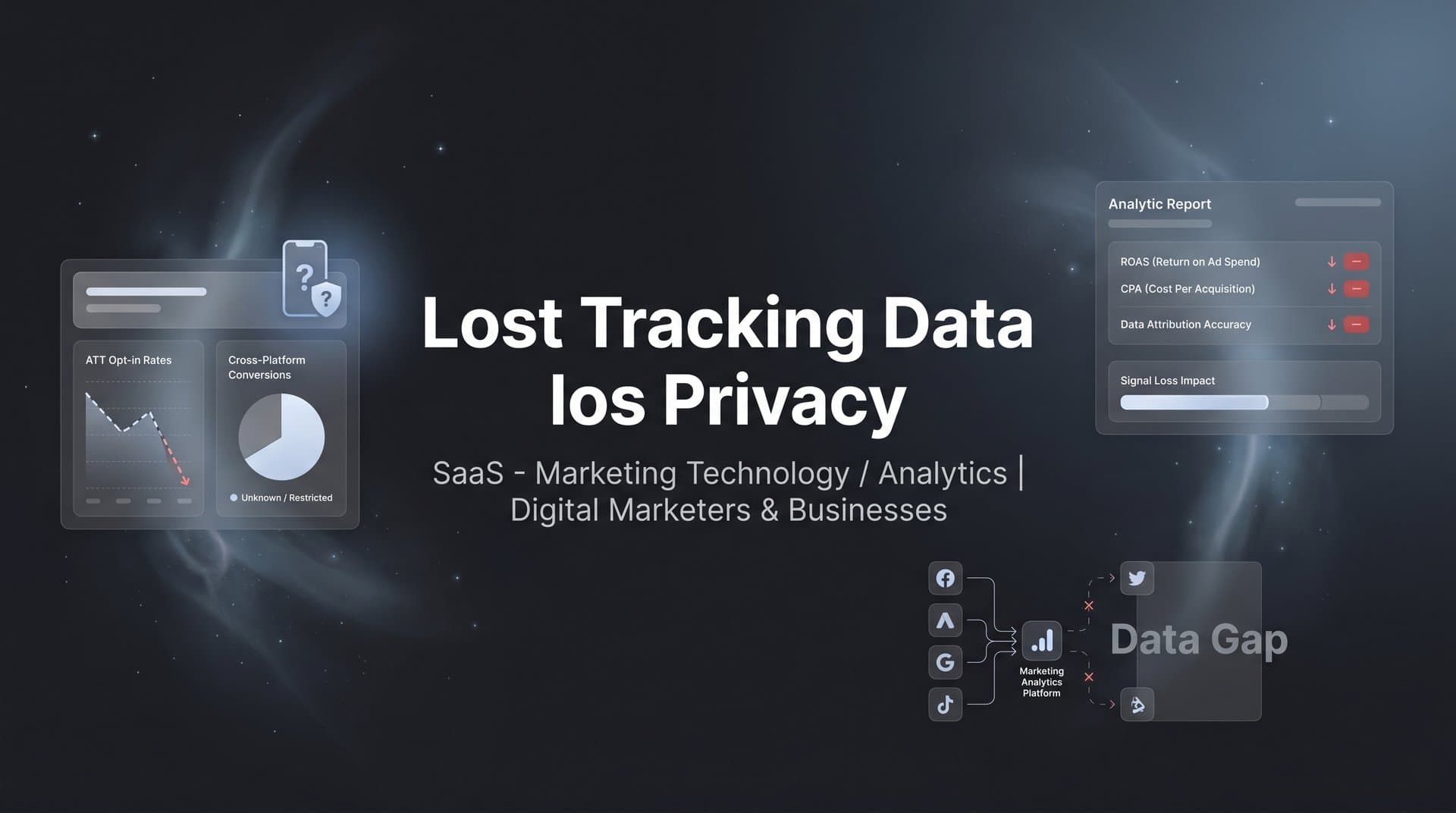
You're staring at your Meta Ads dashboard, and something feels off. Last month, your campaigns showed a clear path from click to conversion. This month? The data looks like Swiss cheese. Conversions that you know happened aren't showing up. Your best-performing campaigns suddenly appear to be underperforming. Your cost per acquisition has supposedly doubled, but your actual sales haven't changed.
You're not imagining it. Your tracking data isn't broken—it's been fundamentally disrupted by iOS privacy changes that have rewritten the rules of digital marketing attribution.
When Apple introduced App Tracking Transparency and began deprecating IDFA, they didn't just add a privacy prompt. They severed the connection between what users do in apps and what advertisers can see. The result? Marketers are making million-dollar budget decisions based on incomplete information, ad platforms are optimizing with one hand tied behind their back, and the customer journey that used to be crystal clear now has massive blind spots.
This isn't a temporary glitch you can wait out. This is the new reality of digital marketing. But here's what most marketers don't realize: you can recover that lost attribution data. You just need to understand what changed, why it matters, and how to build a tracking infrastructure that works regardless of what Apple does next.
How iOS Privacy Changes Broke the Attribution Model You Relied On
Let's start with what actually happened. In April 2021, Apple released iOS 14.5 with a feature called App Tracking Transparency. Sounds innocuous enough, right? Just a privacy feature.
What it actually did was require every app to ask users for explicit permission before tracking their activity across other apps and websites. That little popup that says "Allow [App Name] to track your activity across other companies' apps and websites?" fundamentally changed digital advertising.
The opt-in rates? Devastatingly low. When given a clear choice, most users decline tracking. We're talking about the majority of iOS users—and iOS represents a significant portion of mobile users in key markets—choosing to block the very mechanism that powered mobile advertising attribution.
Here's what that permission actually controlled: access to IDFA, the Identifier for Advertisers. Think of IDFA as a unique ID tag that followed users across apps. When someone clicked your Facebook ad, viewed your product in your app, then converted three days later, IDFA was the thread that connected those dots. It told Facebook "this specific user who saw this specific ad just converted," allowing the platform to attribute that sale back to your campaign.
Without IDFA access, that thread is cut. Facebook shows your ad to a user. The user clicks. They visit your app or website. They convert. But Facebook can't definitively connect that conversion back to the ad impression because they can't track that user's journey across the ecosystem. Understanding the full App Tracking Transparency impact is essential for adapting your strategy.
Apple did provide an alternative: SKAdNetwork. But calling it an alternative is generous. SKAdNetwork provides aggregated, delayed, and extremely limited conversion data. Instead of knowing "User X converted from Campaign Y at 3:47 PM," you get something like "some users from this campaign converted sometime in the last 24-72 hours." The granularity you need for optimization? Gone. The real-time feedback that powered algorithm learning? Delayed by days.
The cascading effects hit fast. Conversion windows that used to capture 7-day post-click activity now miss conversions that happen outside narrow attribution windows. User-level insights that informed lookalike audiences and retargeting strategies disappeared, replaced with modeled estimates and statistical guesses. Ad platform algorithms that relied on precise conversion signals to learn which audiences convert best started operating partially blind.
This wasn't just a data collection problem. It fundamentally broke the feedback loop that made digital advertising work. When platforms can't see which ads drive conversions, they can't optimize toward conversions. When you can't track the customer journey, you can't understand which touchpoints matter. When attribution windows shrink and data becomes aggregated, you're making strategic decisions based on incomplete intelligence.
Why Missing Data Costs You More Than You Think
Let's talk about what incomplete attribution actually does to your marketing performance. Because this isn't just an analytics problem—it's a profitability problem.
Picture this: You're running five campaigns. Campaign A looks like it's breaking even at best according to your ad platform dashboard. Campaign B appears to be your star performer. So you do what any rational marketer would do—you cut budget from A and pour it into B.
But here's what you didn't see: Campaign A was actually driving high-value customers who converted after longer consideration periods, outside your shortened attribution window. Campaign B was generating quick conversions, but from lower-value customers with poor lifetime value. By the time you realize your mistake weeks later, you've already reallocated tens of thousands in budget based on faulty data.
This scenario plays out daily across marketing teams because inaccurate conversion tracking data creates a distorted view of reality. When conversions don't get attributed to their true source, you're essentially flying blind. Your best campaigns look mediocre. Your mediocre campaigns look great. Your optimization decisions compound the problem instead of solving it.
The impact on ad platform optimization is equally damaging. Meta's algorithm, Google's Smart Bidding, TikTok's automated targeting—they all rely on conversion data to learn and improve. When you run a campaign, the platform shows your ads to various audiences, tracks which ones convert, and gradually shifts budget toward the segments that perform best.
But what happens when the platform only sees 60% of your actual conversions? It learns from incomplete data. It identifies patterns that don't actually exist. It optimizes toward the wrong signals. The algorithm thinks Audience X doesn't convert when in reality, those conversions just aren't being tracked. So it stops showing ads to your best customers.
This creates a vicious cycle. Incomplete conversion data leads to poor targeting decisions. Poor targeting leads to worse campaign performance. Worse performance generates even fewer trackable conversions. The gap between your actual results and what the platform sees widens, and the algorithm's ability to optimize degrades further.
The financial impact compounds over time. You're not just losing visibility into individual conversions—you're degrading the entire optimization engine that powers your advertising. Every budget decision based on incomplete data moves you further from optimal performance. Every campaign the algorithm optimizes with partial information becomes less effective than it should be.
And here's the twist: your competitors who have solved this tracking problem are operating with a massive advantage. While you're making decisions based on 60% of the data, they're seeing the full picture. While your ad platform algorithms are learning from incomplete signals, theirs are getting accurate conversion data. The gap in performance isn't just about missing a few conversions—it's about the cumulative effect of better data driving better decisions at every level.
How Server-Side Tracking Recovers What Client-Side Methods Miss
So how do you actually fix this? The answer lies in fundamentally changing where and how you collect data. Instead of relying on tracking that happens in the user's browser or app—which can be blocked by iOS, ad blockers, and privacy restrictions—you collect data on your own servers.
Think of client-side tracking like trying to follow someone through a crowded mall by watching them directly. If they duck into a store, hide behind a pillar, or walk through a section you can't access, you lose sight of them. That's what happens with browser-based tracking pixels and app-based SDKs. They work great when nothing interferes, but iOS privacy settings, cookie restrictions, and ad blockers create massive blind spots.
Server-side tracking is different. Instead of watching from the outside, you're collecting data from inside your own infrastructure. When a user takes an action on your website or app, your server records that event directly. No reliance on third-party cookies. No dependence on client-side scripts that can be blocked. No vulnerability to iOS tracking restrictions. If you're experiencing pixel tracking issues on iOS devices, server-side methods offer a reliable alternative.
Here's what makes this so powerful: your server can see everything that happens on your properties. A user clicks an ad, lands on your site, browses three product pages, adds something to cart, then converts two days later after receiving an email? Your server tracked every single step because all those interactions happened on infrastructure you control.
The data quality difference is dramatic. Client-side tracking might capture 60-70% of events in the current privacy landscape. Server-side tracking captures close to 100% because there's nothing to block—the data collection happens on your backend, completely independent of browser settings or device restrictions.
But here's where it gets even better: server-side tracking gives you first-party data. You're not relying on third-party cookies that browsers are phasing out. You're not dependent on device identifiers that platforms are restricting. You're collecting information directly from users who are interacting with your properties, creating a data asset that you own and control.
This first-party data becomes your source of truth. When ad platforms report incomplete conversion data, you have the complete picture. When attribution windows shrink, you can still connect conversions back to their original source because you tracked the entire journey on your servers. When privacy restrictions tighten further, your data collection infrastructure continues working because it's built on first-party relationships, not third-party tracking mechanisms.
The technical implementation involves setting up server-side event tracking that captures user actions, storing that data in a way that preserves the customer journey, and then sending enriched conversion data back to ad platforms through their server-side APIs. Instead of relying on Meta's pixel to fire in someone's browser, your server tells Meta directly when a conversion happened, who it should be attributed to, and what the conversion value was.
Connecting the Dots Across Every Customer Touchpoint
Here's the thing about modern customer journeys: they're messy. Someone sees your Instagram ad on their phone during their morning commute. They Google your brand name later that day on their work computer. They get retargeted on Facebook that evening. They receive an email the next day. They finally convert three days later after clicking through from a Google search.
Which touchpoint deserves credit for that conversion? The first Instagram ad that introduced them to your brand? The Google search that showed intent? The email that brought them back? The final click that preceded the purchase?
This is where multi-touch attribution becomes essential. Instead of giving all credit to the last click or the first interaction, you need to see the entire journey and understand how different touchpoints work together to drive conversions. Implementing first-party data tracking for ads is the foundation for achieving this visibility.
But here's the challenge: your ad platforms don't talk to each other. Meta doesn't know about your Google Ads clicks. Google doesn't see your email campaigns. Your CRM doesn't automatically connect to your advertising data. Each platform operates in its own silo, claiming credit for conversions based solely on what it can see.
The solution is building a unified view that connects all these data sources. When you track the customer journey from first touch to final conversion, you can see exactly which channels and campaigns contributed to each sale. That Instagram ad that didn't get last-click credit? You can now see it initiated 40% of your customer journeys. That email campaign that seemed ineffective? It's actually the crucial middle touch that moves prospects toward conversion.
This unified tracking works by creating a consistent identifier for each user across touchpoints. When someone clicks your Meta ad, your tracking system assigns them an identifier. When they later visit from Google, that same identifier connects the two visits. When they convert, you can trace their entire path back through every interaction.
The real power comes from feeding this enriched data back to ad platforms. Remember how iOS privacy changes broke the feedback loop between conversions and ad impressions? You can rebuild that loop by sending complete conversion data through server-side APIs.
When someone converts, you don't just tell Meta "a conversion happened." You tell them "this specific user who clicked this specific ad three days ago just converted with a purchase value of $150." You're giving the algorithm the precise signal it needs to learn and optimize, even when client-side tracking can't see that connection.
This creates a powerful advantage. While competitors are letting ad platforms optimize based on incomplete data, you're providing accurate conversion signals that improve targeting and bidding. The algorithms can learn which audiences actually convert, which creatives drive results, and which campaigns deserve more budget—because they're finally seeing the complete picture again.
The impact extends beyond just attribution accuracy. When ad platforms receive better conversion data, their optimization improves. When you understand the full customer journey, you can make smarter decisions about channel mix and budget allocation. When you own the data pipeline connecting all your marketing touchpoints, you're no longer dependent on what individual platforms can or cannot see.
Your Roadmap to Recovering Lost Attribution Data
Understanding the problem is one thing. Actually fixing it requires concrete action. Let's walk through the practical steps to rebuild your tracking infrastructure and recover the attribution visibility you've lost.
Start with implementing server-side tracking as your foundation. This means setting up infrastructure that captures events on your servers instead of relying solely on browser-based pixels. When someone visits your site, adds a product to cart, or completes a purchase, your server records that event directly. This data collection happens regardless of iOS settings, ad blockers, or cookie restrictions. A comprehensive first-party data tracking setup ensures you capture every conversion.
The technical setup involves integrating server-side tracking code into your website or app backend. Instead of loading a Meta pixel that fires in the user's browser, you send event data from your server to Meta's Conversions API. Instead of relying on Google's client-side tag, you use Google's Measurement Protocol to send conversion data directly from your infrastructure.
Next, establish conversion sync between your tracking system and your ad platforms. This is where you close the loop that iOS privacy changes broke. When a conversion happens, you need to send that data back to Meta, Google, TikTok, and any other platforms you advertise on. But you're not just sending a generic "conversion happened" signal—you're sending enriched data that includes the user identifier, the original ad click information, the conversion value, and any other relevant attributes.
This conversion sync is what allows ad platform algorithms to relearn which campaigns drive results. Meta's algorithm can see "the user who clicked this ad in this campaign just purchased for $150" and use that signal to optimize toward similar audiences. Google's Smart Bidding can adjust bids based on which keywords and ad groups are actually converting, not just which ones appear to convert based on incomplete tracking.
The third critical step is implementing AI-powered analysis to identify your true revenue drivers. Because here's the reality: even with improved tracking, you're dealing with complex, multi-touch customer journeys across dozens of campaigns and channels. You need intelligence that can analyze patterns, identify which combinations of touchpoints drive the highest-value customers, and surface insights that would take hours of manual analysis to uncover. Learn how ad tracking tools can help you scale ads using this accurate data.
This is where modern attribution platforms shine. They don't just collect data—they analyze it to show you which campaigns truly drive revenue, which attribution model makes sense for your business, and where you should reallocate budget for maximum impact. AI can spot patterns like "customers who see both a Meta ad and a Google search ad convert at 3x the rate of those who only see one touchpoint" or "campaigns that appear low-value on last-click attribution are actually initiating your most valuable customer journeys."
Throughout this implementation, focus on data quality over data quantity. It's better to have accurate tracking of core conversion events than incomplete tracking of dozens of micro-conversions. Prioritize the events that matter most to your business—purchases, qualified leads, high-value sign-ups—and ensure those are being captured and synced reliably.
Test your implementation thoroughly. Send test conversions through your system and verify they're appearing correctly in your ad platform reporting. Compare your server-side conversion data against what platforms are reporting through their own tracking to identify gaps. Use the discrepancies to fine-tune your setup until you're capturing the complete picture.
Building Marketing Measurement That Survives Future Privacy Changes
iOS privacy changes aren't going away. In fact, privacy restrictions will likely continue tightening as consumers demand more control over their data and regulators introduce new requirements. The marketers who thrive won't be those hoping for a return to the old tracking methods—they'll be those who build measurement infrastructure that works regardless of future restrictions.
The fundamental shift is from relying on ad platform data to owning your attribution. When you control the data pipeline, when you're tracking customer journeys on your own infrastructure, when you're syncing accurate conversion data back to platforms through server-side methods, you're no longer at the mercy of what third-party cookies or device identifiers allow you to see.
This ownership creates resilience. Apple could introduce additional privacy restrictions tomorrow. Google could fully deprecate third-party cookies. New regulations could limit cross-site tracking even further. None of that breaks your attribution because you've built it on first-party data collection and server-side infrastructure that you control.
The competitive advantage this creates is substantial. While other marketers struggle with incomplete data and degraded ad platform performance, you're operating with full visibility into what drives revenue. While their algorithms optimize based on partial signals, yours receive accurate conversion data that improves targeting and bidding. While they make budget decisions based on guesswork, you're allocating spend based on complete attribution intelligence.
Think of this as future-proofing your marketing operations. You're not just solving today's iOS tracking challenges—you're building measurement capabilities that will serve you through whatever privacy changes come next. The infrastructure you implement now becomes the foundation for accurate attribution regardless of how the digital advertising landscape evolves.
The marketers who adapted quickly to iOS changes, who invested in server-side tracking and first-party data strategies, who rebuilt their attribution infrastructure on solid foundations—they didn't just recover lost visibility. They gained an advantage that compounds over time as their data quality and algorithm performance pull ahead of competitors still relying on degraded tracking methods.
Ready to elevate your marketing game with precision and confidence? Discover how Cometly's AI-driven recommendations can transform your ad strategy—Get your free demo today and start capturing every touchpoint to maximize your conversions. Because in a world where tracking data is increasingly fragmented, the marketers who own their attribution pipeline are the ones who win.



