Marketing consultants operate in a results-driven world. Clients hire you to move the needle, and they expect proof that you did. Yet many consultants still rely on surface-level metrics like impressions, clicks, and cost-per-click to tell their performance story. That approach leaves real value on the table and makes it harder to retain clients, justify fees, and scale your practice.
Marketing measurement for consultants is not just about tracking numbers. It is about building a systematic framework that connects your work directly to business outcomes your clients care about: pipeline created, revenue generated, and cost per acquisition. When you can show that clearly, you become indispensable.
This guide covers seven practical strategies that help consultants build credible, client-ready measurement systems. Whether you manage paid ads, demand generation, or full-funnel marketing for B2B SaaS clients, these strategies will sharpen how you track, report, and communicate performance. You will learn how to move beyond last-click attribution, set up multi-touch models, track the full customer journey, and use AI-driven insights to make faster, smarter decisions for your clients.
1. Define Client-Specific Success Metrics Before Campaigns Launch
The Challenge It Solves
One of the most common mistakes consultants make is launching campaigns before agreeing on how success will be measured. Without a shared definition of success, clients evaluate performance using their own benchmarks, often ones that were never discussed. This creates friction, scope disputes, and the uncomfortable situation of defending results that were never actually agreed upon.
The Strategy Explained
Before any campaign goes live, create a pre-campaign measurement brief. This is a short document that aligns you and your client on the specific business outcomes being tracked, the attribution approach you will use, the reporting cadence, and the baseline benchmarks you are measuring against.
Think of it like a contract for how performance will be evaluated. If you are running LinkedIn ads for a B2B SaaS client, the brief might specify that success is measured by qualified pipeline created within 90 days, not by click-through rate or lead volume alone. That distinction matters enormously when reporting time comes.
This step also forces a productive conversation about what the client actually values. Some clients care about cost per opportunity. Others care about payback period or revenue influenced. Surfacing these priorities early shapes how you structure campaigns and which marketing performance metrics you prioritize in your dashboard.
Implementation Steps
1. Schedule a pre-campaign alignment call and come prepared with a draft measurement brief template.
2. Document target metrics, the attribution model you will use, reporting frequency, and baseline performance data.
3. Get explicit sign-off from the client before campaigns launch, and store the brief as a reference point for all future reporting conversations.
Pro Tips
Revisit the measurement brief at the start of each new quarter or campaign phase. Business priorities shift, and your measurement framework should reflect those changes. A brief that was accurate in Q1 may not capture what the client cares about by Q3. Keeping it current protects your relationship and your credibility.
2. Move Beyond Last-Click: Choose the Right Attribution Model
The Challenge It Solves
Last-click attribution assigns all credit for a conversion to the final touchpoint before someone converts. For B2B SaaS clients with longer sales cycles, this creates a distorted picture. It systematically undervalues top-of-funnel channels like LinkedIn ads, content marketing, and brand awareness campaigns, making it look like those investments are not working when they are actually driving the pipeline that eventually closes.
The Strategy Explained
Selecting the right attribution model starts with understanding your client's sales cycle. If the average deal takes 60 to 90 days to close and involves multiple stakeholders, a linear or time-decay model will give a more accurate view of which channels contributed across the journey.
Linear attribution distributes credit equally across all touchpoints. Time-decay attribution gives more credit to touchpoints closer to the conversion. Data-driven attribution, where available, uses historical conversion patterns to assign credit dynamically. Each model tells a different story, and the right choice depends on how many touchpoints are typically involved and where in the funnel the client's biggest blind spots are.
For most B2B SaaS consultants, the practical starting point is moving away from last-click and toward a model that acknowledges the multi-step nature of the buying process. Exploring the best attribution modeling platforms can help you identify which approach fits your client's sales cycle before committing to a single framework.
Implementation Steps
1. Map the average number of touchpoints in your client's sales cycle before selecting a model.
2. Choose a model that reflects the complexity of that journey: linear for even distribution, time-decay for recency weighting, or data-driven if you have sufficient conversion volume.
3. Compare results across two or three models side by side to identify which channels are being under- or over-credited under the current approach.
Pro Tips
Present attribution model comparisons to clients as a strategic insight, not a technical exercise. Showing a client that their LinkedIn spend looks ineffective under last-click but contributes meaningfully under a linear model is a powerful way to demonstrate your analytical depth and protect budget allocations that are actually working.
3. Track the Full Customer Journey Across Every Touchpoint
The Challenge It Solves
B2B SaaS buyers rarely convert after a single interaction. They see a LinkedIn ad, read a blog post, attend a webinar, click a retargeting ad, and then request a demo. Without visibility into that full sequence, you are making optimization decisions based on an incomplete picture. You might pause the LinkedIn campaign that started the journey because it does not show direct conversions, while the retargeting campaign gets all the credit.
The Strategy Explained
Full customer journey tracking means connecting three data sources into a unified view: ad platform data, CRM events, and website behavior. When these are stitched together, you can see exactly how a lead progressed from their first ad click to a closed deal, and identify where prospects are dropping off along the way.
This is where platforms like Cometly become genuinely useful for consultants. Cometly connects ad platforms, CRM data, and website events into a single attribution view, so you can trace the customer journey end to end without manually reconciling data from five different tools. That kind of visibility changes how you diagnose problems and prioritize optimizations.
The practical benefit is that you can answer questions that most consultants cannot: which channel sourced the lead, which touchpoints influenced the deal, and where in the funnel the most drop-off occurs. Understanding how to track marketing campaigns end to end is what separates consultants who report on activity from those who drive strategic decisions for their clients.
Implementation Steps
1. Audit your current tracking setup to identify gaps between ad platform data and CRM data.
2. Implement UTM parameters consistently across all campaigns so traffic sources are accurately captured throughout the journey.
3. Connect your ad platforms and CRM into a unified attribution tool that can map touchpoints to pipeline stages and closed revenue.
Pro Tips
Pay particular attention to the handoff between marketing and sales. This is where data often breaks down. Make sure CRM stages are clearly defined and that lead source data is being passed through correctly when a marketing qualified lead becomes a sales opportunity. A clean handoff means clean attribution data.
4. Implement Server-Side Tracking to Protect Data Accuracy
The Challenge It Solves
Browser-based pixel tracking has become significantly less reliable. Ad blockers prevent pixels from firing, iOS privacy updates limit data sharing, and third-party cookie restrictions reduce the accuracy of conversion tracking across the web. For consultants managing paid campaigns, this means the conversion data flowing back to Meta and Google may be materially incomplete, leading to optimization decisions based on data that does not reflect reality.
The Strategy Explained
Server-side tracking via Conversion APIs sends event data directly from your server to ad platforms, bypassing the browser entirely. Meta's Conversion API and Google's Enhanced Conversions are the two primary implementations. Because the data travels server to server, it is not affected by ad blockers, browser privacy settings, or cookie restrictions.
The result is a higher match rate between your conversion events and ad platform user profiles, which improves the quality of the data feeding into Meta's and Google's machine learning models. Better data means better targeting, more accurate optimization, and typically a lower cost per acquisition over time.
For consultants, implementing server-side tracking is increasingly a baseline requirement rather than an advanced tactic. Clients who are investing meaningfully in paid channels deserve to have their conversion data protected. Tools like Cometly support server-side Conversion API integration, making it straightforward to implement without custom engineering work.
Implementation Steps
1. Audit which conversion events are currently tracked via browser pixels and assess where data loss is likely occurring.
2. Set up Meta Conversion API and Google Enhanced Conversions using a server-side integration or a platform that handles the API connections natively.
3. Run both browser and server-side tracking in parallel initially to compare event volumes and identify the gap that server-side tracking closes.
Pro Tips
When presenting this to clients, frame server-side tracking as protecting their ad spend rather than as a technical upgrade. If their conversion data is incomplete, their ad platforms are optimizing toward an inaccurate signal. Fixing that directly improves campaign performance, which is a message every client understands. Reviewing the best software for tracking marketing attribution can help you identify which tools offer native server-side support so you are not building custom solutions from scratch.
5. Build a Unified Marketing Dashboard for Client Reporting
The Challenge It Solves
Sending clients a collection of screenshots from Google Ads, Meta Ads Manager, LinkedIn Campaign Manager, and Google Analytics creates more confusion than clarity. Each platform uses different attribution windows, different conversion definitions, and different ways of counting results. Clients end up comparing numbers that are not comparable, and you spend half of every reporting call explaining discrepancies instead of discussing strategy.
The Strategy Explained
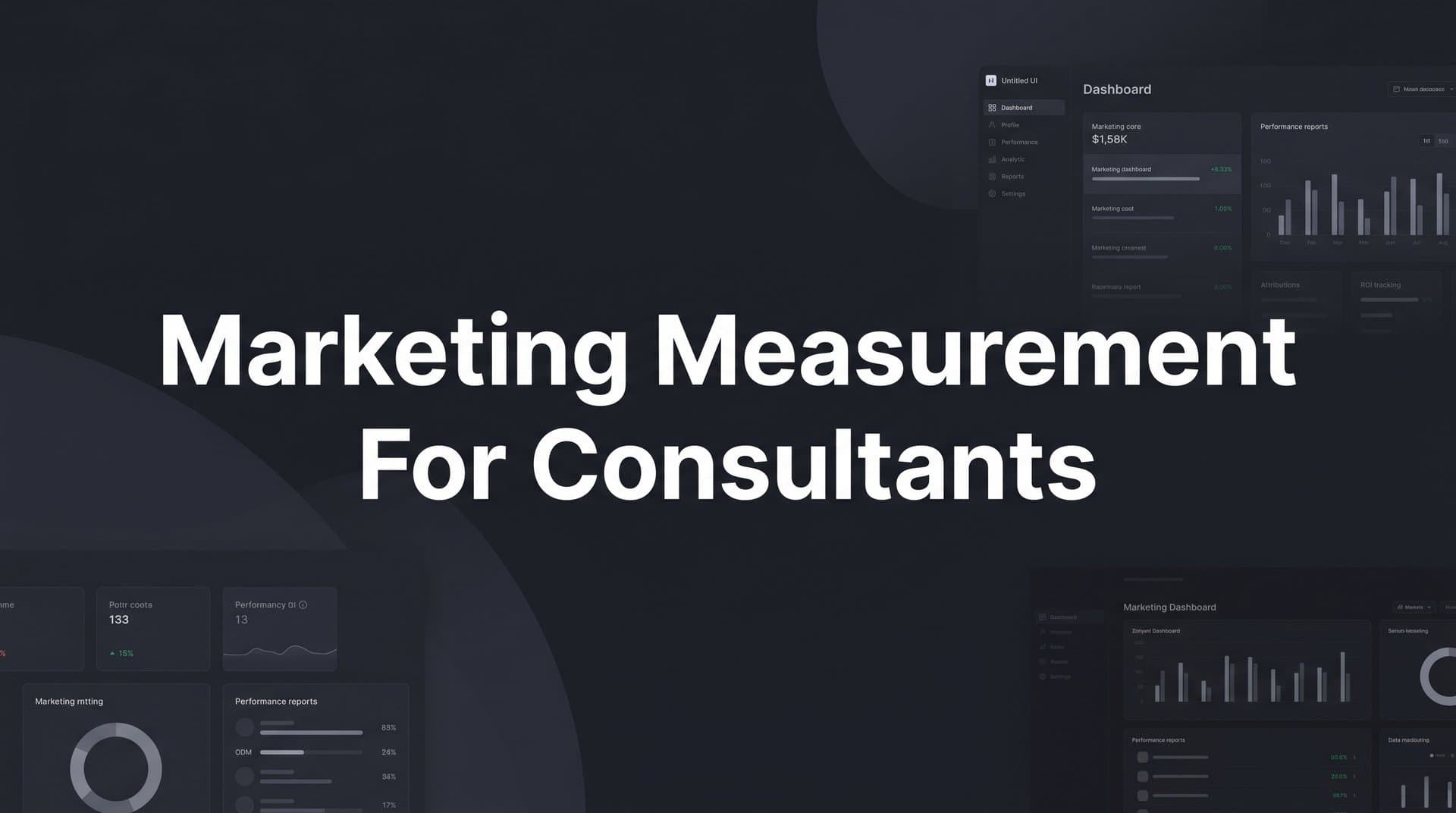
A unified marketing dashboard centralizes all channel data into a single view structured around the outcomes your client cares about: pipeline created, cost per opportunity, revenue influenced, and channel contribution. It removes the need for clients to interpret data from multiple disconnected platforms and positions you as the source of truth for marketing performance.
The key design principle is to organize the dashboard around business outcomes, not ad metrics. A dashboard that leads with pipeline created and cost per acquisition tells a fundamentally different story than one that leads with impressions and click-through rate. The former positions you as a strategic partner. The latter positions you as a campaign manager.
Cometly's dashboard is built around this philosophy, connecting ad spend data to pipeline and revenue outcomes so consultants can report on what actually matters to the business. When clients see a clear line between marketing investment and pipeline generated, the conversation shifts from "what did we spend" to "how do we scale what is working." Choosing the right marketing analytics platform is one of the most important infrastructure decisions you will make for your consulting practice.
Implementation Steps
1. Identify the three to five metrics that most directly reflect your client's business goals and build the dashboard around those.
2. Connect all active ad platforms and your CRM into a single reporting tool that normalizes data across sources.
3. Establish a consistent reporting cadence and share the dashboard link directly with clients so they have access to live data between formal check-ins.
Pro Tips
Add a brief written commentary section to each reporting period. Numbers tell you what happened; your commentary explains why and what you are doing about it. That combination of data and narrative is what separates consultants who are seen as reporters from those who are seen as strategic advisors.
6. Connect Ad Spend Directly to Pipeline and Revenue
The Challenge It Solves
Cost-per-lead conversations put consultants in a vulnerable position. Clients can always find a channel that generates cheaper leads, even if those leads never close. When your measurement framework stops at lead volume, you are competing on a metric that does not reflect actual business value. The shift to pipeline and revenue attribution changes that dynamic entirely.
The Strategy Explained
Connecting ad spend to pipeline and revenue means integrating your ad platform data with CRM pipeline stages and, where possible, closed-won revenue data. When you can show that a specific campaign sourced $200,000 in pipeline at a cost of $8,000, the conversation about whether that campaign is worth running answers itself.
This integration typically involves passing lead source data through the CRM so that as deals progress through pipeline stages, you can attribute their value back to the originating campaign. For clients using Stripe or similar billing tools, integrating revenue data with ad spend data gives you a true ROI calculation rather than a proxy metric. Understanding the return on marketing investment formula gives you a precise framework for presenting these calculations to clients in terms they immediately understand.
Cometly supports this kind of end-to-end attribution, connecting ad platform data with CRM pipeline stages and Stripe revenue data so consultants can move client conversations from cost-per-lead to payback period and revenue ROI. That is a fundamentally different and more defensible way to demonstrate value.
Implementation Steps
1. Ensure lead source and campaign data is being captured and stored in your client's CRM at the point of lead creation.
2. Map CRM pipeline stages to marketing-influenced touchpoints so you can calculate pipeline contribution by channel and campaign.
3. Where revenue data is available via Stripe or CRM closed-won fields, integrate it with ad spend data to calculate true channel ROI and payback period.
Pro Tips
Not every client will have clean CRM data from day one. If you inherit a messy CRM setup, prioritize fixing lead source tracking before anything else. Accurate attribution downstream depends entirely on capturing the correct source at the top of the funnel. A few weeks of clean data is worth more than months of incomplete historical data.
7. Use AI-Driven Insights to Scale What Works Faster
The Challenge It Solves
Consultants managing multiple clients or large ad budgets face a real challenge: there is more campaign data to analyze than there is time to analyze it manually. Identifying which campaigns to scale, which to pause, and which to adjust requires pattern recognition across large data sets. Without AI assistance, consultants either miss opportunities or spend disproportionate time on analysis instead of strategy.
The Strategy Explained
AI-driven analytics tools surface patterns in campaign data that would take hours to find manually. They can identify which campaigns are generating the highest quality pipeline, flag underperforming ad sets before they waste significant budget, and recommend where to reallocate spend based on historical performance signals.
Beyond internal analysis, AI-driven insights also improve ad platform performance through a feedback loop. When you feed enriched first-party conversion data back to Meta and Google via server-side tracking, their machine learning models get better signals about who is actually converting. This improves targeting accuracy and typically reduces cost per acquisition over time because the platforms are optimizing toward real business outcomes rather than proxy events. The broader impact of artificial intelligence on marketing strategies is reshaping how consultants analyze performance and make budget decisions at scale.
Cometly's AI ads manager is designed for exactly this use case. It analyzes performance across channels, surfaces high-performing campaigns, and provides recommendations on where to scale or cut spend. For consultants who want to move faster and make more confident budget decisions, having AI surface the signal from the noise is a meaningful competitive advantage.
Implementation Steps
1. Consolidate your campaign data into a platform with AI-powered analysis capabilities so recommendations are based on cross-channel performance, not siloed platform data.
2. Set up enriched conversion event sharing back to Meta and Google using first-party data to improve their optimization algorithms.
3. Use AI recommendations as a starting point for budget allocation discussions with clients, framing them as data-driven insights rather than manual guesses.
Pro Tips
AI recommendations are only as good as the data feeding them. Before relying on AI-driven insights, make sure your tracking setup is clean, your attribution model is appropriate for the sales cycle, and your conversion events reflect real business outcomes. Garbage in, garbage out applies here just as much as anywhere else in analytics.
Putting It All Together
Consultants who build strong measurement systems do not just report results. They shape strategy, justify budget decisions, and become the trusted partner clients renew year after year.
The seven strategies outlined here form a progressive framework. Start with aligned goals by creating a pre-campaign measurement brief. Choose an attribution model that reflects the complexity of your client's sales cycle. Track every touchpoint by connecting ad platforms, CRM data, and website behavior. Protect data accuracy with server-side tracking. Centralize reporting in a dashboard built around pipeline and revenue outcomes. Connect ad spend directly to closed revenue to move beyond cost-per-lead conversations. Then let AI surface what to scale next.
Each layer builds on the last. A well-defined measurement brief makes attribution model selection more purposeful. Clean journey tracking makes revenue attribution possible. Accurate server-side data makes AI recommendations trustworthy. The whole system compounds over time.
Start by auditing your current tracking setup. Identify where data gaps exist and which attribution model fits your client's sales cycle. Then build toward a dashboard that tells the full revenue story, not just the ad story.
Platforms like Cometly are built specifically for this kind of work, connecting ad platforms, CRM data, and revenue signals into one place so consultants can deliver clear, credible answers to the question every client is asking: what is actually driving growth? Get your free demo today and start capturing every touchpoint to maximize your conversions.