Every dollar in your marketing budget is a decision. Spend it on the wrong channel, and you lose pipeline. Spend it on the right one, and you compound growth. Yet most B2B SaaS marketing teams still allocate budget based on gut instinct, last year's plan, or whoever makes the loudest case in a planning meeting.
That approach works until it doesn't. And by the time you notice it isn't working, you've already burned through a quarter of budget with little to show for it.
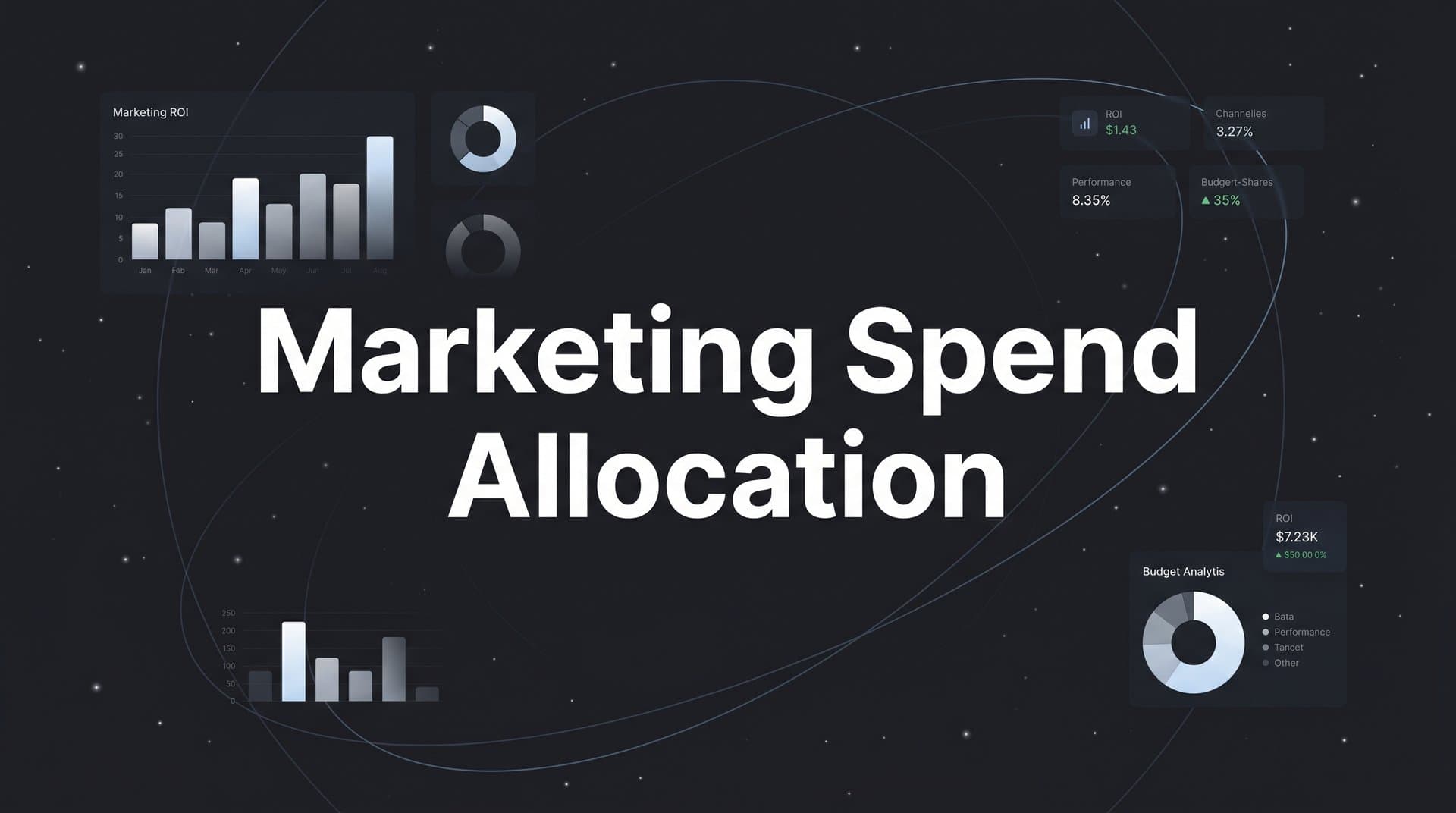
Marketing spend allocation is the process of distributing your marketing budget across channels, campaigns, and initiatives in a way that maximizes return. Done well, it connects every dollar spent to pipeline created and revenue closed. Done poorly, it creates a situation where you're spending confidently but measuring nothing.
This guide walks B2B SaaS marketing teams through a structured, data-driven process for allocating marketing spend. You'll learn how to audit what you're currently spending, define the right performance benchmarks, use attribution data to identify what's actually driving revenue, and build a budget framework you can adjust in real time.
By the end, you'll have a repeatable system for making smarter budget decisions, not just once during planning season, but continuously throughout the year. Whether you're managing a lean growth budget or scaling a multi-channel paid program, these steps apply. The goal is the same: stop guessing and start allocating with confidence.
Step 1: Audit Your Current Marketing Spend
Before you can allocate smarter, you need to know exactly where your money is going right now. Most marketing teams are surprised by what they find when they actually do this exercise.
Start by pulling a complete inventory of every channel, tool, and campaign you're currently funding. That means paid ads across every platform, content production costs, SEO tools, event sponsorships, webinar software, email platforms, and every SaaS subscription sitting in your marketing stack. Don't leave anything out. The goal is a full picture, not a tidy one.
Once you have your inventory, categorize each line item into one of three buckets: acquisition, retention, or brand awareness. This step alone often reveals a mismatch between where teams think their budget is going and where it's actually going. You might discover that a significant portion of your "growth" budget is actually funding retention activities, or that brand spending is higher than anyone realized because it's scattered across multiple line items.
Next, look at each item and ask a simple question: does this have attribution data attached to it? If you're spending on a channel with no visibility into performance, flag it immediately. Understanding SaaS marketing spend benchmarks can help you quickly identify where your allocations are out of line with industry norms. Spending without measurement isn't marketing investment, it's a guess with a budget line.
While you're in the audit, look for duplicate tools or overlapping investments. It's common for B2B SaaS teams to accumulate multiple tools that serve similar functions, especially after rapid hiring or team changes. These redundancies consume budget without adding differentiated value.
Pro tip: Assign an owner to every line item in your audit. If no one owns it, no one is accountable for its performance. That's often a signal the spend should be cut or consolidated.
Success indicator: You have a single spreadsheet or dashboard showing every line item of marketing spend with a category, owner, and current performance status. If you can't build that document, you're not ready to allocate, you're just redistributing the same blind spots.
Step 2: Define Your Attribution Model Before You Allocate
Here's a mistake that derails even experienced marketing teams: they start making budget decisions before agreeing on how to measure performance. The result is that two people can look at the same channel data and reach completely opposite conclusions about where to cut or increase spend.
Your attribution model determines how credit for conversions gets distributed across the touchpoints in a customer journey. And in B2B SaaS, where buying cycles are long and involve multiple stakeholders across multiple channels, that choice has enormous consequences for your budget decisions.
Let's walk through the practical differences. With first-touch attribution, all credit goes to the channel that first brought someone into your funnel. This is useful for understanding which channels are best at generating awareness and top-of-funnel demand. But it tells you nothing about what actually moves deals forward or closes them.
Last-click attribution does the opposite: it gives all credit to the final touchpoint before conversion. This tends to over-reward retargeting and branded search while ignoring the channels that built awareness and intent earlier in the journey. In a B2B SaaS context where a prospect might engage with your content for weeks before requesting a demo, last-click attribution will consistently mislead your budget decisions.
Multi-touch attribution models, including linear, time-decay, and data-driven variants, distribute credit across all touchpoints in the customer journey. This gives you a more complete picture of which channels assist conversions versus which ones close them. For B2B SaaS teams managing complex, multi-channel programs, this is generally the most accurate foundation for budget decisions. If you're evaluating your options, a detailed guide to building a marketing attribution model can help you choose the right approach for your team.
There's another layer worth adding: pipeline attribution and revenue attribution. Most marketing teams default to measuring channel performance by lead volume or cost per lead. But in B2B SaaS, a channel that generates a high volume of low-quality leads can look great on a CPL basis while actually destroying pipeline quality. The right benchmarks are cost per opportunity and cost per closed-won deal.
The consistency principle: Whichever model you choose, your entire team needs to use it consistently. Mixed attribution models across different reports create confusion and conflict. You end up in budget meetings where the paid team is defending their numbers with one model and the content team is defending theirs with another. That's not a data problem, it's a process problem.
Success indicator: Your team has agreed on a single attribution model and is measuring channel performance against pipeline and revenue, not just clicks or form fills. This agreement should be documented and referenced in every budget review.
Step 3: Connect Ad Spend to Pipeline and Revenue Data
This is where most B2B SaaS marketing stacks have a critical gap. Ad platforms report on clicks, impressions, and platform-defined conversions. CRMs track opportunities, deal stages, and closed revenue. But in most setups, these two datasets never actually talk to each other.
The result is that your marketing team is making budget decisions based on ad platform metrics that have no connection to what's happening in your pipeline. You might be scaling a campaign that looks great on Google Ads but generates opportunities that never close. Or you might be underfunding a LinkedIn campaign that looks expensive on a CPL basis but consistently sources your highest-value deals.
Closing this gap requires connecting your ad platforms to your CRM at the campaign level. That means being able to trace a closed-won deal back to the specific ad campaign, ad set, and even the ad creative that initiated or influenced the journey. This isn't a reporting luxury, it's the foundation of accurate marketing spend allocation. Teams that have successfully connected marketing data to revenue consistently make faster, more confident budget decisions.
The infrastructure layer that makes this connection reliable is server-side tracking combined with Conversion API integration. Browser-based pixels are increasingly unreliable due to ad blockers, browser privacy settings, and iOS privacy changes. Server-side tracking sends conversion data directly from your server to ad platforms, bypassing these limitations and improving data accuracy significantly.
First-party data enrichment takes this further. When you enrich the conversion events you send back to ad platforms with CRM data, including deal value, customer segment, and lead quality signals, you improve event match quality. This directly affects how well ad platforms can optimize your campaigns toward the outcomes that actually matter to your business.
Cometly is built specifically to close this loop for B2B SaaS teams. It connects ad spend data from Meta, Google, and LinkedIn to CRM pipeline and Stripe revenue data, giving you a single source of truth for what each channel is actually worth. Instead of toggling between ad dashboards and CRM reports, you can see cost per opportunity and revenue attributed to each campaign in one place.
Success indicator: You can look at a single report and see cost per opportunity, cost per closed deal, and revenue attributed to each channel or campaign. If you can't do that today, this is the most important infrastructure investment you can make before your next budget cycle.
Step 4: Score Each Channel by Revenue Contribution
Once your attribution data is connected to pipeline and revenue, you have what you need to score your channels objectively. This is where the gut-instinct budget conversations get replaced by something more defensible.
Use a three-metric scoring framework for each active channel. First, cost per pipeline dollar: how much do you spend to generate one dollar of pipeline opportunity? Second, conversion rate from lead to closed-won: what percentage of leads from this channel actually become customers? Third, average deal size influenced: what is the typical contract value of deals where this channel played a role?
When you apply these three metrics, the channel rankings often look very different from what CPL or CTR data would suggest. A channel that looks expensive on a cost-per-click basis might rank highly on all three revenue metrics because it consistently attracts enterprise buyers with high intent. A channel that generates a high volume of cheap leads might score poorly because those leads rarely convert and tend to be smaller deals. Learning how to prove marketing channel value with this kind of data makes budget conversations far more productive.
This is also where assisted conversions become important to account for. Some channels rarely appear as the last touch before a conversion, but they consistently show up early in the journeys of your highest-value customers. If you score channels purely on closed-won attribution, you'll undervalue these top-of-funnel contributors and potentially cut them, only to see pipeline quality decline months later.
AI-driven insights can surface these patterns more reliably than manual analysis, especially when you're running multi-channel programs with large volumes of data. Cometly's AI layer identifies which ads and campaigns are driving high-value outcomes across channels, flagging performance patterns that would take hours to find manually.
Success indicator: Every active channel has a revenue contribution score and a clear verdict: scale, maintain, test, or cut. If you can't assign a verdict to a channel because you don't have the data to support one, that's itself a signal that the channel needs better measurement before it receives more budget.
Step 5: Build Your Allocation Framework Using Performance Tiers
With your channel scores in hand, you're ready to build a structured allocation framework. The goal is to move away from arbitrary percentage splits and toward a system that reflects actual performance evidence.
A three-tier budget structure works well for most B2B SaaS teams. The first tier is your core channels: channels with proven ROI, consistent pipeline contribution, and strong revenue attribution scores. These receive the majority of your budget, typically in the range of 60 to 70 percent. Core channels are not immune to review, but they earn their allocation through demonstrated results.
The second tier is your test channels: channels that show early promise or are strategically important but haven't yet proven consistent ROI. These receive a smaller exploratory allocation, enough to generate meaningful data but not so much that underperformance creates significant damage. Think of this as your structured learning budget. For a deeper look at how to structure these decisions, the principles behind optimizing ad spend allocation apply directly to tier-based frameworks.
The third tier is your experimental channels: new bets, emerging platforms, or entirely new formats you want to explore. These receive a minimal allocation. The goal here is not ROI, it's learning. If an experiment graduates to the test tier, you increase its allocation and apply more rigorous measurement.
The right percentage split across tiers depends on your growth stage. Early-stage teams in growth mode may want to weight test and experimental channels more heavily because they're still discovering what works. Teams in scaling mode should concentrate budget in proven core channels while maintaining a disciplined test allocation. Teams in optimization mode focus primarily on efficiency improvements within core channels.
One allocation area that's easy to undervalue is brand and demand generation. These activities don't produce immediate pipeline, which makes them vulnerable to cuts when short-term numbers are under pressure. But cutting brand investment based on short-term data can damage pipeline months down the line when the compounding effect of reduced awareness shows up in your acquisition numbers.
Build reallocation triggers into your framework. These are specific performance thresholds that automatically prompt a budget review: a cost per opportunity exceeding a defined ceiling, a conversion rate dropping below a floor, or a channel's ROAS falling under a minimum threshold. Triggers remove the emotional component from budget decisions and create a systematic optimization process.
Success indicator: You have a documented budget framework with clear tier assignments, percentage ranges, and defined criteria for moving spend between tiers. This document should be a living reference, not a one-time planning artifact.
Step 6: Implement Real-Time Monitoring and a Reallocation Cadence
A well-designed allocation framework only works if you're monitoring it continuously. Static annual budgets fail in performance marketing because channel performance changes faster than annual planning cycles can respond to. By the time you discover a channel has been underperforming for three months, you've already misallocated a significant portion of your budget.
Start by setting up a marketing dashboard that surfaces channel performance against budget in real time. This isn't a monthly report, it's a live view that lets you see whether your spend is tracking toward the outcomes you planned for. Key metrics to surface: spend by channel versus plan, cost per opportunity by channel, pipeline generated versus target, and conversion rates at each funnel stage. A well-configured cross-platform marketing analytics dashboard makes this kind of visibility practical without requiring manual data pulls.
Layer a structured review cadence on top of your dashboard. Weekly reviews should focus on tactical adjustments: pausing underperforming ad sets, shifting budget between campaigns within a channel, or responding to early signals of audience saturation. Monthly reviews should operate at the channel level: are your tier assignments still accurate? Do any channels need to move up or down based on the last 30 days of data? Quarterly reviews are for strategic framework questions: is your tier structure still appropriate for your current growth stage? Do your reallocation triggers need recalibration?
Cross-channel analytics plays an important role here. Channel fatigue and audience saturation rarely announce themselves loudly. They show up as gradual increases in CPA, declining click-through rates, or falling conversion rates. Catching these signals early, before they erode ROI significantly, is one of the highest-value activities in performance marketing management. Teams that invest in cross-channel marketing attribution software are better positioned to spot these patterns before they become costly.
Document every reallocation decision with the reasoning behind it. This builds institutional knowledge that prevents your team from repeating the same experiments and helps new team members understand the logic behind your current allocation. Over time, this log becomes one of your most valuable marketing assets.
Success indicator: Your team has a live dashboard, a defined review cadence, and a documented log of budget decisions with the reasoning behind each one. If budget decisions are still happening ad hoc in Slack threads, you haven't built a system yet.
Step 7: Feed Performance Data Back to Ad Platforms to Improve Efficiency
Most teams treat attribution and tracking as a reporting function. The data flows in, gets analyzed, and informs decisions. But there's a second, equally important direction for that data to flow: back to the ad platforms themselves.
This is the feedback loop concept, and it's one of the most underutilized levers in B2B SaaS paid marketing. The conversion data you collect through attribution and revenue tracking can be sent back to ad platforms to improve their optimization algorithms. When you do this well, the platforms learn which audiences, signals, and behaviors correlate with your highest-value customers, and they optimize toward those patterns automatically.
The mechanism for this is Conversion API integration. Meta's Conversion API (CAPI) and Google's Enhanced Conversions allow you to send conversion events directly from your server to the ad platform, bypassing the limitations of browser-based pixels. But the real advantage comes from enriching those events with revenue data. Instead of sending a generic "lead submitted" event, you send a revenue-qualified event that tells the platform this lead became a customer worth a specific contract value.
When ad platforms receive these enriched signals, they can optimize your campaigns toward audiences that resemble your best customers, not just audiences that click. Over time, this produces better targeting, higher conversion rates, and lower cost per acquisition. The effect compounds: better data produces better targeting, which generates higher-quality leads, which produces more revenue data to feed back into the loop. Understanding how SaaS growth teams attribute revenue to marketing efforts reveals just how powerful this feedback loop can become at scale.
This step is frequently skipped by teams that are focused on reporting rather than optimization. They collect the data, build the dashboards, and stop there. The teams that treat attribution data as an optimization input rather than just a reporting output are the ones that see compounding efficiency gains over time.
Cometly's server-side tracking and Conversion API integration are designed specifically for this use case. By sending enriched, revenue-qualified conversion events back to Meta, Google, and other ad platforms, Cometly helps your campaigns optimize toward the outcomes that actually matter, reducing wasted spend and improving targeting quality continuously.
Success indicator: Your ad platforms are receiving enriched, revenue-qualified conversion events and your cost per acquisition is trending down as the algorithms improve targeting over time. If your ad platforms are still optimizing toward generic lead events with no revenue context, you're leaving significant efficiency gains on the table.
Putting It All Together: A Repeatable System for Smarter Budget Decisions
Marketing spend allocation is not a one-time planning exercise. It's an ongoing system that gets sharper as you feed it better data. Here's a quick checklist to confirm you've built that system:
Complete spend audit: You have a full inventory of every marketing line item with a category, owner, and performance status.
Agreed attribution model: Your team is using a single attribution model tied to pipeline and revenue, not just clicks or form fills.
Connected data sources: Your ad spend is connected to CRM and revenue data in a single source of truth, with cost per opportunity and cost per closed deal visible by channel.
Channel scoring: Every active channel has a revenue contribution score and a clear verdict on whether to scale, maintain, test, or cut.
Tiered budget framework: Your budget is structured in performance tiers with defined reallocation triggers and documented criteria for moving spend between tiers.
Live monitoring: You have a real-time dashboard and a weekly, monthly, and quarterly review cadence with documented decision logs.
Feedback loop active: You are sending enriched conversion data back to ad platforms to improve targeting and reduce cost per acquisition over time.
The teams that win on paid acquisition are not the ones with the biggest budgets. They're the ones who know exactly what each dollar is doing and adjust faster than their competitors. That advantage comes from infrastructure, process, and a commitment to measuring what actually matters.
Cometly gives B2B SaaS marketing teams the attribution infrastructure to do exactly that, connecting every ad click to closed revenue and surfacing the insights needed to allocate with confidence. If your current stack leaves gaps between ad performance and revenue data, that's where budget decisions go wrong, and that's precisely what Cometly is built to fix.
Ready to stop guessing and start allocating with precision? Get your free demo today and see how Cometly connects every touchpoint to revenue so your next budget decision is backed by data, not instinct.