You're running paid search, LinkedIn, Meta, email, and maybe a podcast sponsorship or two. Leads are coming in, pipeline is building, and the board wants to know where to double down heading into next quarter. So you pull the channel reports. And every single platform claims credit for the same deals.
This is the reality for most B2B SaaS marketing teams today. You're operating across more channels than ever, but the data telling you what's working is fragmented, contradictory, and often just wrong. The result is budget decisions made on gut feel dressed up as data-driven strategy.
A media mix optimization platform changes that dynamic entirely. Instead of relying on what each ad platform tells you about itself, you get a unified, attribution-backed view of how your channels actually interact and contribute to revenue. This article breaks down what these platforms do, how attribution models power smarter budget decisions, why first-party data quality matters more than most teams realize, and how to connect all of it to pipeline and closed-won revenue. If you manage marketing spend and want to allocate it more intelligently, this is the framework you need.
The Budget Allocation Problem Modern Marketers Face
Ask any growth marketer to describe their attribution setup, and you'll hear some version of the same story: "We look at each platform's dashboard, pull the numbers into a spreadsheet, and try to make sense of it." That process sounds reasonable until you realize that Google Ads, LinkedIn Campaign Manager, and Meta Ads Manager are each claiming full or partial credit for the same conversions.
This is the double-counting problem, and it's one of the most well-understood yet persistently ignored challenges in digital marketing. Each platform uses its own attribution window, its own conversion logic, and its own incentive to show you the best possible return on your spend with them. Add them all up and your reported conversions can easily exceed your actual conversions by a significant margin.
The downstream effect is a distorted picture of channel performance. High-visibility channels like branded paid search often look exceptional in platform dashboards because they capture intent that was generated elsewhere. Meanwhile, channels that do the heavy lifting earlier in the funnel, like LinkedIn awareness campaigns or organic content, get undervalued because they rarely show up as the final click before conversion.
When budget decisions are made based on this siloed data, teams tend to over-invest in channels that appear to perform well in isolation and under-invest in channels that assist conversions without claiming them. Over time, this compounds. You're not just misreading one quarter's performance; you're systematically reinforcing a misallocation that inflates customer acquisition costs and reduces pipeline efficiency. Investing in budget optimization software can help surface these hidden inefficiencies before they compound.
For B2B SaaS teams with long sales cycles, the problem is even more pronounced. A deal that closes after a 90-day evaluation period may have involved ten or more touchpoints across five channels. Crediting that deal to the last click before the demo request tells you almost nothing useful about what actually drove the purchase decision.
The reactive nature of siloed budget management also creates organizational friction. When every channel team can point to their own dashboard and claim success, there's no shared reality to anchor strategic conversations. Marketing leaders end up arbitrating between competing data stories rather than making clear, confident allocation decisions based on a single source of truth.
This is exactly the gap that a media mix optimization platform is designed to close.
What a Media Mix Optimization Platform Actually Does
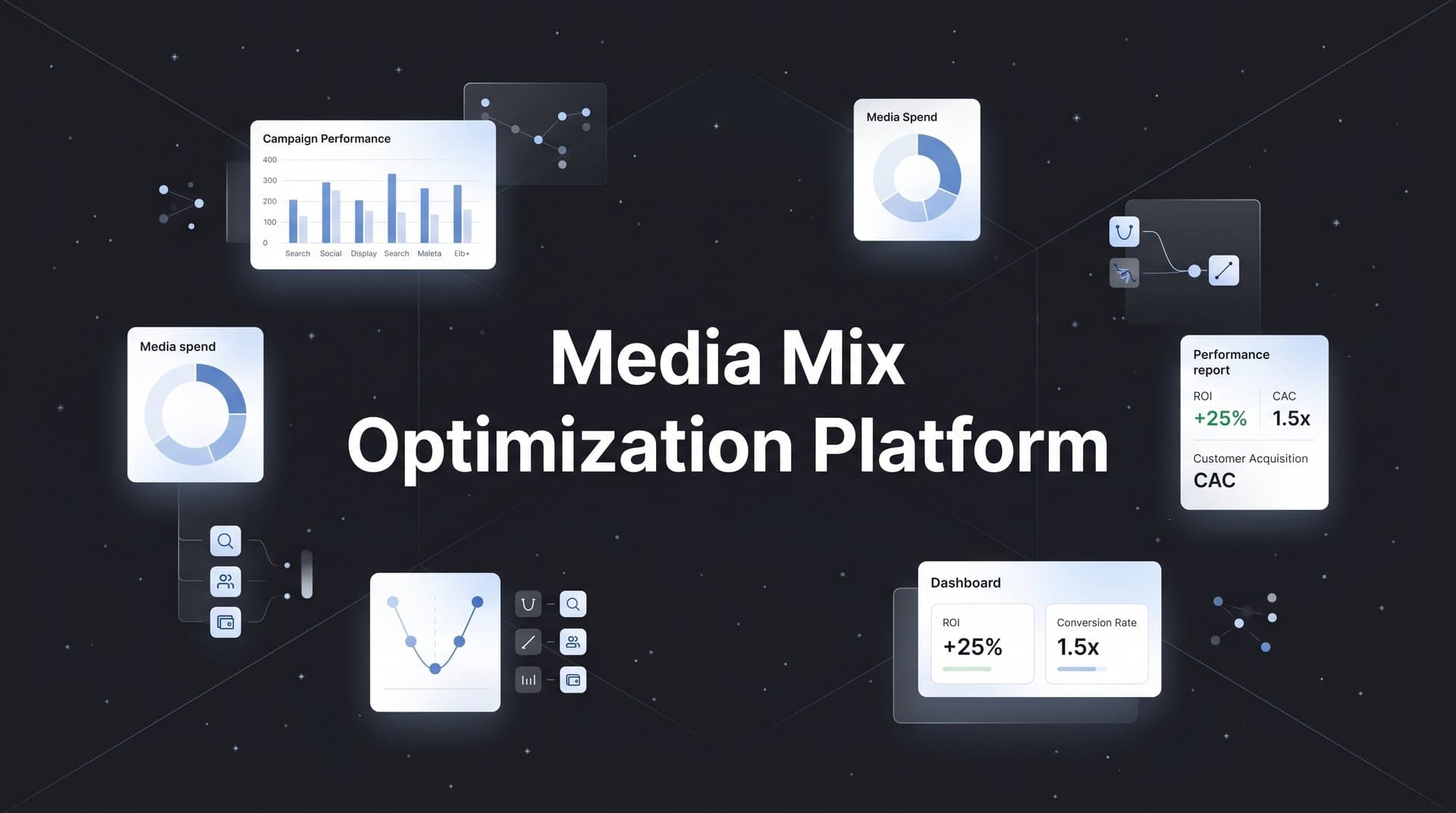
At its core, a media mix optimization platform aggregates performance data from across all your channels and applies modeling to answer one question: which channels are actually driving revenue, and in what proportion?
This is different from what you get in any individual ad platform. Those tools tell you how a specific channel performed according to that channel's own rules. A media mix optimization platform sits above all of them, pulling in data from paid search, paid social, email, organic, events, and any other channel you run, and gives you a unified view of contribution across the full funnel.
For a deeper dive into this space, see our ad spend optimization software guide.
The distinction from traditional media mix modeling is worth clarifying. Classic media mix modeling uses aggregate, statistical analysis to estimate channel contribution based on historical spend and outcome data. It's useful for macro-level planning but tends to lag in real time and doesn't capture individual customer journeys. Multi-touch attribution, by contrast, uses individual-level data to assign credit to specific touchpoints in each customer's path to conversion. Modern platforms increasingly blend both approaches to give marketers a more complete and actionable picture.
The practical output looks like this: instead of seeing that LinkedIn generated 40 leads and Google Ads generated 60, you see that LinkedIn influenced 35 percent of closed-won deals as a first-touch channel, Google Ads captured high-intent searches mid-funnel, and retargeting on Meta accelerated the final conversion step. That's a fundamentally different story, and it leads to fundamentally different budget decisions.
To deliver this, the platform needs to connect several data sources. Ad spend and impression data from your ad platforms. Conversion and pipeline data from your CRM. Revenue data from your payment processor or CRM closed-won fields. Website behavior data from your tracking infrastructure. When these are unified and mapped to individual customer journeys, the platform can attribute pipeline and revenue back to the channels and campaigns that actually influenced each deal.
Key capabilities to look for when evaluating a media mix optimization platform include multi-touch attribution modeling, revenue attribution tied to actual closed-won data, real-time data syncing so your insights reflect current campaign performance, and deep integrations with the ad platforms and CRMs your team already uses. Reviewing the top marketing attribution platforms for revenue tracking can help you benchmark what best-in-class looks like. The goal is a single source of truth that replaces the spreadsheet reconciliation process with a live, accurate view of what your media mix is producing.
Without this infrastructure, budget allocation stays reactive. With it, you can make proactive, evidence-backed decisions about where to invest, where to pull back, and where you're leaving pipeline on the table.
How Attribution Models Power Media Mix Decisions
Not all attribution models are created equal, and the model you choose has a direct impact on how you perceive channel performance and, by extension, where you allocate budget.
Here's a quick breakdown of the most common models and what they surface:
Last-click attribution: Gives 100 percent of the credit to the final touchpoint before conversion. Simple to implement, but systematically undervalues every channel that contributed earlier in the journey. In B2B SaaS, this often means branded search captures all the credit for deals that LinkedIn or content marketing spent weeks nurturing.
First-touch attribution: Gives all credit to the channel that generated the initial awareness. Useful for understanding top-of-funnel channel effectiveness, but ignores everything that happened between awareness and conversion, which in a long B2B sales cycle is often where the real work happens.
Linear attribution: Distributes credit equally across all touchpoints in the customer journey. Better than single-touch models for capturing assisted channels, but treats a quick retargeting impression the same as a high-intent demo request, which doesn't reflect reality.
Data-driven attribution: Uses machine learning to assign credit to each touchpoint based on its actual statistical contribution to conversion. For B2B SaaS with complex, multi-stakeholder buying cycles, this model is most aligned with reality because it weights touchpoints based on observed patterns across your actual customer journeys rather than arbitrary rules.
The practical implication of switching models is significant. Many teams that move from last-click to multi-touch attribution discover that channels they were underinvesting in, particularly organic search, retargeting, and LinkedIn awareness, were consistently assisting conversions without receiving credit. Conversely, some channels that looked like top performers under last-click attribution turn out to be capturing intent generated elsewhere rather than creating it.
This matters because budget follows performance data. If your attribution model is showing you a distorted view of channel contribution, your budget allocation will be distorted in the same direction. Switching to a multi-touch or data-driven model doesn't just change a number in a report; it can fundamentally reshape how you think about your channel mix and where incremental investment will produce the highest return. Understanding the differences in attribution modeling vs marketing mix modeling is essential before committing to either approach.
For B2B SaaS teams specifically, the length and complexity of the buying cycle makes data-driven attribution particularly valuable. A deal that involves a content download, two LinkedIn ad exposures, an organic blog visit, a demo request, and a series of email nurtures before closing cannot be meaningfully attributed to any single touchpoint. The model needs to reflect the full journey, and data-driven attribution is built to do exactly that.
The Role of First-Party Data and Server-Side Tracking
All of this attribution work is only as good as the underlying data quality. And right now, data quality is under serious pressure.
Apple's App Tracking Transparency framework, browser-level cookie restrictions, and the gradual deprecation of third-party cookies have significantly degraded the accuracy of pixel-based tracking. When a user's browser blocks a tracking pixel or an ad blocker prevents a conversion event from firing, that conversion disappears from your attribution data entirely. The result is signal loss: your platforms see fewer conversions than actually occurred, which distorts both your reported performance and the algorithmic optimization that ad platforms use to target and bid on your behalf.
Server-side tracking addresses this problem directly. Instead of relying on a browser pixel to fire a conversion event, server-side tracking sends that event directly from your server to the ad platform, bypassing browser-level restrictions entirely. Conversion API integrations, available through Meta, Google, and other major platforms, work on the same principle: first-party conversion data is sent from the advertiser's infrastructure rather than from the user's browser.
The impact on media mix optimization is substantial. When your conversion data is complete and accurate, your attribution model has better inputs to work with. Channels that were losing signal due to pixel-based tracking limitations suddenly show their true contribution. Ad platform algorithms that optimize toward conversion signals receive richer, more accurate data, which improves targeting and bidding performance over time. This is especially critical for teams running Facebook conversion optimization, where signal loss from browser restrictions has the most direct impact on algorithmic performance.
Clean, deduplicated event data also prevents the inflation problem that occurs when both a browser pixel and a server-side event fire for the same conversion, creating a feedback loop where the quality of your attribution data directly influences the quality of your ad platform performance. Better data in means better optimization out.
For B2B SaaS teams running significant ad budgets, investing in server-side tracking and Conversion API integrations is not optional infrastructure. It's the foundation that makes everything else, including media mix optimization, actually work at the accuracy level required for confident budget decisions.
Connecting Media Mix Insights to Pipeline and Revenue
Channel-level clicks and impressions are not the output that matters. Pipeline contribution and revenue attribution are. The most powerful thing a media mix optimization platform can do is translate your channel performance data into the language your CFO and board actually care about: which channels are generating revenue, and at what cost?
For B2B SaaS teams, this requires thinking about the funnel in stages rather than treating all conversions as equivalent. A lead generated from a LinkedIn awareness campaign is not the same as a demo request from a high-intent branded search query. The former might require significant nurturing before it becomes pipeline; the latter might close in two weeks. If your media mix model treats both as identical conversion events, you're still missing a critical dimension of channel performance.
The more sophisticated approach maps media mix insights to specific funnel stages:
Top-of-funnel contribution: Which channels are generating qualified leads at an acceptable cost? Not just any leads, but leads that match your ICP and have a reasonable probability of becoming pipeline.
Pipeline acceleration: Which channels are touching deals that are already in the funnel and helping them move faster? Retargeting campaigns, nurture emails, and content assets often play this role without showing up prominently in top-of-funnel attribution.
Revenue influence: Which channels are consistently present in the journeys of deals that actually close? This is the ultimate measure of channel value, and it requires connecting your attribution data to closed-won revenue, not just to lead or demo conversion events.
Integrating Stripe or CRM closed-won data with your ad spend data is what makes this closed-loop view possible. When you can see that a specific LinkedIn campaign influenced 15 percent of your closed-won revenue last quarter while consuming only 10 percent of your budget, you have a concrete, defensible case for increasing that investment. When you can see that a channel is generating high lead volume but those leads rarely convert to closed deals, you have an equally concrete case for reallocating that budget elsewhere. A robust paid media analytics framework is what enables this level of closed-loop visibility.
Pipeline velocity adds another layer of insight. When channel attribution data is connected to deal velocity metrics from your CRM, you can identify not just which channels generate leads that convert, but which channels generate leads that convert faster. A channel that produces fewer leads but shorter sales cycles may deliver more revenue per dollar spent than a high-volume channel with long, uncertain conversion paths.
This level of analysis is what separates teams that scale efficiently from teams that grow their budget without growing their returns.
Building a Smarter Allocation Strategy With Media Mix Data
Understanding your media mix is only valuable if it changes how you allocate budget. Here's a practical framework for turning attribution insights into action.
Start with revenue attribution. Before optimizing anything, establish which channels have a documented connection to closed-won revenue. This is your baseline. Channels with strong revenue attribution and efficient cost-per-revenue metrics are your core investments. Protect them before making changes elsewhere.
Next, use multi-touch data to identify your assisted converters. These are channels that consistently appear in the journeys of deals that close but rarely receive last-click credit. Organic search, retargeting, and nurture email sequences often fall into this category. If you're underinvesting in these channels because they look weak in single-touch reports, multi-touch attribution will surface that gap. Leveraging a dedicated marketing spend optimization process ensures these assisted channels receive the budget they deserve.
Then reallocate toward the combination that drives the lowest customer acquisition cost at the highest pipeline velocity. This is not a one-time exercise. As your campaigns evolve, as new channels emerge, and as your ICP shifts, your optimal media mix will shift with it. The goal is a continuous optimization loop where attribution data informs budget decisions on a regular cadence, not just at annual planning time.
AI-driven recommendations within attribution platforms accelerate this process significantly. Manually analyzing performance patterns across dozens of campaigns, multiple channels, and thousands of customer journeys is time-intensive and prone to the same cognitive biases that created the misallocation problem in the first place. AI can surface patterns that manual analysis would miss: which ad sets are generating high-quality pipeline, which audience segments are converting at unusual rates, and where incremental budget is likely to produce the highest return. Purpose-built AI ads optimization tools are increasingly capable of automating these recommendations at scale.
This is where Cometly brings everything together. Cometly is built specifically for B2B SaaS teams that need to connect first ad click to closed-won revenue in a single platform. With multi-touch attribution, server-side conversion tracking, Conversion API integrations with Meta and Google, AI-driven ad recommendations, and 70+ native integrations including CRMs and Stripe, Cometly provides the attribution infrastructure that makes media mix optimization actionable rather than theoretical. You get real-time insights into which channels are driving pipeline and revenue, AI recommendations that identify high-performing campaigns across every channel, and the ability to feed enriched conversion data back to your ad platforms to improve algorithmic performance.
The result is a media mix strategy grounded in actual revenue data, not platform-reported impressions or siloed conversion counts.
The Bottom Line on Media Mix Optimization
Media mix optimization is not a reporting exercise. It is a strategic capability that determines whether your marketing budget compounds into efficient growth or slowly erodes into inflated CAC and stagnant pipeline.
The teams that scale efficiently are the ones that have built the infrastructure to answer the right questions: Which channels are actually driving revenue? How do they interact across the customer journey? Where is budget being misallocated based on misleading platform data? What does the data say about where incremental investment will produce the highest return?
Answering those questions requires attribution modeling that goes beyond last-click, first-party data infrastructure that maintains signal quality in a privacy-constrained environment, and pipeline-level insights that connect channel performance to closed-won revenue rather than proxy metrics.
When all of that comes together in a single platform with AI-driven recommendations, media mix optimization shifts from an aspiration to an operational advantage.
Ready to see which channels are actually driving your revenue? Get your free demo and discover how Cometly's real-time attribution and AI recommendations give you the clarity to optimize your media mix with confidence.