You're running ads on Meta, Google, TikTok, and LinkedIn at the same time. Each platform has its own dashboard, its own numbers, and its own version of the truth. When you add up the conversions reported across all four, the total is somehow higher than your actual sales. Sound familiar?
This is the central frustration of modern paid advertising. You're not doing anything wrong. The platforms are simply designed to take credit wherever they can, using their own attribution windows and tracking logic. The result is a reporting environment where every channel looks like a winner, your budget decisions feel like educated guesses, and the real story of what's driving revenue stays buried.
Multiple marketing channels reporting is the practice of pulling performance data from every paid and organic channel into a single, accurate view, one that connects ad spend to actual revenue rather than platform-reported proxies. Done well, it transforms how you allocate budget, how you evaluate channel performance, and how confidently you can scale. This guide will walk you through why unified reporting is so difficult, what it actually requires to build, and how modern marketing teams are solving it.
Why Every Ad Platform Tells a Different Story
Here's the core problem: Meta, Google, TikTok, and LinkedIn are all competing for credit. Each platform deploys its own tracking pixel, uses its own attribution window, and applies its own conversion logic. When a customer sees a Meta ad on Monday, clicks a Google ad on Wednesday, and converts on Friday, both platforms claim that sale. So does TikTok if the customer watched a video there in between.
This isn't a bug. It's how these platforms are built. Each one is optimized to show its own value to advertisers. Meta might use a seven-day click and one-day view attribution window by default. Google Ads might credit the last click before conversion. TikTok might use a different window entirely. The definitions don't align, and the counting logic doesn't coordinate. So when you pull numbers from each dashboard and add them up, you get a total that can be significantly higher than your actual transaction count.
The gap between platform-reported conversions and real revenue in your CRM or payment processor is sometimes called the attribution inflation problem. Many marketers discover this the hard way when they compare their ad platform totals against actual orders and find the numbers don't reconcile. That discrepancy makes it nearly impossible to know which marketing channels work best and are genuinely earning their budget.
Privacy changes have made this worse. Apple's App Tracking Transparency framework, introduced with iOS 14.5 and now standard across iOS devices, limited the ability of platforms like Meta to track user behavior across apps. Browser-level restrictions on third-party cookies have created similar blind spots on the web. The result is that pixel-based tracking, which relies on a small piece of code running in a user's browser, misses more conversions than it used to. Platforms respond by using modeled data to fill in the gaps, which means some of what you see in your dashboard is an estimate, not a measured result.
The practical consequence is that platform-native reporting has become less reliable precisely as ad budgets have grown and marketers have expanded to more channels. Trusting any single platform's dashboard as your source of truth is a recipe for misallocated spend.
The Building Blocks of Unified Channel Reporting
Building reliable multiple marketing channels reporting starts with understanding what needs to be connected and why. There are three foundational components, and skipping any one of them creates gaps that undermine the whole system.
A single source of truth: Your CRM or payment processor holds the actual record of what happened. A lead was created. A deal was closed. A transaction was completed. This is your ground truth, and all channel reporting should ultimately connect back to it. Platform-reported metrics like clicks, impressions, and even reported conversions are useful signals, but they should be interpreted in light of what your CRM confirms actually happened.
Consistent UTM and tracking conventions: UTM parameters are the tags you append to URLs in your ads so that analytics tools can identify where traffic came from. If your Meta campaigns use one naming format, your Google campaigns use another, and your TikTok campaigns are inconsistently tagged or not tagged at all, your centralized reporting will be a mess. You need a standardized naming convention applied consistently across every channel, every campaign, and every ad. This is unglamorous work, but it's the connective tissue of cross-channel reporting.
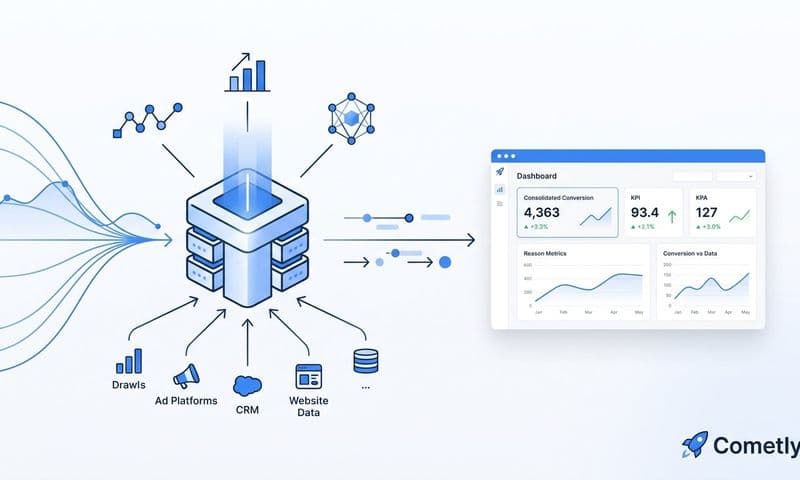
A centralized analytics layer: You need a system that sits above your individual ad platforms and connects click data to revenue data. This is where a unified marketing reporting tool earns its value. Rather than looking at each platform in isolation, a centralized layer pulls data from all your channels, matches it against actual conversions in your CRM, and gives you a view of the full customer journey.
Server-side tracking has become an increasingly important part of this infrastructure. Unlike pixel-based tracking, which depends on a user's browser to fire a tracking script, server-side tracking sends data directly from your company's server to the analytics system. It bypasses browser restrictions, ad blockers, and the data gaps created by privacy changes. For marketers who need accurate attribution in a post-iOS-14 world, server-side tracking is no longer optional. It's the foundation of reliable data.
Attribution models are the final building block worth understanding. First-touch attribution gives all credit to the channel that introduced the customer. Last-touch attribution gives all credit to the channel that drove the final conversion. Multi-touch models, including linear, time-decay, and position-based variations, distribute credit across multiple touchpoints in the customer journey. There is no universally correct model. The right choice depends on your sales cycle, your channel mix, and what decisions you're trying to make. Understanding the types of marketing attribution models available helps you pick one deliberately and apply it consistently, rather than defaulting to whatever each platform reports by default.
Common Pitfalls That Wreck Cross-Channel Reports
Even teams that understand the theory of unified reporting often struggle with execution. A few recurring mistakes tend to undermine the effort before it gains traction.
Inconsistent naming conventions: This is the most common and most avoidable problem. If your paid search team tags campaigns one way, your paid social team tags them another way, and your email team doesn't use UTMs at all, your centralized reporting will be fragmented from the start. You can't compare channel performance if the data isn't structured the same way. Establishing a shared UTM taxonomy before launching campaigns, and enforcing it, is one of the highest-leverage things a marketing ops team can do.
Relying on platform dashboards as the final word: Each platform's native dashboard is designed to make that platform look valuable. That's not cynicism; it's just the reality of how these tools are built. When you use Meta Ads Manager to evaluate Meta, Google Ads to evaluate Google, and TikTok Ads Manager to evaluate TikTok, you're getting each platform's best case for itself. You're not getting a neutral, revenue-connected view of how your total marketing investment is performing. Teams that never connect their ad platform data to CRM or revenue data often end up over-investing in channels that look strong in isolation but contribute less to actual pipeline than the numbers suggest. Understanding the dilemma of attribution in marketing helps explain why this happens so frequently.
Looking at channels in isolation: Customers rarely convert after a single touchpoint. A typical B2B or considered-purchase journey might involve a display ad, a retargeting ad, an organic search visit, and a direct visit before a conversion happens. If you evaluate each channel independently, you'll likely undervalue the upper-funnel channels that introduce customers and over-credit the lower-funnel channels that close them. Understanding how channels work together requires looking at the full journey, not just the last click. This is precisely what multi-touch attribution is designed to reveal.
The common thread across all three pitfalls is treating channels as separate entities rather than parts of a connected system. Multiple marketing channels reporting only works when the data is structured consistently, connected to real outcomes, and analyzed with the full customer journey in mind.
A Step-by-Step Framework for Consolidating Channel Data
Knowing what unified reporting requires is one thing. Building it is another. Here's a practical framework that moves from audit to implementation to ongoing analysis.
Step 1: Audit your current tracking setup. Before you can fix anything, you need to know what's broken. Pull a list of every active campaign across every channel and check whether UTMs are present, consistent, and correctly formatted. Look at your conversion events in each platform and verify that they're tracking the right actions. Compare platform-reported conversion totals against your CRM or payment data for the same time period. The gap you find is your baseline. It tells you how much data you're currently missing or miscounting, and it gives you a benchmark to measure improvement against. Learning how to track conversions across multiple channels is the essential first step in this audit process.
Step 2: Implement server-side tracking and connect your systems. Once you've identified the gaps, close them at the infrastructure level. Implement server-side tracking so that conversion data flows from your server rather than depending on browser pixels. Connect your ad platforms, your website analytics, and your CRM into a unified system. The goal is to ensure that every touchpoint, from the first ad click to the final purchase, is captured in one place. Exploring proven solutions for integrating multiple marketing channels can accelerate this step significantly. This often requires technical resources, but it's the foundation everything else depends on.
Step 3: Choose an attribution model and build revenue-based dashboards. With clean data flowing into a centralized system, you can now apply an attribution model that reflects how your customers actually buy. If your sales cycle is short and customers typically convert quickly, last-touch or time-decay models may be appropriate. If your cycle is long and involves multiple research touchpoints, a linear or position-based model may give you a more accurate picture. Build dashboards that use revenue or pipeline value as the primary metric, not clicks or impressions. Cost-per-acquisition by channel, tied to actual closed revenue, is the number that should drive your budget conversations.
This three-step process isn't a one-time project. It's an ongoing discipline. Tracking setups drift over time as new campaigns launch, new channels are added, and platforms change their tracking behavior. Regular audits and a commitment to consistent conventions are what keep your reporting reliable as your marketing program scales.
How Unified Reporting Changes Budget Decisions
The practical value of multiple marketing channels reporting shows up most clearly when it's time to allocate budget. Without a unified view, budget decisions tend to favor the loudest channels, the ones with the most impressive platform-reported metrics. With a unified view, you can make decisions based on what's actually driving revenue.
When you can track marketing ROI across channels, tied to actual closed deals or transactions rather than platform-reported conversions, the picture often looks different than you'd expect. Channels that appear expensive based on click costs might deliver the highest-quality leads. Channels that report strong conversion numbers in their own dashboards might not hold up when you compare against CRM data. The unified view cuts through the noise.
Unified reporting also reveals the difference between channels that assist conversions and channels that close them. Upper-funnel channels like display advertising or social video often introduce customers to your brand without being the last touchpoint before conversion. If you evaluate those channels only on last-click conversions, they'll look ineffective, and you might cut them. But if you can see that many of your best customers first encountered your brand through those channels, you'll understand their actual contribution to pipeline. Cutting them would be a mistake that hurts performance several weeks or months later.
There's another dimension to this that many teams overlook. When you send accurate, enriched conversion data back to your ad platforms, you improve their optimization algorithms. Meta and Google both use the conversion signals you send them to decide who to show your ads to next. If you're sending incomplete or delayed conversion data because your tracking has gaps, the platform's algorithm is working with a distorted picture. Better data in means better targeting out, which means less wasted spend and higher returns on your existing budget. Leveraging real-time marketing analytics makes this feedback loop even more powerful. This is one of the most underappreciated benefits of investing in accurate attribution infrastructure.
Putting It All Together: From Data Chaos to Clarity
The shift from fragmented, platform-reported metrics to a unified, revenue-connected view of your marketing channels is not a small change. It requires infrastructure investment, process discipline, and a willingness to question numbers that look good on the surface. But the payoff is substantial: budget decisions grounded in real data, a clear picture of how channels work together, and the confidence to scale what's actually working.
If you're starting from scratch, begin with the audit. Understand where your tracking is broken before you try to build anything on top of it. Then invest in server-side tracking and system integration so that every touchpoint feeds into one place. From there, apply a consistent attribution model and build dashboards that connect ad spend to revenue.
This is exactly the problem Cometly is built to solve. Cometly connects your ad platforms, CRM, and website into a single real-time attribution dashboard, giving you a complete view of every customer journey from the first ad click to the final conversion. Server-side tracking ensures you capture what browser pixels miss. Multi-touch attribution models let you compare how credit distributes across channels. AI-powered recommendations surface which campaigns are performing and where you should shift budget. And Cometly's Conversion Sync sends enriched conversion data back to Meta, Google, and other platforms so their algorithms work with the best possible information.
Multiple marketing channels reporting doesn't have to feel like guesswork. With the right foundation, it becomes one of the clearest competitive advantages a marketing team can build.
Ready to stop guessing and start making budget decisions backed by real data? Get your free demo of Cometly today and see how unified attribution can transform the way you understand and scale your marketing channels.