
Poor ad performance tracking is one of the most expensive problems a B2B SaaS marketing team can face. When your tracking is broken or incomplete, you are essentially flying blind. You spend budget on campaigns without knowing which ones actually drive pipeline, which channels convert to revenue, and which ads deserve more investment.
The result is predictable: wasted spend, misaligned teams, and decisions based on guesswork rather than data. Sales blames marketing for low-quality leads. Marketing defends spend with metrics that do not connect to revenue. Leadership loses confidence in the numbers. Everyone loses.
Here is the thing: poor ad performance tracking is not inevitable. It is a solvable problem with a clear, sequential process. Whether you are dealing with missing conversion data, attribution gaps, or tools that do not talk to each other, each step in this guide builds on the last to help you establish a tracking foundation that actually works.
This guide walks you through six concrete steps to diagnose and fix your tracking, followed by a checklist you can use on a recurring basis to keep your setup healthy as platforms evolve. By the end, you will have a system that connects your ad spend to actual revenue outcomes, giving your team the confidence to scale what works and cut what does not.
Let's get into it.
Step 1: Diagnose Where Your Tracking Is Breaking Down
Before you fix anything, you need to know exactly what is broken. Jumping straight to solutions without a clear diagnosis is how teams end up patching one gap while three others go unnoticed. Start with a full audit of your current tracking stack.
The goal here is simple: find every place where data is being lost, distorted, or simply never captured in the first place.
Check pixel firing across key pages. Open your ad platform's pixel helper tool or use browser developer tools to verify that your tracking pixels are firing correctly on every page that matters: landing pages, thank-you pages, demo request confirmations, and any other conversion points. Missing or misfiring pixels are a common and often overlooked source of data loss.
Audit your UTM parameters. Pull a source and medium report from your analytics tool and look at what you see. If you find dozens of variations of the same channel, such as "google," "Google," "google-ads," and "Google_Ads" all appearing as separate sources, your UTM tagging is inconsistent. This fragments your data and makes channel-level analysis unreliable.
Review your conversion event configuration. Go into each ad platform and check which actions are being tracked as conversions. Are they meaningful events like demo requests, free trial signups, or qualified form submissions? Or are you tracking page views and scroll depth as conversions? Tracking the wrong events inflates your numbers without telling you anything useful about revenue impact.
Cross-reference your data sources. Compare the conversion numbers reported in your ad platforms against what your CRM or analytics tool shows for the same time period. Significant discrepancies, which are common, point to gaps in your tracking setup. Document the size of each discrepancy so you have a baseline to measure improvement against.
Look for attribution window mismatches. Different platforms use different default attribution windows. Google Ads, Meta Ads, and LinkedIn Ads may all be claiming credit for the same conversion using different lookback windows. Understanding how each platform counts conversions helps you interpret discrepancies more accurately.
Write everything down. A simple spreadsheet with columns for the platform, the issue, and the estimated data impact is enough. This document becomes your repair roadmap for the steps that follow.
Success indicator: You have a written list of every tracking gap, missing data point, and inconsistency across your ad accounts. You know where the problems are before you start fixing them.
Step 2: Standardize Your UTM Tagging and Campaign Naming
Inconsistent UTM parameters are one of the most common causes of poor ad performance tracking, and they are entirely preventable. Without a standardized naming convention, the same traffic source can appear under dozens of different labels in your analytics tool, making it nearly impossible to accurately measure channel performance.
Think of UTM parameters as the language your tracking system uses to understand where traffic comes from. If everyone on your team speaks a slightly different dialect, the data becomes noise.
Build a complete naming convention. Your convention should cover all five UTM parameters: utm_source (the platform, such as google or meta), utm_medium (the traffic type, such as cpc or paid-social), utm_campaign (the campaign name), utm_content (the specific ad or creative), and utm_term (the keyword or audience, when applicable). Define exact values for each parameter and document them in a shared reference document.
Enforce lowercase and consistent formatting. Analytics tools treat "Google" and "google" as two different sources. Establish a rule that all UTM values use lowercase letters, hyphens instead of spaces, and no special characters. This single rule eliminates a significant portion of fragmentation issues.
Create a shared UTM builder. Build a simple spreadsheet or use a UTM builder tool that your entire team uses to generate URLs. If you are new to the concept, understanding what UTM tracking is and how it helps your marketing will make this step much easier to implement consistently.
Apply naming conventions to ad creative labels. Your UTM content parameter is particularly powerful for creative performance analysis. If you tag ads consistently with the creative type, offer, and audience segment, you can later filter your reporting to see which creative formats and messages drive the most conversions. This turns your UTM structure into a creative insights engine, not just a traffic source tracker.
Audit and update existing campaigns. Go through your live campaigns and update any ads with broken, missing, or inconsistent UTMs. Yes, this takes time. But running campaigns without proper UTM tagging means every day you wait is another day of data you cannot trust.
Document your convention and train your team. A naming convention only works if everyone follows it. Add it to your marketing onboarding materials and review it whenever you bring on new team members or agencies.
Success indicator: Every active campaign across all ad platforms follows the same UTM structure. You can filter cleanly by source, medium, and campaign in your analytics tool without seeing duplicate or ambiguous entries.
Step 3: Implement Server-Side Tracking to Close Data Gaps
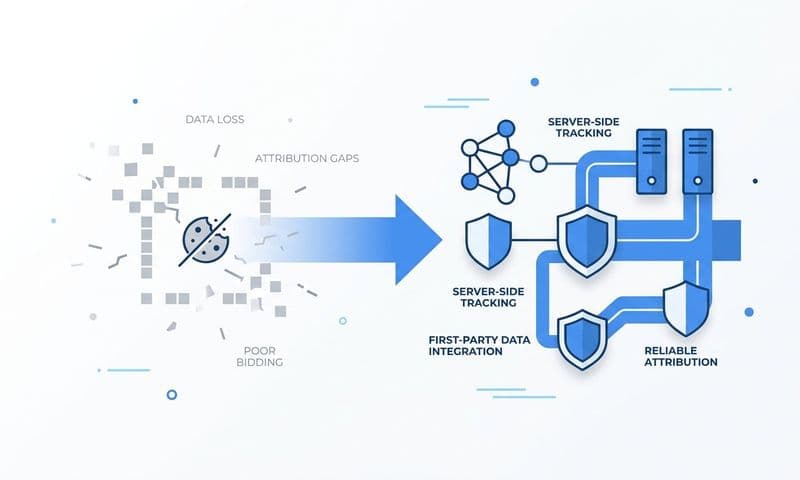
If you are still relying solely on browser-based pixel tracking, you are working with incomplete data. Browser privacy changes, ad blockers, and operating system-level privacy features have significantly reduced the reliability of client-side pixels. The data your pixel captures today represents only a portion of the conversions that are actually happening.
Server-side tracking solves this by sending conversion events directly from your server to ad platforms, bypassing browser restrictions entirely. This approach is now a standard recommendation from Meta, Google, and other major ad platforms for teams that want to recover lost signal and improve data accuracy. Understanding why server-side tracking is more accurate than client-side methods is essential before you begin implementation.
Set up the Meta Conversion API. The Meta Conversion API (CAPI) allows you to send conversion events from your server directly to Meta, independent of what the browser does. This means that even when a browser blocks your pixel, your server can still report the conversion. Meta recommends running CAPI alongside your pixel, not as a replacement, to maximize event match quality.
Implement Google Enhanced Conversions. Google's Enhanced Conversions work similarly by supplementing your standard conversion tags with first-party data sent from your server. This improves the accuracy of your conversion measurement in Google Ads, particularly for users who have opted out of tracking at the browser level.
Configure deduplication carefully. This is the step most teams skip, and it causes significant problems. When you run both pixel and server-side events simultaneously, both may fire for the same conversion. Without deduplication, your ad platform will count that conversion twice, inflating your reported numbers and making campaigns appear to perform better than they actually do.
Both Meta and Google provide deduplication mechanisms using event IDs. When a conversion fires, assign a unique event ID to both the pixel event and the corresponding server-side event. The platform then matches them and counts the conversion only once. Implement this from the start, not as an afterthought.
Validate your setup in platform event managers. Meta's Events Manager and Google Ads both provide diagnostic views where you can verify that server-side events are firing correctly, check event match quality scores, and confirm that deduplication is working as expected. Review these dashboards after implementation to catch any configuration issues before they affect your data.
Understand the downstream benefit. Beyond improving your own reporting, server-side tracking feeds higher-quality data back to ad platform algorithms. Better data means better audience matching, improved optimization, and more efficient budget delivery. The benefits of server-side tracking extend well beyond reporting accuracy into measurable campaign performance gains.
Success indicator: Your server-side events are firing correctly, deduplication is configured, and your event match quality scores have improved in Meta Events Manager and Google Ads. Your reported conversion volumes are more consistent with what you see in your CRM.
Step 4: Connect Your Ad Data to CRM and Revenue Outcomes
Ad platform dashboards are useful for understanding clicks and platform-reported conversions. But they have a fundamental limitation: they cannot tell you which campaigns generated qualified pipeline or contributed to closed revenue. That gap between ad platform data and actual business outcomes is where most B2B SaaS marketing teams lose visibility.
Closing this gap requires connecting your ad data to your CRM and, ultimately, to your revenue data.
Push UTM data into your CRM on lead creation. When a prospect fills out a form or starts a free trial, their UTM parameters should flow automatically into their contact and deal records in your CRM. This requires proper form tracking configuration and, in most cases, hidden form fields that capture UTM values from the URL. Once this is in place, every lead in your CRM carries the attribution data that explains where they came from.
Map your funnel stages to your attribution data. Work with your CRM data to connect each stage of your funnel, from ad click to lead to marketing qualified lead to sales opportunity to closed-won, to the campaign and channel data attached to each record. This lets you see not just which campaigns generate leads, but which campaigns generate leads that actually convert to pipeline and revenue.
Connect revenue data to your attribution platform. If you use Stripe or another billing tool, integrating your revenue data with your attribution platform gives you the ability to calculate true return on ad spend by channel and campaign. You move from measuring cost per form fill to measuring cost per dollar of revenue generated. Tracking closed-won revenue back to specific campaigns is the metric that finance and leadership actually care about.
Account for long B2B sales cycles. B2B SaaS sales cycles often span weeks or months. A prospect might click your ad in January and convert to a paying customer in April. If your attribution window expires after 30 days, that revenue never gets credited to the campaign that started the journey. Use an attribution platform that supports persistent, long-window attribution so you capture the full picture of how your campaigns contribute to revenue over time.
Align with your sales team on definitions. Before you build this reporting, agree with sales on what counts as a qualified lead, an opportunity, and a closed deal. Misaligned definitions lead to reporting that neither team trusts. When marketing and sales operate from the same funnel definitions and the same data, conversations about lead quality become much more productive.
Success indicator: You can open a single dashboard and see which campaigns generated pipeline and revenue, not just clicks and form fills. You can calculate cost per opportunity and cost per acquisition by channel and campaign.
Step 5: Choose and Apply the Right Attribution Model
Even with clean, complete tracking data, the wrong attribution model will give you a distorted view of which channels and campaigns deserve credit. Attribution model selection is not just a technical decision. It directly shapes how you allocate budget and how you evaluate channel performance.
Understanding the tradeoffs between models is essential for B2B SaaS teams where the buying journey involves multiple touchpoints over an extended period.
Understand the limitations of single-touch models. First-touch attribution gives all the credit to the first ad or channel a prospect ever interacted with. It tends to overvalue awareness and top-of-funnel channels. Last-click attribution gives all the credit to the final touchpoint before conversion, which tends to overvalue bottom-funnel retargeting and branded search. Neither model reflects the reality of how B2B buyers actually make decisions.
Explore multi-touch attribution models. Multi-touch models distribute credit across multiple touchpoints in the customer journey. Linear attribution gives equal credit to every touchpoint. Time-decay attribution gives more credit to touchpoints closer to the conversion. Position-based attribution, sometimes called U-shaped, gives more weight to the first and last touchpoints while distributing the remainder across the middle. Data-driven attribution uses your actual conversion data to determine how credit should be distributed based on observed patterns.
Consider funnel-stage weighting for B2B SaaS. For many B2B SaaS teams, a model that weights touchpoints based on their role in the funnel is more useful than a purely time-based model. For example, giving additional credit to the touchpoint that directly preceded a demo request or opportunity creation reflects the reality that some interactions are more commercially significant than others, regardless of when they occurred. Reviewing a complete guide to performance marketing attribution can help your team evaluate which model best fits your sales cycle.
Run models side by side before committing. Before you change your reporting or reallocate budget based on a new attribution model, run your historical data through multiple models simultaneously. Look at how your channel mix and budget allocation recommendations change under each model. This exercise often reveals surprising differences and helps your team make a more informed choice.
Avoid model selection bias. One of the most common pitfalls in attribution is choosing a model because it makes your favorite channel look good rather than because it accurately reflects buyer behavior. Let your actual customer journey data guide the decision. If most of your closed-won deals involved five or more touchpoints spread across three months, a single-touch model is simply not appropriate for your business.
Success indicator: Your team has agreed on a primary attribution model and you can justify the choice with data from your actual customer journey patterns. Budget allocation decisions reference the agreed model consistently.
Step 6: Build a Centralized Reporting Dashboard
Scattered data across multiple ad platform dashboards, spreadsheets, and CRM reports is itself a form of poor ad performance tracking. Even if your underlying data is clean, fragmented reporting prevents fast, confident decisions. When your team spends hours each week reconciling numbers from different sources, they are not spending that time acting on insights.
A centralized reporting dashboard solves this structural problem by giving every stakeholder a single, consistent view of marketing performance.
Define the metrics that matter most. Before you build anything, agree on which metrics your dashboard needs to surface. For most B2B SaaS marketing teams, the core set includes cost per lead, cost per opportunity, cost per acquisition, return on ad spend by channel, pipeline contribution by campaign, and revenue attributed to marketing. These are the digital marketing performance metrics that connect marketing activity to business outcomes.
Consolidate data from all your sources. Your dashboard should pull from your ad platforms, your CRM, your analytics tool, and your revenue data in one place. This eliminates the need for manual data pulls and ensures that everyone is looking at the same numbers at the same time. The goal is a single source of truth that does not require interpretation or reconciliation.
Set up automated alerts for performance changes. Rather than discovering that a campaign's cost per lead doubled three days after it happened, configure automated alerts that notify your team when key metrics move beyond defined thresholds. This allows you to respond to performance shifts quickly, before they compound into significant budget waste.
Share the dashboard with sales and finance. One of the most undervalued benefits of centralized reporting is the alignment it creates across teams. When sales leadership and finance see the same marketing performance data that your marketing team sees, conversations about budget, lead quality, and ROI become much more grounded. There are no competing versions of the truth, which means less time debating numbers and more time making decisions. Using dedicated marketing campaign tracking software can make this consolidation significantly easier to maintain at scale.
Review and iterate on your dashboard regularly. A dashboard built for your goals today may not serve your needs six months from now as your campaigns, channels, and business priorities evolve. Schedule a quarterly review to assess whether the metrics you are tracking still reflect what matters most and update the dashboard accordingly.
Success indicator: Your entire revenue team references one dashboard for marketing performance data. There are no competing spreadsheets or conflicting reports. Decisions about budget allocation, campaign changes, and channel investment are made from the same data.
Your Tracking Fix Checklist: Putting It All Together
Fixing poor ad performance tracking is not a one-time project. It is an ongoing discipline. Platforms change their privacy settings. Campaigns get rebuilt. New team members join and introduce inconsistencies. The six steps in this guide are most valuable when you treat them as a repeatable audit process, not just a one-time cleanup.
Here is a quick checklist you can run on a quarterly basis to maintain tracking health:
1. Audit pixel firing and conversion event configuration across all ad platforms.
2. Review UTM consistency in your analytics tool and correct any deviations from your naming convention.
3. Verify that server-side events are firing correctly and that deduplication is working as expected.
4. Confirm that UTM data is flowing into your CRM and that revenue data is connected to your attribution platform.
5. Review your attribution model and assess whether it still reflects your actual customer journey patterns.
6. Update your centralized dashboard to reflect any changes in campaigns, channels, or business priorities.
Each step in this process builds toward a single outcome: knowing exactly which ads drive revenue so you can scale with confidence and cut what is not working.
Cometly is built specifically to support this workflow for B2B SaaS marketing teams. It brings multi-touch attribution, server-side tracking, Conversion API integration, CRM and revenue connection, and centralized reporting into a single platform. Instead of stitching together five different tools and hoping the data stays consistent, you get one system designed to connect every touchpoint from first ad click to closed-won revenue.
If you are ready to stop guessing and start making budget decisions backed by accurate, complete attribution data, Get your free demo and see how Cometly can transform the way your team tracks and scales ad performance.