In April 2021, Apple flipped a switch that changed digital advertising forever. With the rollout of iOS 14.5 and the App Tracking Transparency framework, millions of marketers woke up to a new reality: the data pipelines they had built their entire paid acquisition strategies on were suddenly unreliable. Conversion numbers looked wrong. CPAs seemed inflated. And the reporting inside ad platforms told a completely different story than what was showing up in the CRM.
For B2C companies running simple, single-session purchase funnels, the disruption was painful. For B2B SaaS teams, it was something closer to a measurement crisis. When your customer journey spans weeks or months, involves multiple decision-makers, and touches a dozen different channels before a deal closes, even small tracking gaps create enormous distortions in how you understand what's actually working. The stakes are too high to rely on guesswork when you're allocating five- or six-figure monthly ad budgets.
The uncomfortable truth is that iOS privacy changes did not just damage attribution. They exposed how fragile pixel-dependent attribution always was. The tools most marketing teams had been using for years were never built to handle the privacy-first, cross-device, multi-stakeholder complexity of modern B2B buying. The gap between reported performance and actual revenue impact has never been wider, and it keeps growing.
This article breaks down exactly what changed, why it broke the measurement systems most teams still rely on, and what a modern attribution stack actually looks like for B2B SaaS companies navigating this post-iOS world. By the end, you will have a clear picture of the problem and a practical framework for building something more accurate than what came before.
How iOS Privacy Changes Rewired the Tracking Ecosystem
Before iOS 14.5, ad platforms had relatively seamless access to the IDFA, the Identifier for Advertisers, which is a unique device identifier that Apple assigned to every iPhone. This identifier allowed platforms like Meta and Google to match ad exposures on mobile devices to downstream conversions, even when those conversions happened in a different app or on a different website. It was the connective tissue of mobile attribution.
App Tracking Transparency changed that by requiring every app to explicitly prompt users before accessing the IDFA. Users now had to actively opt in to being tracked across apps and websites. The result was that a large portion of iOS users became invisible to ad platform tracking systems overnight. When the data pipeline breaks at the device level, every downstream report built on that data becomes unreliable.
Ad platforms did not simply accept this gap. They responded by filling missing data with modeled or probabilistic estimates. Instead of reporting on observed conversions, platforms began blending real signal with statistical inference to produce numbers that looked complete but were increasingly difficult to verify. Marketers had no way to audit which numbers were observed and which were modeled, which made optimization decisions far less reliable than they appeared.
Here is where it gets more complicated. The iOS ATT change was not a single event with a defined impact. It was the opening move in a cascading series of privacy restrictions that have continued to compound. Safari's Intelligent Tracking Prevention, which Apple had been building out since 2017, progressively shortened the lifespan of first-party cookies and blocked cross-site tracking in ways that affected desktop and mobile web behavior alike. Firefox introduced similar Enhanced Tracking Protection. Google began the long process of deprecating third-party cookies in Chrome, a process that has continued to evolve with significant implications for the broader advertising ecosystem.
Each of these changes, taken individually, was manageable. Taken together, they represent a systemic restructuring of how data flows between user behavior and marketing measurement. The tracking infrastructure that most B2B SaaS teams built their attribution strategies on was designed for a world that no longer exists. Understanding that this is a structural shift, not a temporary inconvenience, is the first step toward building something that actually holds up.
The Attribution Gaps That Are Costing B2B SaaS Teams Real Budget
Signal loss at the device level creates specific, predictable blind spots in your attribution data. Understanding exactly where those gaps appear helps explain why budget decisions based on platform reporting have become so unreliable for B2B SaaS teams.
The most immediate gap is mobile app conversions going unreported. When a prospect clicks a LinkedIn ad on their iPhone, visits your website, and fills out a demo request form, that conversion event may never make it back to the ad platform if the user has opted out of tracking. The platform records the click but not the outcome. From the platform's perspective, that campaign looks like it generated clicks but no conversions, which is exactly backwards from what actually happened.
Cross-device journeys create a second, more persistent problem. B2B buyers rarely complete their entire research and evaluation process on a single device. A VP of Marketing might see your ad on their phone during a commute, research your product on their work laptop that afternoon, and sign up for a trial on their home computer that evening. Without a reliable way to stitch those sessions together, each device looks like a separate anonymous user. Attribution models end up crediting the last touchpoint they can observe, which is often an organic search or direct visit, while the paid campaigns that drove the original awareness get no credit at all.
This feeds directly into the dangerous feedback loop that is quietly draining budget from high-performing channels. When a paid campaign cannot prove its contribution through pixel-based tracking, it looks underperforming in the dashboard. Budget gets shifted away from it. The channel that was actually driving pipeline loses investment, while channels that happen to be easier to track receive more spend than they deserve. Over time, this compounds into a systematic misallocation of marketing budget that is invisible unless you have a measurement system that goes beyond what ad platforms self-report.
The B2B-specific dimension makes all of this significantly worse. In a B2C context, a customer journey might span a few days and involve two or three touchpoints. In B2B SaaS, a single deal might involve an initial ad impression, several organic visits, a content download, a webinar attendance, a demo request, and multiple email nurture sequences, all spread across sixty to ninety days or longer. With multiple stakeholders involved, each with their own device and browsing behavior, the number of touchpoints that need to be accurately captured for attribution to work correctly is much higher than in any consumer context.
When tracking gaps compound across that many touchpoints and that long a timeframe, the distortion in pipeline and revenue reporting becomes severe. Teams end up making channel investment decisions based on data that reflects only a fraction of what actually drove a deal to close.
Why Legacy Pixel Tracking Can No Longer Do the Job Alone
Browser-based pixel tracking was an elegant solution for a simpler era. The basic mechanism works like this: a small snippet of JavaScript code is placed on your website, and when a user completes an action, the pixel fires and sends event data back to the ad platform. It was never designed to handle the privacy constraints, cross-device complexity, and consent requirements that now define the modern web. It was designed for a world where browsers were open, identifiers were persistent, and users had no meaningful mechanism to opt out.
That world is gone. And the failure modes of pixel-only tracking have become impossible to ignore.
Ad blockers are the most visible problem. A meaningful portion of your audience, particularly the technically sophisticated buyers who populate B2B SaaS target markets, run ad blockers that prevent pixels from firing entirely. When the pixel cannot fire, the conversion event simply disappears. The platform never knows it happened.
Browser-level restrictions create a second layer of failure. Safari's ITP aggressively limits the lifespan of cookies set by third-party scripts, which means that even when a pixel fires correctly, the data it produces may be incomplete or disconnected from earlier sessions. A user who visited your site a week ago and returns today may look like a brand new visitor to your pixel because the cookie that would have linked those sessions has already expired.
Client-side events also arrive with inconsistent timing and completeness. Network interruptions, slow page loads, and script conflicts can all cause pixels to fire late, fire incorrectly, or not fire at all. When you are trying to make real-time optimization decisions based on conversion data, this kind of noise in the signal creates serious problems. You end up optimizing toward a version of reality that is systematically different from what is actually happening.
The solution to all of these problems starts with the same principle: first-party data. Data collected directly through your own infrastructure, using your own domain and your own server, is not subject to the same restrictions as data collected through third-party scripts. It does not expire when ITP shortens cookie lifespans. It does not disappear when a user has an ad blocker installed. It is not filtered or modeled by a platform trying to fill gaps it cannot see.
First-party data is the foundation of durable attribution in a privacy-first world. But collecting it correctly requires a fundamentally different technical architecture than the pixel-based approach most teams are still relying on.
Server-Side Tracking and Conversion APIs: The Modern Fix
Server-side tracking flips the model entirely. Instead of asking a browser to fire a pixel after a user completes an action, events are sent directly from your server to the ad platform. The browser is no longer in the loop. Ad blockers cannot intercept the request. ITP cannot expire the cookie. The event travels from your infrastructure to the platform's infrastructure, bypassing every browser-level restriction that has made pixel tracking so unreliable.
This is the architecture behind Meta's Conversion API and Google's Enhanced Conversions, two of the most important tools available to marketers navigating post-iOS attribution challenges. Understanding how each works helps clarify both their power and their requirements.
Meta's Conversion API, often called CAPI, allows businesses to send web events directly from their server to Meta's data infrastructure. Rather than relying solely on the browser pixel to report a lead form submission or a trial signup, you send that same event from your own server with richer data attached, including hashed customer information that Meta can use to match the event to a real user profile. When the pixel and the CAPI event both fire for the same conversion, Meta deduplicates them. When the pixel fails and CAPI fires, the conversion is still recorded. The result is a more complete picture of what your campaigns are actually driving.
Google's Enhanced Conversions works on a similar principle for Google Ads. By sending hashed first-party customer data alongside conversion events, Enhanced Conversions improves Google's ability to match conversions back to ad interactions, even when cookie-based tracking has failed. For B2B SaaS teams running significant spend on Google Search and YouTube, implementing Enhanced Conversions is one of the highest-leverage steps available to recover lost signal.
The practical challenge is implementation. Server-side tracking requires your CRM, website, and ad platforms to be connected in a way that allows events to flow from your server in real time. This is not a configuration that most marketing teams can set up with a few clicks. It requires technical infrastructure, data mapping, and ongoing maintenance that goes well beyond placing a pixel on a page.
This is precisely where purpose-built attribution platforms become essential. Rather than requiring engineering resources to build and maintain custom server-side integrations, a platform designed for this problem handles the connections, the event routing, and the deduplication logic out of the box. For B2B SaaS marketing teams that need to move quickly and cannot afford to wait on engineering sprints, having the right attribution tooling in place is the difference between recovering lost signal and continuing to optimize on incomplete data.
Multi-Touch Attribution in a Privacy-First World
Single-touch attribution models have always been a simplification. First-touch attribution gives all credit to the first interaction a prospect ever had with your brand. Last-click attribution gives all credit to the final touchpoint before conversion. Both models were already distorting reality before iOS privacy changes arrived. Post-iOS, they have become genuinely dangerous.
The reason single-touch models are especially vulnerable to post-iOS data loss is structural. When your entire attribution model depends on accurately capturing one specific event, the model collapses the moment that event becomes invisible. If the first-touch ad click happened on an iOS device where the user opted out of tracking, first-touch attribution has nothing to work with. If the last click was a direct visit or an organic search that followed weeks of paid ad exposure, last-click attribution credits organic while the paid campaigns that drove the entire journey receive nothing.
Multi-touch attribution distributes credit across the full customer journey, which makes it fundamentally more resilient to individual tracking gaps. Instead of depending on a single event being captured perfectly, multi-touch models build a picture from patterns across many touchpoints. If one touchpoint is missing, the model can still assign meaningful credit to the touchpoints that were captured. The signal is distributed, so the impact of any single gap is proportionally smaller.
Linear attribution, time-decay attribution, and position-based attribution are all multi-touch approaches that offer more nuance than single-touch models. But the most sophisticated approach available today is data-driven attribution, and it represents a meaningful leap forward in how credit gets assigned.
Data-driven attribution uses machine learning to analyze which touchpoint combinations actually correlate with conversion outcomes across your real customer data. Rather than applying a fixed rule, such as giving more credit to recent touchpoints or splitting credit evenly, data-driven attribution learns from observed patterns in your pipeline. It identifies which sequences of interactions tend to precede closed deals and weights credit accordingly. This means the model is calibrated to your actual buyers, not to a theoretical assumption about how all customers behave.
For B2B SaaS teams with complex, multi-stakeholder journeys, data-driven attribution offers something no fixed-rule model can provide: a credit assignment framework that reflects the actual dynamics of how your deals close. When that is combined with server-side tracking to ensure the underlying data is as complete as possible, you have an attribution approach that is genuinely more accurate than anything pixel-based tracking ever delivered.
Building a Post-iOS Attribution Stack That Actually Works
Knowing what is broken is only useful if it leads to building something better. For B2B SaaS marketing teams, a modern attribution stack has three core components that need to work together: server-side event tracking, CRM integration, and a unified reporting layer that replaces conflicting platform dashboards with a single source of truth.
Server-Side Event Tracking: This is the foundation. Without reliable event collection that bypasses browser restrictions, every other layer of your attribution stack is built on incomplete data. Server-side tracking ensures that conversion events, from form submissions to trial signups to demo requests, are captured and sent to ad platforms with the consistency and completeness that client-side pixels cannot provide.
CRM Integration: For B2B SaaS teams, the conversion that matters is not a demo request. It is a closed-won deal. Connecting your CRM to your attribution stack allows you to tie ad interactions to pipeline stages and revenue outcomes, not just top-of-funnel events. This is the step that most attribution setups skip entirely, and it is the step that makes the difference between knowing which campaigns drive clicks and knowing which campaigns drive revenue.
Unified Reporting: When you are running campaigns across Meta, Google, LinkedIn, and other channels, each platform's self-reported data reflects its own attribution logic, which frequently conflicts with every other platform. A unified reporting layer pulls all of that data into a single view with consistent attribution logic applied across every channel. Instead of reconciling three different dashboards that each claim credit for the same conversion, you see one accurate picture of how your budget is performing.
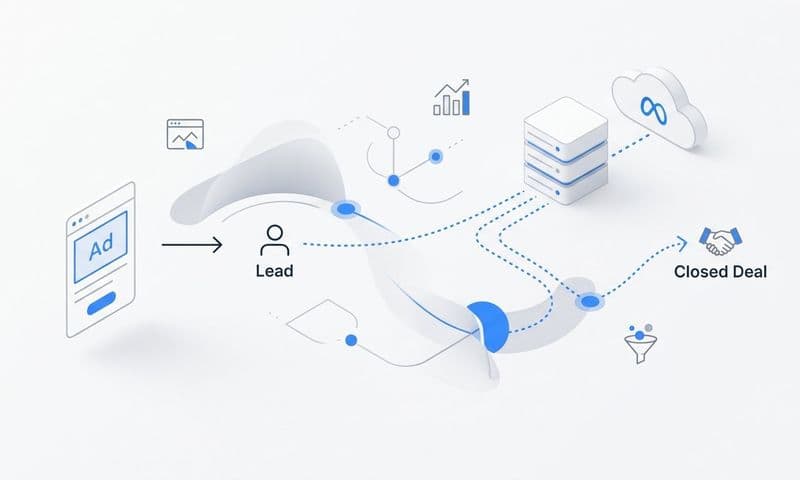
This is exactly the problem Cometly is built to solve for B2B SaaS teams. Cometly connects your ad platforms, CRM, and website behavior in real time, giving you a complete view of every customer journey from the first ad click to closed-won revenue. With server-side conversion tracking, Conversion API integration, and multi-touch attribution models built in, it captures the signal that pixel-only setups miss and surfaces the insights that matter most: which campaigns are actually driving pipeline, which channels deserve more budget, and where spend is going to waste.
The strategic mindset shift that matters most here is this: post-iOS attribution is not about recovering what was lost. It is about building a more accurate measurement system than pixel tracking ever provided. The old approach was always a proxy for reality. The modern approach, built on first-party data, server-side infrastructure, and AI-driven attribution, connects ad spend directly to business outcomes in a way that was never possible before. The marketers who make this transition now will not just survive the privacy-first era. They will have a measurement advantage that compounds over time.
The Path Forward for B2B SaaS Marketers
iOS privacy changes did not create a new problem. They exposed an old one. Attribution built on browser pixels and third-party identifiers was always fragile. It worked well enough when the environment was permissive, but it was never a durable foundation for serious marketing measurement. What Apple's ATT framework did was accelerate the reckoning that was always coming.
The path forward is clear, even if the implementation requires real work. First-party data collection, server-side event tracking through tools like Meta's Conversion API and Google's Enhanced Conversions, and multi-touch attribution that distributes credit intelligently across the full customer journey are the three pillars of modern attribution. Together, they produce a more accurate picture of marketing performance than pixel-based tracking ever could.
For B2B SaaS teams specifically, the urgency is higher than in almost any other context. Long sales cycles, multiple stakeholders, and expensive acquisition costs mean that misattribution does not just distort your reports. It actively misdirects your budget in ways that compound over months and quarters.
The marketers who adapt fastest will have a durable competitive advantage in paid acquisition. They will know which channels actually drive revenue, not just which channels claim credit. They will allocate budget with confidence. And they will be building on a measurement foundation that gets stronger over time rather than more fragile.
Cometly is built specifically to help B2B SaaS teams make this transition. It connects your ad platforms, CRM, and website into a single attribution system that shows you exactly which campaigns drive pipeline and revenue, in real time. If you are ready to move beyond pixel-dependent reporting and build attribution that actually reflects how your deals close, Get your free demo today and start capturing every touchpoint to maximize your conversions.