Account-based marketing demands serious investment. You are dedicating budget, creative resources, and sales alignment to a carefully selected list of high-value accounts, running coordinated campaigns across paid, organic, email, and events to engage multiple stakeholders at each company. Then a deal closes, and someone asks the inevitable question: which campaigns actually moved that account through the pipeline?
For most B2B SaaS teams, that question is surprisingly hard to answer. Not because the data does not exist, but because the measurement frameworks they are using were never designed for the way ABM actually works. Standard attribution models track individuals, not accounts. They credit single touchpoints, not coordinated multi-channel engagement. And they operate on attribution windows far too short for enterprise sales cycles that routinely stretch past six months.
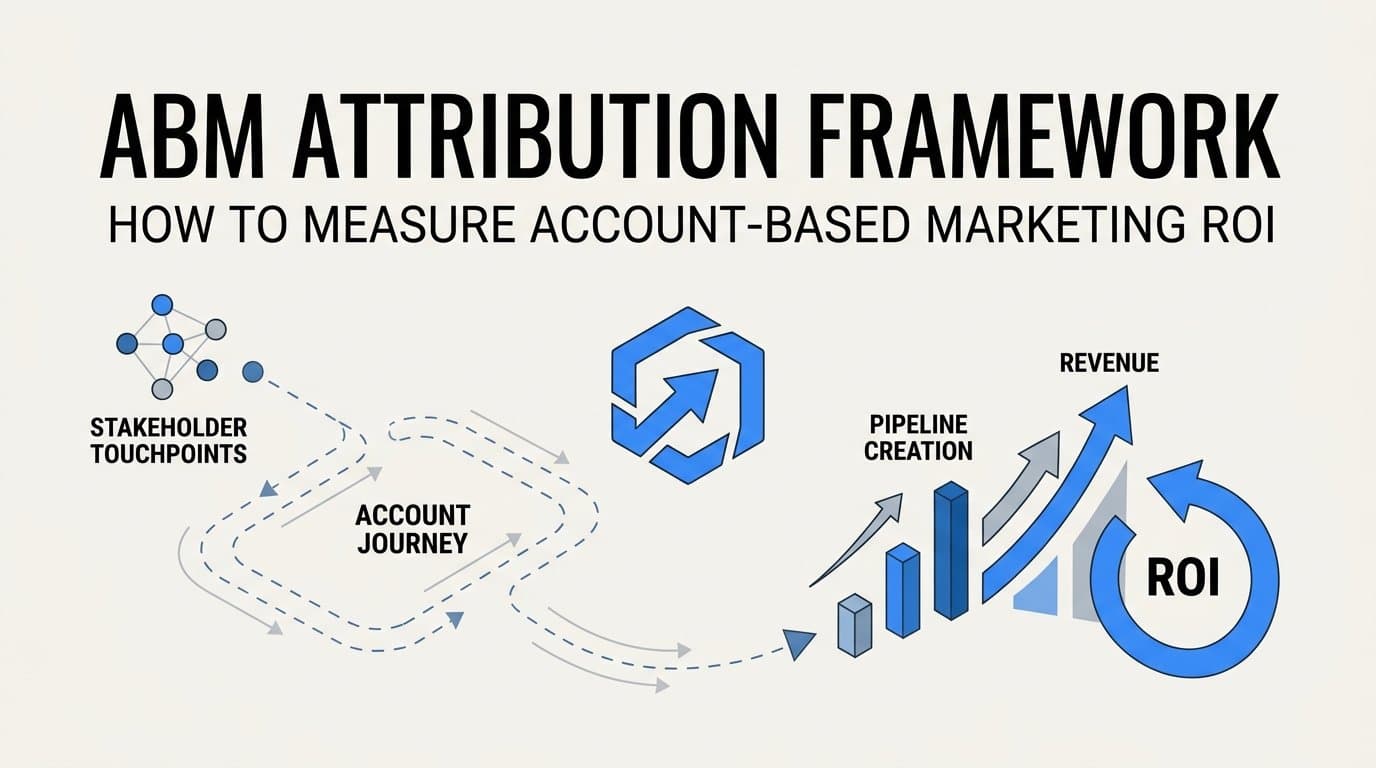
An ABM attribution framework solves this by shifting the unit of measurement from the individual lead to the account itself. It connects every touchpoint from every stakeholder at a target account into a single coherent journey, then ties that journey directly to pipeline creation and closed revenue. By the end of this article, you will understand exactly how that framework is structured, which attribution models fit ABM best, and how to build the technical foundation that makes accurate account-level measurement possible.
Why Standard Attribution Breaks Down in ABM
The structural mismatch between traditional attribution and ABM starts with a simple reality: enterprise buying decisions are not made by individuals. They are made by committees. A typical enterprise deal involves multiple stakeholders, including economic buyers, technical evaluators, end users, and procurement contacts, each interacting with your content, ads, and sales team at different points in the cycle.
When your attribution model tracks individual leads, it treats each of those stakeholders as a separate, unrelated conversion event. The CFO who clicked a LinkedIn ad, the VP of Engineering who downloaded a technical whitepaper, and the Director of Operations who attended a webinar are all logged as distinct leads with no connection to each other. Your attribution data tells you about individual interactions. It tells you nothing about the account-level momentum those interactions collectively created.
This is not just a reporting inconvenience. It actively distorts your understanding of ABM ROI. First-touch attribution will credit whichever channel happened to reach the first stakeholder who entered your CRM, ignoring everything that happened afterward across the rest of the buying committee. Last-touch attribution will over-credit the final sales-stage interaction while erasing the awareness and nurture campaigns that warmed the account over months of engagement. Neither model reflects how ABM actually works.
The data fragmentation problem compounds this further. Your ad platforms track users by cookie or device ID. Your CRM tracks contacts by email address and account record. Your website analytics tracks sessions by browser. These systems use different identifiers, and without a dedicated framework to reconcile them, you end up with siloed data that cannot tell a coherent account-level story.
Consider what this looks like in practice. A target account has five stakeholders engaging with your campaigns over a 90-day period. Your Google Ads account shows three clicks. Your CRM shows two contacts with recent activity. Your website analytics shows seven sessions from that company's IP range. None of these systems are talking to each other, and none of them are giving you the full picture. This is the core problem that an ABM attribution framework is designed to solve.
The Core Components of an ABM Attribution Framework
Building an effective ABM attribution framework starts with understanding its three foundational layers: identity resolution at the account level, multi-touch attribution applied across the account journey, and the connection between engagement data and actual revenue outcomes.
Account-Level Identity Resolution
Identity resolution is the technical foundation that makes everything else possible. It is the process of grouping all contacts, sessions, ad interactions, and content engagements under a single account record, regardless of which stakeholder generated each touchpoint or which system captured it.
In practice, this means matching interactions across multiple signals. Email domain matching connects CRM contacts to web sessions from the same company. CRM account IDs link ad platform conversions to specific pipeline records. IP-based company identification can attribute anonymous web sessions to known target accounts. The goal is a unified account record that aggregates every interaction from every stakeholder into one timeline.
Without this layer, you are not doing ABM attribution. You are doing lead attribution and calling it ABM. The distinction matters enormously when you are trying to understand how a six-month, multi-stakeholder deal actually came together.
Multi-Touch, Account-Level Attribution Models
Once you can see the full account journey, you need a model that distributes credit across it fairly. Multi-touch attribution models applied at the account level give you the ability to evaluate every channel and campaign that engaged the buying committee throughout the sales cycle.
Linear attribution distributes credit equally across all touchpoints in the account journey. Time-decay models give more weight to interactions closer to the deal close. Custom weighted models allow you to assign higher credit to specific touchpoints, such as product demos or high-intent content, based on what your data shows actually correlates with closed revenue. Each model surfaces different insights, and the right choice depends on your sales cycle and the questions you are trying to answer.
Pipeline and Revenue Attribution
The third layer is what separates a true ABM attribution framework from a simple engagement dashboard. Connecting account engagement data to CRM pipeline stages and closed-won revenue transforms your attribution from a marketing metric into a business metric.
This means your framework needs to track not just which campaigns touched an account, but which campaigns touched accounts that became opportunities, and which campaigns touched accounts that became customers. That distinction between pipeline influence and revenue influence is what gives you the data to make confident budget decisions.
Mapping the Account Journey Across Channels
ABM campaigns rarely operate through a single channel. A well-executed ABM program typically combines paid social, display advertising, organic search, email sequences, direct outreach, and events, all working in concert to engage different stakeholders at different stages. Your attribution framework needs to capture every one of those touchpoints and tie them back to the account, not just the individual who happened to click.
Capturing Every Channel in the ABM Mix
Each channel in your ABM mix generates touchpoints that need to be attributed at the account level. A LinkedIn ad impression viewed by a VP at a target account is a touchpoint. A blog post read by a technical evaluator from the same company is a touchpoint. A webinar attended by the economic buyer three weeks before the deal closes is a touchpoint. Your framework needs to capture all of these and connect them to the account record, regardless of whether each individual was already identified in your CRM.
This requires consistent UTM parameter strategy across all paid channels, server-side event tracking on your website, and CRM integration that maps contact activity back to account records in real time. When these systems are connected properly, you can reconstruct the full account journey from first awareness through closed-won.
The Role of Server-Side Tracking and First-Party Data
Browser privacy restrictions have made pixel-based tracking increasingly unreliable. Safari's Intelligent Tracking Prevention, Firefox's enhanced privacy defaults, and the gradual deprecation of third-party cookies across the web mean that a significant portion of your buying committee's interactions may never be captured by traditional JavaScript-based tracking.
Server-side tracking addresses this by moving event collection from the browser to your own server infrastructure, then sending enriched first-party event data directly to ad platforms via Conversion API integrations. Meta's Conversion API and Google's Enhanced Conversions allow you to send hashed first-party signals that maintain attribution accuracy even when browser-side tracking fails. For ABM programs targeting known accounts, this is not optional. It is the difference between seeing 60% of your account touchpoints and seeing 90% of them.
Calibrating Attribution Windows to Your Sales Cycle
Default attribution windows in most ad platforms are built for e-commerce and short-cycle B2C purchases. A 7-day or 28-day attribution window is essentially useless for enterprise ABM deals that take 90 to 180 days or longer to close.
Your attribution framework needs lookback windows calibrated to your actual sales cycle data. Pull your average sales cycle length from your CRM by segment, by deal size, and by target account tier. Then configure your attribution windows to match. If your average enterprise deal takes 120 days from first touch to close, your attribution framework needs to look back at least that far to capture the full influence of your campaigns.
Choosing the Right Attribution Model for ABM Campaigns
There is no single attribution model that is universally correct for ABM. The right model depends on what you are trying to learn, where your program is in its maturity, and how much data you have to work with. Understanding the tradeoffs of each model helps you choose the right lens for the question you are asking.
First-Touch Attribution
First-touch attribution credits the initial interaction that brought an account into your funnel. For ABM programs, this is valuable for one specific question: which channels are most effective at generating awareness among your target account list and converting cold accounts into active pipeline entries?
If you want to understand whether your LinkedIn campaigns or your organic content is better at surfacing new target accounts, first-touch attribution gives you a clean answer. The limitation is that it tells you nothing about what happened after that first interaction. For a program where the nurture and late-stage engagement are just as strategically important as the initial awareness, first-touch alone is an incomplete picture.
Multi-Touch Attribution Models
Linear attribution distributes credit equally across every touchpoint in the account journey. This gives marketing teams a balanced view of which campaigns and channels contributed throughout the sales cycle, rather than over-indexing on either the first or last interaction. It is a good default model for ABM programs that want to evaluate the full mix without making assumptions about which stage matters most.
Time-decay attribution gives progressively more credit to touchpoints closer to the deal close. This can be useful when you want to understand which late-stage content and campaigns are most influential in moving accounts from evaluation to decision. The tradeoff is that it may undervalue the awareness and early nurture campaigns that brought the account into the funnel in the first place.
Data-Driven Attribution
Data-driven attribution uses machine learning to analyze your actual conversion patterns and assign credit based on which touchpoints statistically correlate with closed revenue. It is the most accurate model available, but it requires sufficient data volume to produce reliable outputs. For ABM programs with a large enough base of closed deals, data-driven attribution removes the guesswork from credit assignment and surfaces insights that rule-based models cannot.
The practical reality for many ABM teams is that you will use different models for different purposes. First-touch for top-of-funnel channel evaluation, linear or time-decay for campaign mix analysis, and data-driven attribution as your program matures and your deal volume grows.
Key Metrics That Define ABM Attribution Success
Measuring ABM attribution success requires moving beyond the lead-centric metrics that dominate traditional demand generation reporting. Clicks, impressions, and cost per lead are not the right units of measurement for a program designed to close high-value enterprise accounts. The metrics that matter in ABM connect account engagement directly to pipeline and revenue outcomes.
Account Engagement Score Tied to Pipeline
Rather than measuring individual clicks or form fills, ABM attribution tracks how engagement from target accounts correlates with pipeline creation, deal velocity, and win rates. An account engagement score aggregates all interactions from all stakeholders at a target account and produces a single signal that reflects how active and interested that account is across your entire marketing mix.
The value of this metric comes from connecting it to pipeline outcomes. When you can show that target accounts above a certain engagement threshold convert to opportunities at a higher rate, or close faster, or carry higher average contract values, you have built the business case for your ABM investment in terms that leadership understands.
Revenue Influenced vs. Revenue Sourced
This distinction is critical for accurate budget allocation in ABM programs. Revenue sourced credits the campaigns that directly generated the opportunity. Revenue influenced credits all campaigns that touched the account at any point during the sales cycle, regardless of whether they were the originating source.
Both metrics are useful, but they answer different questions. Revenue sourced tells you which channels are generating new pipeline from target accounts. Revenue influenced tells you which channels are contributing to deals that ultimately close. A channel might source relatively few opportunities but influence a disproportionate share of closed-won revenue. Without both metrics in your framework, you risk cutting channels that are quietly doing critical work in the middle and late stages of your deals.
Cost Per Account Opportunity and Cost Per Closed-Won Account
These account-level ROI metrics replace cost per lead as the primary efficiency measure for ABM programs. Cost per account opportunity calculates how much you are spending to convert a target account into an active pipeline opportunity. Cost per closed-won account calculates the total campaign investment required to close a deal with a target account.
These metrics give leadership a direct line between ABM program investment and revenue outcomes. They also allow you to compare efficiency across account tiers, channels, and campaign types, so you can make data-driven decisions about where to concentrate resources in future ABM cycles.
Building Your ABM Attribution Framework with the Right Tools
An ABM attribution framework is only as good as the technical infrastructure supporting it. Conceptually understanding account-level attribution is one thing. Actually implementing it requires a specific set of integrations and data connections that most standard analytics stacks are not configured to provide out of the box.
The Technical Stack for ABM Attribution
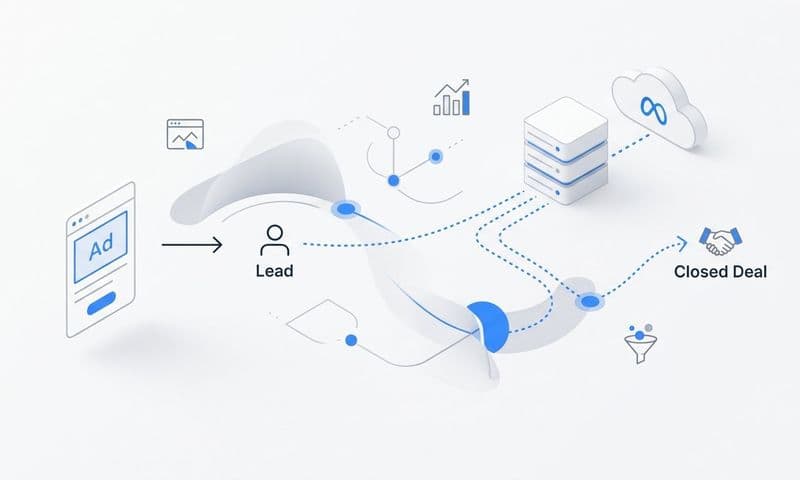
At minimum, your ABM attribution stack needs three things working in concert: your ad platforms (LinkedIn, Google, Meta, and any other paid channels in your ABM mix), your CRM (where account records, pipeline stages, and closed-won data live), and an attribution layer that can resolve account-level identity and connect ad spend to pipeline and revenue in real time.
The attribution layer is the critical piece that most teams are missing. Without it, you have data in three separate systems with no connective tissue between them. Your ad platforms know about clicks and conversions. Your CRM knows about deals and revenue. But neither system can tell you which specific campaigns influenced which specific accounts through which stages of the pipeline. The attribution layer bridges that gap.
Server-Side Tracking and Conversion API Integrations
For ABM attribution specifically, server-side conversion tracking is not a nice-to-have. It is essential. As described earlier, browser-side pixel tracking misses a significant portion of buying committee interactions due to privacy restrictions and ad blockers. Server-side tracking via Conversion API integrations maintains data accuracy by sending enriched first-party event data directly from your server to the ad platforms.
This matters for ABM in two ways. First, it improves attribution accuracy by capturing touchpoints that pixel-based tracking would miss. Second, it feeds better optimization signals back to the ad platforms themselves, improving the targeting and delivery of your ABM campaigns over time. When you send enriched conversion events back to Meta or Google, their algorithms get better data to work with, which improves campaign performance and makes your attribution data more reliable simultaneously.
How Cometly Supports ABM Attribution
Cometly is built specifically for B2B SaaS teams that need to connect ad platform data, CRM events, and website behavior into a single attribution view. It captures every touchpoint across the account journey, from the first ad click to the closed-won event in your CRM, and ties campaign spend directly to pipeline creation and revenue outcomes.
For ABM programs, this means you can see exactly which campaigns engaged which target accounts, how those accounts progressed through your pipeline, and what the revenue impact of each channel and campaign actually was. Cometly's server-side tracking and Conversion API integrations maintain data accuracy as browser privacy restrictions continue to tighten, so your attribution data reflects reality rather than a degraded sample of your actual account interactions.
The AI-powered insights layer surfaces recommendations based on actual conversion patterns across your account data, helping you identify which campaigns are driving account engagement and closed revenue so you can scale what is working and reallocate budget away from what is not. For ABM teams that need to justify significant program investment to leadership, having a single source of truth that connects ad spend to pipeline and revenue is what makes that conversation straightforward.