You have invested heavily in account-based marketing. Your team spent weeks building the target account list, crafting personalized content for each tier, aligning with sales on outreach sequences, and launching coordinated campaigns across LinkedIn, paid search, and direct channels. Now your CMO is asking a simple question: is it working?
This is where most B2B SaaS marketing teams hit a wall. The instinct is to pull up the usual dashboard and report on leads generated, MQL volume, and cost per click. But those numbers tell you almost nothing about ABM performance. They were built for a different kind of marketing, one where individual leads move through a funnel independently, not as part of a coordinated buying group at a strategically selected account.
ABM demands a fundamentally different measurement approach. When six to ten stakeholders at a single target account are each interacting with your brand across different channels over a multi-month sales cycle, traditional metrics obscure more than they reveal. The measurement gap is not just a reporting inconvenience. It becomes a credibility problem that puts your ABM budget at risk every quarter.
This article lays out a practical framework for account-based marketing measurement, covering the right metrics at every stage of the account journey, the attribution models that actually reflect how B2B deals get done, and how to build the data infrastructure that ties it all together from first ad impression to closed-won revenue.
Why Traditional Marketing Metrics Break Down in ABM
Standard marketing analytics tools were designed around a simple premise: a person sees an ad, fills out a form, and becomes a lead. From there, the funnel tracks that individual through stages until they convert or drop off. It is a clean, linear model that works reasonably well for high-volume, transactional sales motions.
ABM is almost the opposite of that. You are not waiting for random individuals to discover you. You are proactively targeting specific companies, engaging multiple stakeholders within those companies simultaneously, and trying to influence a group buying decision that may take six months or longer to reach a conclusion. The individual lead is almost irrelevant. The account is the unit of measurement.
Here is where the breakdown becomes concrete. Imagine three contacts from the same target account interact with your content in a single week: the VP of Engineering reads a blog post, the CFO clicks a LinkedIn ad, and the Head of Operations attends a webinar. In a lead-based system, these are three separate leads with no visible connection. In an account-based system, this is a strong engagement signal indicating that a buying committee is actively evaluating your solution.
MQL counts are particularly misleading in this context. A high MQL volume from non-target accounts can make a marketing program look productive while your actual ABM targets remain unengaged. Conversely, deep engagement from a handful of high-value target accounts might generate very few MQLs but represent enormous pipeline potential. Optimizing for MQL volume actively works against ABM strategy.
Last-click attribution compounds the problem. When a deal finally closes after dozens of touchpoints across a long sales cycle, crediting the last interaction before conversion ignores everything that built awareness, established credibility, and moved the buying committee toward a decision. In ABM, the early touchpoints are often the most strategically important because they are the ones that get your brand into the consideration set at all.
The result is a measurement gap that leaves marketing unable to connect its ABM investment to pipeline and revenue. Without that connection, budget justification becomes a negotiation based on intuition rather than data, and ABM programs remain perpetually vulnerable to cuts when quarterly pressure builds.
The ABM Measurement Framework: Four Stages to Track
Effective account-based marketing measurement is not about finding one magic metric. It is about tracking account progression through a series of stages, each with its own signals and success criteria. Think of it as a journey map for your target accounts, not a funnel for individual leads.
Stage 1: Account Awareness and Reach
Before you can measure engagement, you need to know whether your campaigns are actually reaching your target accounts. Account reach measures what percentage of your target account list has been exposed to your campaigns across paid, organic, and direct channels. If a significant portion of your highest-priority accounts have never seen your ads or visited your website, your ABM program has a reach problem that no amount of engagement optimization will fix.
Tracking reach requires connecting your ad platform data to your account list. You need to know not just how many impressions you served, but whether those impressions landed in front of people at the right companies. This is where account-level audience targeting and server-side data enrichment become critical infrastructure, not optional add-ons.
Stage 2: Account Engagement
Once accounts are being reached, the next question is whether they are engaging. Account engagement measurement goes beyond individual clicks and page views. It looks at the depth and breadth of interaction within a single account: how many contacts are engaging, which content types are driving the most interaction, and whether engagement is increasing or plateauing over time.
Multi-stakeholder activity within a single account is a particularly powerful signal. When multiple contacts from the same company are independently engaging with your content, it suggests the buying conversation is happening internally, not just at the individual level.
Stage 3: Pipeline Influence
This is where ABM measurement starts to connect to revenue. Pipeline influence tracking answers the question: which marketing touchpoints contributed to accounts moving from your target list to an active opportunity in the CRM? This requires a direct integration between your marketing attribution system and your CRM, so that opportunity creation events can be mapped back to the engagement history of that account.
Stage 4: Revenue Attribution
The final stage closes the loop. Revenue attribution ties closed-won deals back to the specific campaigns, channels, and touchpoints that influenced them. This is what allows you to calculate true ABM ROI: the revenue generated relative to the investment made in reaching and engaging those accounts. Without this stage, you can demonstrate engagement but not business impact.
Key ABM Metrics Every B2B Marketing Team Should Monitor
With the four-stage framework in place, you need specific metrics to populate each stage with meaningful data. Here are the core metrics that give B2B marketing teams a complete picture of ABM performance.
Account Coverage and Penetration Rate: Account coverage measures how many contacts within each target account are being reached and engaged by your campaigns. Penetration rate takes this further by expressing it as a percentage of the total known buying committee at that account. Low coverage at a high-priority account is an early warning sign that your targeting needs adjustment before you can expect pipeline movement.
Account Engagement Score: An engagement score is a composite metric that weights different types of interactions to reflect their relative significance as buying intent signals. A webinar attendance, for example, typically carries more weight than a single ad impression. Interactions from senior decision-makers like a CFO or CEO carry more weight than those from junior contacts. When you weight interactions by type and stakeholder seniority, the resulting score gives you a far more accurate picture of where genuine buying intent exists across your target account list.
Engagement scores are particularly useful for prioritizing sales outreach. Rather than asking sales to work every account on the list equally, you can surface the accounts showing the strongest intent signals and direct sales attention where it is most likely to convert.
Pipeline Velocity by Account Tier: Pipeline velocity measures how quickly accounts move through each stage of the sales cycle. When you segment this by account tier, comparing ABM-targeted accounts against non-ABM accounts, you can see whether your ABM strategy is actually accelerating deal progression. If Tier 1 accounts are moving through the pipeline significantly faster than comparable non-targeted accounts, that is strong evidence that ABM is creating a more informed, more prepared buying committee before sales even enters the conversation.
Revenue Influenced vs. Revenue Sourced: This distinction matters enormously for proving ABM value. Revenue sourced refers to deals that marketing directly generated, where the first meaningful interaction came from a marketing campaign. Revenue influenced refers to deals that were already in motion but where marketing touchpoints contributed to progression or outcome. Both numbers are important. Many ABM programs generate more influenced revenue than sourced revenue, particularly in enterprise contexts where sales relationships often precede formal marketing engagement. Reporting only sourced revenue significantly undervalues the program.
Together, these four metrics give you a layered view of ABM performance that connects reach to engagement, engagement to pipeline, and pipeline to revenue. That chain of evidence is what transforms ABM from a strategic initiative into a defensible business investment.
Attribution Models That Actually Work for ABM
Choosing the right attribution model is not a technical detail. It is a strategic decision that determines whether your measurement accurately reflects how your ABM program creates value or systematically misrepresents it.
Single-touch models are the most common starting point because they are simple to implement. First-touch attribution gives all credit to the initial interaction that brought an account into your orbit. Last-click attribution gives all credit to the final touchpoint before conversion. Both models have a place in some marketing contexts, but in ABM they are particularly misleading.
Consider what actually happens during a typical B2B SaaS deal. A target account might first encounter your brand through a LinkedIn thought leadership ad. Over the following months, contacts at that account visit your website multiple times, attend a virtual event, read several blog posts, and engage with a personalized email sequence before a sales conversation begins. By the time the deal closes, there may be dozens of distinct touchpoints across multiple stakeholders. Crediting only the first or last of those interactions erases the contribution of every campaign that built momentum in between.
Multi-touch attribution distributes credit across all touchpoints in an account's journey. This gives marketing a far more accurate picture of which channels and campaigns are genuinely influencing outcomes across the full buying cycle. When you run multi-touch attribution on your ABM data, you often discover that mid-funnel content, thought leadership, and retargeting campaigns play a much larger role in deal progression than single-touch models would suggest.
Data-driven attribution takes this further by using algorithmic weighting to assign credit based on actual conversion patterns in your data. Rather than applying a fixed formula like equal weighting across all touches, data-driven models analyze which touchpoint sequences are most strongly correlated with closed-won outcomes and assign credit accordingly. This makes it the most accurate model for mature ABM programs, though it requires sufficient data volume to produce reliable results.
The practical takeaway is straightforward: if you are running ABM and still relying on last-click attribution to report results, you are almost certainly underreporting the impact of your program. Moving to multi-touch or data-driven attribution is not just a measurement upgrade. It changes the budget conversations you can have with revenue leadership.
How to Build a Single Source of Truth for ABM Data
The biggest operational challenge in account-based marketing measurement is not choosing the right metrics or attribution model. It is getting your data connected in the first place. ABM measurement requires pulling together information from ad platforms, your CRM, website analytics, and potentially intent data providers into a single, unified view. When these systems operate in silos, account-level insights remain fragmented and incomplete.
Think about what a fragmented data environment actually looks like in practice. Your LinkedIn Campaign Manager shows impressions and clicks from your target account audiences. Your Google Ads account shows search clicks and conversions. Your website analytics shows page views and form fills. Your CRM shows opportunities and closed deals. Each system has a piece of the story, but none of them can tell you that the VP of Sales at a Tier 1 target account clicked your LinkedIn ad on Tuesday, visited your pricing page on Thursday, and was then added to an active opportunity by your sales team on Friday.
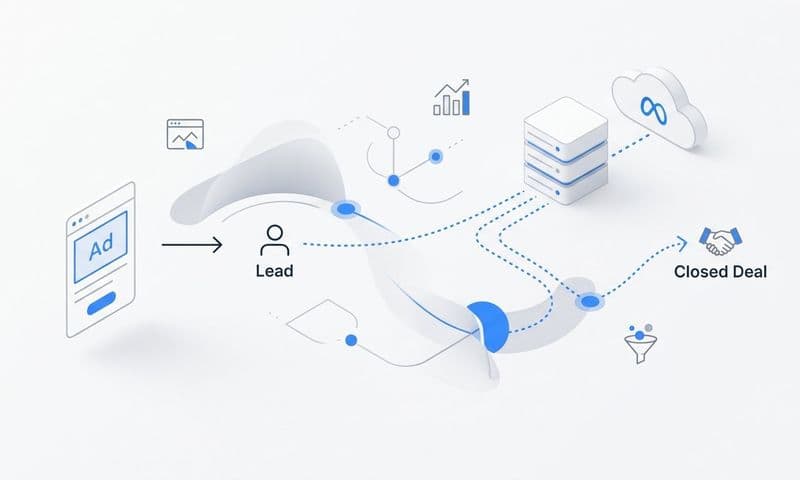
Connecting those dots requires two things: server-side tracking and Conversion API integrations. Server-side tracking captures web events at the server level rather than relying solely on browser-based cookies, which are increasingly unreliable due to privacy changes and ad blockers. Conversion API integrations allow you to send enriched event data back to ad platforms like Meta and Google, including CRM-level context about who converted and what happened after the click. This means your ad platform optimization algorithms are working with complete, accurate data rather than the partial picture they would otherwise see.
When your data infrastructure is properly connected, something powerful becomes possible: you can tie a specific ad impression or click from a named individual at a target account directly to a pipeline opportunity and ultimately to closed revenue. That is the account-level clarity that transforms ABM from a directional strategy into a measurable, optimizable program.
Cometly is built to provide exactly this kind of connected attribution layer for B2B SaaS teams. It integrates with your ad platforms, captures CRM events, and tracks website behavior in real time, mapping every touchpoint to accounts and revenue. Instead of manually stitching together exports from five different systems, your team gets a single view of how each target account is progressing through the buying journey and which marketing investments are driving that progression. For teams running ABM at scale, that kind of account-level clarity is not a nice-to-have. It is the foundation that makes the entire measurement framework work.
Turning ABM Measurement Into Daily Practice
Having the right framework and the right tools only creates value if your team actually builds measurement into how ABM campaigns are planned and reviewed. Here is how to operationalize account-based marketing measurement from the start.
Begin with your target account list before a single campaign goes live. Map every account in your list to your attribution system so that when touchpoints start accumulating, they are immediately associated with the right account and tier. If you wait until campaigns are running to connect your data, you will lose early-stage attribution data that is often critical for understanding how accounts first discovered you.
Define your engagement scoring criteria and pipeline influence thresholds in advance. Decide which interactions count toward an engagement score and how they are weighted. Decide what level of engagement qualifies an account as marketing-influenced for pipeline reporting purposes. These decisions need to be made before reporting begins, not after, because retroactively changing your criteria undermines the credibility of your data when you present it to revenue leadership.
Establish a regular cadence for reviewing ABM performance at the account tier level. Weekly or bi-weekly reviews of engagement scores across Tier 1 accounts allow your team to spot accounts that are heating up and coordinate with sales before intent signals cool off. Monthly reviews of pipeline influence and revenue attribution data give you the trend lines you need to demonstrate program impact over time and make confident budget allocation decisions.
Use attribution data to reallocate budget toward the channels and content types that are generating the most pipeline influence across your highest-value accounts. If your data shows that webinars are consistently driving engagement at Tier 1 accounts while display retargeting is generating activity at Tier 3 accounts with low conversion rates, that is a clear signal to shift investment. This kind of data-driven optimization is only possible when your measurement infrastructure is giving you accurate, account-level attribution in real time.
The Bottom Line on ABM Measurement
The shift from lead-centric to account-centric measurement is not just a reporting change. It fundamentally changes how B2B SaaS marketers allocate budget, prioritize programs, and demonstrate value to the business. When you measure at the account level, you stop optimizing for volume metrics that have little connection to revenue and start optimizing for the signals that actually predict deal progression and pipeline growth.
The foundation of all of this is clean, connected data. Without a system that links ad interactions to account engagement and account engagement to revenue, ABM measurement remains aspirational. With it, you can make the case for your program with confidence, identify what is working before the quarter ends, and continuously improve the efficiency of your ABM investment.
Cometly gives B2B SaaS marketing teams the attribution infrastructure to measure ABM performance end to end. From the first ad impression to closed-won revenue, every touchpoint is captured, connected to the right account, and surfaced in real time so your team can act on what the data is telling you.
If you are ready to move beyond lead metrics and build a measurement system that reflects how your ABM program actually creates revenue, Get your free demo today and see how Cometly connects every touchpoint to the accounts and outcomes that matter most.