Most B2B SaaS marketing teams pour enormous energy into the acquisition funnel. They obsess over click-through rates, cost per lead, and demo conversion rates. And then the deal closes, the champagne emoji gets posted in Slack, and marketing moves on to the next prospect.
What happens next is largely invisible to them.
The post sale customer journey, every interaction, behavior, and experience a customer has after signing the contract, is one of the most underleveraged growth levers in B2B SaaS. It shapes whether customers stay or churn, whether they expand or stagnate, and whether they become advocates who send you warm referrals or quiet detractors who leave one-star reviews.
Here is the part that should matter most to marketers: the post sale journey is not just a customer success concern. It is a revenue intelligence problem. When you understand which customers activate fastest, expand most, and refer others, you gain the data to make your acquisition campaigns dramatically more effective. You stop optimizing for leads and start optimizing for long-term revenue.
This article breaks down the core stages of the post sale customer journey, why marketers cannot afford to ignore them, and how connecting post sale data to acquisition attribution transforms the way growth teams make decisions.
The Stages That Define Life After the Sale
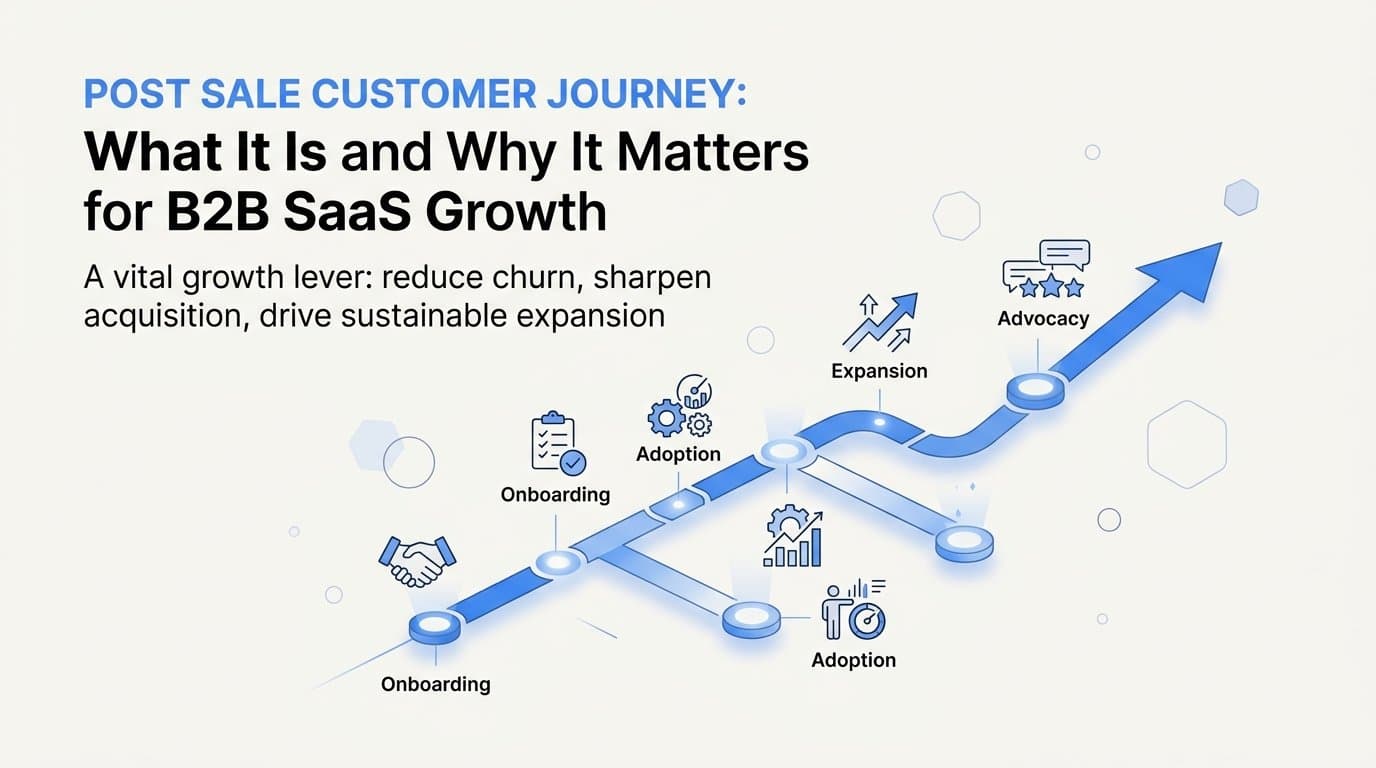
The post sale customer journey is not a single moment. It is a progression through distinct phases, each with its own signals, risks, and opportunities. Understanding these stages is the foundation for everything else.
Onboarding is where the journey begins. The customer has signed the contract and is now setting up the product for the first time. This stage is deceptively critical. A slow, confusing, or unsupported onboarding experience creates doubt early, and doubt is hard to reverse. Speed and quality here set the tone for the entire relationship.
Activation is the milestone that separates customers who will stay from those who will eventually churn. Activation is the moment a customer first experiences meaningful value from the product, often called the "aha moment." It might be the first time they see a report that changes a decision, or the first time a workflow they built actually runs automatically. Customers who reach activation are significantly more likely to retain. Those who never get there rarely do.
Adoption follows activation and represents ongoing, habitual use of core product features. A customer can activate once and then drift away. Adoption means the product has become embedded in their workflow. The deeper the adoption, the harder the product is to remove, and the stronger the retention signal.
Expansion is where subscription businesses compound their revenue. This is the stage where customers upgrade their plan, add seats, or purchase additional products. Expansion revenue is a primary growth driver for SaaS companies because it comes from customers who already trust the product and understand its value.
Advocacy closes the loop. Advocates refer colleagues, leave reviews on G2 or Capterra, participate in case studies, and speak at events. This stage feeds directly back into the top of your acquisition funnel, often generating the highest-quality pipeline you will ever see.
One important nuance: this journey is not always linear. Customers can skip stages, regress, or accelerate depending on their product experience, the quality of support they receive, and changes within their own organization. A customer who was deeply adopted can become at-risk after a leadership change. A customer who stalled in onboarding can suddenly activate after a well-timed check-in call. Treating the post sale journey as a fixed path is a mistake. Treating it as a dynamic, measurable system is where the real insight lives.
These stages also differ fundamentally from pre-sale funnel stages. Pre-sale stages are largely about intent and information gathering. Post sale stages are about behavior, product interaction, and value realization. The signals are different, the data sources are different, and the teams responsible often sit in different parts of the organization. Bridging that gap is the challenge.
Why Marketers Cannot Afford to Ignore What Happens After Closed-Won
There is a persistent myth in B2B SaaS that marketing's job ends at the conversion event. Generate the lead, nurture the prospect, support the close, and hand off to customer success. Job done.
This framing is costing growth teams real money.
Consider expansion revenue first. Upsells and cross-sells to existing customers typically require far less effort to generate than acquiring net new customers. The trust is already established, the product is already in use, and the conversation is about adding value rather than proving it. Marketing teams that treat expansion as purely a CS motion are leaving high-ROI opportunities on the table. Campaigns targeting existing customers with relevant upgrade messaging, product education content, and feature announcements can directly accelerate expansion without the full cost of a new acquisition.
Then there is the advocacy pipeline. When customers reach the advocacy stage, they generate referrals that convert at higher rates and with shorter sales cycles than most paid channels. But here is the attribution problem: most marketing teams never see this pipeline clearly. A referral often enters the CRM as a direct visit or an organic lead, with no connection back to the customer who sent them. The acquisition cost looks low, but the mechanism that drove it, a successful post sale experience, is invisible to the attribution model. You cannot invest in what you cannot measure.
The third reason is perhaps the most strategically powerful. Post sale behavior data tells you which customer segments activate fastest, expand most, and stay longest. That information should flow directly back into your acquisition strategy. If customers who came through a specific paid channel consistently churn within six months, you are paying to acquire customers who will not stick. If customers from a specific industry vertical or company size consistently expand their contracts, those are the audiences you should be doubling down on in your paid campaigns.
Most marketing teams make targeting decisions based on who converts. The smarter question is who converts and then succeeds. The post sale journey is where you find that answer.
This is not a theoretical concern. It is a data problem that has a practical solution: connecting your post sale behavior data to your acquisition attribution. When those two data sets talk to each other, your entire marketing operation becomes more intelligent.
Touchpoints That Shape the Post Sale Experience
The post sale journey is built from specific interactions. Each touchpoint is an opportunity to accelerate a customer toward activation and adoption, or to lose their attention entirely. Mapping these touchpoints matters for both customer success and marketing teams because each one is a trackable event that signals where a customer is in their journey.
Onboarding emails are often the first post sale communication a customer receives. Sequence, timing, and relevance determine whether these emails get opened and acted on, or ignored. A generic welcome series sends a signal that the company does not really know who just signed up. A personalized sequence based on the customer's use case and the features most relevant to their goals sends a very different signal.
In-app guidance includes tooltips, walkthroughs, and contextual prompts that help customers discover value within the product itself. This touchpoint is particularly powerful because it meets customers where they already are, inside the tool, at the moment they need direction.
Check-in calls from customer success managers are high-touch touchpoints that provide qualitative signal. A customer who is enthusiastic on a 30-day check-in is behaving very differently from one who is vague or disengaged. These conversations, when logged consistently in a CRM, become valuable data points in understanding journey progression.
Product update communications serve a dual purpose. They remind customers of the product's ongoing value and introduce features that might unlock new use cases. For customers who have stalled in adoption, a relevant product update can reignite engagement.
Renewal communications are a late-stage touchpoint that should not arrive as a surprise. Customers who reach renewal having experienced strong adoption and expansion are very different from customers who arrive at renewal having never fully activated. The renewal conversation is a reflection of everything that happened before it.
Community engagement through user groups, forums, or events represents the highest-trust touchpoints in the post sale journey. Customers who participate in community are typically deeply adopted and often on the path to advocacy.
Personalization across all of these touchpoints makes a measurable difference. A customer who originally converted through a paid campaign targeting a specific pain point should receive post sale communications that reinforce that same value narrative. Connecting how a customer first engaged with your brand to how you communicate with them after the sale creates continuity that builds trust and accelerates adoption.
Measuring What Moves the Needle in the Post Sale Journey
Tracking the post sale journey requires more than monitoring whether customers log in. Surface-level engagement metrics can be deeply misleading without connecting them to actual product usage depth and revenue outcomes. The metrics that matter most are the ones that predict retention, expansion, and long-term value.
Time to activation measures how quickly a customer reaches their first meaningful value milestone after onboarding begins. This metric is a leading indicator of retention. Customers who activate quickly tend to adopt more deeply and churn less. Customers who take a long time to activate, or never activate at all, are at elevated risk from the start. Tracking this metric across your customer base reveals whether your onboarding experience is working and which customer segments need more support.
Feature adoption rate captures the breadth and depth of how customers use the product. A customer using one feature is more vulnerable than a customer using five. Depth of adoption correlates with how embedded the product is in a customer's workflow, which directly influences renewal probability. This metric also helps identify which features drive the most value, informing both product development and marketing messaging.
Net Revenue Retention (NRR) is one of the most important health metrics for any SaaS business. It measures the revenue retained from existing customers over a period, including expansions and contractions. An NRR above a certain threshold means your existing customer base is growing on its own, independent of new acquisition. NRR is a direct reflection of post sale journey quality.
Customer Lifetime Value (LTV) represents the total revenue a customer generates over their entire relationship with your company. LTV is the metric that should anchor your acquisition strategy. When you know the LTV of customers acquired through different channels, you can make intelligent decisions about where to invest your acquisition budget.
Here is where attribution data from the acquisition phase becomes genuinely powerful. When you layer the channel or campaign that sourced a customer onto their post sale metrics, patterns emerge. You might discover that customers acquired through a specific paid campaign have a significantly higher time to activation than customers who came through organic search. Or that customers from a particular industry segment consistently reach expansion within six months. These insights do not come from post sale data alone. They come from connecting acquisition data to post sale outcomes.
This is the kind of analysis that transforms marketing from a cost center into a revenue intelligence function. But it requires that your acquisition data and your post sale data actually live in the same place, or at least talk to each other.
How Attribution Data Connects the Full Customer Journey
Most marketing teams experience a hard stop in their visibility the moment a deal closes. The lead came from a LinkedIn campaign, moved through a nurture sequence, booked a demo, and eventually became a closed-won deal. That is where the marketing data trail ends.
What happens next, whether the customer activates, expands, or churns, is recorded somewhere else entirely. Product usage data lives in an analytics tool. CRM events live in Salesforce or HubSpot. Renewal and expansion data lives in a billing system. These data sources rarely connect back to the original acquisition data, creating a blind spot that prevents marketers from understanding the true ROI of their campaigns.
This attribution gap has real consequences. When marketers cannot see past the conversion event, they optimize for the wrong outcomes. A campaign that generates a high volume of leads looks successful on paper, even if those leads convert to customers who churn within three months. A campaign that generates fewer but higher-quality leads might look underperforming by traditional metrics, even though it produces customers who expand their contracts and refer others.
Closing this gap requires connecting three data layers: ad platform data, CRM events, and post sale behavior. When these layers are unified into a single attribution view, something powerful happens. You can see not just which campaigns drove leads, but which campaigns drove customers who activated quickly, retained through renewal, and expanded their revenue.
This is exactly the problem Cometly is built to solve. Cometly tracks the full customer journey from first ad click through closed-won and beyond, connecting ad spend directly to pipeline and revenue outcomes. Instead of treating the conversion event as the end of the attribution story, Cometly treats it as a milestone in a longer journey. Marketers can tie expansion revenue and retention signals back to the specific campaigns and channels that sourced those customers, giving them a complete picture of which marketing investments are actually compounding over time.
With 70+ native integrations, Cometly connects your ad platforms, CRM, and website into a single source of truth. The result is attribution data that reflects the full customer lifecycle, not just the top of the funnel. For growth teams trying to make smarter budget decisions, that visibility is the difference between guessing and knowing.
Turning Post Sale Insights Into Smarter Acquisition Decisions
Understanding the post sale journey is valuable. Using it to improve your acquisition strategy is where it becomes transformational. The feedback loop between post sale data and acquisition decisions is one of the most underutilized mechanisms in B2B SaaS marketing.
The concept is straightforward. Your best customers, the ones who activate quickly, adopt deeply, expand their contracts, and refer others, share characteristics. They come from certain industries, company sizes, or job functions. They were sourced through specific channels or campaigns. They had particular pain points that your product addressed directly. When you identify these patterns in your post sale data, you have a blueprint for who to target in your next acquisition campaign.
Enriched conversion data sent back to ad platforms takes this a step further. Through server-side tracking integrations like Meta Conversion API or Google Enhanced Conversions, you can send post sale events back to the ad algorithms. Instead of telling the algorithm to optimize for lead form submissions, you are telling it to optimize for customers who activated, expanded, or reached a high LTV threshold. Over time, the algorithm learns to find more people who look like your best customers, not just people who are willing to fill out a form.
Cometly's Conversion API integration makes this process practical. By sending enriched, conversion-ready events back to Meta, Google, and other platforms, Cometly helps ad algorithms improve their targeting quality based on real revenue outcomes rather than surface-level conversion events. The result is acquisition campaigns that get smarter over time because they are learning from the full customer journey, not just the first touchpoint.
Building this feedback loop requires a few practical steps. First, align your marketing and customer success teams on shared data definitions. What counts as activation? What qualifies as expansion? These definitions need to be consistent across your CRM and attribution tool. Second, connect your attribution platform to your CRM so that post sale events are captured and linked back to original acquisition data. Third, use expansion and retention signals to regularly review and refine your campaign targeting, updating audience definitions as your post sale data reveals new patterns.
This is not a one-time exercise. It is an ongoing process of learning from your existing customers to make smarter bets on your next ones.
Putting It All Together
The post sale customer journey is where B2B SaaS companies either compound their marketing investment or let it slowly erode. Every dollar you spend acquiring a customer is only as valuable as the lifetime revenue that customer generates. If you cannot see what happens after the deal closes, you are flying blind on the most important part of the equation.
The stages from onboarding through advocacy are not just a customer success framework. They are a rich source of data that should inform how you target, message, and invest in acquisition. The touchpoints along the way are trackable events. The metrics that matter, time to activation, feature adoption, NRR, and LTV, tell a more complete story than any top-of-funnel metric ever could.
And when you connect acquisition attribution to post sale behavior in a single platform, the feedback loop closes. You stop optimizing for leads and start optimizing for revenue. You stop asking which campaigns drove the most conversions and start asking which campaigns drove the most valuable customers.
Cometly closes the attribution gap between your ad spend and your long-term revenue. It tracks the full customer journey from first ad click to closed-won and beyond, connecting your ad platforms, CRM, and post sale data into one clear picture. For growth teams who want to make every acquisition dollar work harder, that visibility is not a nice-to-have. It is the foundation of a smarter marketing strategy.
Ready to see the full picture of your customer journey? Get your free demo today and start connecting every touchpoint to the revenue outcomes that actually matter.