
When your Google Ads dashboard says one thing, your CRM says another, and your analytics platform tells a third story, you have a data reconciliation problem. For B2B SaaS marketing teams, this disconnect is not just frustrating. It leads to budget decisions based on incomplete or contradictory information.
You end up either over-investing in channels that look good on paper but underperform in revenue, or cutting campaigns that are quietly driving pipeline. Neither outcome is acceptable when you are trying to grow efficiently.
Reconciling your marketing data sources means aligning the numbers across every platform you use — ad networks, website analytics, your CRM, and your attribution tool — so you have a single, trustworthy view of performance. This is not about making every number match perfectly. It is about understanding why differences exist and knowing which numbers to trust for which decisions.
The good news is that most data discrepancies come from a predictable set of root causes: inconsistent UTM tagging, mismatched conversion definitions, pixel data loss from browser restrictions, and the absence of a unified attribution layer. All of these are fixable with the right process.
This guide walks you through a practical, step-by-step process to reconcile marketing data sources across your entire stack. You will learn how to audit what you are currently tracking, standardize how data flows between platforms, identify and close the gaps causing discrepancies, and build a unified reporting layer your whole team can rely on.
Whether you are dealing with mismatched conversion counts, unexplained gaps between ad spend and pipeline data, or simply trying to connect your first ad click to closed revenue, this process applies directly to your situation. By the end, you will have a clear framework for keeping your marketing data clean, consistent, and actionable — so every budget decision is grounded in reality rather than platform-reported estimates.
Step 1: Audit Every Data Source You Are Currently Using
Before you can reconcile anything, you need a complete picture of what you are working with. Most B2B SaaS teams are surprised to discover just how many systems are generating or storing marketing data once they sit down and list them all out.
Start by documenting every platform that touches your marketing data. This typically includes paid ad platforms like Google Ads, Meta, LinkedIn, and TikTok; website analytics tools like Google Analytics 4; your CRM; marketing automation platforms; any attribution tools you have in place; and your revenue or billing system if you are using something like Stripe.
For each source, document three things:
What it measures: Be specific here. Google Ads measures clicks, impressions, and conversions attributed to Google campaigns. Your CRM measures leads, opportunities, and closed deals. These are fundamentally different views of the same customer journey.
How it collects data: Note whether each source relies on a client-side pixel, a server-side API, a manual import, or a native integration. This matters enormously because client-side pixels are the most vulnerable to data loss from ad blockers, browser restrictions, and iOS privacy changes.
What conversion events it tracks: List every event being fired or recorded in each platform, and note whether those events have been verified as firing correctly.
As you work through this audit, identify which sources are authoritative for specific metrics. Your CRM owns revenue and pipeline data. Your ad platforms own spend data. Your website analytics owns session and behavior data. Knowing which source to trust for which metric prevents confusion later when numbers do not match.
Pay special attention to any sources relying on third-party cookies or client-side pixels. These are your highest-risk data points. Post-iOS 14 privacy changes significantly degraded the reliability of pixel-based tracking, and browser-level restrictions continue to erode client-side data quality over time.
A common discovery during this audit is duplicate tracking setups. Teams often find that the same conversion event is being fired multiple times, or that legacy pixels from previous campaigns are still active alongside newer server-side setups. Document everything before making any changes. You want a complete baseline before you start adjusting anything.
Success indicator: You have a complete data source inventory with collection method, tracked events, and known limitations noted for each platform in your stack.
Step 2: Standardize Your UTM Tagging and Naming Conventions
Inconsistent UTM parameters are one of the most common and most easily fixed causes of data fragmentation. When campaigns are tagged differently across platforms, sessions get miscategorized, traffic appears in the wrong buckets, and cross-channel reporting becomes unreliable.
Think of UTM parameters as the connective tissue between your ad platforms and your analytics. If that tissue is inconsistent, the body does not function correctly.
Define a company-wide UTM structure that covers all five parameters: utm_source, utm_medium, utm_campaign, utm_content, and utm_term. The key is consistency. Every person who launches a campaign needs to follow the same format, every time.
Here are the core rules to standardize:
Use lowercase consistently: UTM parameters are case-sensitive. "Google" and "google" will appear as two separate sources in your analytics. Mandate lowercase across the board.
Replace spaces with hyphens: Spaces in UTM values create encoding issues and make reports harder to read. Use hyphens as separators in campaign names and content labels.
Standardize source and medium values: Decide on a fixed list of accepted values for utm_source (google, meta, linkedin, tiktok, email) and utm_medium (cpc, paid-social, email, organic) and do not deviate from them.
Apply naming conventions inside ad platforms too: Campaign names, ad set names, and ad names inside Google Ads, Meta, and LinkedIn should follow the same structure as your UTM parameters. This makes cross-platform campaign tracking far cleaner when you are pulling data into a unified dashboard.
Once you have documented your naming convention, create a shared UTM builder — a simple spreadsheet or a dedicated tool — that generates compliant UTM strings automatically. This removes human error at the point of campaign creation, which is where most inconsistencies originate.
After setting the standard going forward, audit your existing active campaigns. Any campaign that is live and not following your new convention should be updated. Paused or completed campaigns can be noted in your documentation but do not need retroactive fixes since that data is already recorded.
The goal is to reach a state where every session in your analytics is attributed to a recognizable, standardized source. When you see sessions appearing under "direct" or "(none)" that should not be there, it is almost always a UTM tagging gap.
Success indicator: When you pull a traffic report, every session is attributed to a recognizable source and medium, with no anomalous "direct" or "none" traffic caused by missing or malformed tags.
Step 3: Align Conversion Definitions Across All Platforms
Here is a scenario that plays out constantly in B2B SaaS marketing teams. Meta reports 80 leads from last month's campaign. Your CRM shows 30 leads from the same period. Your marketing manager and your sales manager are now having a very uncomfortable conversation about which number is right.
Both numbers can be technically accurate and still represent completely different things. That is the conversion definition problem.
Different platforms count conversions differently by design. Meta might count a form view as a lead event. Your CRM only counts a lead after a sales rep reviews the submission and marks it as qualified. Google might count a conversion based on a 30-day click window while your CRM timestamps the entry at the moment of form submission. None of these platforms are wrong. They are just measuring different things with the same label.
The fix is a master conversion taxonomy. For every conversion event your team tracks, document the following:
Event name: Use a consistent label across all platforms. "demo-request" should mean the same thing in Meta, Google, GA4, and your CRM.
Trigger action: What specific user action causes this event to fire? A form submission on a specific URL, a button click, a CRM status change?
Platforms that track it: Which systems should record this event, and which should not?
Attribution window: What time window is applied when crediting this conversion to an ad? A 7-day click window on Meta will produce different numbers than a 30-day window, and both will differ from your CRM timestamp.
The most important events to align for B2B SaaS teams are typically: form submissions, demo requests, free trial signups, MQL status changes in the CRM, SQL conversions, and closed-won deals. Each of these sits at a different stage of the funnel and carries a different level of verification.
Critically, decide which metric is authoritative for each conversion type. Ad platforms report modeled or estimated conversions, especially post-iOS 14. Your CRM holds verified pipeline data. For budget decisions, CRM-verified data should always take precedence over platform-reported estimates. Understanding attribution challenges across platforms helps teams set realistic expectations for how much variance is acceptable before triggering an investigation.
Success indicator: Every team member uses the same definition for "lead," "MQL," and "conversion" regardless of which dashboard they are looking at, and discrepancies between platform counts and CRM counts are understood and documented rather than debated.
Step 4: Implement Server-Side Tracking to Close Data Gaps
Even with perfect UTM tagging and aligned conversion definitions, you will still have data gaps if you are relying entirely on client-side pixels. This is not a configuration problem. It is a structural limitation of how browser-based tracking works in the current privacy landscape.
Ad blockers, browser-level tracking prevention, and iOS privacy restrictions all intercept client-side pixel requests before they reach the ad platform. The result is that a meaningful portion of your actual conversions never get recorded. You are making budget decisions based on an incomplete dataset.
Server-side tracking solves this by sending conversion data directly from your server to the ad platform, bypassing the browser entirely. The two most important implementations for B2B SaaS teams are the Meta Conversion API (CAPI) and Google Enhanced Conversions.
When setting up server-side events, keep these principles in mind:
Mirror your pixel events: Your server-side events should track the same actions as your pixel events. This creates redundancy, which is the point. Use event deduplication parameters (event_id on Meta, transaction_id on Google) to prevent double-counting when both the pixel and the server event fire for the same action.
Pass first-party data: Server-side events become significantly more powerful when you include hashed first-party identifiers like email address and phone number. These improve match rates, which means more of your conversions get correctly attributed to the ad that drove them.
Connect your CRM events: For B2B SaaS specifically, the most valuable conversions often happen days or weeks after the initial ad click. A demo that gets booked on Monday might be qualified as an SQL on Thursday and closed as a deal two months later. Server-side integrations allow you to send these delayed, offline conversion events back to your ad platforms so they are factored into optimization and attribution.
Managing multiple server-side API connections manually is technically complex. Platforms like Cometly handle server-side event routing natively, connecting your CRM and ad platforms through a single integration layer. This means you get the benefits of server-side tracking across all your channels without needing to build and maintain separate API connections for each platform.
A healthy server-side setup will show match rates above 80% in your Meta Events Manager and Google Ads diagnostics. You should also see your total tracked conversions increase compared to pixel-only tracking, which reflects the conversions that were previously being lost. Using the right ad tracking tools makes this transition significantly more manageable for lean marketing teams.
Success indicator: Server-side event match rates are above 80% and total tracked conversions increase compared to your previous pixel-only baseline.
Step 5: Build a Unified Attribution Layer Across Channels
You have clean data sources, consistent tagging, aligned conversion definitions, and server-side tracking in place. Now you need a single attribution layer that connects all of it — one place where ad spend across every channel maps to actual pipeline and revenue.
Without this layer, you are still switching between platforms to piece together performance. You might check Google Ads for CPC data, then open your CRM for pipeline numbers, then try to manually connect the two. That process is slow, error-prone, and does not scale.
The first decision is your attribution model. For B2B SaaS companies with sales cycles that span weeks or months, last-touch attribution is particularly misleading. A prospect might click a LinkedIn ad, read three blog posts, attend a webinar, and then convert after clicking a Google retargeting ad. Last-touch gives all credit to Google. First-touch gives all credit to LinkedIn. Neither tells the complete story.
Multi-touch attribution models distribute credit across the full customer journey, which better reflects the reality of B2B buying behavior. Linear models split credit evenly. Time-decay models give more weight to touchpoints closer to conversion. Position-based models emphasize the first and last touch while still crediting the middle. The right model depends on your sales cycle and your team's priorities. Reviewing digital marketing attribution software options helps teams identify which tools support the model complexity their sales cycle requires.
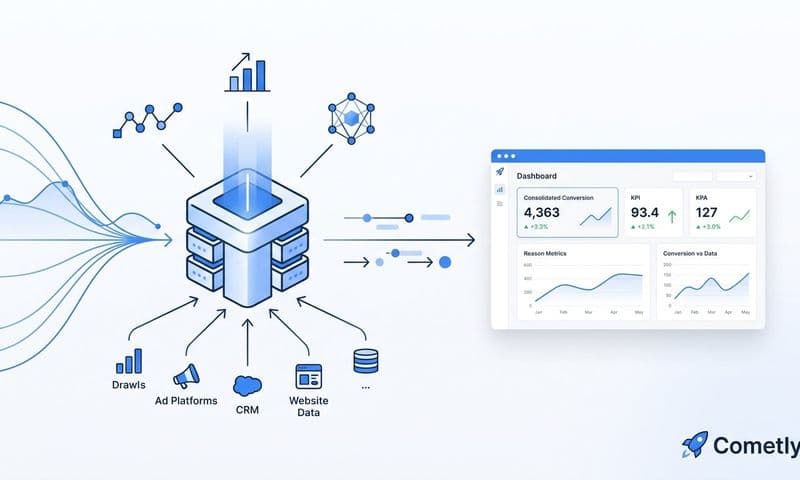
The practical requirement is connecting your ad platform data, website analytics, and CRM data in one place. Cometly connects ad platforms, CRM data, and Stripe revenue into a unified attribution view, giving you a single source of truth that shows which campaigns and channels are actually driving revenue rather than just top-of-funnel activity. This means you can see total ad spend, pipeline generated, and revenue attributed by channel in one dashboard without switching between tools.
One important practice once your attribution layer is in place: compare model outputs side by side. First-touch, last-touch, and multi-touch attribution will tell different stories about the same data. Understanding those differences helps you make more informed budget decisions rather than treating any single model as the absolute truth.
A critical pitfall to avoid: do not rely solely on platform-reported ROAS as your primary performance metric. Build your own revenue attribution that starts from closed deals in your CRM and traces back to the originating campaigns. Platform ROAS is useful as a directional signal, but it is not a substitute for verified revenue attribution.
Success indicator: You can open one dashboard and see total ad spend, pipeline generated, and revenue attributed by channel without switching between platforms or manually combining exports.
Step 6: Create a Reconciliation Workflow and Review Cadence
Data reconciliation is not a one-time project. It is an ongoing operational process. If you treat it as a project, you will clean everything up, feel good about it for a few weeks, and then gradually watch new discrepancies accumulate until you are back where you started.
The solution is a recurring reconciliation workflow with clear ownership and a structured review process.
Set up a weekly data reconciliation check. The core of this review is simple: compare total conversions reported by your ad platforms against CRM entries for the same period. Define a variance threshold — for example, anything above a 15% gap between platform-reported conversions and CRM-verified conversions triggers an investigation. Below that threshold, document the variance and move on.
Build a simple reconciliation report that shows four things side by side:
Ad platform spend by channel: What did you spend on each platform this week?
Platform-reported conversions by channel: What did each platform claim to convert?
CRM-verified conversions by channel: What actually entered your CRM as a lead or opportunity, attributed to each channel?
Variance between platform and CRM numbers: Where are the gaps, and how large are they?
Assign clear ownership for this review. Someone on the marketing or analytics team should be responsible for running the reconciliation check each week and escalating discrepancies that exceed your threshold. Without a named owner, this process will eventually be skipped during busy periods, which is exactly when data quality problems tend to compound.
When discrepancies appear, use a structured investigation sequence. Check UTM coverage first — are sessions being tagged correctly? Then check pixel and server-side event firing. Then review attribution window settings. Then examine CRM data entry quality, because sometimes the gap is not a tracking problem but a data hygiene problem on the CRM side. Applying best practices for data-driven decisions at each stage of this investigation keeps the process systematic rather than reactive.
Document every investigation and its resolution. Over time, this creates a reference library that dramatically speeds up future investigations. You will start to recognize patterns — certain campaigns consistently show higher variance, or a specific integration tends to drift after platform updates.
Success indicator: Your team can explain any variance between ad platform data and CRM data within one business day, and discrepancies trend downward over time as root causes are identified and fixed.
Step 7: Use Reconciled Data to Drive Confident Budget Decisions
Everything in this guide builds toward one outcome: the ability to make budget decisions with confidence. Once your data is reconciled, you stop guessing and start optimizing based on what is actually working.
The first shift is moving from vanity metrics to revenue metrics. Cost per click and cost per lead are directionally useful, but they do not tell you what matters most in B2B SaaS. Cost per opportunity and cost per closed deal are the metrics that connect marketing activity to business outcomes. With a unified attribution layer in place, these numbers become visible and actionable.
The second shift is feeding your reconciled data back into the ad platforms. This is where the compounding benefit kicks in. When you send high-quality, verified conversion events back to Meta via CAPI and to Google via Enhanced Conversions, you are giving those platforms better signals to optimize against. Their machine learning models improve targeting and bidding based on the quality of the conversion data you provide. Better input data leads to better audience matching, which leads to more efficient spend over time.
Use AI-powered insights to surface patterns in your reconciled data that would take hours to find manually. Which campaigns have the highest revenue attribution? Which ad creatives are driving the most qualified leads rather than just the most clicks? Where would a budget reallocation have the biggest impact on pipeline? These are questions that reconciled data can answer quickly.
Cometly's AI ads manager analyzes your reconciled attribution data to surface high-performing campaigns and flag underperformers, giving your team specific recommendations rather than raw numbers to interpret manually. This turns your data infrastructure investment into a direct competitive advantage.
Finally, revisit your attribution model on a quarterly basis. As your channel mix evolves and your sales cycle changes, the model that served you well at one stage may need adjustment. A setup optimized for Google Ads alone may need recalibration when you add LinkedIn or TikTok to the mix. Regular model reviews keep your attribution aligned with how your buyers actually behave.
Success indicator: Budget allocation decisions are backed by revenue attribution data, and your team can clearly articulate why spend is increasing or decreasing on any given channel.
Putting It All Together
Reconciling marketing data sources is one of the highest-leverage investments a B2B SaaS marketing team can make. When your data is aligned, every budget decision, every campaign optimization, and every attribution conversation becomes grounded in reality rather than platform estimates.
Here is a quick checklist to track your progress through this process:
1. Audit all data sources and document their collection methods, tracked events, and known limitations.
2. Standardize UTM tagging and naming conventions across all active campaigns and platforms.
3. Align conversion definitions across every platform and establish which source is authoritative for each metric.
4. Implement server-side tracking via Meta CAPI and Google Enhanced Conversions to close pixel data gaps.
5. Build a unified attribution layer that connects ad spend to pipeline and revenue in a single view.
6. Establish a weekly reconciliation workflow with a named owner and a structured investigation process.
7. Use reconciled data to drive budget decisions and feed verified conversion signals back to ad platform algorithms.
Platforms like Cometly are built specifically to accelerate this process for B2B SaaS teams. By connecting your ad platforms, CRM, and revenue data into a single attribution view, Cometly reduces the time you spend chasing discrepancies and increases the time you spend scaling what works. From server-side event routing to AI-powered campaign recommendations, it is designed for teams that want accurate data and actionable insights without managing a dozen separate integrations.
If your marketing data is currently fragmented, start with Step 1 today. A complete audit of your current sources is the foundation everything else builds on. Once you know exactly what you are working with, every subsequent step becomes significantly more straightforward.
Ready to elevate your marketing game with precision and confidence? Discover how Cometly's AI-driven recommendations can transform your ad strategy. Get your free demo today and start capturing every touchpoint to maximize your conversions.