
Most attribution tools were built to answer one question: what drove the first conversion? That's a reasonable starting point, but for B2B SaaS companies, it's only half the story. The real revenue picture includes renewals, expansions, and repeat purchases, and most marketing teams are flying blind on all of it.
Here's the tension: your acquisition campaigns get meticulously tracked, modeled, and optimized. But the retention campaigns that keep customers buying, the retargeting sequences, the lifecycle emails, the re-engagement ads, often get lumped into vague performance metrics that don't connect back to actual revenue. You end up knowing a lot about how customers arrive, and very little about what keeps them coming back.
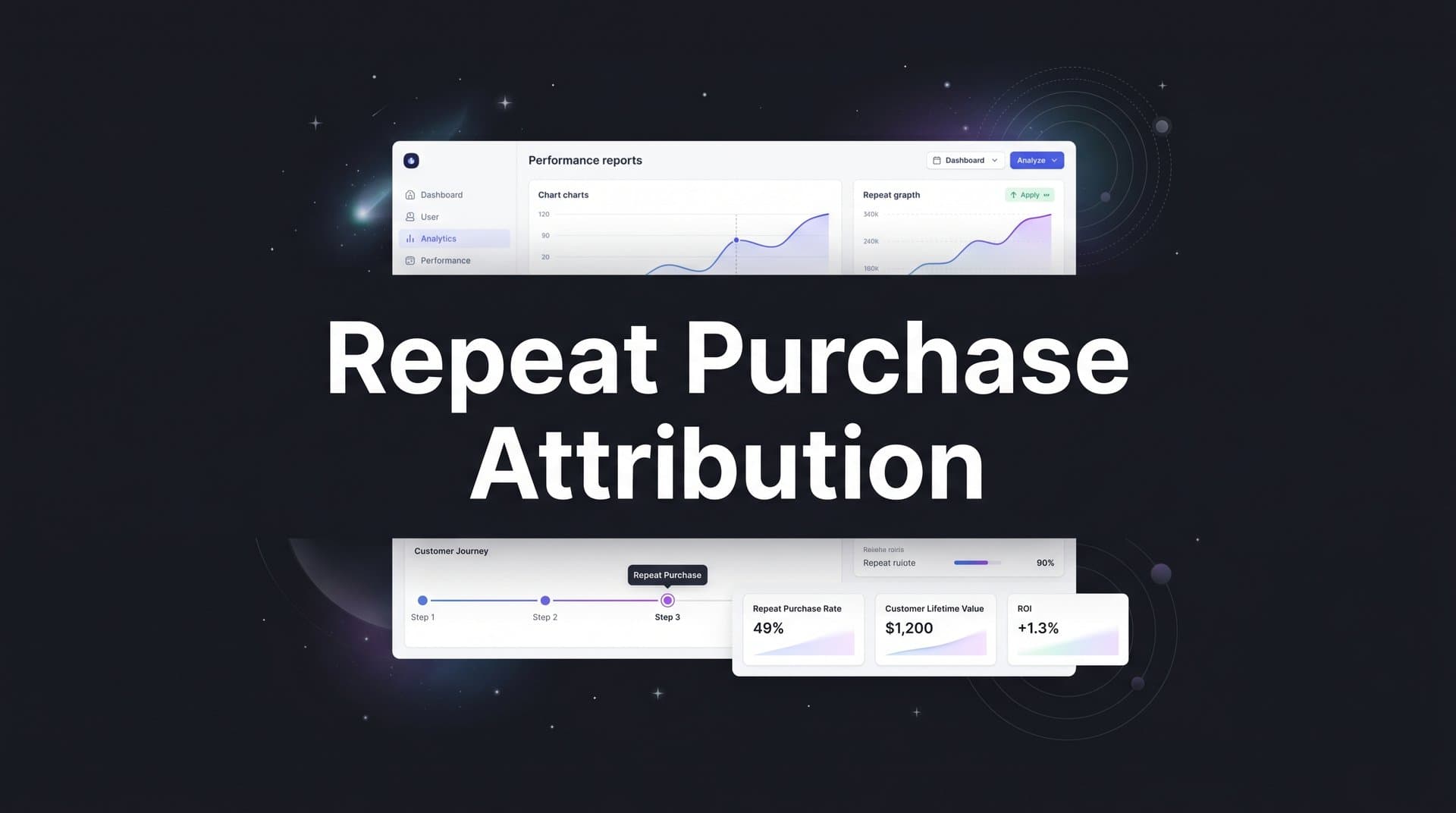
Repeat purchase attribution changes that. It's the practice of identifying exactly which marketing touchpoints, channels, and campaigns influenced a customer to buy again after their initial conversion. For growth teams serious about understanding true customer lifetime value and making smarter budget decisions, it's not a nice-to-have. It's foundational. This article walks through why standard attribution logic breaks down for retention, what accurate repeat purchase tracking actually requires, and how to build a framework that connects post-conversion marketing to long-term revenue.
Beyond the First Conversion: Why Retention Has a Blind Spot
Standard attribution models were designed with a specific goal in mind: figure out which touchpoints deserve credit for turning a stranger into a customer. First-touch, last-click, and even basic multi-touch models all operate within an acquisition-centric frame. They're looking backward from the first purchase, not forward into the customer's ongoing relationship with your brand.
This creates a structural blind spot. Once a customer converts, most attribution setups stop paying close attention. The touchpoints that influence whether that customer buys again, upgrades their plan, or churns quietly in month four, rarely get tracked with the same rigor applied to acquisition campaigns.
Repeat purchase behavior involves a completely different customer mindset. A prospect evaluating your product for the first time is weighing trust, fit, and risk. A customer deciding whether to expand their subscription or make a follow-on purchase already knows you. They're responding to different signals: a well-timed email that resurfaces a relevant use case, a retargeting ad that highlights a new feature, a piece of lifecycle content that reinforces the value they're already getting. These are the touchpoints that drive retention revenue, and standard attribution models simply aren't built to capture them.
For B2B SaaS companies specifically, this gap is expensive. Subscription and expansion revenue often represents the majority of total revenue once a company reaches a certain scale. Upsells, seat expansions, and renewals don't happen in a vacuum. Marketing plays a role in all of them. But if your attribution logic only credits acquisition events, you're making budget decisions based on a fundamentally incomplete picture.
The result is a common and costly misalignment: retention-focused campaigns get underfunded because they can't demonstrate measurable ROI through the same lens used for acquisition. Teams cut lifecycle email programs or reduce retargeting budgets for existing customers because the data doesn't show a clear return. In reality, those campaigns may be driving significant repeat purchase revenue that simply isn't being attributed correctly.
Fixing this requires a deliberate shift in how you think about attribution. Acquisition and retention are different customer behaviors, and they need different measurement logic to be understood accurately.
Defining What Repeat Purchase Attribution Actually Measures
Repeat purchase attribution is the practice of identifying and crediting the specific marketing touchpoints, channels, and campaigns that influenced a customer to make a second, third, or ongoing purchase after their initial conversion. It picks up where acquisition attribution leaves off, treating the post-conversion customer journey as its own trackable sequence of events.
To do this accurately, you need several layers of data working together. Customer purchase history tells you when a repeat purchase occurred and how it relates to prior purchases. Post-conversion touchpoint data captures the marketing interactions that happened between purchases, including email opens and clicks, retargeting ad impressions and clicks, paid search interactions, and session-level behavior on your website or in your product. CRM event data ties all of this back to individual customer records, so you can see the full timeline from first conversion through every subsequent purchase.
Without these inputs connected in a single view, repeat purchase attribution becomes guesswork. You might know that a customer bought again, but you won't know whether it was the re-engagement email campaign, the retargeting sequence, or organic product usage that drove the decision.
It's also worth being precise about what repeat purchase attribution is measuring versus what upsell or expansion attribution tracks. In a B2B SaaS context, these are related but distinct. A repeat purchase might refer to a customer renewing their subscription, purchasing an additional product, or making a second transaction in a transactional model. An upsell or expansion typically involves a customer moving to a higher tier or adding seats to an existing contract.
The tracking logic differs slightly for each. Repeat purchases often involve a clear transaction event that can be tied to a specific touchpoint sequence. Expansion revenue in a subscription model may be more gradual, influenced by a series of product interactions and marketing touchpoints over a longer period. Both matter, but conflating them in your attribution setup leads to muddled data.
The key principle is this: every post-conversion customer interaction that could influence a purchasing decision should be tracked and available for attribution analysis. That means your tracking infrastructure needs to extend well beyond the acquisition funnel and remain active throughout the customer lifecycle.
Attribution Models That Fit Repeat Purchase Scenarios
Not all attribution models are equally useful for tracking repeat purchases. Choosing the right one depends on your customer lifecycle length, purchase frequency, and the types of marketing touchpoints involved in driving retention.
Linear Attribution: This model distributes credit equally across all touchpoints in a defined window. For repeat purchase scenarios, it works well because it acknowledges that multiple interactions, not just the last one before repurchase, contributed to the outcome. A customer who received three emails, saw two retargeting ads, and visited your pricing page before renewing had a multi-step journey. Linear attribution respects that complexity.
Time-Decay Attribution: This model weights touchpoints more heavily the closer they occur to the conversion event. For shorter repurchase cycles or scenarios where a specific campaign clearly triggered a buying decision, time-decay can surface which recent interactions had the most influence. It's particularly useful for evaluating promotional campaigns or time-sensitive re-engagement sequences.
Data-Driven Attribution: When you have sufficient conversion volume, data-driven models use patterns across your full customer dataset to assign credit based on what actually correlates with repeat purchases. This is the most accurate approach when the data supports it, because it surfaces non-obvious patterns that rule-based models miss. It can reveal, for example, that a mid-funnel content touchpoint consistently precedes repeat purchases even though it rarely gets credit in simpler models.
First-touch and last-click models fail in retention contexts for straightforward reasons. First-touch ignores everything that happened after acquisition, which is precisely the territory repeat purchase attribution needs to cover. Last-click over-credits the final nudge before repurchase, often a direct visit or a branded search, while ignoring the sequence of touchpoints that built the momentum leading up to it.
One often-overlooked practice is segmenting your attribution windows by customer lifecycle stage. A customer who converted 30 days ago has a very different behavioral profile than one who has been active for 12 months. Applying the same attribution window and model to both produces misleading results. New customers in their early lifecycle may respond quickly to re-engagement signals, while longer-tenured customers have more complex journeys that require wider attribution windows and different weighting logic.
Building this segmentation into your attribution setup takes more effort upfront, but it produces significantly more accurate data for retention-focused budget decisions.
Building a Tracking Framework That Captures Post-Conversion Touchpoints
Accurate repeat purchase attribution doesn't happen automatically. It requires a tracking infrastructure specifically designed to capture post-conversion customer interactions and connect them to purchase events. Here's what that framework needs to include.
Server-Side Event Tracking: Browser-based tracking degrades over time. Cookies expire, browsers restrict third-party data, and ad blockers create gaps in your data. For post-conversion tracking that needs to remain accurate across a customer's entire lifecycle, server-side event tracking is essential. It captures purchase events and other key behaviors directly from your server, independent of browser conditions, ensuring your data stays complete even as privacy constraints tighten.
CRM Integration: Your CRM is the system of record for customer relationships. To attribute repeat purchases accurately, your attribution platform needs a live connection to your CRM so that purchase events can be tied back to individual customer records. This allows you to see the full journey: when a customer first converted, what marketing touchpoints they've encountered since, and when they made a subsequent purchase. Without this integration, you're attributing events to anonymous sessions rather than real customers with real histories.
Conversion API Integrations: Ad platforms like Meta and Google rely on conversion signals to optimize retargeting campaigns. If those signals are based on browser cookies alone, you're missing a significant portion of the ad interactions that influenced repeat purchases. Conversion API integrations send server-side event data directly to ad platforms, giving them a more complete and accurate picture of which retargeting exposures led to purchases. This improves both your attribution accuracy and the ad platform's ability to optimize toward high-value customers.
Event Taxonomy and Deduplication: One of the most common errors in repeat purchase attribution is double-counting purchase events across platforms. If a purchase event fires in your analytics tool, your ad platform, and your CRM simultaneously without proper deduplication logic, you end up with inflated conversion counts and misleading attribution data. Building a clear event taxonomy, where first purchases, second purchases, and expansion events are tagged distinctly, prevents this problem and makes your retention data far more reliable.
First-party data is the foundation that holds all of this together. As third-party cookies become less reliable, companies that invest in strong first-party data infrastructure gain a durable advantage in post-conversion tracking. When you own the data about how customers interact with your emails, ads, and product after conversion, you're not dependent on platform-level tracking that can disappear with a browser update.
Connecting Repeat Purchase Data to Revenue and Campaign Decisions
Tracking repeat purchase attribution is only valuable if it changes how you make decisions. Here's how the data translates into actionable insights across three critical areas.
LTV Modeling by Acquisition Channel: When you can see which customers are making repeat purchases, you can trace those customers back to the channels that acquired them. This reveals something acquisition-only attribution completely misses: not all acquisition channels produce customers with the same long-term value. A channel with a higher cost-per-acquisition might consistently bring in customers who renew at higher rates and expand their contracts over time. Repeat purchase attribution makes that pattern visible, giving you a much stronger basis for channel investment decisions.
Evaluating Retention Campaign ROI: Retention-specific campaigns, including loyalty emails, re-engagement sequences, and retargeting ads aimed at existing customers, often struggle to justify their budgets because their impact isn't measured against actual revenue. With repeat purchase attribution in place, you can evaluate each of these campaigns based on the purchase revenue they influenced rather than proxy metrics like open rates or click-through rates. That shift in measurement makes it far easier to identify which retention programs are generating real returns and which ones need to be rethought.
Revenue Attribution Reporting for Leadership: One of the most persistent challenges for marketing leaders is demonstrating total revenue influence, not just new pipeline generated. When repeat purchase events are included in your revenue attribution reporting, the picture changes significantly. Leadership can see the full scope of marketing's contribution to revenue, including the retention campaigns that keep existing customers buying. This is particularly important for B2B SaaS companies where expansion and renewal revenue often exceeds new business revenue at scale.
The compounding effect of getting this right is significant. Teams that connect repeat purchase data to budget decisions gradually shift spend toward higher-retention acquisition channels and more effective retention campaigns. Over time, that produces a customer base with higher average LTV and a marketing program with measurably better returns.
Putting Repeat Purchase Attribution to Work With the Right Platform
The framework described in this article requires a platform that can handle the full complexity of post-conversion tracking. Not all attribution tools are built for this. Here's what to look for.
You need multi-touch attribution that spans the entire customer lifecycle, not just the acquisition funnel. The platform should support linear, time-decay, and data-driven models so you can choose the approach that fits your customer behavior. It should also allow you to segment attribution windows by lifecycle stage rather than applying a single window to all customers uniformly.
Native integrations with your CRM and ad platforms are non-negotiable. Manual data exports and spreadsheet stitching introduce errors and delays that make retention attribution impractical at any meaningful scale. Server-side tracking capabilities are equally important, as they ensure your post-conversion data remains accurate as browser-based tracking continues to erode.
Revenue-level reporting is what separates a useful attribution platform from a genuinely strategic one. You want to see ad spend connected to actual closed revenue, including repeat purchase events, not just leads generated or first conversions. That's the reporting that enables the LTV analysis and retention campaign ROI evaluation described above.
Cometly is built specifically for this use case. It connects your ad platforms, CRM events, and purchase data into a single view, so you can see which channels and campaigns drive not just first conversions but ongoing customer revenue. Server-side tracking and Conversion API integrations ensure that post-conversion touchpoints are captured accurately. AI-driven recommendations help identify which retention campaigns are performing and where budget should shift. And revenue attribution reporting gives leadership a clear picture of total marketing influence across the full customer lifecycle.
The strategic takeaway is straightforward: repeat purchase attribution transforms marketing from a cost center focused on acquisition into a measurable growth lever tied to long-term revenue. The teams that implement it gain a compounding advantage, allocating budget more accurately, optimizing retention campaigns with real data, and building a clearer case for marketing's contribution to total company revenue.
The Bottom Line on Retention Measurement
Repeat purchase attribution is not an advanced feature for mature marketing teams to consider eventually. For B2B SaaS companies, it's a foundational requirement for understanding true marketing ROI. Without it, you're optimizing acquisition with complete data while managing retention with almost none.
The path forward involves three interconnected steps. First, choose attribution models that fit retention scenarios, specifically linear, time-decay, or data-driven approaches that distribute credit across post-conversion touchpoints rather than collapsing everything into first-touch or last-click. Second, build a tracking framework that captures those touchpoints accurately, using server-side event tracking, CRM integration, Conversion API connections, and a clear event taxonomy that prevents double-counting. Third, connect that data to revenue reporting so it informs real budget decisions, from channel investment to retention campaign optimization to LTV modeling.
Each of these steps requires the right platform underneath them. The good news is that when the infrastructure is in place, the insights compound. You learn which acquisition sources produce customers who buy again. You identify which retention campaigns actually move the needle. You build a marketing program that's optimized for long-term revenue, not just short-term conversion volume.
Ready to see which channels and campaigns are driving your repeat revenue? Get your free demo and start tracking the full customer journey from first ad click to repeat revenue with Cometly.