Most B2B SaaS marketing teams are running sophisticated campaigns across paid search, social, content, and email. They're spending real budget. They're generating leads. But when it comes time to answer the question "what actually drove that deal?", the answer is frustratingly incomplete.
The problem isn't effort. It's visibility. Modern SaaS buying behavior is complex by nature: multiple stakeholders weigh in, evaluation periods stretch across weeks or months, and prospects touch dozens of pieces of content before ever raising their hand. A prospect might discover your product through a LinkedIn ad, disappear for three weeks, return after reading a G2 review, request a demo, and then spend another month in procurement before signing. Standard analytics tools capture maybe a fraction of that story.
Understanding SaaS customer journey stages isn't just a theoretical exercise. It's the foundation for making smarter decisions about where to invest, what's working, and why deals close or stall. When you know what's happening at each stage, you can attribute credit accurately, optimize campaigns with confidence, and stop guessing at budget decisions.
This guide breaks down every stage of the SaaS customer journey, the metrics that matter at each one, where attribution typically breaks down, and how to build a tracking approach that connects your first ad impression to closed-won revenue.
Why the SaaS Buying Journey Looks Nothing Like Traditional Sales
Traditional sales funnels were built around a simple premise: a prospect enters at the top, moves linearly through stages, and exits as a customer at the bottom. That model works reasonably well for transactional purchases. It falls apart almost immediately when applied to B2B SaaS.
The first reason is stakeholder complexity. A SaaS purchase rarely involves a single decision-maker. Depending on the deal size and company structure, you might have a marketing manager championing the tool, an IT lead evaluating security, a finance director reviewing contract terms, and a VP or C-suite executive signing off on the budget. Each of these stakeholders has different questions, different content needs, and different points of entry into the journey. They don't all arrive at the same time, and they don't all progress at the same pace.
The second reason is that modern SaaS buyers are self-directed. They research independently through search engines, software review platforms like G2 and Capterra, peer communities, LinkedIn, and YouTube before ever engaging with your sales team. By some estimates, B2B buyers complete a significant portion of their evaluation before making any direct contact. This means a large chunk of your customer journey is happening in channels you may not be tracking at all.
The third reason is non-linearity. Unlike a consumer buying a pair of shoes, a SaaS buyer cycles back through stages repeatedly. They might reach the consideration stage, get pulled away by competing priorities, re-enter at the awareness stage weeks later after seeing a retargeting ad, and then accelerate quickly through evaluation. This back-and-forth behavior makes linear funnel models inadequate for capturing what's really happening.
Here's where this creates a real problem for marketers. If your attribution setup only captures the last click before a trial signup or the last touchpoint before a demo request, you're seeing the final moment of a much longer story. The awareness channels, the mid-funnel content, the webinar someone attended two months ago: all of that influence disappears from your data. You end up optimizing for the end of the journey while underfunding the touchpoints that started it.
Recognizing these structural differences is the first step toward building an attribution approach that actually reflects how your buyers behave.
Breaking Down the Core SaaS Customer Journey Stages
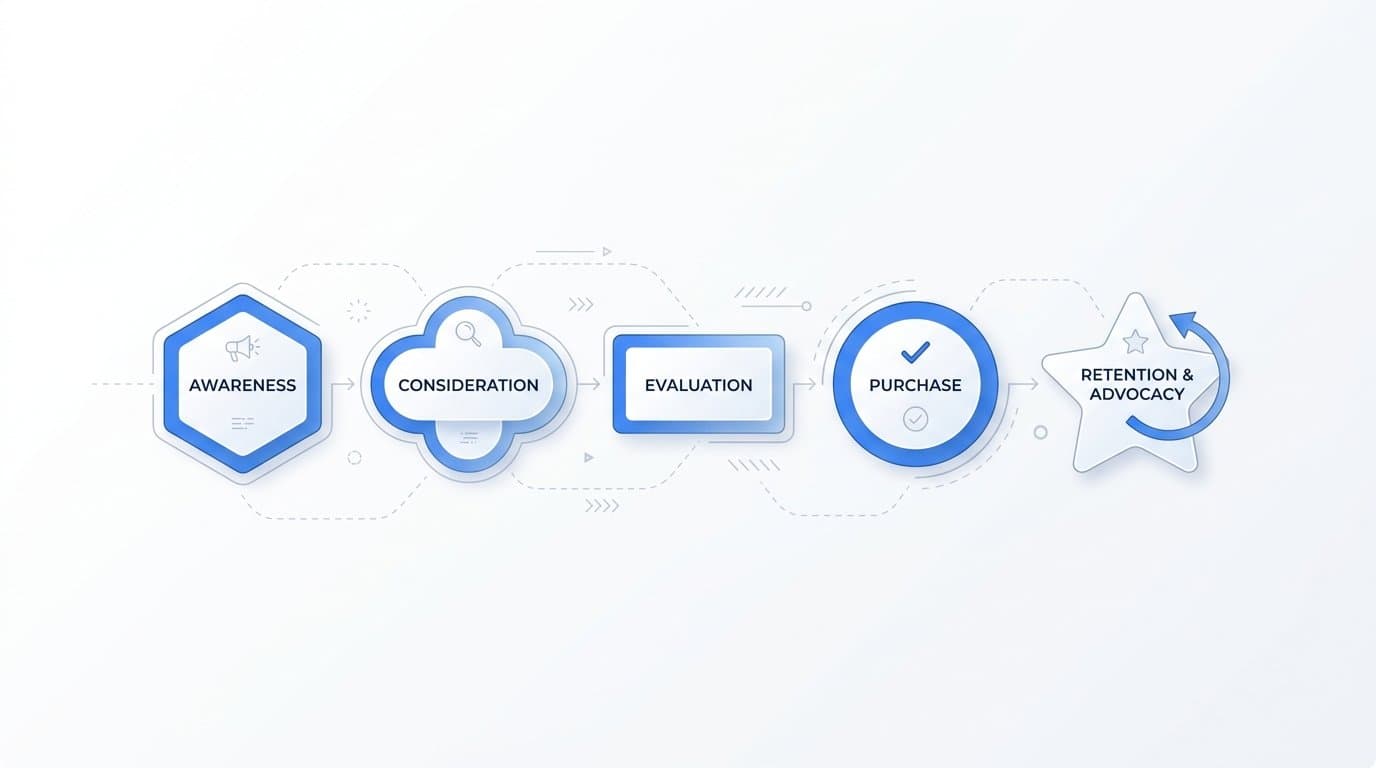
While no two SaaS buying journeys are identical, most follow a recognizable pattern of stages. Understanding what's happening at each stage, and what your marketing needs to accomplish there, is what makes measurement meaningful.
Awareness
This is where the journey begins. A prospect has identified a problem or a pain point and starts looking for solutions. They might search for terms related to their challenge, come across a LinkedIn post, see a paid ad, or hear about your product through a peer recommendation.
At this stage, your goal is simple: get in front of the right people and make a strong enough impression that they remember you. The prospect isn't ready to evaluate features or pricing. They're still defining the problem. Your content and ads need to meet them at that level, speaking to the challenge they're experiencing rather than leading with product capabilities.
First-touch attribution data is especially valuable here. It tells you which channels are actually introducing your brand to net-new audiences, giving you a clearer picture of where your awareness investments are paying off.
Consideration
Once a prospect has a shortlist of potential solutions, they enter the consideration stage. This is where the real evaluation happens. They're comparing features, reading reviews, watching demo videos, attending webinars, and potentially starting a free trial or requesting a live demo.
This stage is where the most touchpoints accumulate. A prospect in active evaluation mode might interact with your brand multiple times across multiple channels in a single week. They're looking for evidence that your product can solve their specific problem, that it integrates with their existing stack, and that your company is credible and trustworthy.
Mid-funnel attribution models become essential here. You need to understand which combinations of touchpoints are accelerating evaluation and which ones are causing prospects to stall or drop off. Multi-touch attribution gives you visibility into the full sequence, not just the last interaction before a conversion event.
Decision
The decision stage is where a prospect moves toward purchase. For many B2B SaaS deals, this involves more than just the champion saying yes. Procurement needs to review the contract, legal may need to sign off on data terms, and a budget holder needs to approve the spend.
This stage can take weeks, even after a prospect has decided they want your product. From a marketing perspective, the key challenge is connecting the deal that closes to the marketing activities that influenced it, sometimes months earlier. Pipeline attribution and revenue attribution are the tools that make this connection possible, tracing a closed-won deal back to its original source.
Retention and Expansion
Many SaaS marketing teams treat the journey as complete once a customer signs. That's a missed opportunity. The post-purchase experience, including onboarding, product adoption, renewal, and upsell moments, all carry measurable marketing influence.
Content that helps customers get value faster, email sequences that drive feature adoption, and campaigns targeting existing customers for expansion are all part of the journey. Teams that measure marketing's influence on retention and expansion get a fuller picture of lifetime value and can make smarter decisions about where to invest in customer success programs.
The Metrics That Actually Matter at Each Stage
Knowing the stages is one thing. Knowing what to measure at each one is where strategy becomes operational. The mistake many teams make is applying the same metrics across the entire funnel, which makes it impossible to evaluate stage-specific performance accurately.
Awareness Stage Metrics
Impressions and reach: These tell you how many people are being exposed to your brand and how broadly you're distributing your message across target audiences. They're not vanity metrics at this stage; they're inputs to your pipeline.
Branded search volume: When awareness campaigns are working, you'll typically see an increase in people searching directly for your brand name. This is one of the cleaner signals that top-of-funnel activity is building recognition.
First-touch attribution data: Track which channels are generating the first interaction for prospects who eventually convert. This reveals the true value of your awareness investments, even when the conversion happens much later.
Consideration Stage Metrics
Trial signups and demo requests: These are the clearest indicators that a prospect has moved from passive awareness into active evaluation. Track not just the volume, but which touchpoints preceded these actions.
Content engagement depth: Time on page, scroll depth, video completion rates, and return visits are all signals that a prospect is genuinely engaging with your evaluation content rather than bouncing after a single view.
Multi-touch attribution data: Which sequences of touchpoints most reliably lead to a demo request or trial signup? This data helps you understand the paths that work and replicate them at scale.
Decision and Revenue Metrics
Pipeline created by source: How much pipeline can be attributed to each marketing channel or campaign? This connects marketing activity to sales outcomes in a way that MQL volume alone cannot.
Sales cycle length by source: Prospects who come through certain channels often close faster than others. Understanding this helps you prioritize the channels that not only generate pipeline but accelerate it.
Win rate by source: Some channels produce high volumes of leads that rarely close. Others produce fewer leads that convert at a much higher rate. Win rate by source is one of the most important metrics for evaluating channel quality.
Closed-won revenue attributed to campaigns: The ultimate measure. Which campaigns and channels can be directly credited with driving revenue? This is the number that justifies budget and informs growth strategy.
Where Attribution Breaks Down Across the Journey
Even teams that care about attribution often end up with incomplete or misleading data. Understanding where the breakdowns happen is the first step toward fixing them.
The most common problem is over-reliance on last-click attribution. When you assign all credit for a conversion to the final touchpoint before the event, you systematically undervalue everything that came before it. Awareness channels like paid social, display, and content marketing often play a major role in introducing prospects and nurturing them through early stages, but they rarely get credit under a last-click model. Over time, this causes teams to cut top-of-funnel investment because the data makes it look ineffective, which weakens the pipeline they're trying to build.
Long sales cycles create a second structural problem. Standard attribution windows in platforms like Google Ads or Meta are typically set to 30 days or fewer. But if your average sales cycle is 90 days, a prospect who saw your ad in month one and closed in month three will never be connected in your platform data. The ad looks like it generated no revenue. The channel looks like it underperforms. Decisions get made on incomplete information.
Privacy changes across browsers and operating systems have made this worse. iOS privacy updates, third-party cookie deprecation, and the growing use of ad blockers mean that client-side pixels miss a meaningful portion of conversion events. A prospect who clicks an ad, visits your site, and signs up for a trial may not be tracked at all if they're using a privacy-focused browser or have tracking blocked.
There's also the CRM disconnect. Many marketing teams track activity up to a trial signup or demo request, but don't have visibility into what happens in the sales process after that. Pipeline stages, deal velocity, and closed-won revenue live in the CRM, and without a connection between marketing data and CRM data, attribution stops at the top of the sales funnel rather than extending to actual revenue.
Each of these breakdowns compounds the others. The result is a partial picture that leads to partial decisions, which is why so many SaaS marketing teams struggle to demonstrate real ROI even when their campaigns are performing well.
How to Track the Full SaaS Customer Journey in Practice
Closing the gaps in your attribution data requires a deliberate technical approach. Here's what that looks like in practice.
Build a unified data layer: The foundation is connecting your ad platforms, CRM, and website into a single system where every touchpoint is captured and linked to a consistent customer record. When a prospect clicks a LinkedIn ad, visits your pricing page, requests a demo, and eventually closes as a customer, all of those events need to be tied together under one identity. Without this connection, you're working with disconnected data sets that can't tell a coherent story.
Use multi-touch attribution models: Rather than assigning all credit to a single touchpoint, multi-touch attribution distributes credit across all the interactions that contributed to a conversion. Linear, time-decay, and position-based models each have different strengths, and the right choice depends on your sales cycle length and funnel structure. The key is moving away from single-touch models that systematically distort your understanding of what's working.
Implement server-side conversion tracking: Server-side tracking captures events directly from your server rather than relying on browser-based pixels. This means conversions are recorded even when a user has an ad blocker, is using a privacy-focused browser, or has restricted tracking at the device level. Conversion API integrations with platforms like Meta and Google also allow you to send enriched event data back to the ad platforms, improving the quality of the signals they use for optimization.
Connect marketing data to revenue: Tracking trials and demo requests is a start, but the real goal is connecting marketing activity to pipeline and closed-won revenue. Integrating your CRM with your attribution platform allows you to trace a deal back to its original marketing source, giving you a true picture of ROI rather than relying on proxy metrics like lead volume or cost per MQL.
Set attribution windows that match your sales cycle: If your average deal takes 90 days to close, your attribution windows need to be set accordingly. Custom attribution windows ensure that early-stage touchpoints are still credited even when the conversion happens months later.
Turning Journey Data Into Smarter Marketing Decisions
Attribution data is only valuable if it changes how you make decisions. Here's how stage-level journey data translates into better marketing strategy.
Reallocate budget toward high-impact stages: When you can see which channels and campaigns consistently move prospects into and through the highest-value stages of the journey, you have a clear basis for budget decisions. Channels that generate pipeline, accelerate sales cycles, or improve win rates deserve more investment. Channels that produce volume without downstream impact deserve scrutiny.
Identify and address drop-off points: Stage-level data lets you see where prospects are stalling or disengaging. If a large percentage of trial signups never convert to paid, that's a signal to examine your onboarding experience and the messaging that follows signup. If demo requests frequently stall before a proposal is sent, that points to a mid-funnel gap in your nurture sequence or sales process. Knowing where drop-off happens gives you a specific problem to solve rather than a general sense that something isn't working.
Feed better data back to ad platforms: This is one of the highest-leverage actions you can take. When you send enriched, stage-level conversion data back to Meta, Google, and other ad platforms, you're giving their algorithms better signals to optimize against. Instead of optimizing toward clicks or form fills, the platform AI can optimize toward the events that actually correlate with revenue. This improves targeting quality, reduces wasted spend, and compounds over time as the algorithms learn from better data.
Align content and messaging to stage-specific needs: Journey data also informs your content strategy. If you can see that prospects who engage with a specific type of content during the consideration stage convert at a higher rate, that's a signal to produce more of it and distribute it more aggressively at that stage. Data-driven content decisions are far more reliable than intuition-based ones.
Putting It All Together
The SaaS customer journey is genuinely complex. It involves multiple stakeholders, extended timelines, non-linear paths, and dozens of touchpoints spread across channels that don't naturally talk to each other. Surface-level analytics will always leave gaps in your understanding of what's actually driving growth.
The teams that scale with confidence are the ones who treat stage-level measurement as a core capability, not an afterthought. They connect their ad platforms to their CRM, implement server-side tracking to capture what pixels miss, use multi-touch attribution to distribute credit accurately, and feed enriched data back to the platforms that power their campaigns. The result is a clear, complete picture of how marketing investment translates into pipeline and revenue.
That's exactly what Cometly is built to deliver. From the first ad click to closed-won revenue, Cometly connects every touchpoint across every stage of the SaaS customer journey into a single source of truth. You get real-time visibility into which campaigns are driving pipeline, AI-powered recommendations for where to scale, and the ability to send conversion-ready data back to Meta, Google, and more to sharpen your targeting over time.
If you're ready to stop guessing and start making attribution decisions based on complete, accurate data, Get your free demo and see how your own customer journey looks when everything is finally connected.