Most B2B marketing teams can tell you how many leads they generated last month. Far fewer can tell you which specific touchpoints, across which channels, actually moved those leads from first awareness to closed-won revenue. That gap is not a reporting inconvenience. It is where budget gets misallocated, good campaigns get cut, and growth stalls.
The B2B buying process is fundamentally different from B2C. It involves multiple stakeholders, extended timelines, and a web of interactions spanning paid ads, organic content, review sites, sales calls, and CRM activity. A buyer might encounter your brand through a LinkedIn ad, disappear for three weeks, return via a branded Google search, read two blog posts, attend a webinar, and then request a demo. That entire sequence is one journey. Last-click attribution sees only the demo request.
This guide is built for growth teams who want to move beyond surface-level metrics. You will walk away understanding exactly what happens at each B2B customer journey stage, where traditional tracking breaks down, which attribution models fit which stages, and how to build the infrastructure needed to connect every touchpoint to real revenue outcomes. Let's get into it.
Why the B2B Buying Process Defies Simple Funnels
The classic marketing funnel, awareness to consideration to decision, is a useful mental model. It is not, however, an accurate map of how B2B buyers actually behave. Real buying decisions are messier, slower, and far more collaborative than any single funnel can capture.
Consider the committee dynamic. A typical B2B purchase involves multiple stakeholders: economic buyers focused on ROI, end users evaluating usability, technical evaluators assessing integration requirements, and internal champions building the case for change. Each of these people enters and exits the buying process at different points. They consume different content, respond to different messages, and carry different objections. Treating this as a single linear journey misses the structural complexity of how decisions actually get made.
Then there is the timeline problem. B2B SaaS sales cycles can stretch across weeks or months depending on deal size and organizational complexity. A prospect who clicked a paid search ad in week one and converted via a direct visit in week twelve represents a journey with potentially dozens of touchpoints in between. Single-touch attribution models, whether first-click or last-click, assign all the credit to one moment and ignore everything else. That is not measurement. It is a guess with a data label on it.
Here is where it gets interesting: the gap between how marketers model the journey and how buyers actually behave is precisely where budget gets wasted. Teams cut awareness campaigns because they do not see direct conversions, not realizing those campaigns were generating the branded search demand that eventually converted. They over-invest in bottom-funnel retargeting while starving the top-of-funnel content that fills the pipeline in the first place.
The solution is not a better funnel model. It is a more accurate picture of the full journey, stage by stage, touchpoint by touchpoint. That starts with understanding what each stage actually looks like for B2B buyers.
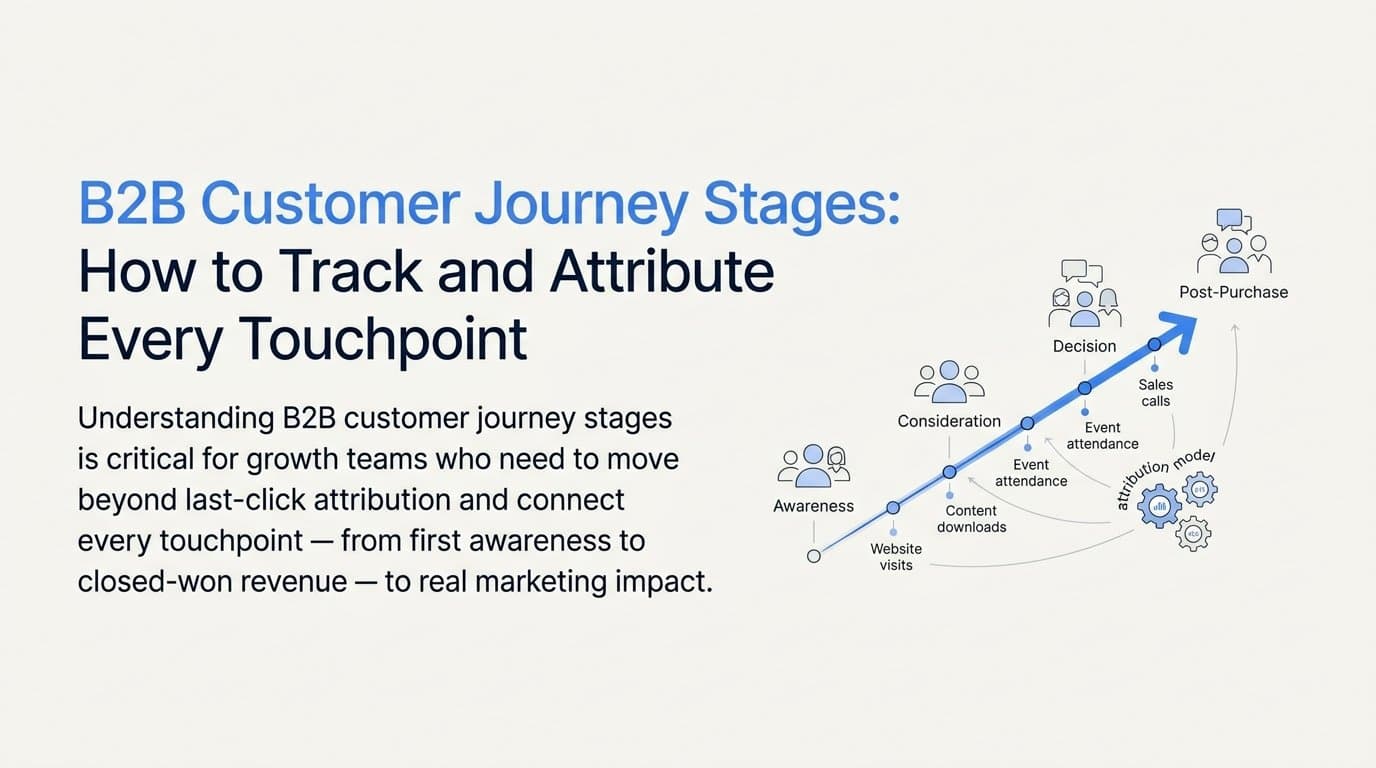
The Core B2B Customer Journey Stages Explained
Breaking the journey into its core stages gives your team a shared framework for understanding buyer behavior, assigning attribution, and making smarter investment decisions. Each stage has distinct characteristics, distinct buyer behaviors, and distinct measurement requirements.
Awareness: Entering the Consideration Set
At the awareness stage, buyers are not yet shopping for a solution. They are recognizing a problem. Maybe they are experiencing friction in their reporting workflow, struggling to attribute pipeline to specific campaigns, or realizing their current analytics stack is not giving them the answers they need.
This is where your brand first surfaces. Paid social ads on LinkedIn, organic search results for educational queries, thought leadership content, and industry newsletters all play a role here. The goal is not to convert immediately. The goal is to become part of the buyer's consideration set before their intent fully forms.
Measuring awareness-stage impact is notoriously difficult because the time lag between first exposure and conversion can be significant. First-touch attribution is the most relevant model here, giving credit to the channel that introduced the buyer to your brand. Without it, you have no visibility into which campaigns are generating net-new demand.
Consideration: Active Evaluation Across Multiple Channels
Once buyers recognize a problem and begin actively seeking solutions, they enter the consideration stage. This is where behavior intensifies. They are comparing vendors, reading case studies, watching product demos, visiting G2 or Capterra for peer reviews, and engaging with deeper content on your website.
Multiple channels are engaged simultaneously during this stage. A buyer might click a retargeting ad on LinkedIn, then run a comparison search on Google, then visit your pricing page directly. Each of these interactions contributes to their evaluation. This is where multi-touch attribution becomes critical, because no single touchpoint tells the full story.
For B2B SaaS teams, consideration-stage content like detailed product pages, integration documentation, and ROI calculators carries significant weight. The teams that win here are the ones who can identify which content assets are actually influencing progression toward a demo or trial, not just generating page views.
Decision: Pipeline Meets Attribution
At the decision stage, a buying committee is aligning on a shortlist. Pricing conversations are happening. Demo requests, trial signups, and sales-qualified leads are being generated. This is where marketing activity connects directly to pipeline and revenue outcomes.
The decision stage is also where the attribution challenge becomes most acute. Sales activity, email sequences, and CRM events are intersecting with digital touchpoints. A buyer who requested a demo after clicking a Google ad six weeks ago needs to be traced back to that original source, even if they visited your site multiple times in between through different channels.
Getting this right requires more than pixel-based tracking. It requires a connected infrastructure that links ad platform data to CRM deal stages, so you can see which campaigns are generating pipeline and closed-won revenue, not just form fills.
What Buyers Actually Do at Each Stage (And Where Marketers Miss It)
Understanding the stages conceptually is one thing. Understanding the specific behaviors that occur at each stage, and where tracking typically fails, is what separates teams that optimize effectively from those that are flying blind.
Awareness Behaviors and the Attribution Gap
Awareness-stage buyers rarely convert on first contact. They consume a piece of content, maybe follow your LinkedIn page, and then move on. Days or weeks later, they run a branded search and land on your website directly. At that point, last-click attribution credits the direct visit. The LinkedIn ad that introduced your brand gets nothing.
This pattern is extremely common in B2B, and it leads to a systematic undervaluation of top-of-funnel campaigns. Teams see low direct conversion rates on awareness content and cut the budget, not realizing they are cutting the demand generation engine that feeds every downstream stage.
Consideration Behaviors and Cross-Device Fragmentation
During the consideration stage, buyers frequently switch devices and channels. They might click a LinkedIn ad on their phone during a commute, then continue their research on a desktop at the office, then visit your site directly from a work laptop the following morning. Without cross-channel, cross-device tracking, these three sessions appear as three separate, unrelated visitors.
The result is a fragmented picture of the customer journey that makes it nearly impossible to understand which channels are influencing evaluation. Teams end up over-crediting direct traffic and under-crediting the paid and organic touchpoints that actually drove consideration.
Decision Behaviors and the Offline Signal Problem
At the decision stage, the journey moves partly offline. Sales calls happen. Email sequences are sent. Proposals are reviewed. These interactions carry significant weight in the final buying decision, but they are invisible to pixel-based tracking tools.
Connecting these offline signals to the original digital touchpoints requires CRM integration. When your CRM records a deal moving to the proposal stage or closing as won, that event needs to be linked back to the ad click or content interaction that started the journey. Without that connection, you can measure form fills but not revenue. And for B2B SaaS teams trying to justify marketing spend, form fills are not enough.
Choosing the Right Attribution Model for Each Journey Stage
Attribution models are not one-size-fits-all. Different models answer different questions, and the right choice depends on which stage of the B2B customer journey you are trying to evaluate. Using the wrong model for the wrong question produces misleading conclusions.
First-Touch Attribution: Understanding Demand Creation
First-touch attribution assigns all credit to the first interaction a buyer had with your brand. It answers one specific question: which channels are generating net-new demand and introducing your brand to buyers who did not know you existed?
This model is most valuable for evaluating awareness-stage campaigns. If you are running LinkedIn thought leadership ads or investing in SEO content targeting early-stage problem-aware queries, first-touch attribution tells you whether those efforts are actually bringing new buyers into your funnel. It is a top-of-funnel lens, and it should be used as one.
Linear and Time-Decay Models: Evaluating Mid-Funnel Influence
Linear attribution distributes credit equally across all touchpoints in the journey. Time-decay attribution gives more credit to touchpoints that occurred closer to the conversion event. Both models are more appropriate for evaluating mid-funnel, consideration-stage campaigns where multiple interactions contribute to a buyer's progression.
If you are running webinar campaigns, retargeting sequences, or content nurture programs, linear or time-decay models give you a more honest picture of how those touchpoints are contributing to pipeline. They prevent any single interaction from dominating the credit picture and reveal the cumulative influence of your consideration-stage investments.
Data-Driven Attribution: The Most Accurate Picture for Long Sales Cycles
Data-driven attribution uses actual conversion path data to assign credit proportionally based on how each touchpoint statistically influences conversion outcomes. Rather than applying a fixed rule, it learns from your specific data and weights touchpoints accordingly.
For B2B SaaS teams with longer sales cycles and sufficient conversion volume, data-driven attribution provides the most accurate picture of how each stage contributes to closed revenue. It surfaces insights that rule-based models miss, such as which mid-funnel touchpoints consistently appear in the journeys of buyers who eventually close, versus those who drop off.
The tradeoff is data volume. Data-driven models require a meaningful number of conversion events to produce reliable outputs. For teams with smaller pipeline volumes, linear or time-decay models may be more practical starting points while data accumulates.
How to Track the Full Journey Without Losing Data
Having the right attribution model means nothing if the underlying data is incomplete. And for most B2B marketing teams, data quality is exactly where the wheels come off. Here is what a reliable tracking infrastructure looks like for full-journey attribution.
Server-Side Tracking: The New Foundation
Browser-based pixels have become increasingly unreliable. Safari's Intelligent Tracking Prevention, Firefox's privacy defaults, and the widespread use of ad blockers all degrade the quality of client-side event data. When a pixel fails to fire, that touchpoint disappears from your attribution picture entirely.
Server-side tracking solves this by sending event data directly from your server to ad platforms, bypassing browser-level restrictions. Meta's Conversion API and Google's Enhanced Conversions are the primary implementations of this approach. When configured correctly, server-side tracking preserves signal accuracy across the entire customer journey, including touchpoints that would otherwise be invisible to browser-based measurement.
For B2B teams running paid campaigns across Meta and Google, server-side tracking is no longer optional. It is the foundation of accurate attribution.
CRM Integration: Connecting Marketing to Revenue
CRM integration is the bridge between marketing touchpoints and actual revenue outcomes. Without it, you can measure top-of-funnel conversions like demo requests and trial signups, but you cannot connect those events to deal stage progression or closed-won revenue.
When ad click data syncs with your CRM, you can see which campaigns generated leads that actually converted to pipeline, which channels produce the highest-value deals, and which touchpoints appear most frequently in the journeys of your best customers. This is the difference between measuring marketing activity and measuring marketing impact.
Platforms like Cometly are built specifically for this integration challenge. With 70+ native integrations and a Stripe revenue integration that connects payment data directly to ad performance, Cometly gives B2B SaaS teams a single source of truth that spans from the first ad click to closed-won revenue.
Deduplication: Keeping Your Data Clean
When you run both browser-based and server-side tracking simultaneously, the same conversion event can be recorded twice: once by the pixel and once by the server event. Without deduplication, your conversion counts inflate and your attribution data becomes unreliable.
Proper deduplication uses event IDs to match browser and server events and ensure each conversion is counted only once. This is a technical detail that has significant downstream consequences. Inflated conversion data leads to over-reporting, which causes ad platforms to optimize toward a distorted signal and ultimately degrades campaign performance across the full funnel.
Turning Journey Insights Into Smarter Ad Decisions
Tracking the full B2B customer journey is not an end in itself. The value is in what you do with the data. Once you have accurate, connected attribution across every stage, you can make fundamentally better decisions about where to invest and how to optimize.
The most immediate application is budget reallocation. When you can see which channels and campaigns influence buyers at each stage of the journey, rather than just which ones appear at the last click, you can shift spend toward the touchpoints that actually move buyers from awareness to pipeline. Campaigns that look underperforming on a last-click basis often turn out to be significant contributors to deal flow when you look at their full-journey influence.
The second application is improving ad platform performance. Meta and Google's machine learning systems, including Meta Advantage+ and Google Performance Max, rely on the quality of the conversion signals you send back to them. When you feed these platforms enriched, accurate conversion data that includes downstream events like pipeline creation and closed-won revenue, their targeting and optimization algorithms improve. You get better audience matching, lower cost per qualified lead, and more efficient spend across the full funnel. Both Meta and Google have publicly documented how richer conversion signals improve their optimization systems.
The third application is AI-driven pattern recognition. Analyzing journey data at scale reveals patterns that are difficult to spot manually. Which content sequence consistently precedes a demo request? Which ad creative drives the highest pipeline value per dollar spent? Which awareness-stage channels produce buyers with the shortest sales cycles? Cometly's AI-driven analysis surfaces these insights automatically, giving growth teams actionable recommendations rather than raw data to interpret.
The natural question becomes: how do you prioritize these improvements when you are starting from a fragmented tracking setup? Start with server-side tracking and CRM integration. Those two steps unlock the data quality needed for everything else. Once your data is clean and connected, attribution model selection and AI-driven optimization follow naturally.