Most B2B SaaS marketing teams are running campaigns across paid search, LinkedIn, content, and email simultaneously. The budget is real. The effort is real. But when leadership asks which channels are actually driving revenue, the honest answer is often: we're not entirely sure.
This is the core challenge. Marketing activity and marketing impact are two different things, and the gap between them widens every time a prospect takes a non-linear path from first ad impression to closed deal. Without visibility into how prospects move through each stage of the buying process, you end up making budget decisions based on incomplete data, gut feel, or whatever your last-click attribution model happened to credit.
The customer journey framework exists precisely to close this gap. When you understand each stage a prospect moves through, from initial awareness all the way through to decision and beyond, you can map the right touchpoints, apply the right attribution models, and finally connect your marketing spend to pipeline and revenue in a way that holds up to scrutiny.
This guide breaks down the stages of a customer journey specifically for B2B SaaS marketers. Not as a theoretical exercise, but as a practical framework for tracking, measuring, and optimizing every step so your team can make smarter decisions with the budget you have.
Why B2B SaaS Journeys Break Simple Funnel Models
The classic marketing funnel works reasonably well for consumer purchases. Someone sees an ad, clicks through, and buys. The journey is short, the decision-maker is singular, and attribution is relatively straightforward. B2B SaaS is an entirely different environment, and applying consumer-grade funnel thinking to it creates serious blind spots.
In most B2B SaaS purchases, you are not selling to one person. You are selling to a buying committee. End users evaluate the product on usability. Managers assess whether it solves the team's problem. Finance approves the budget. IT reviews security and integration requirements. Each of these stakeholders may interact with your brand at different times, through different channels, and with different questions in mind.
This multi-stakeholder dynamic has a direct impact on measurement. When multiple people from the same company are engaging with your content and ads across weeks or months, standard session-based attribution models will fragment that journey into disconnected events rather than recognizing it as a single, coordinated buying process.
The timeline compounds the problem. B2B SaaS sales cycles often span weeks or months depending on deal size and organizational complexity. A prospect might click a LinkedIn ad in January, download a comparison guide in February, attend a webinar in March, and finally request a demo in April. If your attribution model only looks at the last click before the demo request, it gives full credit to whatever happened in April while erasing everything that built intent over the previous three months.
Unlike e-commerce, where a single session can take a prospect from awareness to purchase, B2B SaaS conversions almost never happen in one visit. This means accurate journey tracking requires connecting data from multiple sources: your ad platforms, your website behavior data, and your CRM. Without that unified view, you are not measuring the customer journey. You are measuring fragments of it and drawing incomplete conclusions.
This is the foundational reason why understanding the stages of a customer journey matters so much in B2B SaaS. The complexity is real, and only a structured, multi-touch approach to tracking can reflect it accurately.
Breaking Down the Core Stages of a Customer Journey
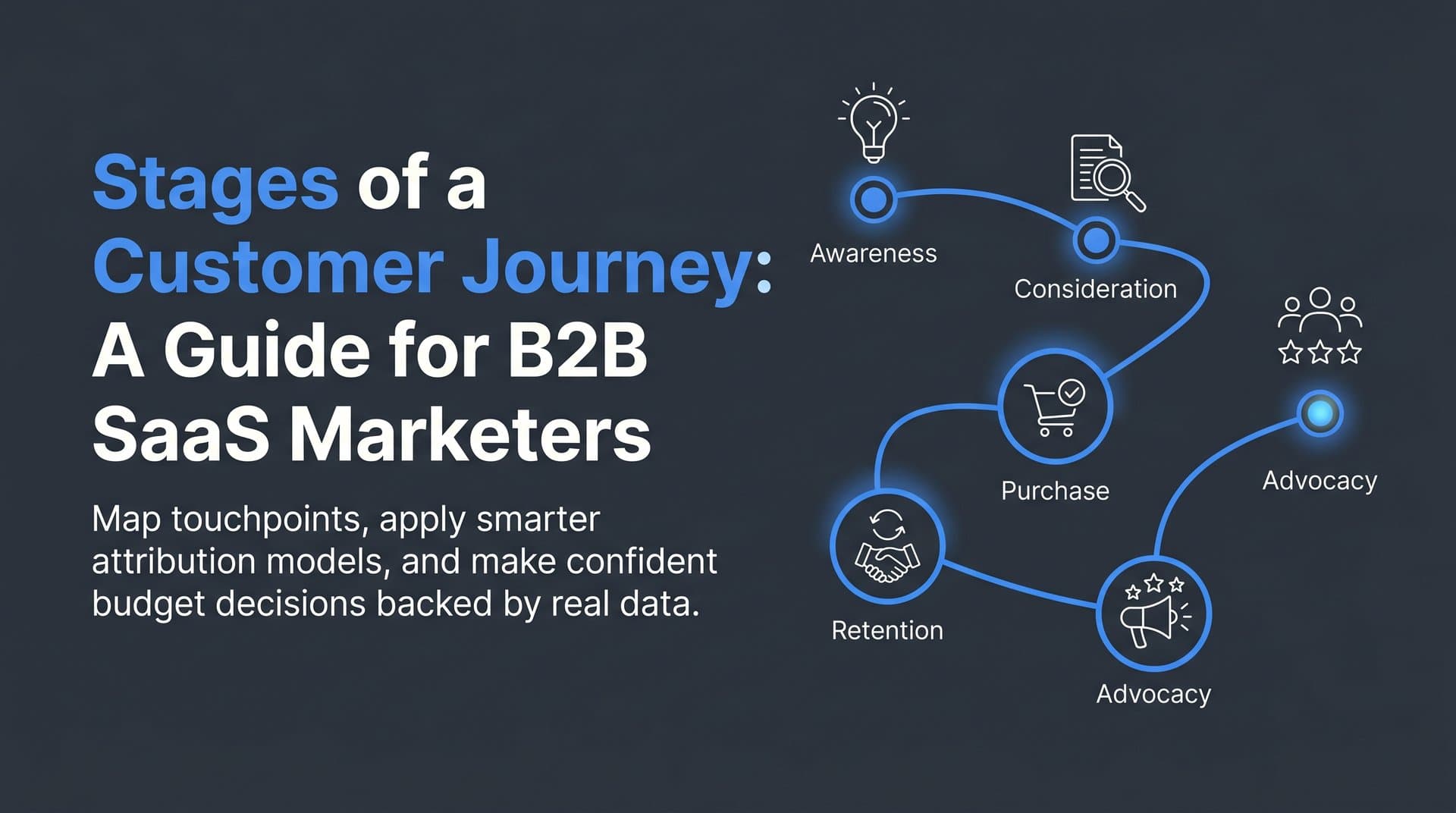
While every buyer's path is unique, most B2B SaaS journeys move through three core stages before a conversion occurs. Understanding what happens at each stage, and what the prospect needs from you, is essential for aligning your channels, content, and measurement accordingly.
Awareness
This is where the journey begins. A prospect encounters your brand for the first time, typically through a paid ad, an organic search result, a LinkedIn post, or a mention from a peer. They may not be actively looking for a solution yet. They might not even know they have the problem you solve.
The goal at this stage is visibility and relevance, not conversion. You are planting a flag in their mental landscape so that when the need becomes urgent, your brand is already familiar. Trying to push for a demo or a sign-up at this stage is usually counterproductive because the prospect has not yet built enough context or trust to act.
From a measurement perspective, awareness touchpoints are often the hardest to credit because they rarely produce direct conversions. But dismissing them as unimportant is a mistake. They are frequently the reason a prospect later searches for your brand by name or responds to a retargeting ad.
Consideration
Once a prospect recognizes they have a problem worth solving, they enter the consideration stage. This is where active evaluation happens. They are comparing solutions, reading reviews on G2 or Capterra, watching demo videos, and engaging with detailed content like comparison guides or case studies.
This stage is where nurture sequences, retargeting campaigns, and mid-funnel content do their most important work. The prospect is educating themselves, and the brands that show up consistently with relevant, credible content during this phase build a significant advantage by the time the decision stage arrives.
For B2B SaaS specifically, the consideration stage often involves multiple stakeholders engaging with different types of content simultaneously. One person might be reading technical documentation while another reviews pricing pages. Tracking this stage accurately requires connecting individual touchpoints to company-level buying signals, not just individual user sessions.
Decision
The prospect is now ready to act. They request a demo, start a free trial, or contact sales. This is the stage where conversion tracking and attribution data become most visible because a measurable event occurs. But it is also the stage most vulnerable to attribution errors.
Last-click models tend to credit whatever channel the prospect used immediately before converting, which is often branded search or direct traffic. This makes the decision stage look like it happened in isolation, when in reality it was the result of weeks of prior touchpoints. Accurate attribution at this stage means looking backward through the full journey, not just at the final click.
The Stages Most Marketers Miss: Post-Conversion and Expansion
Most attribution models treat the initial conversion as the finish line. For B2B SaaS, it is closer to the halfway point. The stages that follow the initial sign-up or closed deal often represent a larger share of total revenue than the initial contract, yet they are frequently left out of the customer journey map entirely.
Onboarding and Activation
After a prospect converts, they enter onboarding. How well this stage goes has a direct impact on retention, expansion, and whether the customer ever becomes an advocate for your product. A poor onboarding experience can undo everything that marketing and sales worked to achieve.
From a marketing perspective, onboarding touchpoints such as welcome email sequences, in-app guidance, and early-stage check-ins are part of the customer journey. They influence whether the customer reaches activation, the point where they experience enough value to stick around and eventually expand their usage.
Tracking activation as a downstream conversion event in your attribution model helps you understand which acquisition channels produce customers who actually engage with the product versus those who sign up and churn quickly. This is a meaningful signal for budget allocation decisions.
Advocacy and Referral
Satisfied customers who refer colleagues, leave reviews, or share your content publicly create new awareness touchpoints that feed directly back into the top of your funnel. This referral loop is one of the most efficient growth mechanisms in SaaS, yet it is rarely represented in standard attribution models.
When a new prospect discovers your brand through a peer recommendation or a G2 review left by an existing customer, that touchpoint originated from your post-conversion journey. Recognizing this connection helps you understand the full downstream value of your initial marketing investments, not just the value visible at the conversion event.
Tracking post-conversion behavior in your attribution model gives you a more complete picture of true ROI. Instead of measuring cost per acquisition in isolation, you can begin to understand which acquisition channels produce customers with the highest long-term value, the strongest retention rates, and the greatest propensity to refer others.
How to Map Touchpoints Across Every Stage
Understanding the stages of a customer journey conceptually is one thing. Mapping the actual touchpoints your prospects move through is where the real work happens, and where most teams run into data challenges.
Each stage of the journey tends to align with specific channels and content types. Paid social and paid search typically dominate the awareness stage, putting your brand in front of prospects who may not be actively looking but match your ideal customer profile. Organic content and thought leadership play a supporting role here as well.
During the consideration stage, email nurture sequences, retargeting campaigns, and in-depth content become the primary drivers of engagement. Prospects are spending more time with your brand, consuming more detailed information, and beginning to form preferences. This is where consistent, relevant touchpoints compound over time to build trust and familiarity.
At the decision stage, direct sales conversations, demo requests, and free trial activations are the critical touchpoints. These are the moments where the journey becomes measurable in your CRM, and where the connection between earlier marketing activity and final conversion needs to be visible.
Connecting the Data Sources
Touchpoint mapping requires pulling data from multiple systems and connecting them into a unified view. Your ad platforms know which ads a prospect clicked. Your website analytics know which pages they visited. Your CRM knows when they became a lead, an opportunity, and eventually a customer. Without connecting these sources, you are working with silos rather than a journey.
This is where many teams hit a wall. Ad platform data does not automatically sync with CRM data. Website behavior is tracked at the session level, not the company level. And without a way to tie these threads together, attribution decisions default to whatever is easiest to measure rather than what is most accurate.
The Role of Server-Side Tracking
Browser-based tracking has become increasingly unreliable due to cookie deprecation, iOS privacy updates, and the widespread use of ad blockers. A meaningful portion of touchpoints that occur in a typical B2B SaaS journey are simply not captured by traditional pixel-based tracking.
Server-side tracking and Conversion API integrations address this by sending conversion data directly from your server to ad platforms, bypassing the browser entirely. This approach captures touchpoints that would otherwise be lost, improving the accuracy of your attribution data across every stage of the journey. For teams serious about understanding the full customer journey, server-side tracking is no longer optional. It is a baseline requirement.
Attribution Models and the Stages They Prioritize
Once you have touchpoint data flowing from every stage of the journey, you need an attribution model to interpret it. Different models tell very different stories about which channels and campaigns deserve credit, and choosing the wrong one can lead to budget decisions that optimize for the wrong outcomes.
First-Touch Attribution
First-touch attribution gives full credit for a conversion to the very first touchpoint in the journey, typically the awareness-stage channel that introduced the prospect to your brand. This model is useful for understanding which channels are effective at generating new demand and bringing net-new prospects into your pipeline.
The limitation is significant, however. First-touch attribution is completely blind to everything that happened after that initial interaction. It tells you which channels start journeys but says nothing about which channels close them. Used in isolation, it can lead to over-investment in top-of-funnel channels while undervaluing the consideration and decision-stage activities that converted the prospect.
Last-Click Attribution
Last-click attribution does the opposite. It gives full credit to the final touchpoint before a conversion, which in B2B SaaS is often branded search, direct traffic, or a sales email. This model is widely used because it is simple and produces clean, measurable results.
But it systematically overweights the decision stage while ignoring everything that built intent and familiarity beforehand. Teams relying on last-click attribution often conclude that their top-of-funnel and mid-funnel investments are not working, when in reality those touchpoints are doing the essential work of creating the demand that eventually converts at the bottom.
Multi-Touch Attribution
Multi-touch attribution models distribute credit across multiple touchpoints in the journey rather than assigning it all to one. Common approaches include linear attribution, which spreads credit evenly across all touchpoints, time-decay attribution, which gives more credit to touchpoints closer to the conversion, and position-based models, which weight the first and last touches more heavily while still crediting the middle.
For B2B SaaS companies with long, multi-channel journeys, multi-touch attribution provides a significantly more accurate view of campaign performance. It allows you to see which channels contribute at each stage of the journey and allocate budget based on actual influence rather than positional bias. This is why multi-touch models are increasingly the standard for teams that want to make genuinely data-driven decisions about where to invest.
Turning Journey Data Into Smarter Marketing Decisions
Collecting journey data is only valuable if it changes how you make decisions. The real payoff comes when you can look at stage-level performance data and use it to reallocate budget, refine creative, and improve targeting in ways that actually move the needle on pipeline and revenue.
When you have visibility into which channels influence each stage of the journey, you can stop making budget decisions based on last-click credit and start making them based on actual contribution. A paid social campaign that rarely closes deals directly might still be generating a significant share of the high-intent prospects who eventually convert through other channels. Without journey-level data, that contribution is invisible. With it, you can defend the investment and scale it confidently.
AI-Driven Pattern Recognition
One of the challenges with multi-touch journey data is that it produces a lot of information. Identifying meaningful patterns manually across dozens of channels, campaigns, and creative variations is time-consuming and prone to confirmation bias. This is where AI-driven analysis creates real leverage.
AI tools applied to journey data can surface insights that would not appear in a standard dashboard: which ad creative tends to attract prospects who convert fastest, which content pieces accelerate movement through the consideration stage, or which acquisition channels produce customers with the highest long-term retention. These are the kinds of insights that change budget strategy, not just campaign tactics.
Platforms like Cometly use AI to analyze performance across every channel and surface recommendations that help marketers identify what is actually working at each stage of the journey. Instead of manually piecing together data from multiple sources, you get a unified view with actionable signals built in.
Feeding Better Data Back to Ad Platforms
There is another dimension to journey data that many teams overlook: its value as an input to ad platform algorithms. Meta, Google, and LinkedIn all use conversion signals to optimize their targeting and delivery. The richer and more accurate those signals are, the better the algorithm performs.
When you send enriched, stage-level conversion data back to ad platforms through server-side integrations and Conversion APIs, you are giving their algorithms a more complete picture of what a high-quality conversion looks like. Instead of optimizing for surface-level form fills, the platform can optimize for the types of prospects who actually move through the full journey and become customers.
Over time, this leads to better audience matching, more efficient spend, and lower cost per acquisition. It is a compounding benefit: better journey data improves your internal decisions and simultaneously improves the performance of the ad platforms you rely on to generate new demand.
Putting It All Together
Understanding the stages of a customer journey is not a theoretical exercise for B2B SaaS marketers. It is a prerequisite for accurate attribution, smarter budget allocation, and sustainable growth. When you can see how prospects move from first awareness through consideration, decision, and beyond, you stop guessing which channels work and start knowing.
The key takeaway is that the journey does not end at conversion. Post-conversion stages like onboarding, activation, and advocacy feed directly back into your funnel and contribute to revenue in ways that only become visible when your attribution model extends beyond the initial sign-up. Teams that track the full journey have a fundamentally different and more accurate picture of their marketing ROI than those who stop at the first conversion event.
B2B SaaS companies that build this kind of visibility can connect every touchpoint to pipeline and revenue, allocate budget based on actual influence rather than last-click assumptions, and feed better data back to the ad platforms that power their growth.
Cometly is built specifically to make this possible. It connects your ad platforms, CRM, and website behavior into a single real-time view of the entire customer journey, with multi-touch attribution, server-side tracking, and AI-driven recommendations built in. If you are ready to move from fragmented data to full journey visibility, Get your free demo and see how Cometly can help you track, measure, and optimize every stage of the customer journey.