Picture this: you're reviewing last month's ad performance and a campaign that's been running for six weeks shows zero conversions. You pause it, reallocate the budget, and move on. Then, eight weeks later, your sales team closes three enterprise deals, and every single one of them traces back to that campaign you killed. The leads were in your pipeline the whole time. You just couldn't see them.
This scenario plays out constantly in B2B SaaS marketing, and it's one of the most expensive mistakes a growth team can make. The root cause isn't bad creative or poor targeting. It's a structural mismatch between how long your deals actually take to close and how long your attribution tools track credit for them.
When your sales cycle is longer than your attribution window, you're not just missing data. You're actively making budget decisions, channel mix choices, and campaign optimizations based on a fundamentally incomplete picture of reality. The campaigns that look like failures might be your best performers. The channels you're scaling might be capturing credit they don't deserve.
This article breaks down exactly why this gap exists, what it costs you, and how to build an attribution approach that reflects the reality of how B2B deals actually close. By the end, you'll have a clear framework for measuring marketing performance in B2B time, not e-commerce time.
The Hidden Gap Between When Ads Run and When Deals Close
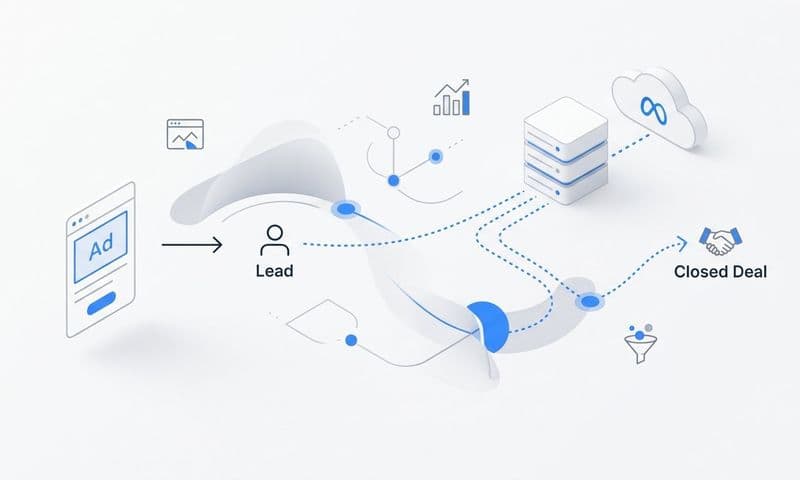
Think about what a typical B2B SaaS buying journey actually looks like. A prospect sees a LinkedIn ad, clicks through to a blog post, and bounces. Three weeks later, they see a retargeting ad on Meta, download a case study, and sign up for a newsletter. A month after that, a colleague mentions your product in a Slack channel, and they book a demo. The demo goes well, but there's an internal evaluation period. A security review. A budget approval cycle. The deal closes four months after that first ad click.
Now ask yourself: how much of that journey does a 28-day attribution window capture?
Most ad platforms default to attribution windows designed for consumer purchase behavior, where someone sees an ad for a pair of shoes and buys them within a few hours or days. These defaults made sense for e-commerce. They are structurally misaligned with B2B buying behavior, where decisions involve multiple stakeholders, formal evaluation processes, and extended timelines that can stretch from 30 days to well over six months depending on deal size and product complexity.
The mismatch is not subtle. When a platform's attribution window closes at 28 days and your average deal takes 90 days to close, the platform is only ever seeing a fraction of the conversions your campaigns actually influence. The rest fall into a blind spot, completely invisible to your reporting.
The practical consequence of this gap is severe. Campaigns that are genuinely building pipeline appear to generate no ROI inside the attribution window. Marketing teams, under pressure to justify spend, cut those campaigns. Budget flows toward channels that happen to capture credit within the window, often because they sit at the bottom of the funnel closest to conversion, not because they're doing the most important work.
This is how high-performing awareness and consideration campaigns get killed. Not because they failed, but because the measurement system wasn't built to see what they were doing.
The fix starts with acknowledging that attribution windows are a configuration choice, not a law of nature. Most marketers leave them at platform defaults and never revisit them. But if your median sales cycle is 75 days, a 28-day window isn't giving you data. It's giving you a distorted sample that systematically undercounts the impact of your best top-of-funnel work.
Understanding this gap is the first step. The next is recognizing why the attribution models themselves compound the problem.
Why Standard Attribution Models Fail Long Sales Cycles
Even if you extend your attribution window, the model you use to assign credit across that window matters enormously. And most of the default models are poorly suited to the complexity of B2B buying journeys.
Last-click attribution is still widely used, and in B2B, it's particularly misleading. It assigns 100% of the credit to the final touchpoint before conversion. For a deal that involved a LinkedIn ad, two blog visits, a webinar attendance, a demo request, and four sales calls over five months, last-click gives all the credit to whatever touchpoint happened to be last. Usually a branded search or a direct visit. The six months of nurturing that built trust and moved the prospect through the funnel gets zero credit.
First-click attribution has the opposite problem. It over-credits the initial touchpoint and ignores everything that happened between awareness and conversion. In a long B2B sales cycle, the first touch often happens long before the prospect is ready to buy. Giving it all the credit misrepresents the role of the channels that kept the prospect engaged and moved them toward a decision.
Time-decay models are sometimes positioned as a more sophisticated option, but they have their own bias. They assign more credit to touchpoints that happened closer to the conversion event. For B2B, this systematically penalizes early-funnel activity. The awareness campaign that introduced your brand to a prospect six months ago gets almost no credit, while the retargeting ad they saw the week before the deal closed gets most of it. This creates a feedback loop where top-of-funnel investment looks chronically unprofitable.
Platform-native attribution adds another layer of distortion. Meta and Google each measure within their own ecosystems and within their own windows. If a prospect clicks a Meta ad, then later converts via a Google search, Meta may claim the conversion and Google may claim the conversion. You're double-counting. And if the conversion happens after either platform's window expires, neither platform reports it at all, regardless of the actual contribution those channels made.
The deeper issue is that all of these models were built around a simplified version of the buyer journey. They assume a relatively short, linear path from ad exposure to purchase. B2B buying doesn't work that way. It involves multiple stakeholders, non-linear research behavior, long evaluation periods, and often a combination of digital and human touchpoints that no single platform can see in full.
Multi-touch attribution models, particularly linear and data-driven approaches, are far better suited to this reality. Linear models distribute credit across every touchpoint in the journey, acknowledging that each interaction contributed something. Data-driven models use actual conversion patterns to weight touchpoints based on their observed influence. Neither is perfect, but both give a more honest picture of how complex B2B deals actually close.
The Real Cost of Misaligned Attribution Windows
When attribution windows are shorter than your actual sales cycle, the damage isn't just a reporting inconvenience. It cascades into real budget decisions, algorithmic degradation, and strategic misdirection that compounds over time.
Budget misallocation: This is the most immediate and visible cost. Top-of-funnel and mid-funnel campaigns, by definition, operate early in the buyer journey. Their contribution to closed revenue won't show up in a 28-day window because the deals they influence haven't closed yet. So they look expensive and unproductive. Budget gets redirected toward bottom-of-funnel channels that appear to be driving conversions, often because those channels are capturing credit for deals that top-of-funnel campaigns already warmed up. You end up over-investing in conversion capture and under-investing in pipeline generation.
Degraded ad platform optimization: This is a less obvious but equally serious consequence. Meta, Google, and other platforms use conversion signals to train their bidding algorithms. When you tell the algorithm to optimize for conversions, it needs to see actual conversion events to learn what a converting audience looks like. If your deals close outside the attribution window and those events never get reported back to the platform, the algorithm is flying blind. It optimizes toward clicks, engagement, or whatever proxy signals it can find, rather than toward the audiences that actually close. Over time, this degrades campaign performance in ways that are hard to diagnose because the root cause is invisible.
Distorted strategic decisions: Channel mix, messaging strategy, and targeting choices all get calibrated against whatever data is available. If that data systematically undercounts the contribution of certain channels and overcounts others, every strategic decision built on it is compromised. You might conclude that content marketing isn't working when it's actually a major driver of pipeline. You might scale a channel that looks productive in the window but is actually just capturing credit generated elsewhere. The original misalignment multiplies into a series of compounding strategic errors.
The frustrating part is that these costs are largely invisible. You don't get an alert saying "your attribution window is too short." You just see campaigns that look like they're underperforming, and you make rational decisions based on the data you have. The problem is that the data is structurally incomplete, and acting on it confidently makes things worse. Understanding why attribution data creates discrepancies is essential before you can fix the underlying measurement gaps.
Building an Attribution Framework That Matches Your Sales Reality
The good news is that this is a solvable problem. It requires some deliberate setup work, but the payoff is an attribution framework that actually reflects how your buyers behave and how your deals close.
Start with your CRM data: Before you touch any attribution settings, pull your actual sales cycle data. Calculate the median time from first touch to closed-won. Then calculate the 90th percentile. These two numbers tell you a lot. If your median deal takes 60 days to close and your 90th percentile is 120 days, you need an attribution window that covers at least 60 days to capture typical deals, and ideally longer to capture the full distribution. Your attribution window should be anchored to your actual sales reality, not to platform defaults.
Adopt multi-touch attribution: Single-touch models are not appropriate for long, complex sales cycles. Implement a multi-touch model that distributes credit across the full journey. A linear model is a reasonable starting point because it acknowledges every touchpoint without making assumptions about which ones matter most. A data-driven model is more sophisticated and more accurate if you have enough conversion volume to train it. Either approach will give you a more honest picture of channel contribution than last-click or first-click ever could. Reviewing which attribution model best fits your ad campaigns can help you choose the right starting point.
Shift your success metrics to pipeline and revenue: Cost-per-lead is a useful operational metric, but it's not a strategic one for B2B. A lead that never converts to revenue isn't worth anything, and a campaign that generates fewer but higher-quality leads that close at higher rates is more valuable than one that floods your CRM with low-intent contacts. Connect your ad spend data to CRM stages and closed-won revenue. This is what pipeline attribution and revenue attribution mean in practice: you're measuring marketing performance against the outcomes that actually matter to the business, not just the top-of-funnel activity that's easiest to count.
Build a unified view of the customer journey: Attribution only works if you can see the full journey. That means connecting your ad platforms, website analytics, marketing automation, and CRM into a single data layer. When a prospect clicks a Meta ad, visits your site three times, attends a webinar, and then closes as a customer four months later, every one of those touchpoints needs to be visible and connected. Without that unified view, you're always working with fragments.
This kind of framework takes more effort to build than leaving platform defaults in place. But it's the only way to make decisions that reflect how B2B marketing actually works.
How to Keep Ad Platforms Informed When Conversions Happen Late
Even with a solid internal attribution framework, you still have a practical problem: the ad platforms themselves need conversion signals to optimize effectively. And if your deals close 90 days after the ad click, you can't rely on browser-based tracking to get those signals back to Meta or Google.
This is where server-side conversion tracking and Conversion API integrations become essential tools for B2B marketers.
Server-side tracking and CAPI: Browser-based tracking has inherent limitations. Ad blockers, cookie restrictions, and browser privacy changes all reduce the fidelity of client-side conversion data. Server-side tracking bypasses these limitations by sending conversion events directly from your server to the ad platform's API. For B2B, this is particularly valuable because it allows you to send conversion events that happen in your CRM, such as a demo booked, a deal moved to a specific pipeline stage, or a contract signed, back to the platform even if those events occur long after the original ad click.
Sending revenue-quality signals: Not all conversion signals are equal. If you send only lead form fills back to Meta or Google, you're training the algorithm to find people who fill out forms, not people who become customers. For B2B, the most valuable conversion signals are tied to revenue events: qualified opportunities, pipeline entries, and closed-won deals. Sending these enriched signals back to the platform trains its algorithm to find audiences that actually close, which improves targeting quality over time and reduces wasted spend on clicks that never convert. This is a core principle behind SaaS marketing attribution best practices for teams managing long sales cycles.
Offline conversion imports: Most major ad platforms support offline conversion imports, which allow you to feed CRM data back to the platform on a regular basis. When a deal closes, you can upload that event with the original click ID, and the platform will attribute the conversion to the original ad even if it happened months later. This closes the loop between your CRM and your ad platforms, ensuring that late-converting deals contribute to the platform's optimization rather than disappearing into a reporting void.
Together, these approaches solve the practical problem of late conversion signals. They keep the ad platform's algorithm informed about what's actually working, which improves bid optimization, audience targeting, and overall campaign performance. For B2B marketers dealing with long sales cycles, this isn't a nice-to-have. It's foundational to running efficient paid campaigns.
Measuring Marketing in B2B Time
The core shift this article has been building toward is this: stop measuring marketing performance against ad platform windows and start measuring against your actual sales cycle. The attribution framework should reflect how your buyers actually behave, not how e-commerce buyers behave.
That means extending attribution windows to match your median deal length. It means adopting multi-touch models that acknowledge the full journey. It means connecting ad spend to pipeline and revenue rather than stopping at lead volume. And it means sending enriched, late-converting signals back to ad platforms so their algorithms can optimize toward audiences that actually close.
None of this is possible without a unified data layer that connects your ad platforms, website behavior, and CRM events into a single view. This is the technical foundation that makes everything else work. Without it, you're always stitching together fragments from different systems, and the gaps between them are exactly where the most important insights get lost.
Cometly is built specifically for this challenge. It captures every touchpoint from first ad click to closed-won revenue, giving you a complete picture of the customer journey regardless of how long that journey takes. It sends enriched conversion signals back to Meta, Google, and other platforms through server-side tracking and CAPI integrations, keeping those algorithms informed even when deals close months after the original ad interaction. And it gives your team a single source of truth that connects ad spend directly to pipeline and revenue, so you can make confident budget decisions based on what's actually driving growth.
For B2B SaaS teams managing complex sales cycles and multi-channel campaigns, that kind of clarity isn't just useful. It's what separates teams that scale efficiently from teams that keep cutting their best campaigns by mistake.
Your Next Steps
When your sales cycle is longer than your attribution window, you are making decisions with incomplete data. The campaigns you pause might be your best performers. The channels you scale might be capturing credit they don't deserve. And the ad platform algorithms you rely on for optimization are learning from a distorted signal.
The solution is not complicated, but it does require deliberate action. Start by auditing your current attribution windows against your actual average deal length. If there's a gap, close it. Adopt multi-touch attribution models that distribute credit across the full journey rather than forcing it onto a single touchpoint. Invest in pipeline and revenue attribution so your success metrics reflect business outcomes, not just top-of-funnel activity. And implement server-side tracking and offline conversion imports to keep ad platforms informed even when conversions happen late.
These changes won't happen overnight, but each one moves you closer to a measurement framework that reflects the reality of how B2B deals actually close. And once you can see that reality clearly, you'll make better decisions about where to invest, what to scale, and what to cut.
Ready to stop flying blind on your B2B campaigns? Get your free demo and see how Cometly helps you track the full customer journey from first ad click to closed-won revenue, so every budget decision is backed by complete, accurate data.