You're spending real budget on paid ads. Your campaigns are running, your creative is dialed in, and your targeting feels right. But when you look at the attribution data, something feels off. Conversions seem underreported. Your ROAS numbers don't match what you're seeing in revenue. You cut spend on a channel, and results drop in ways that don't make sense. Sound familiar?
This is the quiet crisis playing out across paid media teams right now. The tracking infrastructure most marketers rely on, built on browser-based pixels and third-party cookies, is breaking down. Ad blockers, iOS privacy updates, browser restrictions, and cookie deprecation are collectively eroding the data signals that campaigns depend on. And when those signals are incomplete, every downstream decision gets worse: budget allocation, bidding strategies, creative testing, audience building.
Server side tracking is the answer to this problem. But here's what matters: this is not a conversation for your engineering team alone. Server side tracking is a strategic advantage for marketers who need accurate, complete data to make confident decisions. When you understand what it does and why it works, you can use it to build a data foundation that actually reflects reality, and run campaigns that perform accordingly.
This guide breaks down exactly how server side tracking works, what it fixes, and how it directly improves your ad performance and attribution accuracy from the ground up.
Why Browser-Based Tracking Is Letting Marketers Down
To understand why server side tracking matters, you need to understand what it's replacing and why that older approach is no longer holding up.
Traditional pixel-based tracking works like this: a user visits your website, a JavaScript snippet fires in their browser, and that script sends event data (a page view, a lead form submission, a purchase) to the ad platform. It was a clever, lightweight solution when it was introduced, and for years it worked well enough. The web was relatively open, browsers shared data freely, and most users had no idea what a tracking pixel even was.
That era is over.
Today, a meaningful portion of your real conversions are going untracked when you rely solely on browser-based pixels. Several forces are responsible for this:
Ad blockers: A significant share of internet users, particularly among tech-savvy and higher-income demographics, use ad blocking software. Many of these tools block tracking pixels outright, meaning conversions from these users are invisible to your ad platforms.
Browser privacy protections: Apple's Intelligent Tracking Prevention (ITP) and Firefox's Enhanced Tracking Protection (ETP) restrict how long cookies persist and limit cross-site data sharing. Even users who never install an ad blocker are subject to these browser-level restrictions, which silently degrade the quality of your tracking data over time.
iOS 14+ and App Tracking Transparency: When Apple introduced its App Tracking Transparency (ATT) framework with iOS 14.5, it required apps to ask users for explicit permission before tracking them across other apps and websites. The majority of users declined. For platforms like Meta, this dramatically reduced the volume of mobile conversion signals available for campaign optimization, and marketers felt it immediately in their reported numbers.
Third-party cookie deprecation: The broader industry shift away from third-party cookies is ongoing. Browsers are progressively removing support, and while the timeline has shifted over the years, the direction is clear. The tracking infrastructure built on these cookies is living on borrowed time.
The practical result for marketers is serious. Conversions go underreported, which means your ROAS calculations are based on incomplete data. You might be cutting spend on a channel that is actually driving significant revenue, simply because the attribution system can't see it. Ad platforms receive weaker optimization signals, which means their algorithms have less to work with when deciding who to show your ads to. The entire performance loop degrades, and it happens gradually enough that many teams don't realize how much data they're missing until they fix it.
How Server Side Tracking Actually Works
The core idea behind server side tracking is straightforward: instead of relying on the user's browser to send event data to ad platforms, your server does it directly.
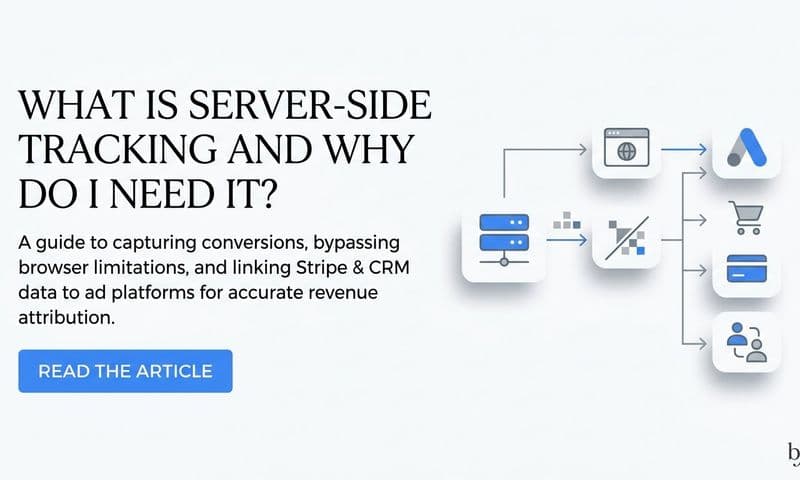
Here's what that looks like in practice. When a user completes a conversion on your website, say they submit a lead form or complete a purchase, that event data is captured by your server. Your server then sends that data directly to the ad platform via its API. No browser involvement in the data transmission step. No opportunity for an ad blocker to intercept it. No dependency on whether the user's browser has privacy restrictions enabled.
The major ad platforms have built exactly this infrastructure to support server-side event ingestion. Meta's Conversions API (CAPI), Google Ads Enhanced Conversions, TikTok's Events API, LinkedIn's server-side Insight Tag, and Pinterest's API for Conversions all accept event data sent directly from your server. These are not workarounds or unofficial integrations. They are the platforms' own recommended solutions to the data loss problem.
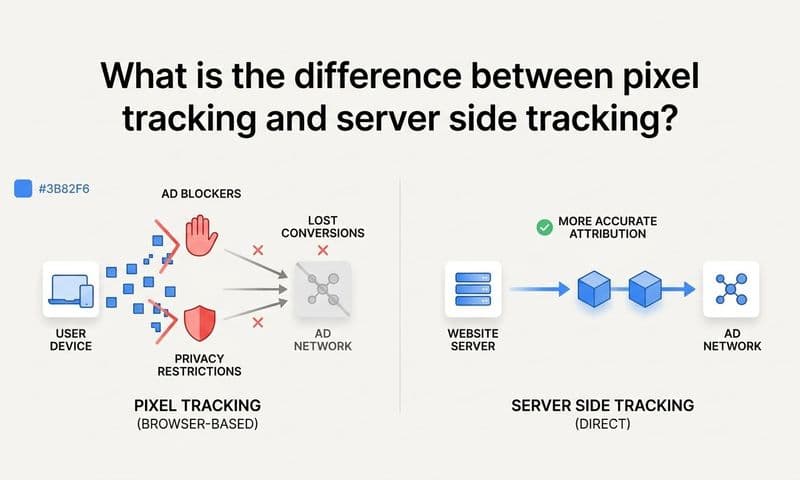
The contrast with client-side tracking is worth making explicit. In browser-based tracking, the data journey goes: user action in browser, pixel fires in browser, data travels from browser to ad platform. Every step in that chain is vulnerable. The browser can block the pixel. Privacy settings can strip identifying data. Cookie restrictions can prevent proper attribution. By the time the signal reaches the platform, it may be incomplete or missing entirely.
In server-side tracking, the data journey goes: user action triggers server event, server sends data directly to platform API. The browser is bypassed for the transmission step. What happens in the browser (ad blockers, privacy settings, cookie restrictions) simply does not affect whether the conversion signal reaches the platform.
One important clarification: server side tracking works best as a complement to client-side tracking, not a complete replacement. Browser-side data still contributes useful signals, and the recommended approach is a deduplication strategy where both methods fire and the platform deduplicates using event IDs. Think of it as redundancy with intelligence. You are not choosing one over the other. You are building a more resilient system that captures what the browser-based method misses, without discarding the signals it does capture correctly.
This layered approach is what transforms your data from a partial picture into something that actually reflects your customers' behavior. If you're ready to move from concept to implementation, a practical guide on how to set up server side tracking can walk you through the technical steps in detail.
The Core Benefits That Change How You Run Campaigns
Once you understand the mechanics, the benefits for marketers become concrete and significant. Server side tracking changes the quality of your data in ways that ripple through every campaign decision you make.
More complete conversion data: This is the most immediate benefit. Server side tracking captures conversion events that ad blockers and privacy browsers would otherwise suppress. When a user with an ad blocker completes a purchase, that conversion still reaches your ad platform via the server-side event. When an iOS user who opted out of tracking converts, the server-side signal still fires. Your reported conversion volume becomes a more accurate reflection of what is actually happening, rather than a filtered, incomplete version of it.
Higher event match quality: Server side tracking enables you to include richer first-party data alongside your conversion events. Because the data transmission happens on your server, you can include hashed email addresses, phone numbers, and customer IDs that you've collected directly from users. On Meta specifically, this translates to a measurable improvement in Event Match Quality (EMQ), which is Meta's own metric for how well conversion data matches to Facebook user profiles. As Meta's developer documentation explains, higher EMQ leads to better ad delivery optimization. Better matching means your conversion signals are more useful to the algorithm, which improves audience targeting and the performance of lookalike audiences built from your customer data.
Better ROAS reporting and budget decisions: When your attribution data is more complete, your reported ROAS reflects reality more accurately. This matters enormously for budget allocation. If a channel is driving conversions that your pixel isn't capturing, your ROAS for that channel looks worse than it actually is. You might reduce spend or pause campaigns based on numbers that are telling you a false story. Server side tracking closes that gap, giving you a clearer signal about which channels and campaigns are genuinely performing. That clarity translates directly into better budget decisions: scaling what works, cutting what doesn't, and doing so with confidence rather than guesswork.
Resilience against ongoing privacy changes: The privacy landscape is not stabilizing. Browser restrictions are tightening, not loosening. Regulatory pressure on tracking is increasing across markets. Server side tracking is inherently more durable in this environment because it does not depend on browser behavior or third-party cookies. The data infrastructure you build around server-side methods today will continue to function as privacy restrictions evolve, while teams relying solely on pixels will continue to see their data quality erode. Understanding best practices for tracking conversions accurately is essential as this landscape continues to shift.
Taken together, these benefits add up to something significant: a data foundation you can actually trust to make decisions from.
How Server Side Tracking Feeds Ad Platform Algorithms
Here's where server side tracking connects directly to campaign performance in a way that goes beyond just better reporting numbers.
Ad platforms like Meta and Google are fundamentally algorithmic systems. They optimize ad delivery based on conversion signals: who converted, when, from which ad, and with what characteristics. The more complete and accurate those signals are, the better the algorithm can identify high-value users and optimize delivery toward them. When conversion signals are incomplete, the algorithm is working with a partial map. It finds some of your best customers, but misses others because it never received the signal that those users converted.
Server side tracking directly improves the quality of the signals you're sending back to these platforms. When you send enriched, server-side conversion events through Meta's Conversions API or Google's Enhanced Conversions, you are giving the algorithm more to work with. More conversions attributed correctly. Richer data about who those converters are. Better matching between your conversion events and real user profiles on the platform. This is precisely why server-side tracking is more accurate than relying on browser-based methods alone.
This feeds into automated bidding strategies in a meaningful way. Strategies like Target CPA and Target ROAS on Google, or Meta's Advantage+ campaigns, rely on conversion data to calibrate their bids. When that data is more complete, the algorithm can optimize more accurately toward your actual cost and return targets. The system gets smarter faster because it has better training data.
The compounding effect here is worth emphasizing. Better conversion signals lead to better algorithmic optimization. Better optimization leads to ads being shown to higher-quality audiences. Higher-quality audiences convert at better rates. Lower cost per acquisition follows over time, not just better reporting numbers. This is the chain of value that makes server side tracking a genuine performance investment, not just a data hygiene exercise.
Platforms are increasingly explicit about this. Meta's own documentation on the Conversions API frames it as a way to improve campaign performance, not just tracking completeness. When the platform recommends you implement server-side tracking, it is telling you that better signals lead to better results. That recommendation is worth taking seriously. Pairing server-side data with the right performance marketing tracking software amplifies these gains across every channel you run.
Server Side Tracking and Multi-Touch Attribution: A Powerful Combination
If server side tracking improves the completeness of your conversion data, multi-touch attribution is how you make sense of that data across the full customer journey. The two work together in ways that fundamentally change how you understand your marketing performance.
Multi-touch attribution models assign credit to the various touchpoints a customer interacts with before converting. A user might see a Facebook ad, click a Google search ad a week later, and then convert after receiving an email. A last-click model gives all the credit to the email. A multi-touch model distributes credit across all three touchpoints based on their relative influence on the conversion.
The problem with multi-touch attribution when you're relying solely on browser-based tracking is that a significant portion of touchpoints are simply never captured. An ad impression on a device where the user has opted out of tracking. A click from a browser with aggressive privacy settings. A visit from a user with an ad blocker. These interactions happen, they influence the customer's journey, but they are invisible to your attribution model. The model is working from an incomplete record, and the credit assignment it produces reflects that incompleteness.
Server side tracking captures touchpoints that browser-based methods miss entirely. When those gaps are filled, your multi-touch attribution model has a more complete record of the actual customer journey to work from. The credit distribution becomes more accurate. The insights you draw about which channels and ads influence conversions at each stage of the funnel become more reliable.
This matters for decisions across the entire funnel. If your attribution model consistently undervalues upper-funnel channels because touchpoints from those channels are frequently dropped, you'll systematically underfund awareness and consideration activities. You'll over-attribute to lower-funnel, last-touch channels because those are the ones your browser-based tracking captures most reliably. Server side tracking corrects this distortion, giving you a clearer view of what is actually driving customers toward conversion at every stage. Exploring a thorough comparison of attribution models can help you choose the right framework once your data foundation is solid.
The combination of server-side data collection and multi-touch attribution is not just a technical improvement. It is a more honest account of how your marketing actually works, and that honesty is the foundation of smarter strategy.
Putting It Into Practice With Cometly
Understanding server side tracking conceptually is one thing. Implementing it in a way that connects to your actual campaign data and drives real decisions is another. This is where a platform like Cometly changes the equation for marketing teams.
Cometly's server-side tracking works as part of a broader attribution platform that connects your ad platforms, CRM, and website data in a single place. Rather than treating server-side tracking as an isolated technical setup, Cometly integrates it into a complete data pipeline. Every conversion event captured server-side feeds directly into the attribution models and analytics dashboards your team uses to make decisions. The data flows from your server to the platform APIs and simultaneously into Cometly's reporting, giving you a unified view of performance that is built on complete, accurate data.
The enriched data that server-side tracking enables is also the foundation for Cometly's AI-powered features. Because Cometly captures a more complete picture of every customer journey, from ad clicks to CRM events, the AI has richer data to analyze. It can surface recommendations about which ads and campaigns are genuinely driving conversions, flag underperformers that might look acceptable on surface metrics but are not delivering real value, and identify scaling opportunities across every channel. These recommendations are only as good as the data behind them, and server-side tracking is what makes that data trustworthy.
Cometly also handles Conversion Sync, sending enriched conversion events back to platforms like Meta and Google to improve their algorithmic optimization. This closes the loop: better data in, better optimization out, better campaign results over time.
It is worth framing server side tracking the right way as you consider implementing it. This is not a one-time technical project that you complete and forget. It is an ongoing data quality investment. The more complete your conversion data becomes over time, the more accurate your attribution models get. The more accurate your attribution models get, the better your budget decisions become. The better your budget decisions become, the more efficiently your ad spend compounds into results. Every improvement in data quality has downstream effects on every decision that data informs.
Teams that build this foundation early develop a compounding advantage over those still relying on incomplete, browser-filtered data. The gap between them grows with every campaign cycle.
The Bottom Line on Server Side Tracking
Server side tracking is not a developer concern that marketers can safely ignore. It is a direct input to the quality of your attribution data, the performance of your ad platform algorithms, and the accuracy of every budget decision your team makes.
The chain of value is clear. More complete data leads to better attribution. Better attribution leads to smarter ad platform optimization. Smarter optimization leads to lower cost per acquisition and higher ROAS over time. Every link in that chain depends on the quality of the conversion signals you're capturing, and server side tracking is what makes those signals complete.
Browser-based tracking is not going to recover. The privacy landscape will continue to tighten, ad blockers will remain widely used, and the conversion data gaps that pixel-based tracking leaves behind will only grow. The marketers who build server-side tracking into their data infrastructure now are the ones who will have reliable attribution when everyone else is flying blind.
If your current setup is missing conversions, underreporting ROAS, and sending incomplete signals to your ad platforms, the fix is available. Get your free demo of Cometly today and start capturing every conversion signal your current setup is missing. Your attribution data, your algorithm performance, and your campaign results will reflect the difference.