
You're spending real budget across LinkedIn, Meta, and other social platforms every month. The campaigns are running, the impressions are climbing, and the clicks are coming in. But when your VP of Sales asks which ads are actually driving pipeline, you find yourself piecing together a story from disconnected dashboards that don't quite add up.
This is the core frustration for most B2B SaaS marketing teams running paid social today. Native platform dashboards are built to show you what happened inside their ecosystem: clicks, impressions, cost per click, and maybe a conversion if your pixel fires correctly. What they cannot show you is whether that LinkedIn ad from three weeks ago influenced the deal that just closed in your CRM.
Social media ad performance tracking, done properly, is not about collecting more metrics. It is about connecting the right data points across the entire buyer journey, from the first ad impression to closed-won revenue. This guide walks through why platform-reported metrics fall short, which metrics actually matter for B2B SaaS, how attribution models change what you see, and how to build the infrastructure that finally connects your ad spend to pipeline and revenue outcomes.
Why Clicks and Impressions Only Tell Half the Story
Clicks and impressions measure activity. They tell you that someone saw your ad and, in some cases, took an action. What they do not tell you is whether that person became a qualified lead, entered your pipeline, or eventually signed a contract. For B2B SaaS teams with average deal cycles measured in weeks or months, that gap is enormous.
Relying on platform-reported performance metrics alone leads to a predictable problem: budget gets allocated toward what looks good in the ad platform, not what is actually generating revenue. A campaign with a strong CTR and low CPC looks like a winner. But if those clicks are coming from the wrong audience and none of them are converting into qualified opportunities, you are optimizing for the wrong outcome entirely.
Attribution gaps make this problem worse. Picture a prospect who clicks a LinkedIn ad, visits your product page, and leaves without converting. Two weeks later, they search your brand name on Google, click a search ad, and book a demo. In last-click reporting, Google gets full credit. The LinkedIn ad that introduced your product and built initial awareness becomes invisible. Over time, this pattern causes social channels to appear underperforming when they may actually be playing a critical role in early-stage influence.
This is the distinction between performance metrics and outcome metrics. Performance metrics live inside the ad platform: impressions, reach, CTR, CPC, and frequency. Outcome metrics live in your pipeline and CRM: leads generated, MQLs created, opportunities opened, and revenue closed. Both matter, but B2B SaaS teams that only track the former are making budget decisions with half the picture.
The goal of social media ad performance tracking is to bridge these two worlds. It requires looking beyond what each platform reports in isolation and building a system that connects ad activity to downstream business results. That starts with knowing which metrics to track at each stage of the funnel.
The Core Metrics That Actually Matter for Social Ad Tracking
Not all metrics deserve equal attention. The ones worth tracking depend on where in the funnel you are measuring and what decision you are trying to make. A useful framework organizes social ad metrics by funnel stage, with revenue-connected metrics at the center of every analysis.
Awareness-stage metrics include reach, frequency, and CPM (cost per thousand impressions). These tell you how efficiently you are getting your message in front of the right audience. They are useful for understanding brand exposure but should never be used to justify budget on their own.
Consideration-stage metrics shift the focus to engagement and site behavior: CTR, CPC, landing page conversion rate, and time on site. These indicate whether your ad creative and messaging are resonating enough to drive meaningful interest. A high CTR with a poor landing page conversion rate, for example, signals a disconnect between the ad promise and the destination experience.
Conversion-stage metrics are where B2B SaaS teams should invest the most attention: cost per lead, cost per MQL, and cost per opportunity. These connect ad spend directly to pipeline entry points. If you know your average cost per opportunity across channels, you can make defensible decisions about where to scale and where to pull back.
Beyond these funnel-stage metrics, the most important numbers for B2B SaaS are revenue-connected. Pipeline influenced measures the total value of deals that had at least one social ad touchpoint in the buyer journey. Pipeline created measures deals where a social ad was the first known interaction. Cost per pipeline dollar tells you how efficiently your ad spend is generating pipeline value. And closed-won revenue attributed to specific campaigns is the ultimate measure of social ad performance.
Customer journey data adds another layer of insight, particularly for understanding time-to-convert. In long B2B sales cycles, a social ad might influence a prospect who does not convert for 60 or 90 days. Without tracking that full journey, you cannot see the ad's contribution. Understanding how many touchpoints typically precede a conversion, and how social ads fit into that sequence, helps teams set realistic expectations and evaluate campaigns over appropriate time horizons rather than cutting campaigns prematurely based on short windows.
How Multi-Touch Attribution Changes What You See
Attribution models determine how credit for a conversion is distributed across the touchpoints in a buyer's journey. The model you choose has a direct impact on how your social ad campaigns appear to perform, and choosing the wrong one can lead to decisions that hurt your pipeline.
Single-touch models are the most common default in ad platforms and the most misleading for B2B. First-touch attribution gives all credit to the first interaction, which tends to over-reward awareness channels like top-of-funnel social ads while ignoring everything that happened between that first click and the eventual conversion. Last-click attribution does the opposite: it credits the final touchpoint before conversion, which is often a branded search or a direct visit, while erasing the social ads that built intent and kept the prospect engaged throughout the consideration phase.
In a B2B context where deals involve multiple stakeholders and months of nurturing, both single-touch models produce a distorted view. They make it nearly impossible to understand the true role social ads play in moving prospects through the funnel.
Multi-touch attribution distributes credit across every touchpoint in the buyer journey. This gives social ads fair recognition for the influence they have at each stage, whether that is an awareness-driving LinkedIn post that introduced the brand or a retargeting ad on Meta that re-engaged a prospect who had gone quiet.
The specific model you use within multi-touch attribution matters. Here is how the common options compare:
Linear attribution divides credit equally across all touchpoints. It is a good starting point for teams new to multi-touch attribution because it is easy to explain and ensures no touchpoint is ignored. The limitation is that it treats every interaction as equally important, which is rarely true in practice.
Time-decay attribution assigns more credit to touchpoints that occurred closer to the conversion event. This model works well for shorter sales cycles where recent interactions carry more weight. For B2B SaaS with longer cycles, it can still undervalue early-stage social ads that planted the initial seed of interest.
Data-driven attribution uses machine learning to assign credit based on the actual patterns in your conversion data. It is the most accurate model when you have sufficient data volume, and it tends to surface surprising insights about which touchpoints are genuinely moving the needle versus which ones appear important but are not.
Choosing the right model depends on your sales cycle length, data volume, and the specific question you are trying to answer. The key takeaway is that any multi-touch model will give you a more accurate picture of social ad performance than last-click or first-touch alone. For a deeper look at how to structure this, the attribution tracking setup process is worth reviewing before choosing your model.
Server-Side Tracking and First-Party Data: The Foundation of Accurate Measurement
Even with the right attribution model in place, your tracking is only as good as the data feeding it. This is where many B2B SaaS teams hit a wall: browser-based pixel tracking, which most ad platforms rely on by default, has become increasingly unreliable.
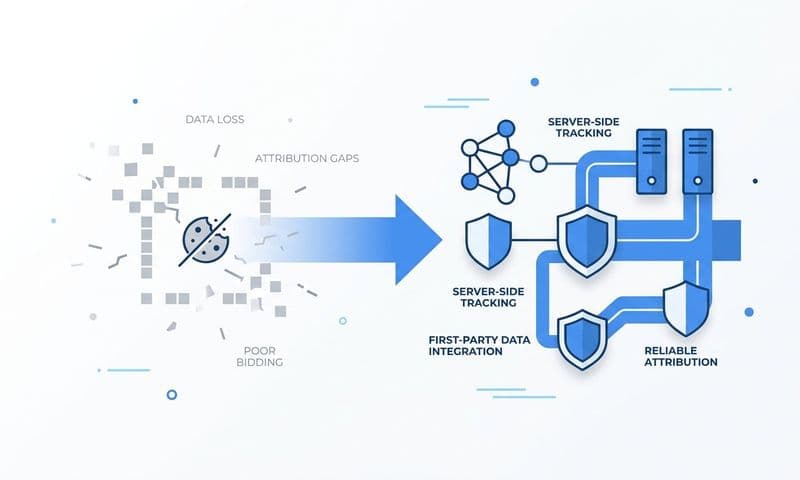
The reasons are well-documented. Apple's App Tracking Transparency framework, introduced with iOS 14.5, significantly reduced the ability of platforms like Meta to track user behavior across apps and websites. Combined with the growing adoption of ad blockers and browser-level restrictions on third-party cookies, pixel-based tracking now misses a meaningful portion of conversion events. The result is that your ad platform reports fewer conversions than actually occurred, which distorts performance data and causes ad optimization algorithms to make worse decisions on your behalf.
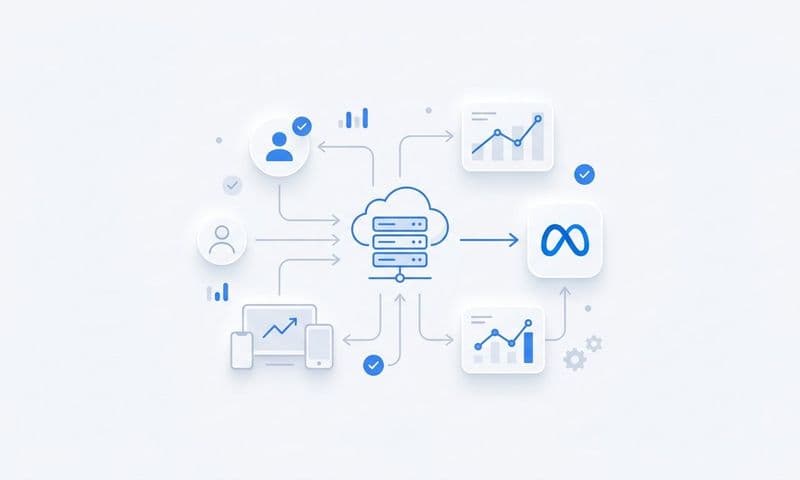
Server-side tracking addresses this directly. Instead of relying on a browser pixel to fire a conversion event, server-side tracking sends that event from your server to the ad platform. Meta's Conversion API (CAPI) and Google's Enhanced Conversions are the primary implementations of this approach. Because the event originates from your server rather than the user's browser, it is not subject to ad blockers or browser privacy restrictions. This restores signal accuracy and gives ad platform algorithms the data they need to optimize effectively. Understanding why server-side tracking is more accurate than pixel-based methods is essential for any team serious about measurement.
First-party data enrichment takes this further. When you capture CRM events, form submissions, and offline conversions alongside ad click data, you create a complete picture of what happened after someone engaged with your ad. A lead that came in through a LinkedIn campaign, progressed to an MQL in your CRM, and eventually became a closed deal can be traced back to its origin. That connection is only possible when your server-side tracking is integrated with your CRM and your attribution layer has access to both ad data and downstream revenue data.
For B2B SaaS teams, this means going beyond the standard pixel setup. Building a tracking foundation that combines server-side event tracking, CRM integration, and first-party data collection is not optional if you want accurate social media ad performance tracking. It is the infrastructure that makes everything else work.
Building a Tracking System That Connects Ads to Pipeline
Accurate social ad performance tracking does not happen by default. It requires intentional infrastructure built around a clear goal: connecting every ad interaction to the downstream outcomes it influences. Here is what that infrastructure looks like in practice.
UTM parameter strategy is the starting point. Every social ad link should include UTM parameters that identify the source, medium, campaign, ad set, and creative. This ensures that when a prospect lands on your site and eventually fills out a form, your CRM captures where they came from. Without consistent UTM tagging, the traffic source data in your CRM becomes unreliable, and the connection between ad spend and pipeline entry breaks down.
CRM integration is the next layer. Your CRM needs to capture UTM data at the point of lead creation and carry it forward through the entire deal lifecycle. When a lead converts to an MQL, an opportunity, and eventually a closed deal, the original ad source should travel with that record. This is what enables revenue attribution back to specific campaigns.
Ad platform connections bring cost and performance data into the same view as pipeline and revenue data. When your ad spend data from LinkedIn, Meta, and other platforms is connected to your CRM data, you can calculate metrics like cost per opportunity and cost per pipeline dollar without manually exporting and reconciling spreadsheets.
A centralized attribution layer sits above all of this. It is the system that unifies data from ad platforms, your website, and your CRM into a single source of truth. This eliminates the discrepancies that arise when the ad platform reports one number and the CRM reports another. With a unified attribution view, your team can make budget decisions based on data everyone agrees on, rather than spending time debating which dashboard to trust.
The practical result of this infrastructure is that you can trace the full customer journey: from the first social ad click through lead capture, sales qualification, and closed-won revenue. No touchpoint is lost in the handoff between marketing and sales, and every campaign can be evaluated based on its actual contribution to pipeline and revenue.
Turning Tracking Data Into Smarter Ad Decisions
Infrastructure and data are only valuable if they lead to better decisions. Once your social ad performance tracking system is in place, the goal shifts to using that data to allocate budget more intelligently and scale what is working.
The first application is identifying which channels, campaigns, and creatives are generating the highest quality pipeline. A campaign that produces a high volume of leads at a low cost per lead may look attractive, but if those leads rarely convert to opportunities, the real cost per pipeline dollar is much higher than it appears. Attribution data lets you see past lead volume and evaluate campaigns based on the quality of the pipeline they create.
AI-driven insights add another dimension. When your tracking system feeds enriched, first-party conversion data back to ad platforms through server-side integrations, the platform algorithms have better signals to work with. This improves audience targeting, reduces wasted spend, and lowers cost per acquisition over time. The more accurate your conversion data, the smarter the ad platform's optimization becomes, creating a compounding advantage for teams that invest in proper tracking infrastructure.
Reporting cadence matters too. Not every metric deserves weekly attention. A practical approach for B2B SaaS teams looks like this:
Weekly reviews should focus on spend efficiency and early lead quality signals: cost per lead by channel, MQL conversion rates, and any significant shifts in CTR or CPC that might indicate creative fatigue or audience saturation.
Monthly reviews should zoom out to pipeline influence and revenue attribution: which campaigns contributed to opportunities created that month, pipeline value influenced by social ads, and closed-won revenue traced back to specific campaigns. These are the metrics that justify budget and inform strategic decisions about channel mix. Teams looking to sharpen this process can benefit from understanding how to improve campaign performance with analytics at each review stage.
This cadence keeps teams responsive to short-term performance signals while maintaining a clear view of the long-term revenue impact that matters most in B2B SaaS.
Putting It All Together
Social media ad performance tracking is not about collecting more data. It is about connecting the right data, from ad click to closed revenue, in a way that gives your team a clear and defensible picture of what is actually driving growth.
The progression covered in this guide moves from surface-level platform metrics to revenue-connected tracking. It requires moving beyond native dashboards, adopting multi-touch attribution models that reflect the complexity of B2B buying journeys, building server-side tracking infrastructure that restores signal accuracy, and unifying ad data with CRM and revenue data in a single attribution layer. Each step builds on the last, and together they transform social ad measurement from a reporting exercise into a strategic advantage.
This is exactly the problem Cometly is built to solve. Cometly connects your ad platforms, CRM, and website into a single attribution view, giving B2B SaaS teams real-time visibility into which social ads are driving pipeline and revenue. With server-side tracking and Conversion API integrations, multi-touch attribution models, AI-powered recommendations, and 70+ native integrations including Stripe for revenue data, Cometly provides the end-to-end tracking infrastructure that platform dashboards alone cannot deliver.
Instead of reconciling conflicting reports or guessing which campaigns deserve more budget, your team gets a single source of truth that connects every ad touchpoint to downstream revenue outcomes. You can see which LinkedIn campaigns are influencing deals, which Meta creatives are generating the highest quality pipeline, and where your budget is generating the strongest return, all in one place.
Ready to see which social ads are actually driving revenue? Get your free demo and start connecting every touchpoint to the outcomes that matter most.