Most B2B SaaS marketing teams are not short on budget or ambition. They run paid social campaigns, invest in SEO, sponsor webinars, and push out content consistently. Yet when leadership asks which efforts actually drove new revenue last quarter, the honest answer is often a shrug followed by a best guess.
The problem is not the campaigns themselves. It is the gap in visibility between a prospect's first interaction with your brand and the moment they become a paying customer. Without a clear map of what happens in between, marketing becomes a series of disconnected activities rather than a coordinated system that drives growth.
That map is the customer journey. Not as a theoretical framework to present in a slide deck, but as a sequence of real, trackable interactions that each play a role in a buying decision. When you understand the steps in the customer journey at a data level, you stop guessing about what works and start making decisions grounded in evidence. This article breaks down each stage, explains what you need to track, and shows how attribution data transforms the journey from a concept into a measurable growth lever.
Why the Customer Journey Is a Revenue Map, Not Just a Marketing Model
There is a tendency in marketing to treat the customer journey as a visual metaphor: a funnel, a flywheel, or an arc from stranger to advocate. These visuals are useful for communication, but they can obscure something more important. Every stage in the journey represents actual interactions between a real person and your brand, and those interactions leave data behind.
In B2B SaaS, that data trail is longer and more complex than most teams account for. A typical B2B buying decision involves multiple stakeholders, each entering the journey at different points. A product manager might discover your tool through an organic search result. A director might see a retargeted ad two weeks later. A VP might attend a webinar before the procurement team requests a security review. Each of these touchpoints is a step in the journey, and each one contributes to whether the deal closes.
This is fundamentally different from B2C purchasing behavior, where a single individual often moves from awareness to purchase in hours or days. B2B buying cycles can stretch across weeks or months, loop back through earlier stages as new stakeholders join the evaluation, and involve a higher volume of touchpoints before any commitment is made.
Understanding the journey at a data level changes how you allocate marketing budget. When you can see which channels introduce prospects to your brand, which content moves them toward a demo request, and which touchpoints correlate with closed-won deals, you are no longer making budget decisions based on instinct. You are making them based on evidence about what actually moves prospects forward.
This is why the customer journey is better understood as a revenue map. It connects marketing activity to business outcomes in a way that a funnel metaphor alone cannot. When each step is tracked and attributed correctly, the journey stops being a story you tell about your marketing and becomes a system you can optimize for growth.
The Core Steps in the Customer Journey Explained
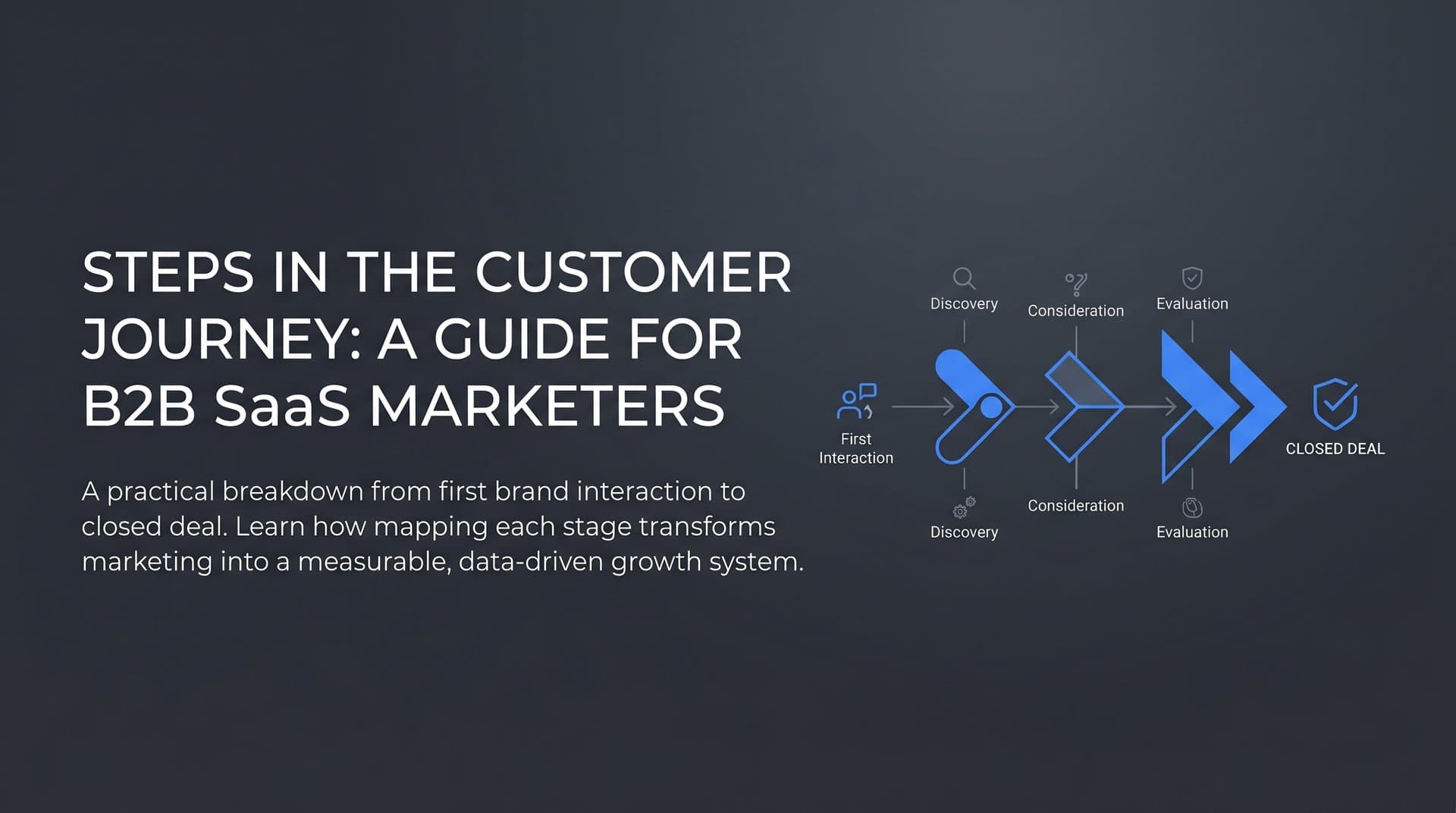
While the specific path every prospect takes is unique, the customer journey in B2B SaaS generally moves through five primary stages. Understanding what each stage means in practice, and what kinds of touchpoints occur there, is the foundation for building a tracking and attribution strategy that actually works.
Awareness: This is the stage where a prospect first becomes aware that a problem exists and that solutions like yours are available. Common touchpoints include paid social ads, organic search content, thought leadership articles, and podcast appearances. The goal at this stage is discoverability. You want to be present when a prospect first starts asking questions about a challenge your product addresses.
Consideration: At this stage, prospects are actively evaluating options. They are comparing solutions, reading reviews, watching demo videos, and engaging with high-intent content like comparison pages and product walkthroughs. Demo requests and free trial sign-ups typically happen here. This is where your messaging needs to shift from problem awareness to solution differentiation. The touchpoints that matter most are those that help a prospect understand why your product is the right fit for their specific situation.
Decision: The prospect is ready to buy, or close to it. Sales-assisted touchpoints become critical: discovery calls, product demos, pricing conversations, and proposals. Marketing's role at this stage is less about generating new interest and more about enabling the sales team. The right case studies, ROI calculators, and competitive battle cards can be the difference between a closed deal and a lost one.
Retention: This stage begins the moment a customer signs a contract and continues throughout their lifecycle. Onboarding sequences, in-app messaging, customer success check-ins, and renewal campaigns are all touchpoints that influence whether a customer stays, expands their usage, or churns. In B2B SaaS, retention is where a significant portion of revenue is actually generated, through seat expansions, tier upgrades, and annual contract renewals. Yet it is often the least tracked stage in the marketing stack.
Advocacy: Satisfied customers who become advocates are one of the most valuable and underutilized assets in B2B SaaS marketing. Reviews on G2 or Capterra, referrals to peers, and participation in case studies all feed directly back into the Awareness stage for new prospects. When a potential buyer sees that someone in a similar role at a similar company achieved real results with your product, that social proof carries more weight than almost any paid ad.
The critical insight here is that Retention and Advocacy are not afterthoughts. They are stages in the journey that generate measurable revenue and pipeline, and they deserve the same level of tracking attention as Awareness and Consideration.
What Marketers Miss When They Only Track the Top of the Funnel
Here is a scenario that plays out in many B2B SaaS marketing teams. The team runs a LinkedIn campaign, tracks click-through rates and cost per MQL, and declares it successful when leads flow into the CRM. Then those leads get handed to sales, and marketing's visibility effectively ends. Whether those leads converted, how long the sales cycle was, and which other touchpoints influenced the final decision remain unknown to the marketing team.
This is the top-of-funnel tracking trap. It creates the illusion of measurement while leaving the most important questions unanswered. Clicks and impressions tell you that people saw your ad and engaged with it. They do not tell you whether those people became customers or whether the ad played any meaningful role in the revenue outcome.
The blind spot is especially costly when it comes to multi-channel influence. A prospect might first encounter your brand through a LinkedIn thought leadership post, then read three blog articles over two weeks, then attend a webinar, and finally convert after clicking a Google search ad. If your attribution model only captures the last click, the LinkedIn campaign and the content program receive zero credit. The search ad looks like the hero, and budget decisions get made accordingly.
This is how channels that genuinely assist conversions get cut from budgets while last-touch channels receive disproportionate credit. Over time, this creates a distorted picture of what is actually driving growth. Teams double down on bottom-of-funnel channels while underinvesting in the Awareness and Consideration touchpoints that influence buying decisions earlier in the journey.
There is also the challenge of the dark funnel: the portion of the B2B customer journey that happens in channels that are inherently difficult to track. Peer conversations at industry events, recommendations in Slack communities, discussions in private forums, and direct word-of-mouth referrals all influence buying decisions without leaving a clean data trail. Attribution tools that rely solely on pixel-based or last-click tracking miss a meaningful portion of the actual journey.
The solution is not to achieve perfect tracking of every interaction, which is not realistic. The solution is to build a tracking architecture that captures as much of the journey as possible and uses attribution models that distribute credit across all known touchpoints, not just the final one.
How Attribution Connects Every Step to Revenue
Multi-touch attribution is the practice of assigning credit to multiple touchpoints across the customer journey rather than crediting a single interaction. Instead of asking "which ad did this customer click last?" it asks "which channels and campaigns contributed to this customer's decision at each stage of their journey?"
Different attribution models answer this question in different ways. A linear model distributes credit equally across all touchpoints. A time-decay model gives more weight to touchpoints that occurred closer to the conversion. A data-driven model uses historical patterns to assign credit based on which touchpoints most frequently correlate with conversions. The right model for your team depends on the length and complexity of your sales cycle, but any multi-touch approach gives you a more accurate picture than last-click alone.
Accurate attribution also depends on how touchpoint data is collected. Browser-based tracking has become increasingly unreliable as privacy regulations tighten and ad blockers become more common. Server-side tracking and Conversion API integrations address this by capturing conversion events directly from your server rather than relying on a browser pixel. This means that when a prospect submits a demo request or completes a purchase, that event is recorded accurately regardless of what is happening on the client side.
The most powerful form of attribution in B2B SaaS connects ad platform data to CRM pipeline events and closed-won revenue. When you can see that a specific campaign influenced a specific opportunity that closed at a specific contract value, you are measuring pipeline attribution rather than just lead volume. This is the standard that modern B2B SaaS marketing teams are working toward, and it requires connecting data across ad platforms, your website, your CRM, and your payment or subscription system.
This level of attribution transforms how marketing teams communicate with leadership. Instead of reporting on impressions and MQLs, you can report on revenue influenced, pipeline generated, and cost per closed deal by channel. These are the metrics that drive budget decisions, and they are only possible when attribution connects every step in the journey to a revenue outcome.
Tracking the Journey in Practice: Tools and Data Inputs
Understanding the steps in the customer journey conceptually is one thing. Building the infrastructure to track them accurately is another. Effective journey tracking requires connecting multiple data sources into a single, coherent view of how prospects move from first touchpoint to closed customer.
The core data inputs are: ad platform data from channels like Meta, Google, and LinkedIn; website analytics that capture on-site behavior and conversion events; CRM data that records lead status, opportunity stages, and deal outcomes; and payment or subscription data that ties marketing activity to actual revenue. When these sources are siloed, you get a fragmented picture. When they are connected, you get a revenue map.
Ad Platform Integration: Connecting your ad platforms to your attribution system ensures that every click, impression, and campaign interaction is captured and associated with a prospect's journey. This is the starting point for understanding which channels are generating awareness and which are driving consideration-stage engagement.
CRM Connection: Your CRM holds the record of what happens after a lead is created. By connecting CRM pipeline stages and closed-won data to marketing touchpoints, you can see which campaigns influenced deals at different stages of the sales cycle. This is where marketing attribution connects to revenue attribution.
First-Party Data and Server-Side Tracking: As third-party cookies become less reliable, first-party data collection becomes a foundational requirement. Server-side tracking and Conversion API integrations ensure that conversion events are captured accurately and sent back to ad platforms with the data quality needed to support algorithmic optimization.
AI-driven analytics add another layer of value here. When you have a high volume of touchpoint data across a large number of customer journeys, identifying patterns manually is not practical. AI can surface which journey paths most commonly lead to high-value conversions, which channels tend to appear early in the journeys of your best customers, and where prospects most often drop off. These insights enable more precise budget allocation and more targeted messaging by stage.
Feeding enriched, first-party conversion data back to ad platforms also improves their algorithmic targeting. When Meta or Google receives accurate signals about which events led to closed revenue, their optimization algorithms can find more prospects who are likely to follow similar paths. This creates a compounding effect: better data leads to better targeting, which leads to higher-quality prospects entering the journey.
Putting It All Together: Building a Journey-Aware Marketing Strategy
Mapping and measuring each step in the customer journey shifts marketing from activity-based reporting to revenue-based decision-making. Instead of asking "how many leads did we generate?" you start asking "which touchpoints in the journey drove the most pipeline?" and "where are prospects dropping off, and what can we do about it?"
This shift has practical implications for how you run your marketing operation. It means reallocating budget toward the channels and campaigns that appear most frequently in the journeys of your best customers. It means refining your messaging by stage, so that Awareness content addresses the problems your prospects are just beginning to recognize, while Decision-stage content speaks directly to the concerns of someone ready to buy. It means improving the handoff between marketing and sales so that reps have visibility into a prospect's full journey history when they enter a discovery call.
None of this is possible without the right infrastructure. You need a platform that connects your ad data, CRM, website, and revenue data into a single source of truth, and that gives you the attribution models and analytics to act on what you find.
This is exactly what Cometly is built to do. Cometly connects every touchpoint in the customer journey to pipeline and revenue in real time, giving B2B SaaS marketing teams the visibility they need to make smarter budget decisions, optimize campaigns by stage, and prove the impact of marketing on revenue. From multi-touch attribution and server-side tracking to AI-driven insights and 70+ native integrations, Cometly gives you the complete picture of how your marketing drives growth.
Ready to stop guessing and start making marketing decisions based on what actually drives revenue? Get your free demo today and see how Cometly maps the full customer journey from first ad click to closed-won deal.