Picture this: your marketing team is running campaigns across Meta, Google, TikTok, and email simultaneously. A prospect clicks a TikTok ad on their phone, browses your site, then searches Google a week later, clicks another ad, signs up for your email list, and finally converts after opening a promotional email. The sale comes in, and suddenly Meta claims credit, Google claims credit, and your email platform is also raising its hand. Meanwhile, your actual budget decisions are being made on data that looks nothing like reality.
This is the daily frustration for marketing teams who lack the ability to track customer touchpoints accurately. Fragmented data, misattributed conversions, and platform-level self-reporting bias quietly drain budgets while making it nearly impossible to identify which channels and campaigns are genuinely driving revenue.
The good news is that this problem is solvable. With the right combination of server-side tracking, multi-touch attribution, and consistent data practices, you can build a system that gives you a clear, reliable view of every step your customers take before converting. This guide walks you through exactly how to do that, covering what touchpoints are, why most tracking systems fail, and how to build a stack that actually works.
The Anatomy of a Customer Touchpoint
A customer touchpoint is any interaction a prospect has with your brand. That definition is broader than most marketers initially assume. It includes the obvious moments: a paid ad impression, a click, a website visit. But it also includes email opens, retargeting exposures, chat conversations, organic social posts, and CRM events like demo requests, trial sign-ups, or completed purchases.
Every one of these interactions is a data point that tells part of the story. Individually, they are fragments. Together, they reveal the full customer journey and that distinction matters enormously when you are trying to allocate budget intelligently. Understanding customer journey touchpoints in depth is the first step toward building a system that captures them all.
Modern buyer journeys are rarely linear. A prospect might see your brand for the first time through a YouTube pre-roll ad, forget about it, then encounter a Meta retargeting ad two weeks later, visit your pricing page, download a guide via email, and convert a month after that first impression. B2B journeys in particular often span weeks or months and involve multiple stakeholders across multiple devices. Expecting a single-channel, last-click view to capture that complexity is like reading only the final chapter of a novel and claiming you understand the plot.
It helps to think about touchpoints in two categories. Pre-conversion touchpoints cover the awareness and consideration phases: everything that happens from a prospect's first exposure to your brand through the moment they convert. These are the touchpoints paid advertisers need the most visibility into, because this is where budget decisions are made. Post-conversion touchpoints cover onboarding, retention, and expansion, which matter enormously for lifetime value but operate in a different part of the funnel.
For the purposes of scaling paid campaigns profitably, the pre-conversion path is where accurate tracking delivers the most immediate impact. If you cannot see which touchpoints are genuinely moving prospects toward a purchase, you are essentially optimizing in the dark. You might cut a channel that was warming up leads for another channel to close, or you might scale a campaign that looks good in platform dashboards but contributes little to actual revenue.
Understanding what touchpoints are and why each one matters is the foundation. The harder question is why so many tracking systems fail to capture them reliably.
Why Most Tracking Systems Fall Short
The obstacles to accurate touchpoint tracking have multiplied significantly in recent years, and many marketing teams are still operating on infrastructure that was built before these challenges existed.
The most significant shift came with Apple's App Tracking Transparency framework, introduced with iOS 14.5, which required apps to get explicit user permission before tracking activity across other apps and websites. The result was that a large portion of mobile users became invisible to browser-based pixel tracking almost overnight. Meta's pixel, which had been the backbone of conversion tracking for many advertisers, suddenly had significant gaps in its data. Understanding what a tracking pixel is and how it works helps clarify why these limitations matter so much.
At the same time, Google's ongoing Privacy Sandbox initiative has been steadily dismantling reliance on third-party cookies in Chrome. While the timeline has shifted multiple times, the direction is clear: browser-based tracking as it has traditionally worked is becoming less reliable, not more. Ad blockers compound this further, with a meaningful portion of desktop users running software that blocks pixels and tracking scripts entirely.
Cross-device and cross-browser fragmentation adds another layer of complexity. A user who clicks your ad on their iPhone, then converts on their work laptop using a different browser, appears as two separate anonymous visitors in most tracking systems. Without a way to stitch those sessions together, you are seeing a broken journey rather than a complete one. This is precisely the challenge that digital marketing strategies that track users across the web are designed to solve.
Then there is ad platform self-reporting bias. Each platform, Meta, Google, TikTok, LinkedIn, uses its own attribution window and methodology. Meta might claim a conversion if a user saw your ad within the last seven days and converted within a day of clicking. Google might claim the same conversion because the user clicked a search ad before purchasing. The result is that the sum of conversions reported across your platforms often significantly exceeds the number of conversions that actually occurred. When every platform is grading its own homework, the grades tend to be inflated.
Relying solely on platform-native analytics creates siloed, self-serving data. Meta Ads Manager will always make Meta look like a strong performer. Google Ads will do the same for Google. Neither has any incentive to show you that a different channel actually initiated the journey or that both platforms are claiming credit for the same sale.
The cost of this inaccuracy is real. Budgets get misallocated toward campaigns that report impressive platform-level numbers but contribute little to actual revenue. Channels that play a critical role in the consideration phase get defunded because they rarely get last-click credit. Scaling decisions get made on data that does not reflect reality, which means growth becomes expensive and unpredictable.
Solving this requires moving beyond browser-based pixels and platform dashboards. It requires a different technical foundation entirely.
Server-Side Tracking: The Foundation for Reliable Data
Traditional browser-based tracking works by loading a small piece of JavaScript code, a pixel, in the user's browser. When a conversion event happens, that pixel fires and sends data to the ad platform. The problem is that this entire process happens in the browser, which means it is vulnerable to ad blockers, cookie restrictions, and the privacy changes described above. If the pixel cannot fire, the conversion goes unrecorded.
Server-side tracking works differently. Instead of relying on the user's browser to send data, your server sends conversion data directly to the ad platform's API. Meta calls this the Conversions API. Google has enhanced conversions and the Google Ads API. Because the data travels from server to server rather than through the browser, it bypasses ad blockers entirely and is not affected by cookie restrictions or iOS privacy settings. To understand the full scope of benefits, explore why server-side tracking is more accurate than traditional methods.
The practical result is more complete data capture. Events that would have been lost due to ad blockers or browser restrictions are now recorded reliably. Many marketing teams that implement server-side tracking find that their reported conversion volume increases, not because more conversions are happening, but because conversions that were previously going untracked are now being captured.
Server-side tracking also enables richer data enrichment before that data is sent to ad platforms. Because the event passes through your server first, you can match it against CRM data, append customer information, and include offline conversion events like phone calls, in-person purchases, or deals closed in your sales CRM. This creates a much more complete picture of what each ad interaction actually produced downstream.
Think of it this way: browser-based tracking is like trying to listen to a conversation through a wall. You catch some of it, but pieces are muffled or missing entirely. Server-side tracking is like being in the room. The signal is clean, complete, and reliable.
For marketers running paid campaigns at any meaningful scale, server-side tracking is no longer a nice-to-have. It is the technical foundation on which accurate touchpoint tracking is built. Without it, the data feeding your attribution models and your ad platform algorithms is inherently incomplete, and every decision downstream is compromised by that gap.
Multi-Touch Attribution: Connecting the Dots Across Channels
Once you have reliable data flowing in, the next challenge is making sense of it. Which touchpoints deserve credit for a conversion? This is where multi-touch attribution becomes essential.
Multi-touch attribution (MTA) distributes conversion credit across multiple touchpoints in the customer journey rather than assigning all credit to a single interaction. This approach reflects the reality that most conversions are the result of several exposures across multiple channels, not a single magical moment. Investing in customer attribution tracking is what allows you to see these cross-channel dynamics clearly.
There are several attribution models, each with a different logic for how credit is distributed, and understanding them helps you choose the right lens for your specific goals.
First-touch attribution gives all credit to the first interaction a prospect had with your brand. This model is useful for understanding which channels are best at generating awareness and bringing new prospects into your funnel. If you are evaluating top-of-funnel campaigns, first-touch helps you see what is actually initiating journeys.
Last-touch attribution gives all credit to the final interaction before conversion. This is the default model in many ad platforms and analytics tools. It is useful for understanding what closes deals, but it dramatically undervalues the channels that warmed up the prospect earlier in the journey.
Linear attribution distributes credit equally across every touchpoint in the journey. This model treats every interaction as equally important, which is a reasonable starting point but can obscure the outsized role that certain touchpoints play.
Time-decay attribution weights touchpoints more heavily the closer they are to the conversion. The logic is that recent interactions had more influence on the final decision. This works well for shorter sales cycles where recency genuinely correlates with influence.
Position-based attribution, often called U-shaped, gives more credit to the first and last touchpoints while distributing the remainder across the middle. This reflects the intuition that the initial awareness moment and the final closing interaction are both especially important.
The right model depends on your sales cycle length, channel mix, and what question you are trying to answer. A company with a 90-day B2B sales cycle will get very different insights from a time-decay model versus a first-touch model. The most powerful approach is to compare models side by side. When you do, channels that are chronically undervalued in last-touch reporting often reveal themselves as critical contributors to revenue when viewed through a linear or position-based lens.
This comparison is where budget reallocation decisions get genuinely data-driven rather than intuition-driven.
Building Your Touchpoint Tracking Stack Step by Step
Understanding the concepts is one thing. Building the actual system is another. Here is a practical framework for setting up reliable touchpoint tracking across your campaigns.
Step 1: Implement UTM parameters consistently across every campaign. UTM parameters are the tags you append to URLs to identify the source, medium, campaign, content, and keyword associated with each click. Without them, traffic from your paid campaigns arrives in your analytics platform as unidentified or misattributed. Consistent UTM tracking is the simplest and most foundational layer of touchpoint tracking, and it costs nothing to implement beyond the discipline to do it every time.
Step 2: Establish naming conventions and stick to them. UTM parameters are only as useful as the names you give them. If your team tags campaigns as "Meta-Retargeting," "meta retargeting," and "META_RETARGETING" interchangeably, your data becomes fragmented and difficult to analyze. Define a naming convention for campaigns, ad sets, and creatives, document it, and enforce it. Clean naming is what allows you to slice and analyze data at scale without spending hours cleaning up inconsistencies first.
Step 3: Set up server-side tracking to capture events reliably. As covered earlier, this means implementing your ad platform APIs (Meta Conversions API, Google enhanced conversions, and equivalents for other platforms) so that conversion data flows from your server rather than depending on browser pixels alone. Our server-side tracking implementation guide walks through this process in detail.
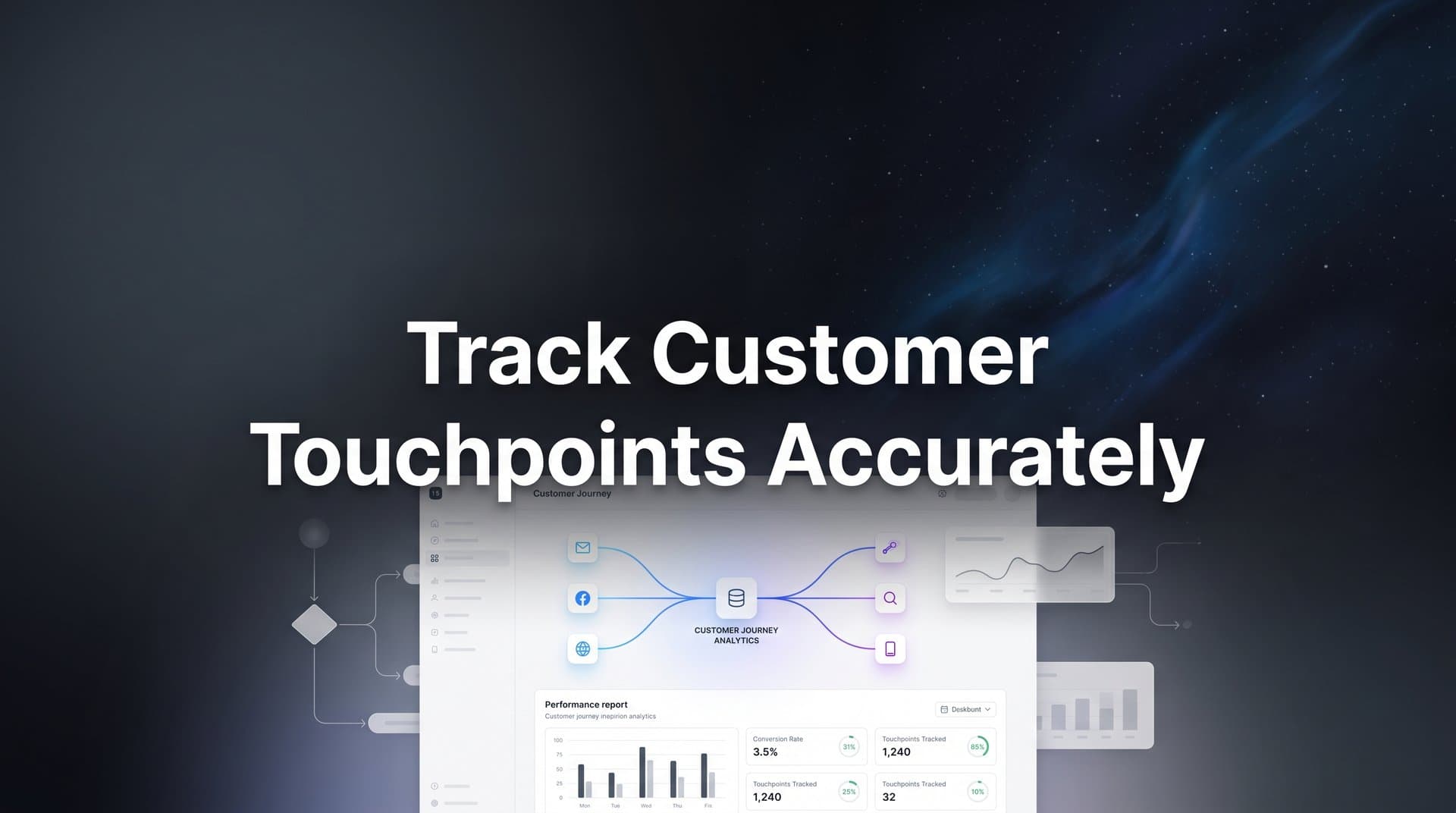
Step 4: Connect your ad platforms and CRM into a unified attribution platform. Individual platform dashboards will always show you a fragmented, biased view. A unified attribution platform pulls data from every channel into a single place, applies consistent attribution logic, and shows you the complete customer journey. This is where you can actually see how channels interact and which touchpoints are genuinely contributing to revenue.
Step 5: Define your conversion events and map them to funnel stages. Not all conversions are equal. A newsletter sign-up, a demo request, and a closed deal represent very different levels of intent and value. Define which events matter, assign them to the appropriate funnel stage, and make sure your tracking system captures each one. This mapping is what allows you to understand not just which channels drive conversions, but which channels drive the conversions that actually matter to your business.
Step 6: Feed enriched conversion data back to ad platforms. This is sometimes called conversion sync, and it is increasingly important as ad platforms rely more heavily on algorithmic optimization. When you send accurate, enriched conversion data back to Meta, Google, and other platforms, their machine learning models can optimize for the outcomes that actually matter to your business rather than proxy metrics like clicks or surface-level form fills. Over time, this improves targeting quality and can meaningfully reduce your cost per acquisition.
Turning Accurate Touchpoint Data Into Smarter Decisions
All of this infrastructure exists for one purpose: to help you make better decisions with your marketing budget. Here is how accurate touchpoint data translates into real competitive advantage.
The most immediate benefit is budget reallocation. When you can see which channels and campaigns are genuinely driving revenue rather than simply reporting the most platform-attributed conversions, you can shift spend toward what actually works. This often means defunding campaigns that look impressive in native dashboards but contribute little when viewed through a cross-channel attribution lens, and increasing investment in channels that were previously undervalued because they rarely got last-click credit. The right marketing attribution software makes this kind of analysis straightforward.
Accurate data also enables smarter creative decisions. When you can track which ad creatives appear in the journeys of your highest-value customers, you can identify what resonates and replicate it. This is difficult to do reliably when your data is fragmented across platforms. With a unified view of every touchpoint, patterns emerge that would otherwise be invisible.
AI-powered analytics amplifies this further. When your attribution platform has clean, complete data to work with, AI can surface insights that would take a human analyst significant time to find manually. Identifying which audience segments respond to which creative formats across which channels, at scale, is exactly the kind of pattern recognition where AI adds genuine value. But AI is only as good as the data it works with. Garbage in, garbage out is not a cliche; it is a description of what happens when you try to apply machine learning to fragmented, incomplete data.
There is also a compounding effect worth understanding. When you send better conversion data back to ad platforms, their algorithms optimize more effectively. Better optimization produces higher-quality leads and customers. Those higher-quality customers generate better conversion data. That data feeds the algorithms again, improving performance further. This virtuous cycle is one of the most powerful dynamics available to marketers who invest in accurate tracking infrastructure, and it is essentially unavailable to those who do not. Learning how ad tracking tools help you scale ads using accurate data illustrates this compounding advantage in practice.
The difference between a marketing team that scales profitably and one that grows increasingly frustrated with rising costs and unclear results often comes down to this: one has a reliable system for tracking customer touchpoints accurately, and the other is still relying on platform dashboards and gut instinct.
Putting It All Together
The ability to track customer touchpoints accurately is not a technical luxury reserved for enterprise teams with large engineering resources. It is the foundation of every profitable scaling decision in modern paid advertising. Without it, you are allocating budget based on each platform's self-interested version of the truth rather than what is actually happening in your customers' journeys.
The key pillars are straightforward: server-side tracking for reliable, complete data capture that bypasses browser limitations; multi-touch attribution to understand how channels work together rather than compete for credit; consistent UTM parameters and naming conventions to keep your data clean and analyzable; and conversion sync to feed enriched data back to ad platform algorithms so they optimize for outcomes that matter.
Each of these pillars reinforces the others. Server-side tracking gives you complete data. Multi-touch attribution makes sense of it. Clean naming conventions make it analyzable. Conversion sync turns it into a performance advantage that compounds over time.
Cometly is built to handle all of these elements in one place. It connects your ad platforms, website, and CRM to give you a unified, accurate view of every customer journey, from the first ad impression to the final conversion and beyond. With AI-powered analytics and real-time attribution data, Cometly helps you see what is actually driving revenue and act on it with confidence.
If you are ready to stop guessing and start scaling on data you can trust, Get your free demo today and see exactly how Cometly captures every touchpoint to help you maximize your conversions.