Most marketers know their ROAS number. The problem is that number is often wrong.
Between fragmented customer journeys, cross-platform tracking gaps, and the steady decline of third-party cookies, the return on ad spend you see in your ad platform dashboards rarely tells the full story. Meta might take credit for a sale that Google also claims. TikTok might show a conversion that actually started with an organic search. And the result is a misleading picture that leads to misallocated budgets and missed growth opportunities.
Tracking return on ad spend accurately is not just about installing a pixel and reading a dashboard. It requires a deliberate system that connects your ad platforms, your website, your CRM, and your revenue data into one unified view. When you get this right, you stop guessing which campaigns are working and start making confident decisions backed by real data.
This guide walks you through six actionable steps to build an accurate ROAS tracking system from the ground up. Whether you are running campaigns on a single platform or managing spend across Meta, Google, TikTok, and more, these steps will help you close the data gaps and finally see which ads are truly driving revenue.
Step 1: Define Your Revenue Events and Assign Accurate Values
Before you can track return on ad spend accurately, you need to be crystal clear about what you are actually measuring. This sounds obvious, but it is one of the most commonly skipped steps in attribution setup.
The first task is identifying the specific conversion events that represent real revenue for your business. These are not engagement signals or pipeline indicators. They are the moments where money changes hands or a deal is definitively closed. For ecommerce businesses, this typically means a completed purchase. For B2B SaaS companies, it might be a subscription activation or a closed-won deal in your CRM. For service businesses, it could be a signed contract.
The distinction matters because many marketers inadvertently track proxy metrics like form submissions, add-to-carts, or free trial signups as their primary conversion events. These actions have value, but they do not equal revenue. When you feed these proxy metrics into your ROAS calculation, you end up with a number that feels impressive but does not reflect what is actually happening in your bank account.
Once you have identified your true revenue events, the next step is assigning accurate monetary values to each one. For ecommerce, this means pulling actual transaction values from your store rather than using estimated averages. Most ecommerce platforms allow you to pass dynamic revenue values with each conversion event, so your attribution data reflects the real dollar amount of every order. Understanding the return on ad spend formula is essential to ensuring these values feed into meaningful calculations.
For B2B and SaaS businesses, the process is slightly different. You may not know the exact deal value at the moment of a lead conversion, but you can use average deal values pulled from your CRM to assign a meaningful number. As deals close, you can update these values to reflect actual revenue, which is where CRM integration becomes critical. Learning how to properly track closed-won revenue ensures your ROAS reflects real business outcomes rather than pipeline estimates.
Common pitfall to avoid: Many ad platforms pre-populate default conversion values or allow you to set a static value for all conversions. If you are using a flat number like $10 for every lead regardless of deal size, your ROAS data is already distorted before you even start analyzing it. Always pull real revenue data where possible, and update static values regularly to reflect current averages.
A useful self-check: look at the total conversion value your ad platforms are reporting over the last 30 days. Then compare that number to your actual revenue for the same period. If there is a significant gap, your event definitions or assigned values need attention before anything else.
Step 2: Implement Server-Side Tracking to Close Data Gaps
Here is where many ROAS tracking systems quietly fall apart. You have defined your revenue events and assigned accurate values. But if your tracking relies entirely on browser-based pixels, a significant portion of those conversions is simply never recorded.
Browser-based tracking works by placing a small snippet of JavaScript on your website that fires when a user completes a conversion action. The pixel sends data from the user's browser to the ad platform. The problem is that this method depends entirely on the browser cooperating, and increasingly, it does not. To understand the mechanics in more detail, read about what a tracking pixel is and how it works.
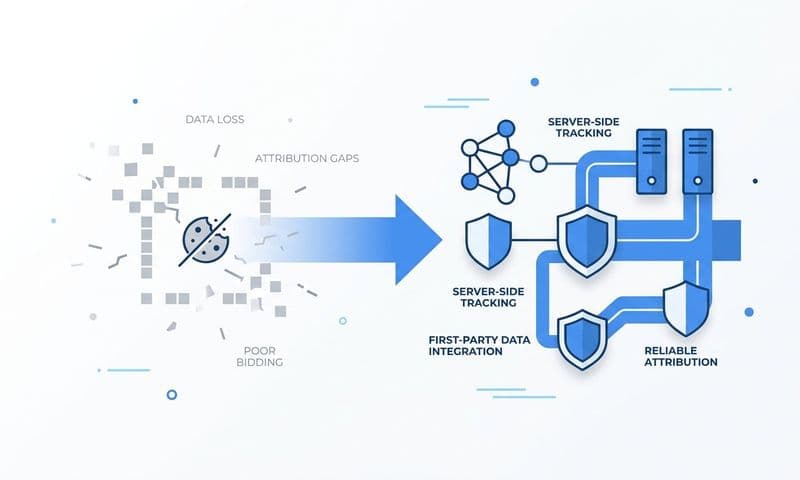
iOS privacy updates have restricted cross-site tracking for a large portion of mobile users. Ad blockers prevent pixels from loading altogether. Browser privacy settings in Chrome, Firefox, and Safari limit how long cookies persist and how data is shared. The cumulative effect is that a meaningful share of real conversions never get attributed to the campaigns that drove them.
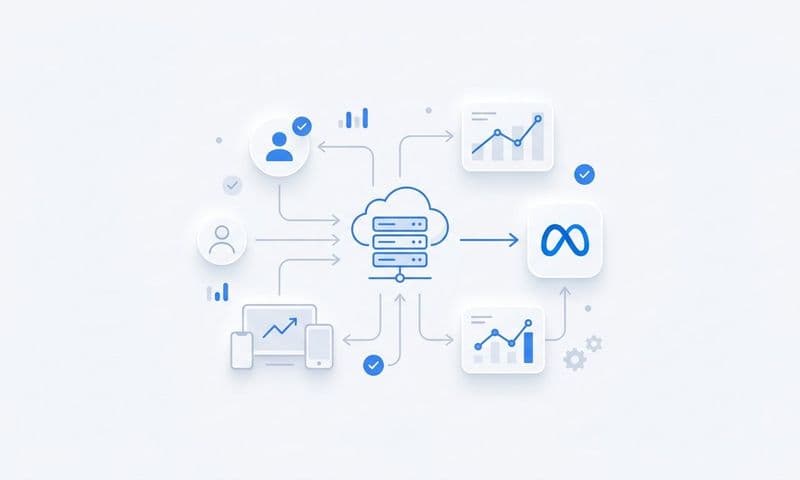
Server-side tracking solves this by moving the data transmission off the browser and onto your server. Instead of relying on a pixel in the user's browser to fire and report back, your server sends conversion data directly to the ad platforms via their APIs. This approach bypasses browser limitations entirely because the communication happens server to server, not browser to platform. For a deeper look at why this approach delivers better results, explore why server-side tracking is more accurate.
The practical result is a more complete conversion dataset. Conversions that would have been lost due to ad blockers or privacy restrictions are now captured and attributed correctly. This directly improves the accuracy of your ROAS calculations because you are working with a fuller picture of what actually happened.
Setting up server-side tracking typically involves a few key components. You need a way to capture conversion events on your server, a method for matching those events to the right users (using hashed email addresses or other identifiers), and a connection to each ad platform's conversion API. Meta's Conversions API, Google's Enhanced Conversions, and TikTok's Events API all support server-side data ingestion.
Tip: Cometly's server-side tracking is built specifically for this challenge. It connects directly to your ad platforms and CRM to capture every touchpoint without relying on third-party cookies or browser-based pixels. This means your attribution data includes conversions that client-side tracking would have missed entirely, giving you a more accurate foundation for every ROAS calculation you make.
One important note: server-side tracking and client-side pixels are not mutually exclusive. Running both in parallel, with deduplication logic in place, gives you the best of both worlds. You capture the speed and granularity of browser-side events while ensuring server-side tracking fills in the gaps where browser tracking fails.
Step 3: Connect Your Ad Platforms, Website, and CRM Into One System
Think of the customer journey as a relay race. A user sees your ad on Meta, clicks through to your website, reads a few pages, leaves, searches for your brand name on Google a week later, clicks a search ad, and finally converts. That conversion involved at least two paid touchpoints and possibly an organic one in between.
Now ask yourself: where does that conversion show up in your reporting? If you are relying on each platform's native reporting, Meta will claim it, Google will claim it, and you will have no way of knowing which channel actually deserves the credit or how the two worked together to drive the sale.
This is the fundamental problem with siloed reporting. Every ad platform has a built-in incentive to claim as much credit as possible. They use their own attribution windows, their own models, and their own data. The result is that the sum of all your platform-reported conversions often exceeds your actual total conversions by a wide margin. Your apparent ROAS looks great on paper, but it does not reflect reality. Implementing proper cross-channel tracking is the first step toward solving this problem.
The solution is to build a unified system that sits above all your individual platforms and tracks the full customer journey independently. This means integrating every ad platform you run, your website analytics, and your CRM into a single attribution tool that applies consistent rules across all data sources.
Mapping the full journey requires connecting several pieces. Your ad platforms provide click and impression data. Your website captures the behavior between click and conversion. Your CRM holds the ground truth on which leads actually became paying customers and at what value. When these three data sources are connected, you can trace a single customer from their first ad exposure all the way through to closed revenue.
Why this matters in practice: without a unified system, you might look at Meta's dashboard and see a strong ROAS, then look at Google's dashboard and see a strong ROAS, and conclude both channels are performing well. But when you look at the unified view, you might discover that many of those conversions are the same customers counted twice, and one channel is actually carrying far more weight than the other. This kind of overlap is a major source of wasted ad spend on wrong channels.
Cometly is built around this exact problem. It connects your ad platforms, website, and CRM into one place, giving you a single source of truth for every conversion and every dollar of revenue. Instead of toggling between platform dashboards and trying to reconcile conflicting numbers, you see one consistent, accurate picture of what is driving results.
Step 4: Choose the Right Attribution Model for Your Business
Once your data is flowing into a unified system, you need to decide how credit gets distributed across the touchpoints in each customer journey. This is where attribution models come in, and the model you choose can dramatically change how your ROAS looks across different campaigns and channels.
Here is a quick overview of the most common models and what they prioritize:
Last-click attribution: Gives 100% of the credit to the final touchpoint before conversion. Simple to understand, but it systematically undervalues awareness and consideration channels that played a role earlier in the journey.
First-click attribution: Gives 100% of the credit to the first touchpoint. Useful for understanding what initially drives customers into your funnel, but it ignores everything that happened between discovery and conversion.
Linear attribution: Distributes credit equally across all touchpoints in the journey. More balanced than single-touch models, but it treats a brief mid-funnel interaction the same as a high-intent bottom-funnel click.
Time-decay attribution: Gives more credit to touchpoints that occurred closer to the conversion. This model assumes that recent interactions were more influential, which often aligns with how purchase decisions actually unfold.
Data-driven or multi-touch attribution: Uses algorithmic analysis to assign credit based on actual patterns in your conversion data. This is generally the most accurate model for businesses with sufficient data volume, as it reflects the real contribution of each touchpoint rather than applying a fixed rule. Choosing the right marketing attribution software makes implementing these models far more practical.
The right choice depends on your business. If you run a short sales cycle ecommerce business where customers typically convert in one or two sessions, last-click or time-decay may be sufficient. If you run a B2B SaaS business with a long sales cycle involving multiple campaigns across several weeks, a multi-touch or data-driven model will give you a much more honest view of what is working.
The most important thing you can do is test multiple models side by side. When you compare last-click ROAS against multi-touch ROAS for the same campaigns, you often discover that the channels you thought were underperforming were actually doing a lot of heavy lifting earlier in the funnel. Conversely, channels that looked like stars under last-click attribution sometimes look far less impressive when credit is distributed more fairly.
This comparison is not about finding the "right" answer once and moving on. It is about building a more nuanced understanding of how your campaigns interact and which model most accurately reflects your actual revenue patterns.
Step 5: Sync Enriched Conversion Data Back to Your Ad Platforms
Accurate ROAS tracking is not just about improving your own reporting. It also creates a compounding benefit for campaign performance when you feed better data back to the ad platforms themselves.
Here is the concept: ad platforms like Meta, Google, and TikTok use machine learning algorithms to optimize campaign delivery. These algorithms learn from the conversion signals you send them. When they receive accurate, enriched conversion data, they get better at finding users who are likely to convert at a high value. When they receive incomplete or inaccurate data, their optimization suffers, and so does your actual ROAS.
Conversion sync is the practice of sending verified, enriched conversion events back to each ad platform via their conversion APIs. Instead of relying on what their pixels captured (which, as we covered in Step 2, is often incomplete), you are sending them the full, accurate picture of what happened, including conversions they would have missed and the real revenue values associated with each one. Addressing these issues is a core part of fixing conversion tracking gaps in your marketing stack.
The impact on campaign performance can be significant. When Meta's algorithm receives better conversion signals, it can identify lookalike audiences more accurately, optimize bidding more effectively, and allocate budget toward users who are more likely to generate real revenue rather than just clicks or low-value conversions. The same principle applies to Google's Smart Bidding and TikTok's optimization engine.
This creates a positive feedback loop. Better data leads to better targeting. Better targeting leads to higher-quality conversions. Higher-quality conversions generate better data to send back. Over time, this compounding effect can meaningfully improve your actual ROAS, not just your reported ROAS.
How to implement this: each major ad platform offers a conversion API that accepts server-side conversion events. You can configure these manually, but the process requires technical setup for each platform individually and ongoing maintenance as APIs evolve.
Cometly's Conversion Sync feature automates this entire process. It captures enriched conversion events from your unified tracking system and sends them back to Meta, Google, TikTok, and other platforms automatically. You get the performance benefits of feeding better data to ad platform algorithms without having to manage each API integration separately.
One thing to keep in mind: when you start sending more complete conversion data to ad platforms, you may see their reported conversion numbers change. This is expected and actually a sign that the system is working. The goal is not to inflate reported numbers but to ensure the platforms are optimizing based on accurate signals.
Step 6: Audit, Compare, and Optimize Your ROAS Continuously
Building an accurate ROAS tracking system is not a one-time project. It is an ongoing practice that requires regular attention to stay calibrated and actionable.
The most valuable habit you can build is a regular audit cadence. Set aside time weekly or biweekly to compare the ROAS data in your unified attribution tool against the self-reported numbers from each individual ad platform. Discrepancies between these two views are not bugs. They are signals that tell you where platforms are over-claiming credit and where your actual performance differs from what the dashboards suggest.
When you find a channel where platform-reported ROAS is significantly higher than your attribution tool shows, that is a red flag. It usually means that platform is counting conversions that were actually driven by other touchpoints. On the flip side, if your attribution tool shows a channel performing better than its own dashboard suggests, that channel may be undervalued in your current budget allocation. Using a return on ad spend calculator alongside your attribution data helps quantify these discrepancies quickly.
Use these discrepancies to inform budget decisions. The goal of accurate ROAS tracking is not just better reporting. It is better allocation. When you know which campaigns are genuinely driving revenue versus which ones are benefiting from attribution inflation, you can confidently scale what works and cut or adjust what does not.
This is also where AI-powered analysis becomes a real advantage. Manually reviewing performance data across multiple platforms, campaigns, and attribution models is time-consuming and easy to get wrong. Cometly's AI Ads Manager surfaces optimization opportunities you might miss in manual analysis, flagging underperforming campaigns, identifying budget reallocation opportunities, and recommending actions based on actual revenue data rather than surface-level metrics.
A few things to check in every audit:
Conversion volume discrepancies: Compare total conversions reported by each platform against the total in your unified system. A large gap suggests tracking gaps or attribution overlap that needs investigation.
Revenue value accuracy: Verify that the revenue values being attributed match your actual revenue for the same period. If the numbers are consistently off in one direction, your event values may need updating.
Attribution model shifts: Periodically revisit your chosen attribution model to see if it still reflects your actual customer journey. As your marketing mix evolves, the model that was right six months ago may no longer be the best fit.
The marketers who get the most value from accurate ROAS tracking are the ones who treat it as a living system rather than a setup task. Regular audits keep the data honest and ensure your optimization decisions are always grounded in reality.
Putting It All Together: Your Accurate ROAS Tracking Checklist
Building an accurate ROAS tracking system is a process that compounds over time. Each step reinforces the others, and the full system is far more powerful than any individual component. Here is a quick-reference checklist to keep you on track:
1. Define revenue events: Identify the specific events that represent real revenue, assign accurate monetary values using actual transaction or CRM data, and separate revenue events from engagement metrics.
2. Implement server-side tracking: Move beyond browser-based pixels by setting up server-side data transmission to capture conversions that ad blockers and privacy restrictions would otherwise miss.
3. Unify your data sources: Connect all ad platforms, your website, and your CRM into a single attribution system so every touchpoint in the customer journey is captured and credited consistently.
4. Choose and test attribution models: Select a model that fits your sales cycle and business type, and compare multiple models side by side to understand how credit distribution affects your ROAS view.
5. Sync conversion data back to platforms: Feed enriched, verified conversion events back to Meta, Google, TikTok, and other platforms to improve their optimization algorithms and create a positive performance feedback loop.
6. Audit regularly: Compare your unified attribution data against platform-reported numbers on a weekly or biweekly basis, and use the insights to reallocate budget toward what is genuinely working.
Accurate ROAS tracking is an ongoing system, not a one-time setup. The marketing landscape keeps shifting, platforms keep updating their algorithms, and your customer journey keeps evolving. The teams that win are the ones who build a reliable tracking infrastructure and commit to maintaining it.
Cometly brings all six of these steps together in one platform. From server-side tracking that captures every conversion to multi-touch attribution that distributes credit fairly, to Conversion Sync that feeds better data back to your ad platforms, to AI-powered analysis that surfaces optimization opportunities in real time, Cometly gives you everything you need to track return on ad spend accurately and act on what you find.
Ready to stop guessing and start making confident, data-backed decisions? Get your free demo today and see exactly which ads are driving your revenue.