Today's customers don't convert in a straight line. Someone might scroll past your ad on a mobile app during their morning commute, visit your website from a desktop browser later that afternoon, and then finally convert after clicking a retargeting ad on their phone that evening. That journey crosses at least three touchpoints across two devices and two environments, and it happens constantly.
The problem is that most marketing teams are only seeing pieces of that journey. App data lives in one tool. Web data lives in another. And the connection between the two? Often missing entirely. Without app and web attribution tracking working together, you're left making budget decisions based on incomplete information, and that's a recipe for wasted spend.
Fragmented attribution doesn't just create reporting headaches. It actively misleads you. Channels that look like top performers in isolation might be getting credit for conversions they didn't really drive. Channels that are quietly warming up your best customers might be getting cut because they don't show up in the last-click report. This guide breaks down exactly what app and web attribution tracking is, why the stakes have never been higher, and how to build the infrastructure to get it right.
The Cross-Platform Blind Spot Most Marketers Don't Realize They Have
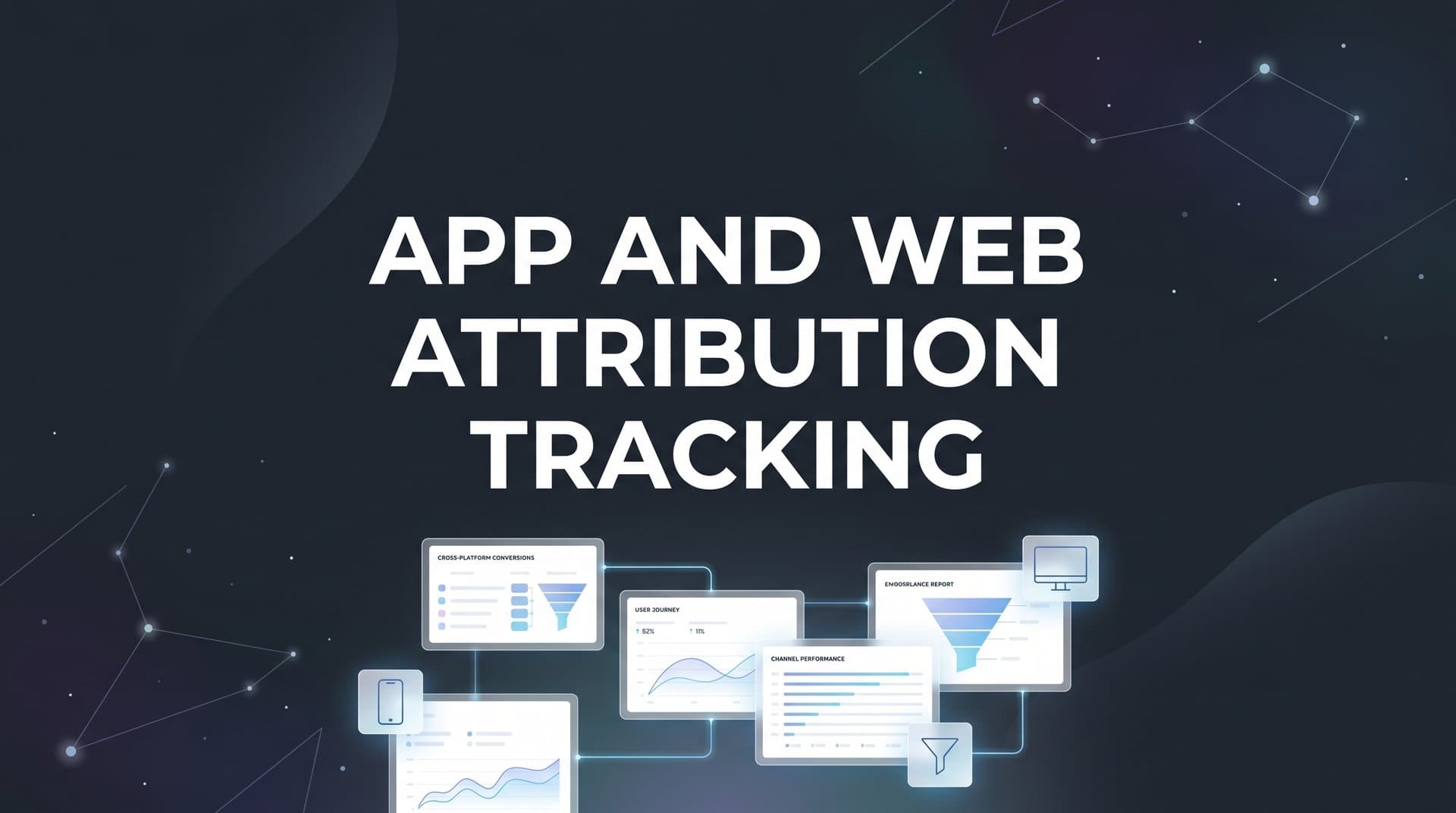
App and web attribution tracking is the process of identifying which marketing touchpoints across mobile apps and websites contribute to conversions, and then connecting those interactions into a single, coherent customer journey. It sounds straightforward, but in practice, it requires stitching together data from fundamentally different environments using different identifiers, different tools, and often different teams.
The core problem with siloed tracking is that it creates a distorted picture of reality. When your app analytics platform and your web analytics platform operate independently, you end up with data that overlaps, contradicts, and misleads. A user who clicked a mobile app ad and later converted on your website might get counted as a conversion in both systems. Alternatively, the app touchpoint might get no credit at all because the web-based last-click model can't see what happened before the user landed on your site. Learning how to fix attribution discrepancies in data is essential for addressing these gaps.
This leads to three specific and costly problems. First, double-counting: conversions appear inflated because the same user journey is being measured by two separate systems that don't know about each other. Second, misattribution: revenue gets assigned to the wrong channels, making some campaigns look far more effective than they actually are. Third, overspending: when you optimize based on flawed attribution data, you naturally pour more budget into channels that appear to perform well in isolation, even if they're not the ones actually driving downstream revenue.
Think about the contrast between traditional single-channel attribution and unified cross-platform attribution. In a single-channel world, you measure your Facebook ad performance in Meta's dashboard, your Google Ads performance in Google's dashboard, and your app installs in your mobile measurement partner. Each view looks reasonable on its own. But none of them show you the full picture of how a customer actually moved from first touch to final conversion.
Unified cross-platform attribution changes that. Instead of isolated snapshots, you get a continuous view of the customer journey: which ad introduced them to your brand, which touchpoints kept them engaged, and which final interaction pushed them to convert. Investing in the right customer attribution tracking approach is what makes smart budget allocation possible. Without it, you're optimizing in the dark.
How App Attribution and Web Attribution Actually Work (And Where They Differ)
To understand why unifying these two systems is challenging, it helps to understand how each one works independently. They're built on different technologies, use different identifiers, and were designed to solve different problems.
Web attribution mechanics have traditionally relied on a combination of cookies, UTM parameters, referrer data, and pixel-based tracking. When someone clicks an ad and lands on your website, a cookie gets set in their browser, capturing where they came from. Understanding UTM tracking and how it helps marketing is fundamental to this process. Pixels embedded on your site fire events back to ad platforms when specific actions occur, like a purchase or form submission.
This system worked reasonably well for years, but privacy changes have disrupted it significantly. Apple's Intelligent Tracking Prevention (ITP) limits how long cookies persist in Safari. Third-party cookie deprecation in Chrome has been a moving target, but the direction of travel is clear: browser-based tracking is becoming less reliable. iOS restrictions have further limited what data can be collected client-side. The result is that traditional pixel-based web attribution increasingly undercounts conversions and misattributes the ones it does capture.
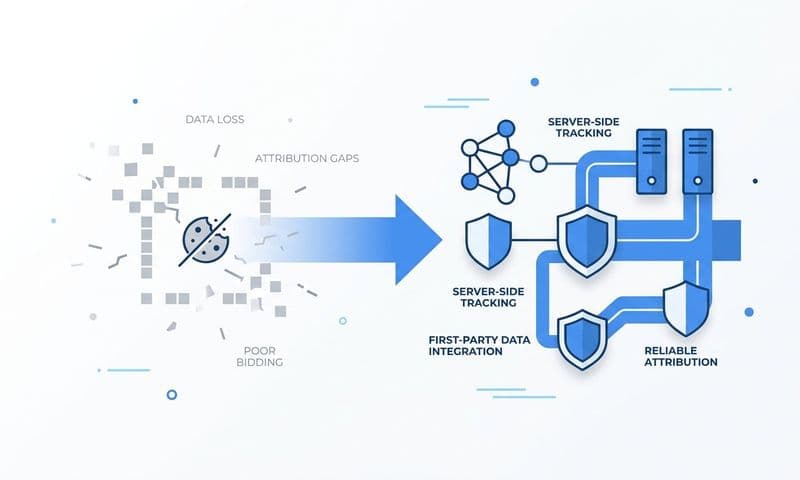
Server-side tracking has emerged as the more durable alternative. Instead of relying on a browser pixel to fire and transmit data, server-side tracking sends conversion information directly from your server to ad platforms. It bypasses browser-based limitations entirely, improving data accuracy and match rates in ways that client-side tracking simply can't match in today's privacy environment.
App attribution mechanics operate on a completely different foundation. Mobile measurement partners (MMPs) like AppsFlyer, Adjust, and Branch are the standard infrastructure for tracking app installs and in-app events. Understanding how app marketing attribution works is critical for anyone running mobile campaigns. They use device identifiers like Apple's IDFA and Google's GAID to match ad clicks to app installs.
But Apple's App Tracking Transparency (ATT) framework, introduced with iOS 14.5, requires apps to explicitly ask users for permission before accessing the IDFA. Opt-in rates have generally been low, which means a significant portion of iOS app attribution now flows through Apple's SKAdNetwork, a privacy-preserving framework that provides aggregated, delayed attribution data rather than user-level insights. Deep links help bridge app-to-web experiences by routing users to specific in-app content from web links, but they add another layer of technical complexity to the attribution picture.
Here's the core challenge: these two systems speak different languages. Web attribution thinks in cookies and sessions. App attribution thinks in device IDs and install events. They live in separate dashboards, are managed by different vendors, and often sit with different teams inside a marketing organization. Connecting them into a unified view requires deliberate infrastructure choices, not just a reporting workaround.
Why Unified Attribution Tracking Has Become Non-Negotiable
The case for unified app and web attribution tracking used to be a nice-to-have argument. Now it's a survival argument. Several forces have converged to make fragmented attribution not just inefficient, but genuinely dangerous for campaign performance.
Privacy regulations and platform changes have fundamentally altered the reliability of traditional tracking methods. ATT's impact on iOS app attribution is well documented. Third-party cookie deprecation continues to erode web-side tracking. These changes don't just create data gaps, they create systematic bias. If your attribution system consistently undercounts conversions from certain channels or devices, you'll systematically underinvest in those channels. Over time, that compounds into significant misallocation of budget.
The response to these changes isn't to accept less data. It's to shift toward server-side tracking for more accurate attribution and first-party data strategies that don't depend on browser behavior or device-level identifiers that users can opt out of. First-party data, collected directly from your own customers through your own properties, is far more durable than third-party signals. Building your attribution infrastructure around it is no longer optional; it's the foundation of accurate measurement going forward.
Ad platform algorithms are the second reason unified attribution has become non-negotiable. Meta, Google, and TikTok all rely on conversion signals from advertisers to optimize their campaigns. Their machine learning models need accurate, complete data to understand which users are most likely to convert and how to find more of them. When your attribution is fragmented and your conversion data is incomplete, you're essentially feeding these algorithms bad inputs. The output, naturally, is suboptimal targeting and higher acquisition costs.
Conversion APIs, like Meta's Conversions API (CAPI), Google's enhanced conversions, and TikTok's Events API, allow advertisers to send first-party conversion data directly from their servers to these platforms. This bypasses the browser-based limitations that have degraded pixel performance and gives ad platform algorithms the signal quality they need to optimize effectively. Marketers who implement these properly tend to see improved campaign performance because the algorithms are working with better information.
Budget allocation is the third pressure point. When you're making decisions about where to scale and where to cut based on incomplete attribution data, you're essentially guessing with large sums of money. Channels that drive early-stage awareness and consideration often look weak in last-click reports, even if they're essential to the conversion path. Leveraging the right marketing attribution platforms for revenue tracking reveals those contributions, giving you the confidence to invest in the full funnel rather than just the final click.
Attribution Models That Make Sense for Cross-Platform Journeys
Attribution models determine how credit gets assigned to the touchpoints in a customer journey. When that journey spans both app and web environments across multiple devices, the choice of model matters enormously, and some models are far more misleading than others.
Last-touch attribution is the most common default, and it's also the most problematic for cross-platform journeys. It assigns 100% of the credit to the final touchpoint before conversion. In a multi-device journey, that final touchpoint is often a retargeting ad that caught a user who was already well down the funnel. The app ad that introduced them to your brand, the blog post they read on desktop, the comparison page they visited on mobile: all of those get zero credit. Understanding the difference between single source and multi-touch attribution is critical for avoiding this trap.
First-touch attribution has the opposite problem. It gives all the credit to the first interaction, which is useful for understanding what drives awareness but tells you nothing about what actually closes conversions. For cross-platform journeys with long consideration cycles, first-touch alone is equally incomplete.
Linear attribution distributes credit equally across all touchpoints in the journey, which is more honest but doesn't account for the fact that some touchpoints are more influential than others. Time-decay attribution weights touchpoints closer to conversion more heavily, which can work well for shorter sales cycles. Position-based attribution (also called U-shaped) gives more credit to the first and last touchpoints while distributing the remainder across the middle, which is a reasonable compromise for many businesses.
Multi-touch attribution is the most complete approach for cross-platform tracking because it assigns proportional credit to each touchpoint regardless of whether it happened in an app or on a website. Exploring the best multi-touch attribution models for data can help you find the right fit for your business. It treats the customer journey as a whole rather than isolating individual interactions, which means it can accurately reflect the contribution of every channel, device, and environment in the path to conversion.
Choosing the right model depends on your specific situation. If your business has a short sales cycle and most conversions happen in a single session, a simpler model might be sufficient. If you're running a mix of app and web campaigns with a longer consideration period, multi-touch attribution is almost certainly going to give you more accurate and actionable data. The key question is: does my current model capture the full journey my customers actually take? If the answer is no, you're making optimization decisions on a partial map.
Building a Reliable App and Web Attribution Stack
Understanding the theory of unified attribution is one thing. Actually building the infrastructure to support it is another. The good news is that the technical components are well-established; the challenge is connecting them correctly and prioritizing implementation in the right order.
Server-side tracking is the foundation and should be your first priority. Client-side pixels are increasingly unreliable due to ad blockers, browser restrictions, and iOS privacy changes. Server-side tracking sends conversion data directly from your server to ad platforms and analytics tools, bypassing these limitations entirely. A proper attribution tracking setup that prioritizes server-side infrastructure improves data accuracy, increases match rates on conversion events, and gives you a more complete picture of what's actually happening across your web properties.
Deep linking for app-to-web continuity is the next critical component. Deep links allow you to route users from a web context into a specific location within your app, and vice versa, while preserving the attribution context. Without proper deep linking, you lose the thread of the customer journey at every transition between environments. A user who clicks a web ad and opens your app should carry their attribution data with them through that transition.
CRM integration connects your marketing touchpoints to actual revenue. Most attribution systems can track clicks and conversions, but connecting those events to real customer lifetime value requires pulling in CRM data. When your attribution platform knows not just that a conversion happened, but what that customer went on to spend over time, you can make much smarter decisions about where to invest. This is especially important for businesses with longer sales cycles where the initial conversion is just the beginning of the customer relationship.
Conversion sync with ad platforms closes the loop by feeding your first-party conversion data back to Meta, Google, TikTok, and other platforms through their respective APIs. Choosing the right performance marketing tracking software is what improves ad platform algorithm performance. When these systems receive accurate, enriched conversion signals, their machine learning models can optimize targeting more effectively, which reduces acquisition costs over time.
This is where Cometly comes in. Cometly unifies app and web attribution by connecting your ad platforms, CRM, and website data into a single view. Its server-side tracking infrastructure maintains data accuracy despite browser-based limitations, and its conversion sync capabilities feed enriched conversion data back to ad platforms to improve their optimization. Rather than managing separate tools for web analytics, app attribution, and ad platform reporting, Cometly brings those streams together so you can see the complete customer journey in one place and act on it with confidence.
The practical implementation sequence: start with server-side tracking to stabilize your web data collection. Then integrate your CRM to connect touchpoints to revenue. Set up conversion sync with your key ad platforms. Finally, layer in multi-touch attribution modeling to understand the full contribution of each touchpoint across app and web environments.
Turning Attribution Data Into Smarter Spending Decisions
Unified attribution data is only valuable if it changes how you make decisions. The goal isn't a prettier dashboard; it's better allocation of your marketing budget and more effective campaigns.
The most immediate impact of unified attribution is clarity on which channels and campaigns are truly driving revenue, not just clicks or installs. When you can see the complete customer journey, you often discover that the channels you thought were underperforming are actually essential to the conversion path. Upper-funnel app campaigns that introduce users to your brand might not show up well in last-click reports, but unified attribution reveals their contribution to the journeys that ultimately convert on your website. Leveraging the right ad tracking tools can help you scale ads based on these complete insights.
Feeding enriched conversion data back to ad platforms is the second lever. When Meta, Google, and TikTok receive accurate, complete conversion signals through their APIs, their algorithms get better at finding users who are likely to convert. This isn't a one-time improvement; it compounds over time as the algorithms learn from better data. The practical result is improved targeting precision and, typically, lower cost per acquisition as campaigns optimize more effectively.
AI-powered recommendations take this a step further. Cometly's AI can surface high-performing ads and campaigns across every channel, identifying what's working before it becomes obvious in aggregate metrics. Instead of manually analyzing fragmented dashboards to figure out where to scale, you get clear recommendations grounded in unified attribution data. That means your team spends less time on reporting and more time on the decisions that actually move the needle.
The compounding effect of getting attribution right is significant. Better data leads to better platform optimization. Better platform optimization leads to lower acquisition costs. Lower acquisition costs mean more room to scale. And scaling with confidence, knowing exactly which channels are driving revenue, is what separates teams that grow efficiently from teams that grow expensively.
Putting It All Together
App and web attribution tracking is no longer a technical nice-to-have for sophisticated marketing teams. It's the baseline requirement for any marketer running campaigns across multiple platforms and devices. The customer journey has become too complex, and the privacy landscape has become too restrictive, to rely on fragmented, siloed measurement systems.
The key takeaway is this: accurate, unified attribution connects every touchpoint to revenue, feeds better data to ad platform algorithms, and gives your team the confidence to scale what's actually working. Without it, you're making budget decisions based on a partial map of your customer's journey, and that gap between what you think is happening and what's actually happening costs real money.
The path forward is clear: invest in server-side tracking, integrate your CRM, set up conversion sync with your ad platforms, and adopt a multi-touch attribution model that reflects the full cross-platform journey your customers actually take. Then use that unified data to make smarter decisions, feed better signals to ad algorithms, and scale with precision.
Cometly is built to make exactly that possible. It brings app and web attribution together in one platform, with server-side tracking, AI-powered insights, and conversion sync built in so you can see the complete picture and act on it. Ready to stop guessing and start scaling with confidence? Get your free demo today and start capturing every touchpoint to maximize your conversions.