Running campaigns on both Google Ads and Facebook Ads is standard practice for most marketing teams. But tracking performance across both platforms in a unified way? That is where things get genuinely complicated.
Each platform has its own pixel, its own conversion tracking logic, and its own attribution model. Google gives itself credit for conversions. Facebook does the same. When you look at both dashboards side by side, the numbers rarely add up. The result is inflated conversion counts, unclear ROI, and budget decisions built on incomplete data.
Sound familiar? You are not alone. This is one of the most common frustrations among digital marketers managing cross-platform campaigns. You might see Google Ads reporting 80 conversions and Facebook reporting 60, but your CRM only shows 90 actual customers. Where did those extra 50 conversions come from? The answer is attribution overlap, and it is costing you real money in misallocated budget.
The good news is that this problem is solvable. With the right setup, you can track Google Ads and Facebook Ads together in a way that gives you a clear, accurate picture of the entire customer journey. You will understand which platform actually drives revenue, how they work together across the funnel, and where your next dollar should go.
This guide walks you through exactly how to build that system. By the end of these six steps, you will have a cross-platform tracking setup that captures every touchpoint, resolves discrepancies between platforms, and gives you a single source of truth for ad performance. Let us get into it.
Step 1: Audit Your Current Tracking Setup on Both Platforms
Before you build anything new, you need to understand what you already have. Jumping straight into new tracking configurations without auditing your existing setup is one of the most common mistakes marketers make. You could end up layering new tracking on top of broken or duplicate tracking, making the problem worse.
Start with Google Ads. Confirm that your Google tag or Google Tag Manager container is firing correctly on every key conversion page. This means checking your purchase confirmation pages, lead form thank-you pages, and any other events you are tracking as conversions. Use Google Tag Manager's Preview mode or the Google Tag Assistant browser extension to verify that tags fire when expected and that conversion data is flowing into your Google Ads conversion tracking account.
Next, move to Meta. Check that your Meta Pixel is installed and actively passing events. Go into Meta Events Manager and look at the Event Testing tool to confirm that standard events like PageView, Lead, and Purchase are firing correctly. If you have the Conversions API set up, verify that server events are also appearing and that deduplication is working properly. When both the pixel and the Conversions API send the same event, Meta needs a matching event ID to avoid counting it twice.
Here is the critical comparison step: pull conversion counts from both platform dashboards and line them up against your actual CRM or sales data for the same time period. If Google is reporting significantly more conversions than your CRM shows, you likely have a duplicate tracking issue. If the numbers are dramatically lower, you may have tracking gaps. Understanding Facebook Ads reporting discrepancies is an important part of this process.
Common pitfall to watch for: Duplicate conversions are especially common when marketers have both a pixel-based tag and a server-side integration firing for the same event without proper deduplication logic in place. This inflates reported conversions and can cause your bidding algorithms to optimize toward phantom results.
Document everything you find. Write down which conversion events each platform is tracking, whether they match across platforms, and where the discrepancies are. This audit becomes your baseline for everything that follows.
Success indicator: You have a clear map of what is tracking, what is broken, and where conversions are being double-counted. You know the gap between platform-reported conversions and actual CRM data.
Step 2: Establish Consistent UTM Parameters Across Every Campaign
UTM parameters are the connective tissue of cross-platform tracking. They are the reason any analytics tool can attribute a conversion to the correct campaign, regardless of which ad platform drove the click. Without a consistent UTM structure, your data becomes fragmented and unreliable the moment traffic hits your website. If you are new to this concept, learning what UTM tracking is and how it helps your marketing is a great starting point.
The first thing to do is create a standardized UTM naming convention that applies to both Google and Facebook campaigns. Your convention should cover all five UTM parameters: source, medium, campaign, content, and term. The key word here is standardized. If one team member uses "facebook" as the source and another uses "fb" or "meta," your analytics data splits into separate buckets that are hard to reconcile.
A clean example structure might look like this:
utm_source: Use "google" for Google Ads and "facebook" for Meta Ads, consistently, every time.
utm_medium: Use "cpc" for paid search and paid social to distinguish paid traffic from organic.
utm_campaign: Use a descriptive name that matches your campaign naming convention in the ad platform, such as "spring-sale-2026" or "lead-gen-q2."
utm_content: Use this to differentiate ad creatives or ad sets, which is especially useful for Facebook where multiple creatives run under one campaign.
utm_term: Use this for Google Ads keywords or Facebook audience identifiers.
For Google Ads, enable auto-tagging so the GCLID parameter appends automatically. This is important for Google Analytics integration. However, you still need manual UTMs because GCLID does not pass meaningful data to non-Google tools. Your attribution platform needs UTMs to identify the campaign, not just the click ID.
For Facebook Ads, set UTM parameters at the ad level inside Ads Manager using dynamic URL parameters. Facebook supports dynamic values like {{campaign.name}} and {{adset.name}} that automatically populate with the correct names when the ad runs. This saves time and reduces human error.
Build a UTM template spreadsheet and share it across your team. Include approved values for each parameter, a URL builder tab, and a log of all active UTMs in use. A marketing campaign tracking spreadsheet can help you maintain consistency when multiple people are building campaigns.
Success indicator: Every active campaign on both platforms has UTMs that follow your naming convention. In your analytics tool, traffic from Google Ads and Facebook Ads appears in clearly labeled, separate segments with no ambiguous or missing source data.
Step 3: Implement Server-Side Tracking to Capture Data That Pixels Miss
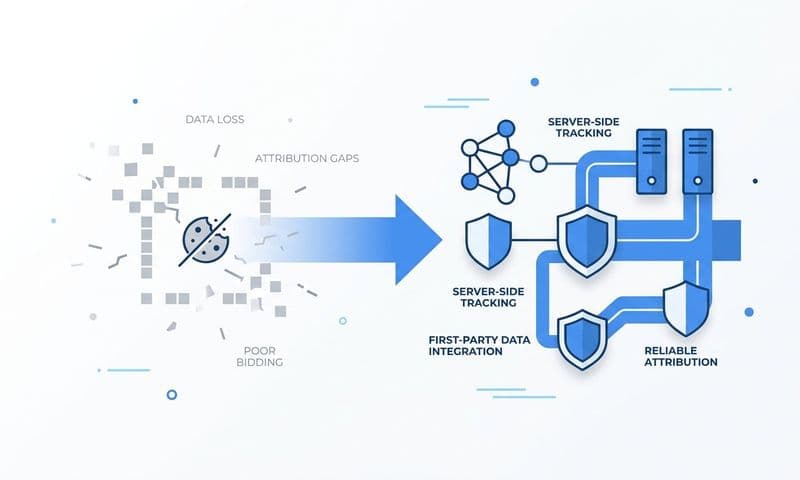
Browser-based pixels were the backbone of digital ad tracking for years. But that era is eroding. Apple's iOS App Tracking Transparency update significantly reduced the data Meta's pixel can capture from iPhone users. Ad blockers prevent pixels from firing on a meaningful portion of web traffic. Browser privacy restrictions continue to tighten, and the broader move away from third-party cookies is shrinking the accuracy of client-side tracking across the board. Understanding what a tracking pixel is and how it works helps clarify why these limitations matter so much.
The practical impact is this: if you rely solely on browser pixels, you are working with incomplete data. Conversions are being missed, attribution is off, and your ad platforms are optimizing based on a partial picture of reality.
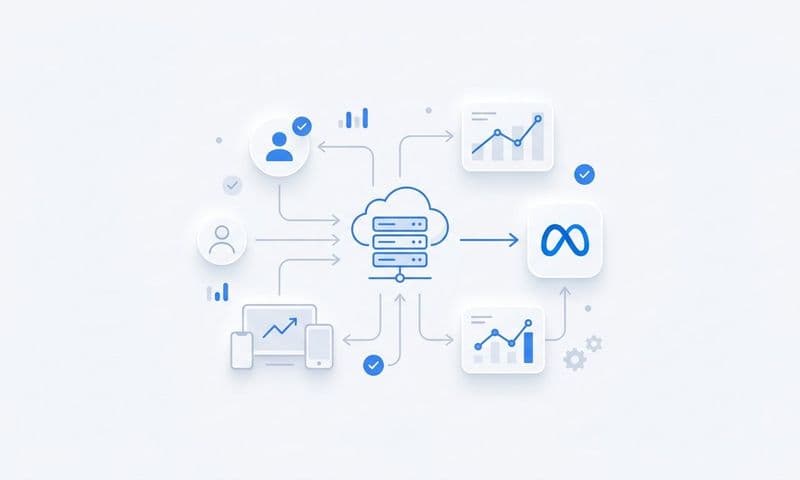
Server-side tracking solves this by sending conversion data directly from your server to the ad platforms, completely bypassing the browser. Because the data never has to travel through a user's browser, it is not affected by ad blockers, iOS restrictions, or cookie limitations.
For Google Ads, you can implement server-side tagging through Google Tag Manager's server container. This involves setting up a server container hosted on your own infrastructure (or a cloud provider), routing tag requests through it, and sending conversion data to Google from the server rather than the client. Pairing this with enhanced conversions in Google Ads further improves match rates and data accuracy.
For Meta, the solution is the Conversions API. The Conversions API sends conversion events from your server directly to Meta, supplementing or replacing pixel-based tracking. When implemented alongside the pixel with proper deduplication using a matching event ID, you get redundant coverage: the pixel captures what it can from the browser, and the Conversions API fills in the gaps from the server side.
This is where a platform like Cometly makes a real difference. Cometly's server-side tracking connects to both Google Ads and Facebook Ads simultaneously, capturing touchpoints that client-side pixels miss. Instead of configuring separate server-side solutions for each platform, Cometly handles the data pipeline and sends accurate, enriched conversion events to both platforms from a single integration. This means you get better data quality across both channels without having to manage two separate server-side setups.
Success indicator: Your conversion counts stabilize or increase after implementing server-side tracking, reflecting events that were previously being lost. The gap between platform-reported conversions and your CRM data begins to narrow.
Step 4: Connect Both Ad Platforms to a Unified Attribution Dashboard
Here is the core problem with relying on native dashboards: Google Ads and Facebook Ads each report performance from their own perspective, using their own attribution windows and logic. Google takes credit for every conversion where a Google ad was clicked within its attribution window. Meta does the same. Neither platform knows what the other is doing, and neither has visibility into your full customer journey.
The result is a fragmented, inflated view of performance. When you add up the conversions from both dashboards, the total almost always exceeds your actual revenue. This makes it nearly impossible to know which platform is genuinely driving results and which is getting credit it does not deserve. Building a proper attribution tracking setup is the key to solving this problem.
The solution is to connect both platforms to a unified attribution dashboard that sits outside of either platform's ecosystem. A neutral attribution layer can ingest data from Google Ads, Facebook Ads, your website, and your CRM, then map the complete customer journey without platform bias.
This is exactly what Cometly is built to do. Cometly pulls data from both ad platforms alongside your CRM and website activity to map every touchpoint from first click to closed deal. Instead of seeing two separate, competing dashboards, you see one unified view of how your campaigns are actually performing.
Within that unified view, multi-touch attribution models become especially powerful. Rather than assigning 100% of the credit to the last click (which almost always favors one platform over another), multi-touch models distribute credit across every touchpoint in the customer journey. This reveals how Google and Facebook actually work together in your funnel rather than treating them as competitors for the same conversion credit.
For example, you might discover that Facebook campaigns are consistently driving first-touch awareness, while Google Search ads are closing the deal at the bottom of the funnel. With last-click attribution, Google gets all the credit and Facebook looks like it is underperforming. With multi-touch attribution, you see that Facebook is essential to the journey even if it rarely gets the final click. Exploring Facebook Ads attribution in depth helps you understand how Meta's own models compare to a unified approach.
Understanding attribution models in depth is worth the investment of time. Different models, including first-touch, last-touch, linear, time decay, and data-driven, tell very different stories about your campaigns. Choosing the right model for your business depends on your sales cycle, funnel structure, and how you want to value different stages of the journey.
Success indicator: You have a single dashboard where you can compare true, deduplicated performance across Google Ads and Facebook Ads. Conversion totals align more closely with your CRM data, and you can see how each platform contributes at different stages of the funnel.
Step 5: Sync Enriched Conversion Data Back to Each Ad Platform
Most marketers think of tracking as a one-way street: data flows from the ad platform to your analytics. But there is a second direction that is just as important, and most teams overlook it. Sending accurate, enriched conversion data back to Google and Meta is one of the highest-leverage things you can do to improve campaign performance.
Here is why it matters. Both Google's Smart Bidding and Meta's Advantage+ campaigns rely on conversion signals to optimize targeting and bidding. The better the conversion data you feed them, the smarter their algorithms become. When you send back only pixel-tracked events, you are giving the algorithm an incomplete picture. When you send back verified, server-side conversions tied to real revenue, you give the algorithm something it can actually optimize toward. Leveraging AI-powered ads optimization takes this a step further by automating how these signals are used.
The practical impact is that your campaigns start bidding more efficiently. Google's Smart Bidding can optimize toward actual revenue rather than estimated conversion value. Meta's algorithm can identify the audience segments that are most likely to convert based on real purchase data rather than browser-based approximations.
Cometly's Conversion Sync feature is designed specifically for this purpose. It takes the verified, enriched conversion events that Cometly has captured through server-side tracking and sends them back to each ad platform in the format each platform expects. This closes the loop between your attribution data and your ad platform's optimization engine.
After setting up Conversion Sync, verify that the synced conversions are appearing correctly in each platform's conversion columns. In Google Ads, you should see imported conversions alongside your standard tracked conversions. In Meta Events Manager, you should see server events being received and matched to ad activity.
One thing to watch for: make sure your synced conversions are not being double-counted alongside your existing conversion tracking. Set up your conversion actions in Google Ads and Meta so that synced conversions are the primary signal, or clearly segment them to avoid adding phantom conversions on top of existing ones.
Success indicator: Your ad platform dashboards begin reporting conversion numbers that align more closely with your CRM revenue data. Over time, you should see improvements in campaign efficiency as the algorithms optimize based on higher-quality conversion signals.
Step 6: Analyze Cross-Platform Performance and Optimize Budget Allocation
With your unified tracking system in place, you now have something most marketing teams never achieve: a complete, accurate picture of how your ad spend is performing across both platforms. The question shifts from "what do the dashboards say?" to "what does the data actually tell us about where to invest?"
Start by comparing true ROAS and CPA across Google Ads and Facebook Ads using your unified attribution dashboard. Not the numbers each platform reports for itself, but the deduplicated, multi-touch numbers that reflect actual revenue contribution. Using a robust paid ads analytics approach ensures these figures are accurate and actionable rather than misleading.
Look specifically for assist conversions. An assist conversion happens when a campaign on one platform contributes to a conversion that is ultimately closed by another platform. This is extremely common in longer sales cycles where a prospect might click a Facebook ad, browse your site, see a Google retargeting ad a week later, and then convert through a branded search. In a last-click model, Google gets all the credit. In a multi-touch model, you see that Facebook initiated the journey.
Identifying these assist patterns changes how you think about budget allocation. Cutting a campaign because it shows low direct conversions might actually hurt overall performance if that campaign is consistently initiating journeys that other campaigns close.
Cometly's AI-powered features add another layer to this analysis. The AI can scan performance data across both platforms, identify high-performing campaigns and ad sets, and surface recommendations for where to scale and where to pull back. Instead of manually combing through data to find patterns, you get actionable suggestions based on what is actually driving revenue.
Use these insights to reallocate budget based on actual revenue contribution, not platform-reported vanity metrics. If your unified data shows that Google Search drives the majority of bottom-funnel conversions while Facebook drives top-of-funnel awareness at a low cost per engaged visitor, your budget split should reflect that dynamic. Understanding how to measure Facebook Ads ROI accurately is essential to making these allocation decisions with confidence.
Finally, establish a regular review cadence. Weekly or biweekly reviews of your unified dashboard keep you ahead of performance shifts and prevent you from making reactive decisions based on a single platform's data. Set up your review to include cross-platform ROAS, assist conversion patterns, and any AI recommendations that have surfaced since your last review.
Success indicator: You are making budget decisions based on unified attribution data rather than individual platform dashboards. Your overall campaign efficiency improves as you shift spend toward what is actually driving revenue across the complete customer journey.
Putting It All Together
Bringing Google Ads and Facebook Ads tracking together is not just a technical exercise. It is the foundation for making smarter budget decisions and scaling campaigns with confidence. When you can see the complete customer journey across both platforms, you stop guessing and start knowing.
Here is a quick checklist to confirm your setup is complete:
1. Both platforms have verified, working conversion tracking with no duplicate events.
2. UTM parameters follow a consistent naming convention across all campaigns on both platforms.
3. Server-side tracking is active to capture conversion data that browser pixels miss.
4. Both platforms feed into a single attribution dashboard for a unified, deduplicated view of performance.
5. Enriched conversion data syncs back to each platform to improve algorithm optimization and targeting.
6. You are reviewing cross-platform performance regularly and reallocating budget based on real revenue contribution.
With this system in place, you stop asking which platform deserves credit and start making decisions based on the complete picture. The double-counting problem disappears. The fragmented dashboards get replaced by a single source of truth. And your budget starts working harder because it is guided by accurate data.
Cometly brings all of this together in one platform. It connects your ad channels, website, and CRM so you always know what is actually driving revenue, captures the touchpoints that pixels miss, syncs enriched data back to your ad platforms, and gives your team AI-powered recommendations to scale what is working.
Ready to stop guessing and start scaling with confidence? Get your free demo today and see exactly how Cometly unifies your Google Ads and Facebook Ads tracking into one clear, actionable view.