
If your view through conversions are missing or showing zero in your ad platform reports, you are not alone. This is one of the most frustrating tracking gaps marketers face because it silently distorts your attribution data. You end up undervaluing display and video campaigns, misallocating budget, and making decisions based on incomplete information.
View through conversions measure users who saw your ad but did not click, then converted later. When these conversions disappear from your reports, you lose visibility into the full impact of your brand awareness and retargeting efforts.
The problem can stem from several places: incorrect attribution window settings, pixel misconfiguration, browser restrictions, third-party cookie deprecation, or how your ad platform is reporting conversions. Each of these causes looks different in your data, which is why a structured diagnostic approach matters more than guessing.
This guide walks you through exactly that. You will audit your current setup, fix the most common causes, and implement a more reliable tracking foundation using server-side methods and first-party data. Whether you are running campaigns on Meta, Google, or other ad platforms, the principles here apply across the board.
Let us get into the steps.
Step 1: Confirm Your Attribution Window Is Set Up Correctly
The single fastest fix for missing view through conversions is checking your attribution window settings. This is often the culprit, and it takes less than five minutes to verify.
An attribution window defines how long after an ad impression a conversion can still be credited to that ad. For view through conversions specifically, the window tracks users who saw your ad but never clicked, then completed a conversion action within that defined timeframe. Most platforms default to a one-day view through window, meaning if a user sees your ad on Monday and converts on Tuesday, that conversion counts. If the window is set to zero or disabled entirely, none of those conversions will appear in your reports.
In Meta Ads: Attribution windows are configured at the ad set level. Navigate to your ad set settings and look for the Attribution Setting option. You will typically see options like "7-day click and 1-day view" or "1-day click only." If your setting is click-only, view through conversions are completely excluded from your reported numbers. Switch to a setting that includes at least a 1-day view through window to start capturing impression-based conversions.
In Google Ads: View through conversion windows are managed at the account level. Go to Tools and Settings, then select Measurement and Conversions. Click into any conversion action and look for the View-Through Conversion Window setting. Google supports windows ranging from one day to thirty days. If this is set to a very short window or if view through conversions are excluded from your conversion columns, the data simply will not show up in your standard reports.
One common pitfall worth flagging: attribution windows can silently reset when you duplicate campaigns or create new ad sets. If you recently restructured your campaigns and view through conversions disappeared around the same time, this is almost certainly the cause. Always verify window settings after any campaign duplication.
Another thing to check is whether your reporting date range aligns with your attribution window. If you set a one-day view through window but you are analyzing a campaign that ran two weeks ago, the conversions may have already fallen outside the reporting window you are looking at.
Success indicator: Your view through conversion window is set to at least one day and your reporting period overlaps with when your campaigns were running. Once this is confirmed, move to the next step.
Step 2: Audit Your Pixel and Tag Installation
If your attribution windows are configured correctly and view through conversions are still missing, the next place to look is your pixel health. A broken or misfiring pixel is one of the most common reasons view through conversions go missing, and it is easy to overlook because your other metrics may look fine on the surface.
The pixel is responsible for detecting when a conversion happens on your website and sending that signal back to the ad platform. If the pixel is not firing on the right pages, or firing inconsistently, the platform cannot connect the impression to the eventual conversion. The result is a gap in your view through data.
Use platform-native diagnostic tools first. Meta offers the Meta Pixel Helper as a Chrome browser extension. Install it, visit your conversion pages, and watch whether the pixel fires correctly. You will see which events are triggered, whether there are errors, and whether the pixel ID matches what is in your ad account. Google offers Tag Assistant, which works similarly for Google Ads tags and Google Analytics. These tools give you a real-time view of what is actually firing on your pages.
Check every conversion page, not just the homepage. A common mistake is verifying the pixel on the homepage and assuming everything is fine. Your view through conversions depend on the pixel firing on your actual conversion pages: thank-you pages, demo confirmation pages, sign-up confirmations, or wherever your key conversion events happen. If the pixel is missing from any of these pages, those conversions will not be tracked.
Look for duplicate pixel installations. If your pixel code was added multiple times, either through a tag manager and also hardcoded in the page template, you may be firing duplicate events. This triggers deduplication logic in Meta and Google, which can cause some conversions to be discarded entirely. Your reported numbers end up lower than reality, which looks exactly like missing view through conversions.
Verify event mapping in your ad account. Even if the pixel fires correctly, the conversion event needs to be mapped to the right action in your ad account settings. In Meta Events Manager, check that your Purchase, Lead, or custom conversion events are active and receiving data. In Google Ads, verify that your conversion actions are linked to the correct tag triggers in Google Tag Manager.
Slow page loads and ad blockers can also interfere with pixel firing. If a significant portion of your audience uses ad blockers or privacy-focused browsers, client-side pixel tracking will miss their conversions entirely. This connects directly to the next step.
Success indicator: Your pixel fires consistently on all conversion pages with no errors in the diagnostic tools, no duplicate events, and conversion actions are correctly mapped in your ad account.
Step 3: Check for Browser and Cookie Restrictions Blocking Tracking
Even with a perfectly installed pixel and correct attribution windows, you may still see view through conversions missing. The reason is increasingly common: browser-level restrictions are blocking the third-party cookies that ad platforms rely on for impression-based tracking.
Safari's Intelligent Tracking Prevention (ITP) and Firefox's Enhanced Tracking Protection (ETP) both restrict or block third-party cookies by default. These cookies are how ad platforms identify that a specific user saw your ad and then later visited your website to convert. When those cookies are blocked, the platform cannot make that connection, and the view through conversion is never recorded.
This is not a niche problem. Safari consistently accounts for a significant share of web traffic, particularly on mobile devices and among certain demographic groups. If your audience skews toward Apple device users, the impact on your view through conversion data can be substantial.
The broader trend here is third-party cookie deprecation. Browser vendors have been steadily reducing reliance on third-party cookies for years, and this trajectory is not reversing. Client-side pixel tracking alone is increasingly unreliable for capturing the full picture of your conversions, view through or otherwise.
How to identify if this is affecting your data: Go into your analytics platform and segment your traffic by browser. Compare conversion rates across Safari, Firefox, and Chrome users. If you see significantly lower conversion rates or missing attribution data for Safari and Firefox visitors, browser restrictions are likely suppressing your view through conversions for those users. The gap between what your pixel reports and what your CRM records is another strong signal.
The solution to this problem is not to fix the pixel. The pixel is working as designed. The problem is that the browser is preventing the cookie from being set in the first place. That requires a different approach entirely: server-side tracking.
Understanding this distinction matters because many marketers spend time troubleshooting their pixel when the real issue is architectural. The pixel cannot solve a browser restriction problem. Server-side tracking can.
Success indicator: You can identify what percentage of your traffic comes from browsers with tracking restrictions and you have a clear picture of the data gap this creates in your view through conversion reporting.
Step 4: Implement Server-Side Tracking and Conversion API
Server-side tracking is the most durable fix for view through conversions that browser restrictions are blocking. Instead of relying on a browser-based pixel to fire and set a cookie, server-side tracking sends conversion data directly from your server to the ad platform. Browser restrictions cannot interfere with server-to-server communication.
Meta's implementation of this is called the Conversions API (CAPI). Google's equivalent is Enhanced Conversions. Both work on the same principle: when a conversion happens, your server sends the event data directly to the platform, enriched with first-party identifiers like hashed email addresses, phone numbers, or customer IDs. The platform uses these identifiers to match the conversion back to the user who saw your ad, restoring the view through attribution that browser restrictions would otherwise block.
Setting up Meta Conversions API: At a conceptual level, you need to configure your server or tag management system to send conversion events to Meta's API endpoint when key actions occur on your site or in your CRM. The Meta Conversions API provides a setup guide in Events Manager. The key data points to send are event name, event time, user data (hashed), and your pixel ID. The richer the user data you can send, the higher your event match quality score will be.
Setting up Google Enhanced Conversions: Google Enhanced Conversions work by supplementing your existing Google tag with first-party user data. When a user converts, you send hashed customer data alongside the conversion event. Google uses this to improve attribution accuracy, including for view through conversions where cookie-based matching would otherwise fail.
Event deduplication is essential. If you run both a client-side pixel and server-side CAPI simultaneously (which is the recommended approach for maximum coverage), you must implement deduplication. Both the pixel and CAPI may fire for the same conversion event. Without deduplication, the platform counts it twice. You avoid this by including a unique event ID in both the pixel event and the CAPI event. The platform uses this ID to recognize and discard the duplicate.
First-party data improves match rates. The more accurately the platform can match your server-sent conversion to a known user, the more likely that view through touchpoints are correctly attributed. This is where first-party data collected through your own forms, sign-ups, and CRM becomes a competitive advantage.
Platforms like Cometly handle server-side event sending natively. Rather than manually configuring CAPI endpoints and managing deduplication logic yourself, Cometly connects your ad platforms, website, and CRM and handles the server-side transmission automatically. This removes significant technical overhead and ensures your view through conversion data flows reliably without ongoing maintenance.
Success indicator: Your event match quality score improves in Meta Events Manager and view through conversions begin populating more consistently across your campaigns.
Step 5: Cross-Reference Data Across Attribution Models
Here is something that trips up a lot of marketers: view through conversions may not actually be missing from your data. They may simply be hidden by the attribution model you are currently using to view your reports.
Attribution models determine how credit for a conversion is assigned across the touchpoints in a customer's journey. Last click attribution, which is the default in many platforms, assigns 100% of the conversion credit to the final click before conversion. In this model, view through touchpoints (impressions without a click) receive zero credit and do not appear in your reported conversion numbers. If you are looking at last click reports and wondering where your view through conversions went, this is likely the answer.
How to switch attribution models in Meta Ads: In Meta Ads Manager, go to your campaign reports and look for the Columns dropdown. Select Customize Columns and then look for the Attribution Setting comparison options. Meta also allows you to compare attribution windows side by side, so you can see what your numbers look like under different window configurations, including those that include view through.
How to switch attribution models in Google Ads: In Google Ads, navigate to Tools and Settings, then Attribution under Measurement. Here you can view the Model Comparison report, which shows how different attribution models distribute conversion credit across your touchpoints. Switching from Last Click to Data-Driven or Linear attribution will surface impression-based touchpoints that last click ignores.
Understanding the key differences:
Last Click: All credit goes to the final click. View through touchpoints receive no credit. This is the most common default but the least accurate for understanding brand awareness campaigns.
Linear: Credit is distributed equally across all touchpoints in the conversion path, including impressions. View through conversions appear in this model.
Data-Driven: Uses machine learning to assign credit based on which touchpoints actually influenced the conversion. This model handles view through conversions most sophisticatedly, but requires sufficient conversion volume to function.
Comparing attribution models side by side is one of the fastest ways to determine whether your view through conversions are truly missing from the data or simply invisible under your current model selection. If they appear when you switch models, the tracking is working. The issue is purely a reporting configuration.
Success indicator: You can see view through conversions appear in your reports when switching to an attribution model that includes impression-based touchpoints, confirming the data exists and the tracking is functioning.
Step 6: Build a Unified Attribution View to Catch Future Gaps
You have audited your attribution windows, verified your pixel, addressed browser restrictions with server-side tracking, and confirmed your attribution model settings. At this point, most missing view through conversion issues will be resolved. But there is a deeper problem worth addressing: relying solely on ad platform native reporting means you will always be working with incomplete data.
Each ad platform reports conversions in a way that favors itself. Meta will claim credit for conversions that Google also claims. Neither platform shows you what happened in your CRM after the initial conversion. And neither gives you a clear picture of how view through impressions from one platform contributed to a conversion that was eventually attributed to a click on another. This overlap and fragmentation is why marketers consistently feel like their view through data does not add up.
A centralized attribution platform solves this by connecting your ad platform data, CRM events, and website behavior into a single source of truth. Instead of reconciling reports across five different dashboards, you see the complete customer journey in one place, including every impression, click, and CRM event that preceded the conversion.
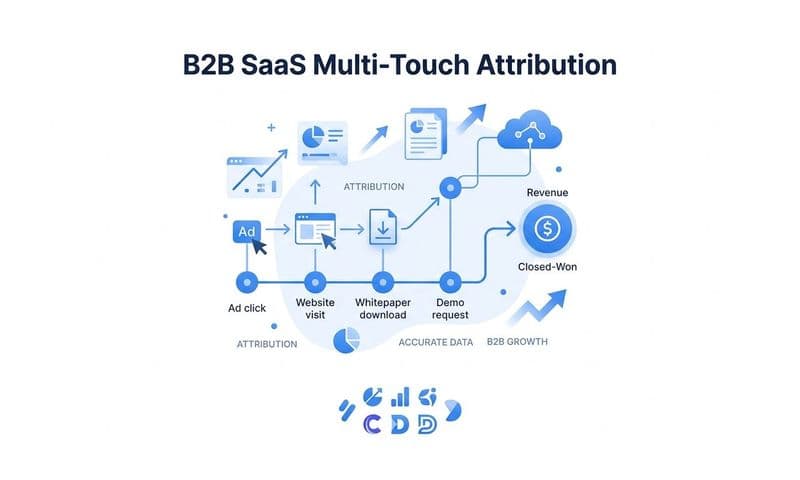
Multi-touch attribution is the methodology that makes this possible. Rather than crediting a single touchpoint, multi-touch attribution distributes credit across all the interactions that contributed to a conversion. This surfaces view through touchpoints that platform-native reporting consistently underreports, giving you a more accurate picture of how your display and video campaigns are actually performing.
Cometly is built specifically for this use case. It connects your ad spend data from Meta, Google, and other platforms with your CRM and website events, then maps every touchpoint across the customer journey to pipeline and revenue outcomes. You can see which impressions contributed to conversions, how view through touchpoints fit into longer B2B sales cycles, and which campaigns are driving actual revenue rather than just surface-level metrics.
For B2B SaaS companies where sales cycles can span weeks or months and multiple stakeholders interact with your ads before a deal closes, this level of visibility is not optional. It is the difference between scaling the campaigns that drive revenue and cutting the ones that actually do.
Success indicator: You have a single dashboard showing all touchpoints including impressions, with revenue outcomes attached, so future gaps in view through conversion data are immediately visible and diagnosable.
Your View Through Conversion Fix Checklist
Missing view through conversions are almost always a technical or configuration issue, not a performance issue. Your campaigns may be working better than your data suggests. Here is a quick reference checklist to work through:
1. Attribution window audit: Verify that your view through attribution window is set to at least one day in Meta Ads at the ad set level and in Google Ads under conversion action settings. Check that windows were not reset after recent campaign duplication.
2. Pixel health check: Use Meta Pixel Helper and Google Tag Assistant to confirm your pixel fires correctly on all conversion pages. Remove duplicate installations and verify event mapping in your ad account.
3. Browser restriction assessment: Segment your analytics data by browser to identify the gap created by Safari ITP and Firefox ETP. Understand what percentage of your traffic is affected.
4. Server-side tracking implementation: Set up Meta Conversions API and Google Enhanced Conversions to restore view through data that browser restrictions block. Implement event deduplication when running pixel and CAPI simultaneously.
5. Attribution model review: Switch from last click to a model that includes impression-based attribution to confirm whether view through conversions exist in your data but are hidden by model selection.
6. Unified attribution platform: Connect your ad platforms, CRM, and website data into a single attribution view so future gaps are immediately visible.
Start with the attribution window audit since it is the fastest fix. Then work through pixel health, browser restrictions, and server-side tracking in order. Each step builds on the previous one.
If you want a platform that handles multi-touch attribution, server-side tracking, and revenue attribution in one place so you never have to guess which touchpoints are driving conversions, Get your free demo of Cometly today and start capturing every touchpoint that matters.