
If you've ever looked at your ad platform dashboards and felt like something didn't add up, you're not imagining it. Conversion numbers seem lower than they should be. Your automated bidding strategies feel sluggish. Budget decisions are getting harder to justify because the data underneath them keeps getting less reliable.
This is the reality of modern marketing, and it has a root cause: the tracking infrastructure most teams still rely on is quietly falling apart. Browser-based tracking, the kind that fires JavaScript tags directly in a visitor's browser, was built for a different internet. One without widespread ad blockers, aggressive privacy settings, or browser-level cookie restrictions that strip data before it ever reaches your analytics tools.
Server side tagging has emerged as the architecture that fixes this. It shifts tracking logic off the browser and onto your own server, creating a more reliable, controllable, and privacy-resilient data pipeline. For B2B SaaS marketing teams trying to understand what is actually driving pipeline and revenue, this shift is not a nice-to-have. It is becoming a foundational requirement for accurate attribution.
This article breaks down what server side tagging is, how it works, why it differs from traditional client-side tracking, and why it matters so much for the kind of complex, multi-touch buyer journeys that define B2B SaaS marketing.
Why Client-Side Tracking Is Losing the Battle
Traditional tracking works like this: a visitor lands on your website, their browser downloads your page, and a collection of JavaScript tags fires in the background. Those tags send event data to Google Analytics, Meta, your CRM tool, and anywhere else you've pointed them. It sounds straightforward, and for years it worked well enough.
The problem is that this entire process depends on the browser cooperating. And increasingly, browsers are not cooperating.
Safari's Intelligent Tracking Prevention actively limits how third-party cookies function and restricts certain JavaScript behaviors that tracking tags rely on. Firefox's Enhanced Tracking Protection takes a similar stance. These are not fringe browsers used by a small slice of your audience. They represent a substantial portion of web traffic, and among the technical, privacy-conscious buyers that B2B SaaS companies often target, browser-level privacy protections are even more common.
Then there are ad blockers. Browser extensions like uBlock Origin and similar tools are widely installed among professional and developer audiences, which are exactly the kinds of people evaluating B2B software. When an ad blocker is active, it can silently prevent tracking scripts from loading at all. Your tag fires, or rather, it tries to fire, and nothing reaches your analytics platform or ad network.
Third-party cookies are the other piece of this puzzle. Client-side tracking has long depended on these cookies to identify users across sessions and pass conversion signals back to platforms like Meta and Google. As browser support for third-party cookies continues to erode, that data pipeline becomes increasingly unreliable.
The downstream consequences are real and compounding. When conversions go unreported, your ad platforms see a distorted picture of campaign performance. Automated bidding algorithms, which rely on conversion signals to optimize spend, start making decisions based on incomplete data. You end up underfunding campaigns that are actually driving revenue and overfunding ones that look better than they are. Attribution models reflect this same distortion, making it harder to understand what is genuinely working.
This is not a minor data quality issue. It is a structural problem with how tracking is built, and it gets worse as privacy restrictions continue to tighten.
How Server Side Tagging Actually Works
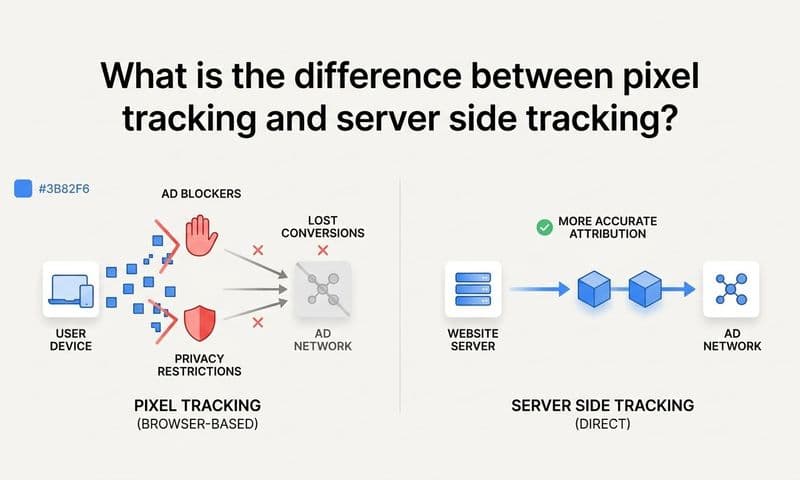
Server side tagging solves the browser problem by moving tracking logic off the browser entirely. Instead of firing tags directly in the visitor's browser, the browser sends a single event to your own server or a cloud-hosted tagging server. That server then processes the event and forwards the data to your ad platforms, analytics tools, and any other destinations you've configured.
Think of it like a relay system. The browser's job becomes simple: send one signal to your server. Everything else, the routing, the transformation, the distribution to multiple platforms, happens server-side, away from browser extensions and privacy restrictions.
Because the tracking logic lives on your infrastructure rather than in the user's browser, it cannot be intercepted by ad blockers. Browser privacy settings that restrict JavaScript behavior or third-party cookie access have no effect on what happens between your server and Meta's API. The data moves through a direct, server-to-server channel.
The tagging server also acts as a transformation layer, not just a relay. When raw event data arrives, you can enrich it before it gets sent anywhere. This is where first-party data becomes powerful. You can append CRM fields, user identifiers, or hashed customer attributes like email addresses and phone numbers to the event before forwarding it to your ad platforms. This enriched data dramatically improves match rates, which is the ad platform's ability to tie your conversion events back to real user profiles in their systems.
A practical example helps here. Imagine a user fills out a demo request form on your site. With client-side tracking, the browser fires a conversion event, but if the user has an ad blocker installed, the event never reaches Meta or Google. With server side tagging, the form submission triggers an event sent to your tagging server. Your server receives it, enriches it with the user's hashed email from your CRM, and forwards a clean, structured conversion event directly to Meta's Conversion API. The browser extension never had a chance to interfere.
This architecture also reduces the number of third-party scripts loading in the browser. Instead of each ad platform loading its own JavaScript, your browser-side code becomes leaner. That has a secondary benefit we will cover shortly: improved page performance.
Server Side vs. Client-Side Tagging: What Actually Changes
Understanding the difference between these two approaches comes down to three dimensions: data reliability, data control, and page performance. Each one has meaningful implications for how well your tracking actually works.
Data Reliability: This is the most significant gap between the two approaches. Client-side tags are vulnerable to ad blockers, browser privacy settings, and the ongoing deprecation of third-party cookies. Any of these can silently drop conversion events without you ever knowing. Server side tags are more accurate, sent directly from your server to the ad platform through a channel that browser-level restrictions cannot touch. The result is a more complete and consistent data stream reaching your attribution systems and ad platforms.
Data Control and Enrichment: With client-side tracking, you are largely at the mercy of what the browser can capture and what the tag vendor allows. With server side tagging, you control the entire data pipeline. You decide what gets collected, how it gets transformed, and what gets sent to each destination. You can filter out bot traffic before it reaches your analytics. You can append first-party identifiers that improve audience match rates. You can standardize event schemas so data arrives clean and structured at every destination. This level of control is simply not possible when tracking logic lives in the browser.
Page Load Performance: Every third-party JavaScript tag that loads in the browser adds weight to your page. Multiple ad platform pixels, analytics libraries, and tag management scripts can meaningfully slow down load times. Server side tagging reduces the number of scripts that need to execute in the browser, because the heavy lifting moves to the server. Faster pages have well-documented benefits for conversion rates and for ad Quality Scores on platforms like Google Ads, so this is not just a technical improvement. It has commercial implications.
The fundamental shift is one of control. Client-side tracking is something that happens in someone else's environment, the user's browser, with all the unpredictability that comes with it. Server side tagging brings that process into your own infrastructure, where you can ensure it runs reliably every time.
Why B2B SaaS Attribution Depends on This
B2B SaaS buyer journeys are not simple. A prospective customer might encounter your brand through a LinkedIn ad, return weeks later via an organic search, attend a webinar, click a retargeting ad, and finally convert on a demo request form after a sales follow-up. That journey can span multiple sessions, multiple devices, and multiple months.
Every missed touchpoint in that journey creates a gap in your attribution model. If a conversion event is dropped because the user had an ad blocker active during a key session, your model loses the thread. It cannot accurately credit the channels and campaigns that contributed to the eventual conversion. Over time, these gaps compound into a systematically distorted view of what is driving revenue. Understanding lead attribution becomes nearly impossible when tracking gaps are this pervasive.
Server side tagging helps close those gaps by capturing events that client-side tracking would have silently missed. When your tracking is more complete, your attribution models have better data to work with, and the picture they produce is closer to reality.
There is also a direct connection to ad platform performance. Meta and Google use the conversion events you send them as training signals for their machine learning algorithms. These algorithms drive automated bidding strategies like Target CPA and Target ROAS. When conversion signals are incomplete or inconsistent, the algorithms learn from flawed data and make suboptimal decisions. They may underbid on audiences that are actually converting well, or overspend on segments that look strong only because tracking gaps are creating a misleading signal.
Sending enriched, server-side conversion events directly feeds these algorithms with better signal. More complete data leads to smarter bidding, more accurate audience targeting, and improved return on ad spend. This is not a marginal improvement. For teams running significant ad budgets, the difference between well-optimized and poorly-optimized automated bidding can be substantial.
For B2B SaaS teams specifically, there is another layer: connecting ad data to pipeline and revenue. The conversion events captured through server side tagging can be matched to downstream CRM data, linking an ad click to a closed-won deal weeks or months later. This is the foundation of lead-to-revenue attribution, and it requires the conversion signal to be reliable enough to serve as the anchor point for that connection.
Server Side Tagging and the Conversion API Connection
Server side tagging does not operate in isolation. It works in conjunction with the server-to-server integration points that ad platforms have built specifically to receive this kind of data. For most B2B SaaS marketers, the two most important ones are Meta's Conversion API and Google's Enhanced Conversions.
Meta's Conversion API, often called Meta CAPI, accepts conversion event data sent directly from your server to Meta's systems. It bypasses the browser entirely, which means events arrive regardless of what is happening on the user's device. Understanding the difference between Meta browser events vs Meta server events is essential for implementing this correctly. Google's Enhanced Conversions work similarly, allowing you to send hashed first-party data alongside your conversion events to improve match accuracy and fill gaps left by cookie restrictions.
The recommended approach is not to replace your existing browser-side pixel or tag with server side events, but to run both simultaneously as a redundant layer. This hybrid model captures events from two directions: the browser fires when it can, and the server fires as a reliable backup. Deduplication logic built into the ad platforms ensures that if both the browser and server capture the same event, it is only counted once. You get improved data completeness without inflating your conversion counts.
This redundancy is important because no single tracking method is perfect. Browser-side tags still capture events that your server might miss in certain edge cases. Running both in parallel, with proper deduplication, gives you the most complete picture possible.
Server side tagging also enables you to send richer event data than a browser pixel can typically capture on its own. Hashed customer emails, phone numbers, and custom parameters can be appended at the server level, pulling from your CRM or first-party data store. These additional identifiers improve match rates, which is the ad platform's ability to connect your conversion event to a real user profile in their system. Higher match rates mean the conversion data you send has more impact on audience targeting and bidding optimization.
Building a Tracking Foundation That Actually Holds
Server side tagging is a critical component of modern tracking, but it works best as part of a broader first-party data strategy rather than as a standalone fix. The goal is to build a tracking foundation where every layer reinforces the others: browser-side events for immediacy, server-side events for reliability, and a unified attribution platform that brings the data together into a coherent view.
For B2B SaaS teams, the end goal is a complete picture of the customer journey from first ad click through to closed-won revenue. Server side tagging ensures the conversion signals feeding into that picture are reliable and enriched. But those signals still need to be connected to CRM data, pipeline stages, and revenue outcomes to tell the full story. Learning how to set up server side tracking correctly is the critical first step toward building that foundation.
This is where an attribution platform becomes essential. Without a system that connects ad platform data, website behavior, and CRM events into a single source of truth, you end up with reliable individual data points that still do not add up to a coherent view of what is driving revenue. The tracking infrastructure and the attribution layer need to work together.
Cometly is built for exactly this. It connects your ad platforms, CRM data, and server-side conversion events into one unified attribution view, giving marketing teams the accurate, enriched data they need to understand which channels and campaigns are genuinely driving pipeline and revenue. From first ad click to closed-won deal, every touchpoint is captured and connected, so budget decisions are grounded in reality rather than incomplete data.
The Bottom Line on Server Side Tagging
The shift from client-side to server side tagging is not a trend. It is a necessary response to a tracking environment that has fundamentally changed. Browser privacy restrictions are not going away. Ad blocker adoption is not reversing. Third-party cookie support continues to narrow. Teams that keep relying on browser-based tracking alone are building their attribution on an increasingly shaky foundation.
Server side tagging restores the reliability that client-side tracking has lost. It gives marketing teams control over their data pipeline, improves the quality of conversion signals reaching ad platforms, and enables the kind of first-party data enrichment that makes attribution models genuinely useful.
For B2B SaaS companies, where buyer journeys are long, budgets are significant, and the pressure to demonstrate marketing ROI is constant, accurate attribution is not optional. Every missed conversion event is a gap in your understanding of what is working. Server side tagging closes those gaps.
Better data leads to better ad platform optimization. Better optimization leads to smarter budget allocation. Smarter budget allocation leads to clearer revenue attribution. That chain of value starts with getting your tracking right.
Ready to elevate your marketing game with precision and confidence? Discover how Cometly's AI-driven recommendations can transform your ad strategy. Get your free demo today and start capturing every touchpoint to maximize your conversions.