
You're running paid ads, generating leads, booking demos, and closing deals. The pipeline looks healthy. But when your CFO asks which campaigns actually drove closed revenue last quarter, you're left piecing together spreadsheets, gut feelings, and incomplete data. Sound familiar?
This is one of the most common frustrations in B2B SaaS marketing. The tools that track your ads measure clicks and form fills. Your CRM tracks deals and revenue. But the connection between those two worlds is often missing entirely, leaving marketing teams unable to prove which campaigns actually contributed to closed won opportunities.
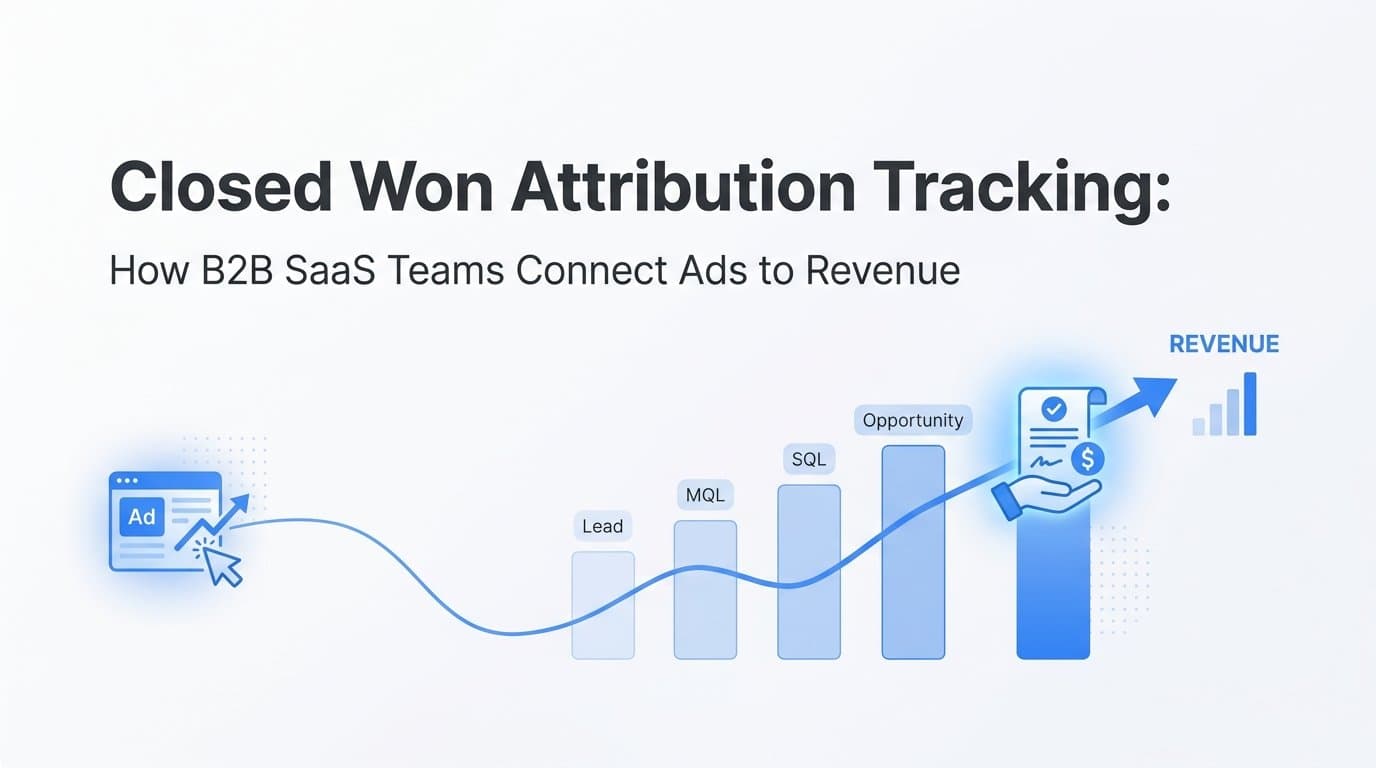
Closed won attribution tracking solves this problem. It bridges the gap between CRM deal stages and ad platform data, giving marketing and revenue teams a clear line of sight from the first ad impression to the signed contract. Instead of optimizing toward leads that may never convert, you optimize toward revenue that already has.
This article breaks down exactly how closed won attribution tracking works, how to implement it, and how to use it to make smarter budget decisions. Whether you're a marketing leader managing a significant ad budget or a growth operator trying to build a more accountable attribution system, this is the practical foundation you need.
Why Lead-Level Tracking Gives You the Wrong Answers
Most B2B marketing teams measure success at the top of the funnel. A campaign generates impressions, those impressions drive clicks, clicks drive form fills, and form fills become MQLs. The dashboard looks great. The CPL is low. The volume is high. But here's the problem: none of that tells you whether those leads actually turned into revenue.
The disconnect between lead-level tracking and revenue-level tracking is one of the most widely recognized challenges in B2B marketing. A channel can produce a high volume of leads while simultaneously delivering a low close rate, long sales cycles, and poor contract values. When you only measure at the MQL stage, you can't see any of that.
Consider what happens when a marketing team invests heavily in a channel because it produces the most leads. Without visibility into what happens downstream, they have no way of knowing whether those leads are converting into paying customers or churning out of the sales process. Meanwhile, a different channel might produce fewer leads but a much stronger close rate and higher average contract value. Without closed won attribution, that channel looks underperforming on paper even though it's the one actually driving revenue.
The B2B sales cycle compounds this problem. Unlike B2C transactions that happen in minutes, B2B deals often take weeks or months to close and involve multiple stakeholders. The channel that generated the initial lead may be completely different from the touchpoints that kept the opportunity warm during the evaluation phase or pushed the final decision over the line.
When attribution stops at the lead stage, marketing teams make budget decisions based on incomplete information. They over-invest in channels that produce volume but low-quality pipeline. They under-invest in channels that produce fewer but more valuable opportunities. They optimize ad campaigns toward audiences that fill out forms but rarely become customers. Every one of these decisions costs money and compounds over time.
The fix is not a better lead scoring model or a more sophisticated MQL definition. The fix is tracking further down the funnel, all the way to closed won, so that revenue becomes the signal your marketing decisions are built on.
Closed Won Attribution Tracking: A Clear Definition
Closed won attribution tracking is the practice of connecting a deal marked as closed won in your CRM back to every marketing touchpoint that influenced it, from the first ad click to the last nurture email before the contract was signed.
The concept sounds straightforward, but the implementation requires connecting systems that don't naturally talk to each other. Your ad platforms know about clicks and impressions. Your CRM knows about contacts, opportunities, and deal stages. Your marketing automation platform knows about email opens and content downloads. Closed won attribution tracking creates a unified layer that links all of these data points together and evaluates them in the context of actual revenue.
The key difference between standard conversion tracking and closed won attribution tracking is the data source and the trigger event. Standard conversion tracking fires when a user submits a form, books a demo, or completes a purchase on your website. These events are captured by browser-based pixels or tags and reported back to the ad platform in near real time.
Closed won attribution tracking fires when a deal stage changes in your CRM. When a sales rep marks an opportunity as closed won in Salesforce or HubSpot, that event triggers your attribution system to pull the associated deal value, map it back to the contact's touchpoint history, and distribute credit across the campaigns and channels that influenced the journey. The conversion signal is not a form fill. It is a signed contract.
This distinction matters enormously for how ad platforms optimize. When you feed form submission events to Google or Meta, their algorithms learn to find more people who fill out forms. When you feed closed won events with actual contract values, their algorithms learn to find more people who become paying customers. That is a fundamentally different optimization target, and it produces fundamentally different results.
Closed won attribution tracking also enables a different kind of reporting. Instead of asking "which campaign generated the most leads?", you can ask "which campaign generated the most revenue?" and "what was the true cost per closed deal for each channel?" Those are the questions that drive serious budget decisions.
How the Data Flows from Ad Click to CRM Close
Understanding the mechanics of closed won attribution tracking helps you build it correctly and troubleshoot it when something breaks. The data flow has several distinct stages, and each one needs to work reliably for the full picture to come together.
Stage 1: Capturing the Ad Click. The tracking chain starts the moment a prospect clicks on an ad. UTM parameters appended to the destination URL capture the source, medium, campaign, ad group, and creative that drove the click. At the same time, first-party identifiers such as cookies or user IDs are set in the browser to associate that click with a specific session and, eventually, a specific person.
Stage 2: Tracking the Touchpoint Journey. As the prospect moves through your funnel, each interaction is recorded. A visit to your pricing page, a content download, a webinar registration, a demo booking. Each of these touchpoints is logged and associated with the contact record in your CRM. Over the course of a multi-week or multi-month sales cycle, this builds a detailed journey map that shows every channel and campaign that touched the opportunity.
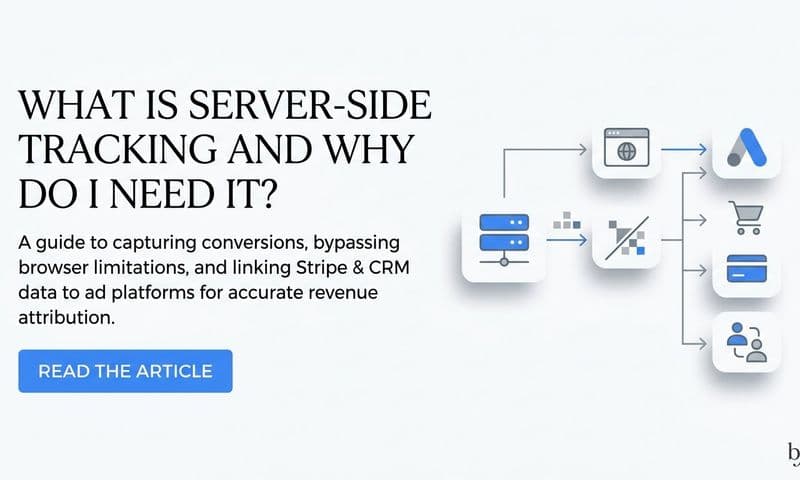
Stage 3: Firing the Closed Won Event. When the deal is marked closed won in your CRM, your attribution platform listens for that stage change event. This is where server-side tracking becomes essential. Because the closed won event originates in your CRM rather than a browser, traditional pixel-based tracking cannot capture it. A server-to-server connection reads the CRM event, pulls the associated deal value and contact data, and passes it to the attribution layer.
Stage 4: Distributing Attribution Credit. With the closed won event recorded and the deal value confirmed, your attribution platform maps the revenue back to every touchpoint in the journey. Credit is distributed across channels, campaigns, and creatives according to your chosen attribution model. The result is a revenue-weighted view of which marketing investments actually drove the deal.
This four-stage flow requires careful setup, but once it is running reliably, it transforms the quality of data available to your marketing team. Every budget decision can be grounded in actual closed revenue rather than proxy metrics that may or may not correlate with it.
Choosing the Right Attribution Model for Revenue Data
Once you have closed won data flowing into your attribution system, you need to decide how to distribute credit across the touchpoints in each deal's journey. Different attribution models answer different questions, and the right choice depends on what you are trying to learn and optimize.
First Touch Attribution gives 100% of the credit to the channel or campaign that originally generated the lead. This model is useful for understanding which top-of-funnel sources are bringing new prospects into your pipeline. If you want to know which channels are most effective at creating awareness and generating net-new demand, first touch attribution gives you a clear signal. The limitation is that it ignores everything that happened after the initial touchpoint, which in a long B2B sales cycle can be a significant blind spot.
Last Touch Attribution gives all the credit to the final touchpoint before the deal closed. This model tends to favor bottom-of-funnel activities like sales outreach or retargeting campaigns and can make it look like top-of-funnel demand generation had no impact. For most B2B teams, last touch attribution alone is too narrow to be useful for budget decisions.
Linear and Time Decay Models distribute credit across all touchpoints in the journey. Linear attribution gives equal weight to every interaction. Time decay attribution gives more weight to touchpoints that occurred closer to the close date, on the premise that later interactions had more influence on the final decision. Both models are generally more representative of the complex, multi-channel nature of B2B buying decisions and are a solid starting point for teams new to multi-touch attribution.
Data-Driven Attribution uses patterns across all of your closed won deals to algorithmically assign credit based on which touchpoints statistically correlate with revenue. Rather than applying a fixed rule to every deal, data-driven attribution learns from your actual customer data and adjusts credit dynamically. This is the most accurate model for teams with sufficient data volume, and it tends to surface insights that rule-based models miss entirely.
For most B2B SaaS teams, the practical recommendation is to start with a linear or time decay model to establish a baseline, then graduate to data-driven attribution as your closed won data set grows.
Implementation Challenges and How to Address Them
Closed won attribution tracking is not a plug-and-play setup. There are real technical and organizational challenges that need to be anticipated and solved. The teams that implement it successfully are the ones who understand these challenges before they encounter them.
Identity Resolution. The most fundamental challenge is connecting an anonymous ad click to a named contact in your CRM. When someone clicks your ad, they are initially anonymous. When they fill out a form, they become identifiable. But linking the pre-form anonymous session to the post-form contact record requires consistent use of first-party identifiers and a reliable mechanism for passing those identifiers into your CRM at the point of conversion.
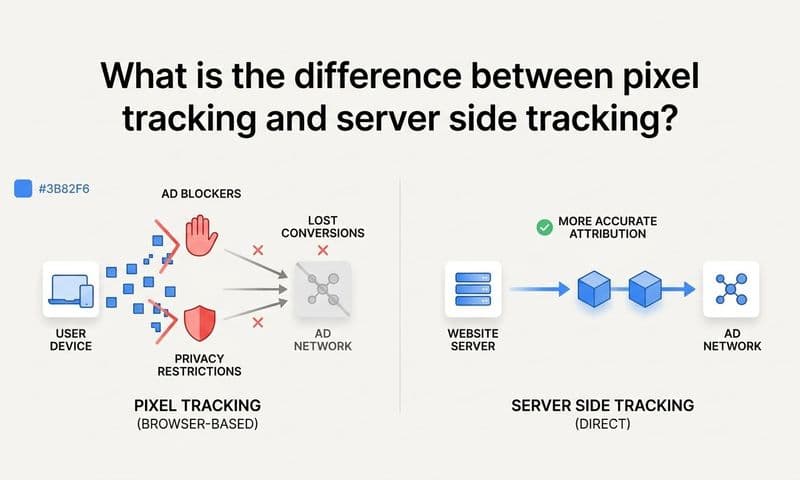
Server-side tracking is increasingly important here because browser restrictions and ad blockers degrade the reliability of client-side pixels. A server-side tracking setup captures the identifying data at the point of form submission and passes it directly to your attribution layer without depending on browser behavior. This reduces data loss and improves the accuracy of your touchpoint records.
Attribution Window Mismatches. Ad platforms like Google and Meta default to attribution windows of 7 or 28 days. For many B2B sales cycles, which can span 60, 90, or even 180 days, these windows expire long before a deal closes. This means ad platforms routinely undercount their contribution to closed revenue because the attribution window has already closed by the time the deal does.
The solution is to use an attribution platform that operates independently of ad platform windows. Rather than relying on the ad platform's own attribution logic, you maintain a complete touchpoint record in your own system and apply your own attribution windows that match the reality of your sales cycle.
Data Fragmentation. In most B2B SaaS companies, the data needed for closed won attribution lives across multiple systems: ad platforms, a CRM, a marketing automation tool, and sometimes a product analytics platform. None of these systems were designed to talk to each other natively in the way that closed won attribution requires.
This is why a unified attribution layer is essential. Rather than trying to stitch together reports from four different tools, you need a single platform that ingests data from all of these sources, resolves identities across them, and produces a coherent attribution view. Without that unified layer, you will always be working with incomplete data and making decisions based on gaps.
Using Closed Won Data to Drive Smarter Budget Decisions
Closed won attribution tracking is only valuable if you use the data it produces to make better decisions. Once the system is running, here is how to put it to work.
Calculate True Cost Per Closed Deal. With closed won attribution in place, you can calculate the actual cost per closed deal by channel, campaign, and ad creative. This replaces cost per lead, a metric that tells you nothing about revenue efficiency, with a metric that tells you exactly how much you are spending to acquire each paying customer from each source. This is the number that should drive channel budget allocation decisions.
Use Pipeline Attribution for Forward-Looking Decisions. Closed won attribution tells you what worked historically. Pipeline attribution tells you what is working right now. By tracking which campaigns are currently influencing open opportunities, you can make forward-looking budget decisions rather than only analyzing past performance. If a campaign is heavily influencing your highest-value open opportunities, that is a signal to increase investment now, not after those deals close.
Feed Closed Won Events Back to Ad Platforms. One of the most impactful things you can do with closed won data is send it back to Google and Meta as offline conversion events or server-side events via their Conversion APIs. When ad platforms receive closed won signals with actual deal values, their machine learning algorithms can optimize toward the audience profiles most likely to become paying customers rather than just people who fill out forms. This improves targeting quality over time and compounds the return on your ad spend.
Platforms like Cometly make this workflow straightforward. By connecting your CRM, ad platforms, and website into a single attribution layer, Cometly tracks every touchpoint from first ad click to closed won deal, distributes credit across your chosen attribution model, and sends enriched conversion events back to Meta, Google, and other ad platforms. The result is a complete, revenue-grounded view of your marketing performance without the manual data stitching that typically makes this kind of setup impractical.
The Bottom Line on Revenue-Focused Attribution
Closed won attribution tracking is not a reporting upgrade. It is a fundamental shift in how your marketing team defines success and makes decisions. When you stop optimizing toward leads and start optimizing toward revenue, every budget allocation, every channel test, and every creative decision becomes grounded in data that actually reflects business outcomes.
The shift requires connecting systems that don't naturally integrate, solving identity resolution challenges, and choosing attribution models that reflect the complexity of B2B buying behavior. None of that is trivial. But the teams that build this capability stop guessing and start compounding. They know which channels produce the highest-value customers. They know where to invest and where to pull back. They can defend every budget decision with revenue data rather than proxy metrics.
For B2B SaaS companies running paid acquisition at any meaningful scale, closed won attribution tracking is the foundation of a serious revenue marketing strategy. Without it, you are making million-dollar decisions with incomplete information.
Cometly is built to make this connection real. It links your ad platforms, CRM events, and closed won revenue into a single attribution view so you can see exactly which campaigns are driving pipeline and revenue, not just leads. You get multi-touch attribution, server-side tracking, Conversion API integration, and AI-powered recommendations all in one place, built specifically for B2B SaaS teams who need accurate, actionable marketing data.
Ready to stop optimizing toward form fills and start optimizing toward revenue? Get your free demo today and see how Cometly connects every touchpoint to closed won revenue in a single attribution view.