
Your outbound team is busy. Emails are going out, sequences are running, calls are being logged, and your sales engagement platform is lighting up with activity. But when your VP of Revenue asks which outbound channels are actually driving pipeline, you hesitate. You have data, but not the right data. You have activity, but not clarity.
This is one of the most common frustrations in B2B SaaS go-to-market teams today. Outbound efforts generate enormous amounts of noise, but translating that noise into a clear picture of pipeline health and revenue impact is a different challenge entirely. Without proper outbound pipeline tracking, budget decisions get made on intuition rather than evidence. Teams scale what looks productive rather than what actually converts.
This article breaks down exactly what outbound pipeline tracking means, why it breaks down so consistently in practice, which metrics actually reveal performance, and how connecting outbound activity to closed revenue changes the way you run your go-to-market motion. If you manage marketing, revenue operations, or sales development at a B2B SaaS company, this is the framework you need to build real visibility into your outbound program.
The Gap Between Outbound Activity and Pipeline Reality
Here is the thing about outbound activity metrics: they are easy to generate and easy to misread. A team sending thousands of emails per month, running multi-step sequences, and logging dozens of calls per day looks productive on paper. But activity and pipeline impact are not the same thing, and treating them as equivalent is where many outbound programs go wrong.
The core problem is disconnection. Outbound touches happen inside sales engagement tools like Outreach, Apollo, or Salesloft. CRM records live in HubSpot or Salesforce. Ad impression and click data sits in LinkedIn, Google, or Meta. Marketing automation events are tracked in yet another system. Each platform captures a slice of the customer journey, but none of them naturally connects to the others. The result is a fragmented picture where no single view shows how outbound activity translates to pipeline stages and eventually to revenue.
This fragmentation creates a predictable failure mode. Without clear attribution, teams tend to evaluate outbound channels by the metrics those channels make it easy to measure. Email sequences get evaluated on reply rates. Cold calling gets evaluated on connect rates. LinkedIn outreach gets evaluated on connection acceptance. These metrics feel meaningful, but they sit at the top of the funnel and tell you almost nothing about what happens downstream.
The consequence is misallocation. It is common for outbound-heavy organizations to double down on the channels that generate the most visible activity while underinvesting in the channels that actually produce qualified pipeline. A sequence with a high reply rate might generate mostly negative or unqualified responses. A lower-volume, higher-effort channel might produce fewer replies but better meetings and larger deals. Without tracking that connects outbound touches to pipeline outcomes, you cannot see the difference.
Closing this gap requires a shift in how outbound performance is defined and measured. Activity is an input. Pipeline is the output. Outbound pipeline tracking is the discipline of connecting one to the other in a systematic, reliable way.
What Outbound Pipeline Tracking Actually Means
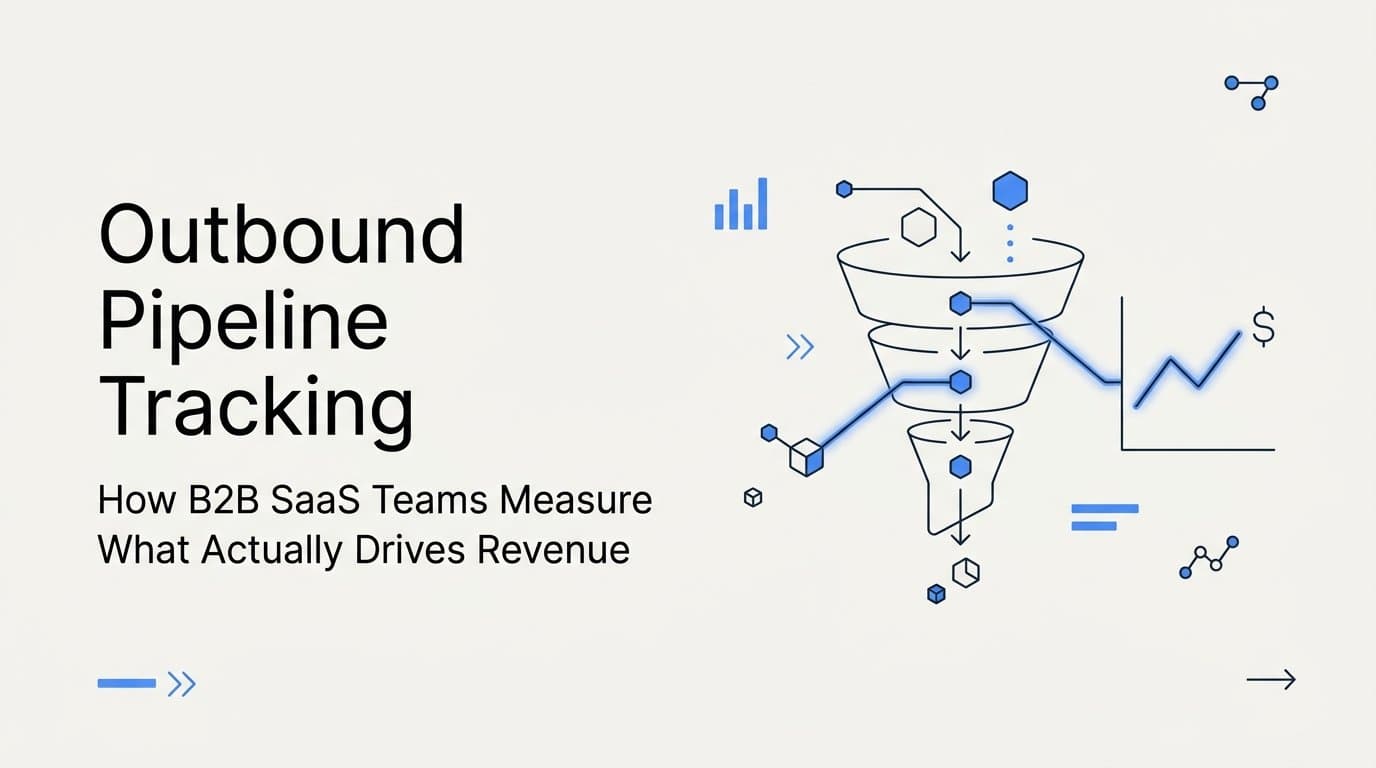
Outbound pipeline tracking is the practice of connecting initiated outbound touchpoints to pipeline stages and ultimately to closed revenue. That definition sounds simple, but the word "initiated" carries a lot of weight. It is what separates outbound attribution from inbound attribution, and it changes everything about how the tracking must be structured.
With inbound, someone expresses intent first. They search a keyword, click an ad, visit a pricing page, or fill out a form. That intent signal becomes the anchor point for the attribution journey. The prospect came to you, and you can track the path they took to get there.
With outbound, your team initiates contact. There is no initial intent signal from the prospect. The seller reaches out cold, and the journey begins with that outreach rather than with a prospect-driven action. This means outbound attribution cannot rely on the same logic as inbound attribution. You cannot simply track which page someone landed on before converting, because the converting touchpoint was an email your SDR sent, not a page the prospect found on their own.
This distinction matters because most attribution tools and CRM configurations are built with inbound logic in mind. Applying them directly to outbound produces inaccurate or incomplete data.
A useful way to think about outbound pipeline tracking is in three layers:
Activity tracking: What outbound actions were taken? This includes emails sent, calls made, LinkedIn messages sent, sequences enrolled, and direct mail pieces delivered. This layer captures what your team did.
Engagement tracking: How did prospects respond to those actions? This includes emails opened, links clicked, replies received, calls answered, and meetings booked. This layer captures what prospects did in response to your outbound efforts.
Outcome tracking: What pipeline and revenue resulted from those engagements? This includes opportunities created from outbound sources, deal stages progressed, closed-won deals, and average deal value by outbound channel. This layer is where outbound pipeline tracking earns its name.
Most teams have reasonable coverage of the first two layers. The third layer is where visibility breaks down, and it is the layer that actually drives business decisions. Building a complete outbound pipeline tracking system means connecting all three layers into a continuous, reliable data flow.
The Metrics That Actually Matter for Outbound Pipeline
Reply rates and open rates are not pipeline metrics. They are engagement signals. They tell you whether your messaging is resonating enough to generate a response, which matters, but they stop well short of telling you whether your outbound program is generating revenue. To evaluate outbound performance at the pipeline level, you need a different set of metrics.
Meetings booked per channel: How many qualified meetings does each outbound channel produce? This metric connects engagement to the first meaningful pipeline event. Tracking it by channel reveals which outbound motions are actually converting interest into conversations, not just generating replies.
Opportunity creation rate by outbound source: Of the meetings booked through outbound, what percentage convert into qualified opportunities? This metric separates channels that generate conversations from channels that generate pipeline. A channel with high meeting volume but low opportunity creation rate is producing unqualified interest, not pipeline.
Average deal size from outbound versus inbound: Outbound-sourced deals often have different characteristics than inbound-sourced deals because your team is targeting specific accounts rather than responding to self-selected interest. Tracking average deal size by source helps you understand the quality of pipeline each motion produces.
Pipeline velocity for outbound-sourced deals: How quickly do outbound-sourced opportunities move through your pipeline stages? Slower velocity might indicate that outbound prospects need more nurturing before they are ready to buy. Faster velocity might indicate strong ICP fit from targeted outbound efforts. Either way, the data informs how you structure your follow-up motion.
One of the most important conceptual distinctions in outbound pipeline tracking is the difference between sourced pipeline and influenced pipeline. These are not interchangeable, and conflating them produces misleading reporting.
Sourced pipeline means the outbound effort directly created the opportunity. An SDR sent a cold email, the prospect responded, a meeting was booked, and an opportunity was created. Outbound sourced that deal.
Influenced pipeline means outbound touched a deal that was sourced through a different channel. A prospect might have come inbound through a content download, but an SDR followed up with a personalized sequence that accelerated the deal to a meeting. Outbound influenced that deal without sourcing it.
Both types of pipeline contribution have real value, and both need to be tracked separately. Mixing them together either overstates or understates outbound's contribution depending on how your CRM is configured. Building separate tracking logic for each gives you an accurate picture of what your outbound program is actually doing for the business.
Where Outbound Tracking Breaks Down in Practice
Understanding what to track is one thing. Getting the tracking to work reliably in a real B2B SaaS environment is another challenge. There are several common failure points that undermine even well-intentioned outbound pipeline tracking systems.
Attribution gaps are the most structurally difficult problem. Consider a prospect who receives a cold outbound email from an SDR, then sees a LinkedIn ad from your marketing team, then visits your pricing page after a Google search, and then books a demo through a form. Which touchpoint gets credit for that opportunity? In most CRM configurations, either the first touch or the last touch gets 100% of the credit, and every touchpoint in between disappears from the attribution record. The SDR's email and the LinkedIn ad both contributed to the outcome, but neither is accurately reflected in the data.
This is why single-touch attribution models consistently misrepresent outbound performance. B2B SaaS buying journeys involve multiple touchpoints across marketing and sales channels, often over weeks or months. Any attribution model that assigns full credit to one touchpoint erases the contribution of every other interaction, which makes it impossible to understand how outbound sequences interact with paid channels to move deals forward.
Data fragmentation is the second major failure point. The typical B2B SaaS go-to-market stack includes a sales engagement platform, a CRM, one or more ad platforms, and a marketing automation tool. Each system holds a piece of the customer journey, but they rarely integrate cleanly enough to produce a unified view. Pipeline source data in the CRM might reflect what the SDR manually entered at lead creation, which may or may not match what the engagement platform recorded or what the ad platform attributed.
Manual data entry compounds this problem significantly. When SDRs are responsible for entering opportunity source data in the CRM, the quality of that data depends on consistent behavior across every rep, every day. In practice, source fields get filled in inconsistently, left blank, or populated with whatever option is easiest to select. Any reporting built on top of unreliable source data inherits that unreliability.
Inconsistent UTM practices create a similar problem on the marketing side. When outbound emails contain links without proper UTM parameters, or when UTM conventions vary across campaigns, it becomes impossible to trace which outbound touchpoints drove website visits, form fills, or demo requests. The tracking infrastructure breaks at the point where outbound activity meets digital behavior, and the result is a gap in the attribution chain that no amount of reporting can bridge after the fact.
Building an Outbound Pipeline Tracking System That Works
Building reliable outbound pipeline tracking is not primarily a technology problem. It is a data architecture problem. The tools matter, but the foundation matters more. Without a clear structure for how data flows from outbound touchpoints to pipeline records to revenue outcomes, even the most sophisticated attribution software will produce unreliable results.
The starting point is a unified source of truth. All outbound touchpoints, CRM pipeline stages, and ad platform data need to flow into one place before any meaningful reporting is possible. This does not mean replacing your existing tools. It means connecting them through integrations that pass data reliably between systems, so that a touchpoint recorded in your sales engagement platform is visible in the same reporting view as a paid ad impression and a CRM opportunity stage change.
Consistent UTM tagging is the next non-negotiable foundation. Every link in every outbound email, every LinkedIn message, every direct mail piece with a URL, every SDR follow-up sequence needs to carry properly structured UTM parameters. This means establishing a UTM convention your team uses consistently and enforcing it through templates and tooling rather than relying on individual judgment. When a prospect clicks a link in an outbound email and eventually converts, the UTM parameters are what allow you to trace that conversion back to the specific outbound sequence and channel that drove it.
CRM source fields need the same level of discipline. When a new lead or contact enters your CRM as a result of outbound activity, the source needs to be captured accurately and consistently at the moment of creation. This is best achieved through automation rather than manual entry. If your sales engagement platform can pass source data directly to the CRM when a meeting is booked, that is far more reliable than asking an SDR to fill in a dropdown field.
Once the data foundation is in place, multi-touch attribution becomes the analytical layer that makes outbound pipeline tracking genuinely useful. Multi-touch attribution distributes credit across all the touchpoints that contributed to an outcome rather than assigning all credit to one. For outbound, this means you can see how an SDR email sequence, a LinkedIn ad, and a retargeting campaign each contributed to a deal, rather than crediting only the first or last touchpoint. This view reflects the reality of how B2B buying decisions actually happen and gives marketing and sales teams a shared, accurate picture of what is driving pipeline.
Attribution models worth considering for outbound include linear attribution, which distributes credit equally across all touchpoints; time decay attribution, which gives more credit to touchpoints closer to conversion; and position-based attribution, which weights the first and last touches more heavily while distributing remaining credit across middle touches. Each model has tradeoffs, and the right choice depends on your sales cycle length and how your team uses the data to make decisions.
Connecting Outbound Pipeline Data to Revenue Attribution
Pipeline tracking is valuable. Revenue attribution is where it becomes transformative. There is a meaningful difference between knowing which outbound channels generate opportunities and knowing which outbound channels generate deals that actually close. Teams that stop at opportunity creation are missing the most important part of the picture.
It is common for outbound channels to produce different win rates, different average deal sizes, and different time-to-close patterns. A channel that generates a high volume of opportunities might produce a low win rate if the ICP targeting is off. A channel that produces fewer opportunities might generate larger, faster-closing deals if the targeting is precise. Without connecting outbound pipeline data all the way to closed-won revenue, you cannot see these differences, and you cannot make confident decisions about where to invest.
Revenue attribution for outbound requires integrating CRM closed-won data with marketing touchpoint data and ad spend data. When these three data sources are connected, you can calculate true cost per acquisition and ROI by outbound channel. You can see not just which channels generated pipeline, but which channels generated revenue, and at what cost. This is the level of visibility that allows marketing and sales leaders to make budget decisions with confidence rather than intuition.
This is where platforms like Cometly become directly relevant. Cometly connects ad spend data, CRM pipeline events, and customer journey touchpoints into a single attribution view. Rather than piecing together reports from multiple disconnected systems, marketing and sales teams get a shared, real-time picture of how outbound efforts across paid channels and direct outreach are contributing to pipeline and revenue. Cometly's multi-touch attribution capabilities make it possible to see how outbound sequences interact with paid prospecting campaigns across the full customer journey, so budget decisions reflect the complete picture of what is driving deals.
Cometly also feeds enriched conversion data back to ad platforms like Meta, Google, and LinkedIn, which improves the targeting and optimization logic those platforms use. When your ad platform AI has accurate data about which clicks led to closed revenue rather than just which clicks led to form fills, it optimizes toward the outcomes that actually matter for your business.
The result is a closed loop: outbound activity generates touchpoints, those touchpoints are tracked through pipeline stages, closed-won data flows back into the attribution system, and the entire picture informs both outbound strategy and paid channel investment. That loop is what separates teams that scale effectively from teams that stay stuck optimizing for activity metrics.
Putting It All Together
The shift that outbound pipeline tracking requires is not primarily a technical one. It is a mindset shift. Outbound is not measured by how much activity your team generates. It is measured by how much revenue that activity produces, and by how clearly you can trace the path between the two.
Teams that build this visibility make better decisions at every level. They know which channels to scale and which to cut. They understand how marketing and sales touchpoints interact across the customer journey. They can calculate the true cost of acquiring a customer through outbound versus inbound, and they can defend budget decisions with data rather than intuition.
The building blocks are consistent: a unified data foundation, disciplined UTM and source tracking, multi-touch attribution that reflects the full customer journey, and a connection between pipeline data and closed revenue. None of these are technically complex in isolation, but making them work together reliably requires intentional design and the right tools.
If your team is ready to move beyond activity metrics and build a clear line of sight from outbound touchpoints to pipeline and revenue, Cometly gives you the attribution infrastructure to do it. Get your free demo and see how Cometly can become your team's single source of truth for outbound pipeline attribution.