You're running ads on LinkedIn, Google, and Meta. Leads are coming in. The pipeline is moving. But when someone asks you which campaigns are actually driving revenue, you hesitate. You pull up the dashboards, see a dozen different numbers, and realize you're about to give an answer based on a best guess rather than hard evidence.
This is one of the most common and costly situations in B2B SaaS marketing. The budget is real. The spend is real. But the signal telling you where that money is actually working? Murky at best.
The danger isn't just uncertainty. It's the decisions that flow from that uncertainty. Teams scale campaigns that look good on paper but generate low-quality pipeline. They cut awareness ads that appear expensive but are quietly warming up the leads that eventually close. They optimize for the wrong metrics because those are the only ones they can see clearly. Over time, the compounding effect of these misallocations can quietly drain growth potential while the team remains confident they're being data-driven.
This article gives you a practical framework for answering the question every B2B SaaS marketer should be able to answer with confidence: which ads are actually working? We'll cover why attribution is so hard to get right, which metrics actually matter, how to connect ad spend to real revenue, and what it takes to build a system that gives you reliable answers in real time.
The Attribution Trap Most Teams Fall Into
The root of the problem is how most teams measure ad performance by default. Last-click attribution, the model baked into many analytics tools and ad platforms, assigns all credit for a conversion to the final touchpoint before someone converted. It's simple, easy to understand, and deeply misleading for B2B SaaS.
Think about how a typical B2B buyer actually behaves. They might see a LinkedIn ad for your product in January. They search Google for a comparison review in February. They attend a webinar in March. They click a retargeting ad in April. And they finally book a demo after clicking a branded search ad in May. Under last-click attribution, that branded search ad gets full credit. Every other touchpoint gets nothing.
This creates a systematic blind spot. Top-of-funnel and mid-funnel campaigns look ineffective because they rarely capture the last click. Marketers cut them. Pipeline dries up. Then they wonder why the bottom-of-funnel ads that were "working" suddenly stop performing. The reality is those ads were harvesting demand that the awareness campaigns created.
The problem compounds when you factor in how ad platforms report their own results. Each platform uses its own attribution window and logic. Meta might claim credit for a conversion because the user saw an ad within a 7-day window. Google claims the same conversion because the user clicked a search ad. Your CRM shows one deal closed. Your combined ad platform dashboards show two or three attributed conversions. The numbers don't reconcile, and these Facebook ads reporting discrepancies can make it feel like everything is working when the reality is far more nuanced.
For B2B SaaS specifically, this disconnect is especially pronounced. Sales cycles often span weeks or months. Multiple stakeholders are involved. A single deal might involve a dozen touchpoints across several channels before someone signs a contract. No single platform's reporting captures that full picture, and relying on any one of them in isolation will consistently lead you to the wrong conclusions.
The Metrics That Actually Signal What's Working
Before you can identify which ads are working, you need to agree on what "working" actually means. For most B2B SaaS teams, the answer should be rooted in revenue, not activity.
Click-through rate and cost-per-click are useful for diagnosing creative and audience efficiency, but they tell you nothing about whether an ad is generating revenue. An ad with a high CTR and low CPC might be attracting tire-kickers who never convert downstream. An ad with a higher CPC might be reaching exactly the right decision-makers who close at a strong rate. Volume metrics at the top of the funnel can mask serious problems further down.
The metrics that deserve your attention are the ones tied to pipeline and revenue outcomes.
Cost per SQL: How much does it cost to generate a sales-qualified lead from each campaign? This moves beyond MQLs, which often include leads that marketing considers interesting but sales doesn't prioritize.
Cost per opportunity: How much does it cost to generate an actual pipeline opportunity? This is where you start seeing the real efficiency of each channel and campaign.
Pipeline influenced: What is the total pipeline value that each campaign touched, across any stage of the buyer journey? This metric respects the multi-touch reality of B2B buying.
Closed-won revenue attributed: Which campaigns are connected to deals that actually closed? This is the ultimate signal, though it requires proper attribution infrastructure to measure accurately.
CAC payback period by channel: How long does it take to recoup the customer acquisition cost for leads sourced through each channel? This helps you understand the long-term efficiency of each investment.
The shift from vanity metrics to revenue metrics requires patience. You need enough time in the funnel for conversions to mature. But once you make this shift, the picture of which ads are working changes dramatically. Campaigns that looked expensive at the top of the funnel often prove to be highly efficient when you trace them to closed revenue. Campaigns that generated impressive click volume often disappear when you look at what they actually produced downstream.
Understanding the difference between volume and quality is especially important for B2B SaaS teams with defined ICP criteria. High-volume campaigns can feel reassuring, but if they're attracting the wrong audience, they're actively diluting your sales team's time and your pipeline quality. Investing in paid ads analytics that go beyond surface-level metrics is what separates teams making confident decisions from those operating on assumptions.
Attribution Models: Choosing the Right Lens for Your Data
Attribution models are frameworks for distributing credit across the touchpoints in a customer journey. Each model tells a different version of the story, and understanding what each one reveals and hides is essential for making smart decisions.
First-touch attribution assigns all credit to the first interaction a prospect had with your brand. It's useful for understanding which channels are best at generating awareness and bringing new prospects into your funnel. The weakness is that it ignores everything that happened after that initial contact.
Last-touch attribution assigns all credit to the final touchpoint before conversion. As discussed earlier, this systematically undervalues awareness and mid-funnel activity. It tends to make retargeting and branded search look like your best channels because they sit at the bottom of the funnel.
Linear attribution distributes credit equally across all touchpoints in the journey. It's more balanced than single-touch models but doesn't account for the fact that some touchpoints are more influential than others.
Time-decay attribution gives more credit to touchpoints that occurred closer to the conversion. This makes intuitive sense for shorter sales cycles but can undervalue early-stage campaigns that planted the seed for a deal that took months to close.
Data-driven attribution uses machine learning to assign credit based on patterns in your actual conversion data. It's the most sophisticated model but requires significant data volume to produce reliable results.
Here's the thing: no single model is universally correct for B2B SaaS. The right model depends on your sales cycle length, your channel mix, and what decision you're trying to make. If you're trying to understand which channels generate awareness, first-touch is informative. If you're trying to understand what closes deals, last-touch or time-decay might be more relevant. If you want a holistic picture of how ads contribute across the entire journey, B2B software marketing attribution platforms that support multi-touch models are the most honest lens.
Multi-touch attribution is generally the most appropriate approach for B2B SaaS because it respects the reality of how B2B buyers actually engage with content and ads before making a purchase decision. Rather than forcing you to pick a single winner, it shows you how different campaigns contribute at different stages of the funnel. That visibility is what allows you to make budget decisions with real confidence rather than educated guesses.
How to Connect Ad Spend to Real Revenue
Understanding attribution models is one thing. Actually implementing accurate attribution across your ad platforms, website, and CRM is another challenge entirely. This is where most teams hit a wall, and it's worth understanding why the technical gap exists and how to close it.
Ad platform data and CRM data typically live in completely separate systems. Your Google Ads account knows about clicks and conversions as defined by your pixel. Your Salesforce or HubSpot instance knows about leads, opportunities, and closed deals. Without a deliberate effort to connect these systems, you're left reconciling them manually, which is time-consuming, error-prone, and often incomplete.
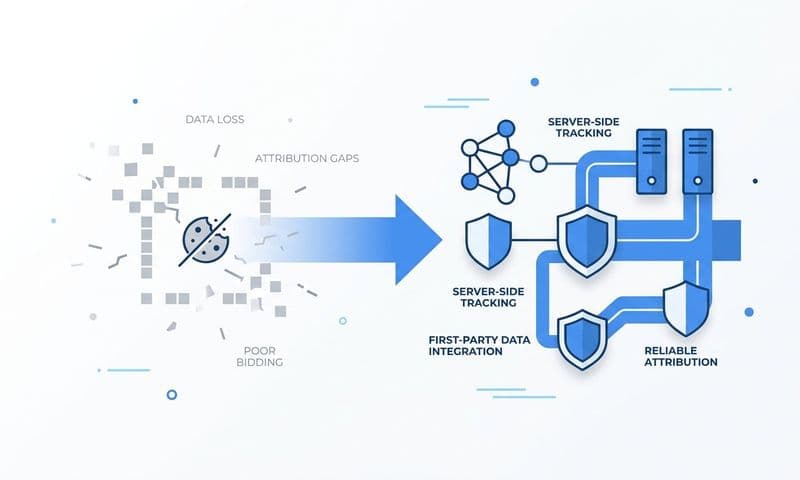
The traditional approach to bridging this gap relied on browser-based pixels. A user clicks an ad, lands on your site, the pixel fires, and a conversion is recorded. This works reasonably well in a world where cookies are reliable and users don't block tracking. But that world is changing rapidly. Browser restrictions, cookie deprecation, and the widespread use of ad blockers mean that pixel-only tracking misses a growing share of actual conversions. The result is underreported data that makes your campaigns look less effective than they actually are, and it erodes your ability to make accurate decisions.
Server-side tracking addresses this directly. Rather than relying on a browser pixel to fire, server-side events are sent directly from your server to the ad platform's API. This approach bypasses browser restrictions entirely and provides a much more reliable signal. Meta's Conversion API and Google Ads conversion tracking are the primary implementations of this approach for paid social and paid search respectively.
First-party data is the foundation of this infrastructure. When you capture user data at the point of conversion, such as an email address from a form submission or a CRM record created when a lead is qualified, you can use that data to match conversions back to the ad interactions that preceded them. This matching process is what allows you to connect ad spend to real pipeline and revenue outcomes rather than estimated platform conversions.
Integrating your ad platforms, website, and CRM into a unified attribution view requires the right infrastructure. The goal is a system where every touchpoint, from the first ad impression to the closed-won event in your CRM, is captured and connected to a single customer record. When that infrastructure is in place, you can trace a closed deal backward through every ad interaction that contributed to it, and you can do it accurately rather than relying on platform-reported estimates.
This level of integration is what separates teams that genuinely know which ads are working from teams that are guessing with confidence. The data is available. The challenge is building the plumbing to connect it all.
A Practical Framework for Auditing Your Ads Right Now
Even before your attribution infrastructure is fully optimized, there are practical steps you can take to get a clearer picture of which campaigns are actually performing. Here's a structured approach to auditing your ads with the data you have today.
Step 1: Segment your campaigns by channel and map them to funnel stages. Start by organizing your campaigns not just by platform but by their intended role in the funnel. Awareness campaigns targeting cold audiences belong in one category. Retargeting campaigns targeting engaged prospects belong in another. Bottom-of-funnel campaigns targeting high-intent signals belong in a third. This segmentation is the foundation for a fair performance comparison.
Step 2: Pull outcome data from your CRM and match it to campaign sources. For every lead, opportunity, and closed deal in your CRM, identify the campaign source if it's tracked. Even imperfect UTM data gives you a starting point. Understanding what UTMs are and how marketers use them for campaigns is essential here. Look at how leads from each campaign progress through the funnel. What percentage become SQLs? What percentage become opportunities? What percentage close?
Step 3: Calculate cost-per-outcome at each funnel stage, not just at the top. A campaign might generate leads at a low cost-per-lead but convert those leads to opportunities at a much lower rate than another campaign that looks more expensive at first glance. When you calculate cost-per-opportunity and cost-per-closed-deal, the rankings often change significantly. This is where you find your true winners and losers.
Step 4: Look for downstream performers that are being undervalued. Some of your best campaigns will have modest top-of-funnel volume but strong downstream conversion rates. These are the campaigns that are often at risk of being cut because they don't generate impressive click or lead numbers. Protecting these campaigns requires looking past the surface metrics to what they actually produce in pipeline.
Step 5: Use AI-driven insights to surface patterns you'd miss manually. As campaign datasets grow across multiple channels, manually analyzing performance at the ad, audience, and creative level becomes impractical. AI ads optimization can surface patterns across large datasets quickly, identifying which combinations of audience, creative, and placement are consistently driving pipeline outcomes. Acting on these signals by reallocating budget toward proven performers is how you compound the returns from your attribution investment.
The goal of this audit isn't perfection. It's clarity. Even a rough version of this analysis will surface insights that change how you allocate budget and which campaigns you prioritize for optimization.
Building on the Right Attribution Foundation
Doing this analysis manually, across multiple platforms and a CRM, is possible but unsustainable at scale. The teams that consistently know which ads are working are the ones that have invested in an attribution platform that connects all of these data sources automatically and surfaces insights in real time.
When evaluating attribution solutions, the most important capabilities to look for are full-funnel visibility, support for multiple attribution models, native integrations with your ad platforms and CRM, server-side tracking support, and real-time reporting rather than delayed batch updates. Delayed data is particularly problematic in paid advertising because budget decisions often need to be made quickly to avoid wasting spend on underperforming campaigns. Reviewing a marketing attribution software comparison can help you identify which platforms offer the capabilities your team actually needs.
Cometly is built specifically for B2B SaaS teams facing exactly this challenge. It connects your ad platforms, website, and CRM into a single attribution view, capturing every touchpoint from the first ad click to the closed-won event in your CRM. With support for multi-touch attribution models, server-side conversion tracking, and Conversion API integration, Cometly gives your team the technical foundation to measure what's actually driving revenue rather than relying on platform-reported estimates.
The AI-driven insights layer within Cometly goes further, analyzing patterns across your campaigns to surface recommendations about where to scale and where to pull back. Those enriched conversion signals are also fed back to Meta, Google, and other ad platforms, improving the quality of their targeting and optimization algorithms. Better data in means better performance out.
The compounding benefit of getting attribution right is significant. Accurate attribution leads to better budget decisions, which leads to better performance, which generates better data, which improves the ad platform algorithms you depend on. Over time, the gap between teams with accurate attribution and teams without it grows wider with every campaign cycle.
Your Next Steps Toward Attribution Clarity
Knowing which ads are working is not a reporting luxury. For any B2B SaaS team managing meaningful paid spend, it is a strategic requirement. Without it, you're making budget decisions based on incomplete information, and the cost of those decisions compounds over time.
The framework is straightforward: fix your tracking foundation with server-side events and first-party data, choose attribution models that reflect the complexity of your actual sales cycle, connect your ad data to CRM outcomes rather than stopping at top-of-funnel metrics, and use a platform that brings all of this together in real time.
The good news is that the tools to do this well exist today. The teams that invest in getting attribution right gain a durable competitive advantage: they scale what works faster, cut what doesn't sooner, and feed better data back into the systems that drive their ad performance.
If you're ready to stop guessing and start knowing which ads are driving your pipeline and revenue, Get your free demo of Cometly today and see exactly what your attribution data has been missing.