You've done everything right. The campaigns are live, the budget is allocated, and traffic numbers are climbing. But the conversion rate? Flat. Maybe even declining. If you manage marketing for a B2B SaaS company, this scenario is one of the most demoralizing things you can experience, because the problem is invisible from the surface.
Driving visitors to your site is only half the job. The harder half is understanding why they leave without taking action. And here's the uncomfortable truth: most teams cannot answer that question accurately because they are missing the data to diagnose it properly.
The root cause of visitors not converting is almost never a single thing. It is usually a combination of traffic quality issues, message-to-market misalignment, on-site friction, and attribution blind spots that prevent your team from seeing what is actually happening. Each of these problems compounds the others, making the conversion gap feel impossible to close without knowing where to look.
This article walks through each root cause in depth, gives you a practical diagnostic framework, and explains how to turn conversion data into decisions that actually move the needle. Let's start at the foundation.
The Gap Between Traffic and Revenue
High traffic with low conversions is not primarily a UX problem. It is a signal of misalignment between who you are attracting and who actually buys your product. Many B2B SaaS teams optimize their paid campaigns for click volume and cost-per-click, which are metrics ad platforms are very good at delivering. The problem is that clicks are not customers.
When you optimize for clicks, ad platforms optimize for clicks. They find the audiences most likely to engage with your ad, which is not the same as finding the audiences most likely to become paying customers. The result is high traffic from visitors who have no real intent to buy, no budget authority, or no immediate problem your product solves.
This is the traffic quality versus traffic volume distinction. A hundred visitors from a highly targeted, intent-matched audience will consistently outperform ten thousand visitors from a broad, low-intent audience. Volume without quality is just noise, and it is expensive noise at that.
The deeper issue is visibility. Without end-to-end tracking that connects your ad spend to actual pipeline and revenue, your team has no way to distinguish high-quality traffic from low-quality traffic. You can see that visitors arrived. You cannot see whether the visitors from Campaign A ever became customers, while the visitors from Campaign B converted at three times the rate on a third of the budget.
This visibility gap is where most conversion diagnoses fall apart. Teams look at landing page performance, tweak button colors, and test headlines, all while the real problem sits upstream in the traffic source itself. Without connecting ad data to downstream revenue outcomes, you are optimizing the wrong variable entirely. Understanding how to track website visitors accurately is the first step toward closing this gap.
The foundation of solving any conversion problem is establishing that end-to-end view first. Once you can see which traffic sources produce revenue, not just leads, the misalignment becomes obvious. And once it is obvious, it becomes fixable.
Mismatched Messaging and Audience Intent
Here is a scenario that plays out constantly in B2B SaaS marketing. A prospect searches a broad informational query, clicks an ad, and lands on a page with a prominent "Request a Demo" CTA. They are in early research mode. They are not ready to talk to sales. They bounce immediately, and your team interprets that as a landing page problem.
It is not a landing page problem. It is a message-to-market fit problem.
B2B buyers move through distinct stages: awareness, consideration, and decision. Each stage comes with very different informational needs and very different tolerances for commitment. An awareness-stage visitor wants to understand their problem better and explore possible solutions. A decision-stage visitor wants to compare options and talk to someone who can close the deal. These are fundamentally different people with fundamentally different needs, even if they clicked the same ad.
When your ad creative and landing page copy do not match the intent of the visitor at their actual stage, you create friction. The ask feels too aggressive. The content feels irrelevant. The visitor feels misunderstood. And they leave.
This is a structural funnel problem. You cannot patch it with better copywriting on a single page. You need to map your content and CTAs to the right intent stages, and then make sure you are routing traffic accordingly. Understanding the full B2B customer journey is essential for aligning your messaging to where buyers actually are in their decision process.
Attribution data is what makes this fixable. When you can see which channels and campaigns are bringing visitors who are actually in a buying mindset, versus which are bringing early-stage researchers, you can align your messaging to match. You stop wasting demo request pages on people who are three months away from a buying decision, and you stop offering educational content to people who are ready to buy today.
Without that attribution visibility, you are guessing at intent. And guessing at intent is one of the most expensive mistakes a B2B SaaS marketing team can make, because every mismatched message is a wasted click and a wasted opportunity to build the right relationship at the right time.
Trust, Friction, and the Conversion Killers on Your Site
Even when you have the right visitor with the right intent, on-site factors can still kill the conversion. These are the elements that erode trust and increase friction before a visitor ever reaches your CTA.
Unclear value proposition: If a visitor cannot understand what your product does and why it matters to them within the first few seconds of landing on your page, they will leave. B2B buyers are busy and skeptical. Your headline needs to communicate specific value, not clever positioning.
Weak or absent social proof: B2B buyers rely heavily on peer validation. Generic testimonials, logos without context, and review counts without specifics do very little to build confidence. Social proof needs to be relevant to the visitor's industry, role, and use case to actually move them forward.
Confusing navigation: When visitors have too many choices, they make no choice. Cluttered navigation, competing CTAs, and unclear page hierarchy all dilute conversion intent. A high-converting page has a clear primary action and removes friction from the path to that action.
Forms that ask for too much too soon: Every additional form field reduces the likelihood of completion. Asking for company size, budget range, and phone number before you have established value feels presumptuous. Progressive data collection, where you ask for more as trust builds, consistently outperforms front-loaded forms.
Beyond these structural elements, page load speed and mobile experience have a direct impact on whether a visitor stays long enough to convert. B2B buyers increasingly use mobile devices for research, even when their final purchase decision happens on desktop. A slow or poorly formatted mobile experience cuts off that research journey before it starts.
This is also where micro-conversion tracking becomes critical. Not every visitor will convert on the first visit, but many will take smaller steps: watching a demo video, downloading a resource, scrolling to the pricing section, or clicking a case study. These micro-conversions are signals of intent, and tracking them tells you exactly where in your B2B SaaS marketing funnel visitors are dropping off.
When you can see that visitors consistently abandon at the pricing page, or that mobile visitors never reach the CTA, you have a specific problem to solve rather than a vague sense that "conversions are low." That specificity is what separates teams that improve conversion rates from teams that keep testing randomly and wondering why nothing changes.
Attribution Blind Spots: Why You Cannot See the Real Problem
Even if your traffic quality is solid and your on-site experience is clean, you may still be flying blind on conversions. The reason is attribution, and specifically, the limitations of how most teams measure it.
Last-click attribution is still the default in many marketing setups. It assigns full credit for a conversion to the last touchpoint a visitor interacted with before converting. This sounds logical until you consider that a typical B2B SaaS buyer touches your brand many times before making a decision: a LinkedIn ad, a Google search, a blog post, a retargeting ad, a direct visit to your pricing page. Last-click attribution credits only that final visit and ignores everything that built the relationship up to that point. Reviewing the most common ad attribution models reveals just how much revenue credit gets misassigned under this approach.
The consequence is systematic undervaluation of top-of-funnel and mid-funnel channels. Teams see that organic search or LinkedIn is not showing up in last-click conversions, so they cut those budgets. But those channels were actually doing the heavy lifting of building awareness and intent. Cutting them causes conversion rates to drop further, which feels like a new problem but is actually a direct result of the attribution model's distortion.
Tracking gaps compound this problem. Browser-based tracking through pixels has become increasingly unreliable. Privacy-focused browsers, iOS privacy changes, and ad blockers all intercept client-side tracking events before they reach your analytics platform. The result is a growing percentage of your customer journey that simply goes unrecorded.
When data is missing, your attribution models are working from an incomplete picture. A visitor might have clicked three ads and visited your site four times before converting, but your tracking only captured one of those events. Your model then misattributes the conversion, and every optimization decision you make based on that data is built on a flawed foundation. The impact of pixel tracking problems on iOS alone accounts for a significant share of this missing data.
Server-side tracking and Conversion API (CAPI) integrations with platforms like Meta and Google are the modern solution to this problem. Instead of relying on a browser to fire a pixel, server-side tracking sends conversion events directly from your server to the ad platform. This bypasses client-side limitations entirely, ensuring that every conversion event is captured accurately regardless of browser restrictions or ad blockers.
First-party data strategy sits at the center of this. As third-party cookies continue to be deprecated across browsers, businesses that have invested in server-side infrastructure and first-party data collection maintain measurement accuracy. Those still relying on legacy pixel-only tracking see their data quality degrade over time, widening the gap between what they can see and what is actually happening.
Without solving the attribution blind spot, every other conversion optimization effort is working from incomplete information. You cannot fix what you cannot accurately measure.
How to Diagnose Why Your Visitors Are Not Converting
Diagnosing why visitors are not converting requires a structured approach. The temptation is to jump straight to solutions, but solutions applied without diagnosis often fix the wrong problem. Here is a practical framework that moves from the broadest issues to the most specific.
Step 1: Audit traffic source quality. Start by connecting your ad spend data to downstream revenue outcomes, not just lead counts. Look at which channels, campaigns, and ad sets produce customers, not just clicks or form fills. You will often find that a significant portion of your traffic volume is coming from sources that have never produced a single closed deal. This is where traffic quality issues become visible.
Step 2: Map funnel drop-off points. Use event tracking to identify where visitors are abandoning the funnel. Which pages have high exit rates? Where do visitors stop engaging? Are mobile visitors dropping off at a different point than desktop visitors? Micro-conversion data, such as video views, scroll depth, and CTA clicks, gives you a granular map of where intent breaks down.
Step 3: Audit tracking completeness. Before drawing any conclusions from your data, verify that your tracking is actually capturing everything it should. Check for broken pixels, missing event tags, and gaps in your CRM data. If your tracking is incomplete, your funnel analysis is unreliable. Server-side tracking implementation is often the fix needed at this stage.
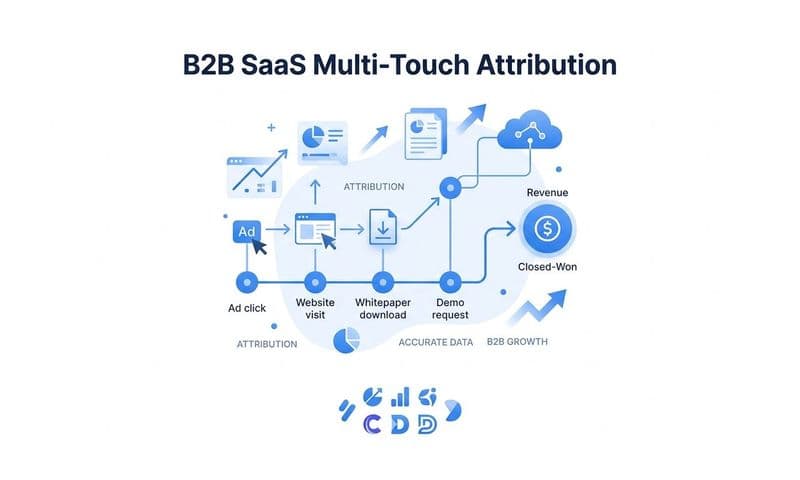
Step 4: Apply multi-touch attribution. Once your tracking is complete, apply a multi-touch attribution model to understand the full path visitors take before converting. Multi-touch models distribute credit across all touchpoints in the journey, revealing which channels are contributing to conversion even when they are not the final click. This often surfaces channels that last-click models were systematically undercounting.
Step 5: Connect ad spend to pipeline and revenue. The final step is connecting the full picture: ad spend, touchpoints, pipeline stage, and closed revenue. This gives growth teams the true conversion performance view. You can see not just which campaigns generate leads, but which campaigns generate revenue, and at what cost. Understanding how SaaS growth teams attribute revenue to marketing efforts is the data that makes optimization decisions obvious rather than speculative.
This diagnostic sequence is not a one-time exercise. It is an ongoing practice. Conversion performance shifts as market conditions change, as competitors adjust their positioning, and as your own product evolves. Teams that build this diagnostic capability into their regular workflow consistently outperform those who treat conversion optimization as a periodic project.
Turning Conversion Data Into Decisions That Scale
Diagnosing the problem is only valuable if it leads to decisions that improve performance. This is where AI-powered analysis of conversion data becomes a genuine competitive advantage.
Manual review of conversion data across multiple channels, campaigns, and audience segments is time-consuming and prone to confirmation bias. AI analysis in marketing analytics can surface patterns across large datasets that human review would miss entirely. For example, identifying which specific ad creatives consistently correlate with visitors who convert to revenue, not just visitors who fill out a form, is a pattern that might span thousands of data points across months of campaign history. That is exactly the kind of insight that changes how you allocate budget.
The feedback loop to ad platforms matters just as much. Meta and Google's targeting algorithms rely on conversion signal quality to optimize their delivery. When you send incomplete or delayed conversion data, the algorithm has limited signal to work with. It cannot distinguish between a visitor who converted to a paying customer and one who filled out a form and never responded to follow-up. Both look the same to the platform if you are only sending lead events.
When you send enriched, server-side conversion events that include downstream revenue data, the algorithm learns what a high-value conversion actually looks like. Over time, it shifts delivery toward audiences that match that profile. The result is a compounding improvement in traffic quality, where better data leads to better targeting, which leads to higher-intent visitors, which leads to better conversion rates, which generates even better data.
This is why a single source of truth for your marketing data is not just a reporting convenience. It is the foundation for sustainable conversion improvement. When every optimization decision is grounded in verified, complete data that spans from first ad click to closed revenue, you are no longer guessing. You are compounding on what works.
Platforms like Cometly are built specifically for this purpose. By connecting ad platforms, CRM data, and website events into a unified view of the customer journey, and by using server-side tracking to ensure data completeness, Cometly gives B2B SaaS marketing teams the visibility they need to diagnose conversion problems accurately and optimize with confidence. The AI layer then surfaces which campaigns and creatives are driving actual revenue, not just activity, so budget decisions are made on signal rather than assumption.
The Path From Guessing to Growing
Visitors not converting is always a solvable problem. But it is only solvable when you have the right data to diagnose the actual cause rather than treating symptoms.
The progression is clear: start by auditing traffic quality to identify whether you are attracting the right audience in the first place. Then examine whether your messaging matches visitor intent at their actual funnel stage. Address on-site friction and trust factors that prevent even motivated visitors from taking action. Solve the attribution blind spots that prevent you from seeing the full picture. Apply a structured diagnostic framework to identify where the real drop-off is happening. Then use complete, enriched conversion data to make optimization decisions that compound over time.
Every step in this progression depends on data quality and data completeness. Teams that invest in server-side tracking, multi-touch attribution, and a unified view of the customer journey consistently find the answers that teams relying on fragmented, last-click data cannot see.
If your traffic is growing but your conversions are not, the answer is in your data. You just need the right tools to see it clearly. Get your free demo today and see how Cometly connects every touchpoint from first ad click to closed revenue, so you can stop guessing and start fixing the real causes of conversion failure.