Most B2B SaaS marketing teams are caught in the same trap. They pour budget into demand generation, watch MQL numbers climb, and then wonder why pipeline stays flat and sales keeps complaining about lead quality. The problem is not the execution. The problem is the strategy.
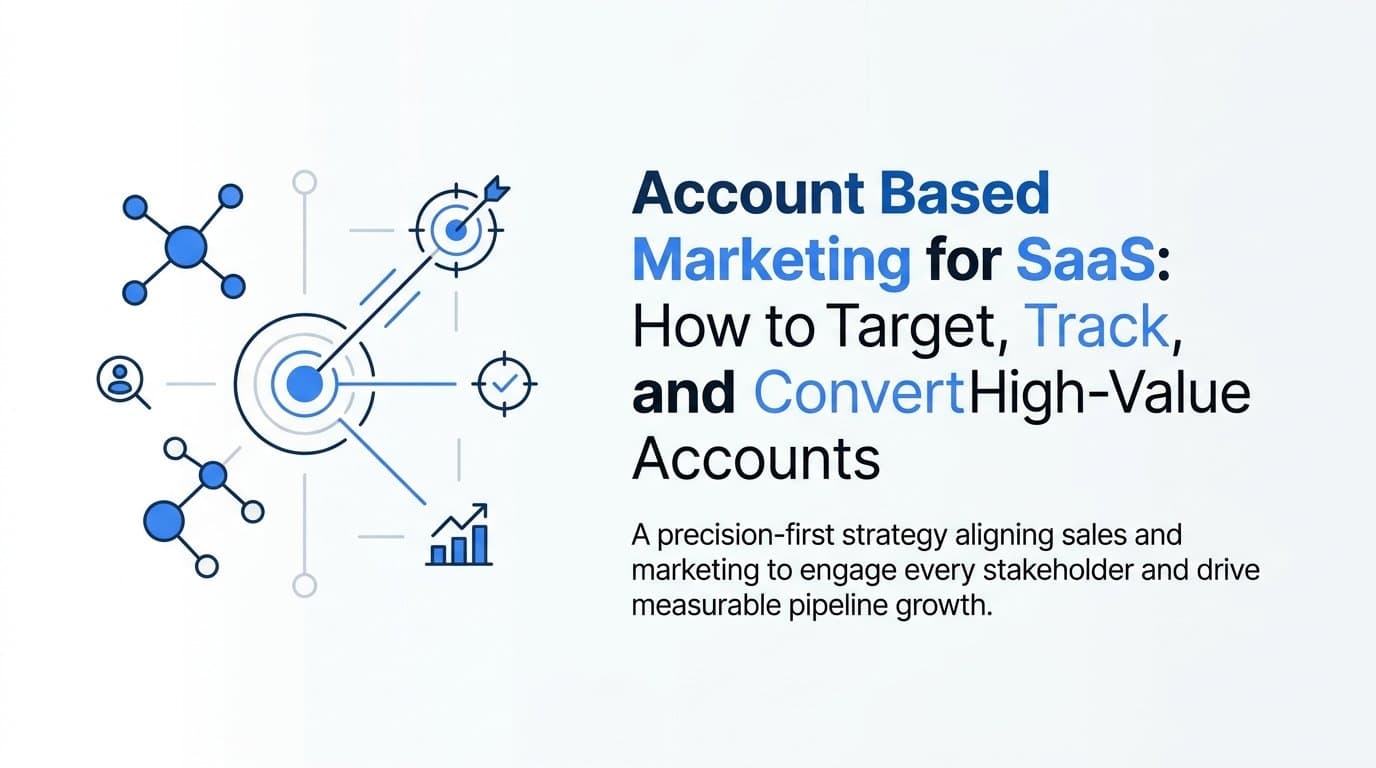
Broad demand generation is built for volume. Account based marketing for SaaS is built for precision. And for companies selling complex software to multiple stakeholders across longer sales cycles, precision is not a luxury. It is the only approach that actually maps to how enterprise and mid-market buyers make decisions.
ABM flips the traditional funnel on its head. Instead of attracting as many leads as possible and hoping the right ones convert, you start with a defined list of high-value accounts and work backward to engage every relevant stakeholder within those accounts. Marketing and sales stop operating in parallel and start operating as a unified revenue team with shared targets, shared messaging, and shared accountability for outcomes.
This guide covers the full picture: why traditional lead generation breaks down for B2B SaaS, how to build and activate an ABM program, and crucially, how to measure whether your ABM efforts are actually driving pipeline and revenue. Because without the right measurement foundation, ABM becomes expensive guesswork.
Why Traditional Lead Generation Falls Short for B2B SaaS
Here is a scenario that will feel familiar. Your marketing team hits its MQL target for the quarter. The dashboard looks great. Then you pull the pipeline report and realize that most of those leads are stuck at the top of the funnel, unqualified, unengaged, or simply wrong-fit for your product. Sales is frustrated. Marketing feels undervalued. And the disconnect between marketing KPIs and actual revenue outcomes grows wider.
This is the volume-versus-quality problem that plagues SaaS demand generation. When teams optimize for lead volume, they naturally gravitate toward tactics that produce large numbers of contacts: broad paid search campaigns, gated content with low barriers to entry, and social ads optimized for clicks rather than fit. The result is an inflated MQL count that looks good in marketing reports but produces little in the way of closed revenue.
The deeper issue is structural. B2B SaaS purchases rarely involve a single decision-maker. A typical mid-market software deal might involve a champion from the business side, sign-off from IT on security and integrations, budget approval from finance, and input from operations on workflow impact. That is four or more stakeholders, each with different concerns, different information needs, and different levels of influence over the final decision.
A lead-centric approach captures one contact and hopes that person can carry the deal internally. In reality, deals stall because the champion lacks the organizational influence to move things forward, or because other stakeholders were never engaged and raise objections late in the process. Marketing touched one person. The buying committee had five.
ABM reframes the fundamental unit of measurement. Instead of counting leads, you count accounts. Instead of measuring how many people filled out a form, you measure how deeply you have engaged the stakeholders that matter within the accounts most likely to close. This shift changes how teams define success, how they allocate budget across channels, and how they coordinate with sales to move deals forward. It is a more demanding approach, but it is the one that actually maps to how B2B SaaS buyers behave.
What Account Based Marketing Actually Means for SaaS Teams
ABM is a coordinated go-to-market strategy where marketing and sales treat individual high-value accounts as markets of one. Rather than building campaigns around broad buyer personas and hoping the right people find your content, you identify specific companies you want to win, learn everything you can about their needs and buying structure, and design outreach, content, and advertising specifically for those accounts.
The key word is coordinated. ABM does not work when marketing runs account-targeted ads while sales sends generic outreach sequences. It requires both teams to operate from the same account list, the same messaging framework, and the same definition of what engagement and progress look like at the account level.
In practice, most SaaS teams run ABM across three tiers that differ in personalization depth and resource intensity.
One-to-one ABM: Highly personalized programs designed for a small number of strategic accounts, typically the largest and most complex opportunities in your pipeline. This tier involves custom content, dedicated landing pages, executive-level outreach, and bespoke campaigns built around the specific business context of each account. The investment is significant, but so is the potential deal value.
One-to-few ABM: Segmented campaigns targeting clusters of similar accounts grouped by industry vertical, company size, or use case. The personalization is not account-specific but it is relevant to the segment. A campaign targeting fintech companies at the Series B stage, for example, can speak directly to the growth challenges and compliance pressures that segment faces without requiring fully custom content for each account.
One-to-many ABM: Programmatic ABM at scale, using technology to serve personalized ads and content to a larger list of target accounts based on firmographic and behavioral signals. The personalization is lighter, but the targeting logic is still account-based rather than persona-based, which keeps the approach more precise than traditional demand generation.
Most SaaS companies blend all three tiers, concentrating one-to-one resources on their highest-value opportunities, running one-to-few programs for their core ICP segments, and using one-to-many to maintain presence across a broader account list while their sales team focuses on priority targets.
What separates ABM from traditional inbound or outbound is not just the targeting logic. It is how success gets measured. In ABM, a campaign that reaches 500 people within 50 target accounts is more valuable than a campaign that reaches 5,000 people with no account-level relevance. Engagement score, pipeline influenced, and time to opportunity creation replace click-through rate and cost per lead as the metrics that matter.
Building Your Ideal Customer Profile and Target Account List
ABM is only as good as the accounts you target. A poorly constructed target account list means you are running precise campaigns at the wrong companies, which is arguably worse than broad demand generation because you are spending more per impression while still missing the mark on fit.
Building a strong ideal customer profile for SaaS starts with your existing customer data. Pull your CRM and look for the customers with the highest lifetime value, lowest churn rates, fastest time to value, and strongest expansion revenue. These are not just your best customers. They are the signal that tells you which types of companies your product serves exceptionally well. Look for patterns across firmographic dimensions: company size, industry vertical, geographic market, growth stage, and technology stack. The intersection of these signals is where your ICP lives.
Behavioral signals matter as much as firmographic ones. Customers who expanded quickly, adopted more features, and became internal advocates often share characteristics that are worth identifying. Did they come from a specific industry? Did they have a particular tech stack that made integration easy? Were they at a specific growth stage where your product solved an acute problem? These patterns become the criteria you use to score and prioritize accounts on your target list.
Building the target account list itself involves layering multiple data sources. Your CRM is the foundation, particularly accounts that have shown prior intent through demo requests, content downloads, or sales conversations that did not convert. Intent data platforms can surface accounts that are actively researching solutions in your category based on content consumption, review site visits, and search behavior patterns. First-party signals from your own website, such as companies whose employees have visited your pricing page or product pages multiple times, are among the strongest indicators of near-term buying intent.
Once you have a raw list, prioritize by fit score and buying stage. An account that perfectly matches your ICP but shows no intent signals is a different priority than an account that is a strong fit and actively researching your category. The accounts at the intersection of high fit and active intent are where your one-to-one and one-to-few resources should concentrate first.
Common mistakes at this stage include building a TAL that is too large to activate meaningfully, targeting enterprise accounts that require sales cycles far longer than your team can support, and failing to align the account list with sales territory planning so that every account has a clear owner. ABM requires sales to be ready to engage the accounts marketing is activating. Without that alignment, even well-targeted campaigns create opportunities that nobody follows up on.
Running ABM Campaigns Across Paid and Owned Channels
With your target account list defined, the next step is activation: getting your message in front of the right stakeholders within those accounts across the channels where they spend their time.
LinkedIn is the primary paid channel for B2B SaaS ABM, and for good reason. Its company and job title targeting capabilities allow you to serve ads specifically to people at your target accounts in the roles that matter most to your buying committee. You can upload your account list directly, match against LinkedIn's company database, and layer on job function and seniority filters to reach the champions, influencers, and economic buyers within each account. Sponsored content, message ads, and conversation ads each serve different purposes depending on where the account sits in the funnel.
Google Search ABM works differently but is equally valuable. Using customer match audiences and account-level targeting, you can ensure your ads appear when employees at target accounts are actively searching for relevant terms. This captures intent at the moment it is expressed, which makes it a strong complement to LinkedIn's awareness-focused approach. The combination of LinkedIn presence and Google search coverage means target accounts encounter your brand whether they are passively scrolling or actively researching.
Meta and other platforms can extend your reach through contact list uploads and custom audience matching. Match rates vary depending on how well your contact data aligns with platform profiles, but for accounts where you have strong contact data, Meta can provide additional touchpoints that reinforce your message outside of professional contexts.
Personalized content assets are what separate ABM campaigns from standard advertising. Generic messaging that could apply to any company misses the opportunity to demonstrate that you understand the specific challenges facing the account you are targeting. Account-specific landing pages that reference the prospect's industry, use case, or even their company name by name create a noticeably different experience. Custom demo environments configured for the prospect's vertical, tailored case studies that highlight outcomes relevant to their business model, and ROI calculators built around their specific metrics all serve to make the account feel seen rather than targeted.
The critical coordination piece is ensuring that paid advertising and sales outreach deliver consistent messaging simultaneously. When a prospect receives a LinkedIn ad referencing a specific challenge and then gets a sales email that morning addressing the same challenge with a relevant resource, the effect is compounding. The account starts to feel your presence across multiple channels, which builds familiarity and credibility in ways that single-channel outreach cannot replicate.
Measuring ABM Performance: From Account Engagement to Pipeline
This is where many ABM programs fall apart. Teams invest in account targeting, personalized content, and coordinated outreach, then try to measure success using the same metrics they used for demand generation. Click-through rates and cost per lead tell you almost nothing about whether your ABM program is actually working.
The metrics that matter in ABM operate at the account level. Account engagement score aggregates all the interactions that stakeholders within a target account have had with your brand across channels: ad impressions, content views, website visits, email opens, event attendance, and sales conversations. A rising engagement score across multiple contacts within an account is a meaningful signal that the buying committee is paying attention. A single contact clicking an ad is not.
Pipeline influenced per account measures how much of your sales pipeline can be connected to ABM activity. This requires tracking which accounts in your pipeline were on your target account list and which touchpoints preceded the opportunity creation. Time to opportunity creation tracks how quickly target accounts move from first engagement to an active sales conversation, which gives you a sense of whether your ABM program is accelerating the buying process or simply creating awareness that takes months to translate into pipeline.
Multi-touch attribution becomes essential in ABM because the path from first touch to closed deal is rarely linear and almost never involves a single stakeholder. A deal might start with a LinkedIn ad that a director-level champion sees, progress through a content download by a technical evaluator, include a webinar attended by a VP, and close after a sales conversation with the CFO. Each of those touchpoints influenced the account's decision, and understanding which ones carried the most weight tells you where to invest more and where to pull back.
Last-click attribution is particularly misleading in ABM contexts. If you attribute the deal entirely to the final touchpoint before conversion, you systematically undervalue the awareness and education touchpoints that built the case for your product across the buying committee. You end up cutting the campaigns that were actually doing the heavy lifting and doubling down on the ones that simply happened to be last.
The gold standard for ABM measurement is connecting ad spend data to CRM pipeline and closed revenue at the account level. This means being able to answer: for each account that became a customer, which channels and campaigns touched them before they converted, and what was the total ad spend against those accounts relative to the revenue they generated? That calculation gives you a true picture of ABM ROI, not a proxy metric that approximates it.
Achieving this level of measurement requires infrastructure. Your ad platform data, CRM data, and website analytics need to be connected in a way that preserves account-level identity across touchpoints and channels. Without that connection, you are left with channel-level reporting that cannot tell you which accounts your campaigns actually reached or influenced.
How Attribution Data Makes ABM Smarter Over Time
ABM programs that start with good targeting but poor measurement tend to plateau. Teams make budget decisions based on incomplete data, continue running campaigns that are not moving target accounts through the funnel, and cannot identify which channels are actually influencing the accounts that matter. Accurate attribution is what transforms ABM from a static campaign into a continuously improving system.
When you have reliable account-level attribution data, you can identify patterns that would otherwise be invisible. You might find that LinkedIn Sponsored Content is excellent at generating initial awareness within target accounts but that Google Search ads are what drive stakeholders to your pricing page. Or you might discover that accounts who attend a webinar before entering the sales process close at a significantly higher rate than those who do not. These insights directly inform where you allocate budget and how you sequence your ABM campaigns.
First-party data and server-side tracking are increasingly important as the reliability of pixel-based tracking continues to decline. When tracking depends entirely on browser-based pixels, you lose visibility into a meaningful portion of account-level activity due to ad blockers, browser restrictions, and the ongoing deprecation of third-party cookies. Server-side tracking captures conversion events directly from your systems rather than relying on the browser, which means your attribution data reflects what is actually happening rather than what the pixel managed to record.
This matters enormously for ABM because the blind spots created by incomplete tracking are not random. They tend to cluster around certain channels, devices, and audience segments, which means your attribution data can systematically misrepresent which channels are performing well for target accounts. Decisions made on that data lead you to underinvest in channels that are working and overinvest in channels that look good in incomplete reports.
Feeding enriched conversion data back to ad platforms is another layer where attribution data improves ABM performance over time. When you send high-quality, account-level conversion signals back to Meta, Google, and LinkedIn, you give their optimization algorithms a clearer picture of what a valuable conversion looks like. Instead of optimizing toward surface-level engagement signals like clicks and video views, the platform starts optimizing toward the account characteristics and behaviors that correlate with pipeline and revenue. Over time, this improves the quality of the audiences your ABM ads reach within your target account list.
Platforms like Cometly are built to create exactly this kind of data loop. By connecting your ad platforms, CRM, and website into a single attribution layer, Cometly gives SaaS marketing teams account-level visibility into which touchpoints are influencing target accounts, which channels are driving pipeline, and how to feed better conversion signals back to the platforms running your ABM campaigns. The result is an ABM program that gets smarter with every campaign cycle rather than one that requires manual analysis to produce insights that arrive too late to act on.
Putting It All Together: ABM as a Revenue Growth System
ABM is not a campaign type. It is a system, and like any system, it produces better results as its components become more refined and better connected to each other.
The core framework is straightforward: define your ICP and build a prioritized target account list, activate that list across paid and owned channels with personalized messaging that speaks to the specific needs of each account tier, measure performance at the account level using engagement scores and pipeline influence rather than lead volume, and use attribution data to continuously optimize your channel mix and creative strategy toward the accounts and tactics that actually drive revenue.
What makes ABM durable as a strategy is that each cycle of execution produces data that makes the next cycle more effective. As you learn which accounts convert fastest, which content assets resonate with specific verticals, and which channel combinations move buying committees through the funnel, your program becomes progressively more precise. The ICP gets sharper. The TAL gets more accurate. The campaigns get better targeted. And the attribution data gets richer because you have more conversion events to learn from.
Sales and marketing alignment deepens over time as well. When both teams are working from the same account list, reviewing the same engagement data, and measuring success against the same pipeline outcomes, the friction that typically exists between demand generation marketing and quota-carrying sales starts to dissolve. ABM creates a shared language and shared accountability that makes collaboration the natural mode of operation rather than the exception.
For this system to function at its best, the attribution and analytics layer has to be accurate and comprehensive. Cometly provides SaaS marketing teams with the account-level visibility they need to run ABM with confidence, connecting ad spend to pipeline and revenue so that every campaign decision is grounded in real data rather than assumptions about what is working.
The Foundation That Makes ABM Work
ABM works best when it is grounded in accurate data at every stage: the right accounts identified through real customer signals, the right channels activated based on where target account stakeholders actually engage, and the right measurement framework that connects marketing activity to pipeline and closed revenue.
Without proper attribution, SaaS teams are running ABM on assumptions. They are targeting accounts based on intuition rather than behavioral signals, allocating budget based on channel-level metrics that do not reflect account-level impact, and making optimization decisions without knowing which touchpoints actually influenced the deals that closed. The strategy might look sophisticated, but the decisions underneath it are no more informed than traditional demand generation.
The good news is that the infrastructure to do this right exists. Server-side tracking, multi-touch attribution, and CRM-to-ad-platform data connections are no longer out of reach for mid-market SaaS teams. They are table stakes for any ABM program that wants to prove its value and improve over time.
If you are ready to build the attribution foundation your ABM strategy needs, Cometly gives you the account-level visibility to track every touchpoint, connect ad spend to revenue, and make smarter decisions with every campaign cycle. Get your free demo today and start capturing every touchpoint to maximize your conversions.