You're spending real budget on paid ads. Your team is running campaigns across Meta, Google, and LinkedIn. Leads are coming in, platform dashboards show green numbers, and ROAS looks healthy. But when your CFO asks which campaigns actually drove closed revenue last quarter, you go quiet.
This is the defining frustration for B2B SaaS marketing teams today. There is a fundamental gap between the metrics ad platforms celebrate and the outcomes leadership actually cares about. Clicks, impressions, and platform-reported conversions are easy to measure. Connecting those events to a closed-won deal six weeks later is a different challenge entirely.
Accurate revenue attribution reporting is how you close that gap. It is the practice of tracing every marketing touchpoint across a multi-step B2B buying journey and connecting those touchpoints to real, verifiable revenue. Not platform-estimated conversions. Not MQL counts. Actual closed customers and the dollars they represent.
This guide is built for B2B SaaS marketers and growth leaders who are done making budget decisions based on last-click guesswork. We will walk through why most revenue reporting fails, what a proper attribution system looks like, how the data actually flows from ad click to closed deal, and how to build reports that your leadership team will trust and act on.
Why Most Revenue Reporting Gets It Wrong
The most common approach to revenue attribution in B2B SaaS is also the most misleading: single-touch attribution. Either the first click gets all the credit, or the last click does. It is simple to implement and easy to report. It is also structurally wrong for how B2B buying actually works.
A typical B2B SaaS deal involves multiple decision-makers, several weeks or months of evaluation, and a sequence of touchpoints that might include a LinkedIn ad, an organic search, a retargeting campaign, a webinar, and a sales call. Collapsing that entire journey into one data point does not tell you what drove the deal. It tells you which channel happened to be first or last in line.
The platform reporting problem: Ad platforms like Meta and Google are optimizing for their own conversion events, not your CRM. When Meta reports a conversion, it is matching an ad impression or click to an event it can observe within its attribution window. That event might be a form fill, a trial signup, or a page view. It is almost never a closed-won opportunity in your CRM. The result is ROAS numbers that look impressive but do not reflect actual revenue outcomes.
The data gap between platforms and CRM: Because ad platforms count their own events and your CRM counts actual deals, the two numbers rarely align. A campaign that Meta credits with 40 conversions might have contributed to only a handful of closed customers when you trace those leads through your sales cycle. Without a system that connects these data sources, you have no way to know. Understanding how to fix attribution discrepancies in data is the first step toward building a reporting foundation you can trust.
The cost of getting this wrong: Budget allocation decisions made on inaccurate data compound over time. Channels that look expensive at the top of the funnel get cut, even when they consistently generate high-value pipeline. Channels that produce cheap leads get scaled, even when those leads rarely close. The marketing team ends up optimizing for the metrics that are easy to measure rather than the outcomes that actually matter.
This is not a reporting problem. It is a decision-making problem. And it starts with building the right attribution foundation.
Defining the Three Layers of Attribution
Before building an accurate revenue attribution system, it helps to be precise about what you are actually trying to measure. In B2B SaaS, attribution operates at three distinct levels, and conflating them is one of the most common sources of confusion.
Lead attribution answers the question: which channels and campaigns are generating leads? This is the most widely tracked layer and the easiest to implement. UTM parameters and form tracking can tell you where a lead came from when they first converted. It is useful for understanding top-of-funnel reach and lead volume by source.
Pipeline attribution goes deeper. It asks: which channels are generating qualified opportunities that enter your sales pipeline? A channel might produce a high volume of leads while contributing very little pipeline if those leads consistently fail to qualify. Pipeline attribution connects your marketing data to your CRM's opportunity stage, giving you a more honest view of channel quality.
Revenue attribution is the full picture. It connects every marketing touchpoint to actual closed revenue. Which campaigns contributed to deals that closed? How much revenue can be credited to each channel, campaign, or ad? This is the layer that leadership cares about, and it is the hardest to build correctly. For a deeper dive into how this works across different SaaS business models, the comparison of B2B revenue attribution in sales-led vs PLG frameworks is worth exploring.
Accurate revenue attribution reporting requires all three layers working together. Lead and pipeline attribution give you leading indicators. Revenue attribution gives you the outcome. When you can see all three in a single view, you can identify not just which channels generate revenue, but how quickly deals from those channels move through the funnel and at what cost.
The technical components that make this possible include first-party data collection at the point of lead capture, CRM integration that preserves source data through every pipeline stage, multi-touch attribution modeling that distributes revenue credit across the full customer journey, and the ability to pull actual revenue records from your CRM or billing system rather than relying on platform-reported conversions.
Without these components working together, you are always measuring a proxy for revenue rather than revenue itself.
Attribution Models and Which One Fits Your Funnel
Once you have the data infrastructure in place, you need to decide how to distribute revenue credit across the touchpoints in a customer journey. This is where attribution models come in, and the choice matters more than most teams realize.
First-touch attribution gives all credit to the first interaction a prospect had with your brand. It is useful for understanding which channels are best at generating awareness and bringing new prospects into your funnel. The limitation is that it ignores everything that happened between that first touch and the closed deal.
Last-touch attribution gives all credit to the final interaction before conversion. It highlights what pushed a prospect over the line but tells you nothing about the channels that built awareness, nurtured interest, or kept the prospect engaged during a long sales cycle. Understanding the difference between single-source and multi-touch attribution models helps clarify why single-touch approaches fall short for complex B2B funnels.
Linear attribution distributes revenue credit equally across all touchpoints in the customer journey. It is more complete than single-touch models and is a reasonable starting point for teams that want to move beyond first or last click. The drawback is that it treats a LinkedIn ad someone scrolled past as equally influential as the demo request that started the sales conversation.
Time-decay attribution gives more credit to touchpoints that occurred closer to the conversion event. This model reflects the intuition that recent interactions are more influential in driving a decision. It works well for shorter sales cycles but can undervalue the awareness-stage channels that brought prospects into your funnel in the first place.
Data-driven attribution uses machine learning to assign credit based on the actual influence each touchpoint had on conversion outcomes. It is the most accurate model when you have sufficient conversion volume to train it properly. For teams with lower conversion volume or shorter track records, rules-based models like linear or time-decay are often more practical and more stable. A detailed breakdown of data-driven attribution methodology can help you evaluate whether your conversion volume supports this approach.
The honest answer is that no single model tells the full story. The most useful approach is to compare multiple models side by side. When a channel looks valuable under first-touch but disappears under last-touch, that tells you something meaningful about its role in the funnel. When a channel shows up consistently across all models, you can invest in it with real confidence.
Your choice of model should also reflect your sales cycle. Longer cycles with many touchpoints benefit from linear or data-driven models. Shorter, higher-velocity cycles may be well served by time-decay. The goal is not to find the one right model but to use attribution modeling as a lens for understanding how your funnel actually works.
The Technical Foundation: How Data Flows from Ad Click to Revenue
Understanding attribution models is one thing. Getting the data to flow cleanly from an ad click to a closed-won revenue record is another challenge entirely. This is where many teams run into problems, and where the quality of your attribution data is determined.
The pixel tracking problem: Traditional browser-based tracking relies on pixels and cookies to match ad clicks to conversion events. This approach has become significantly less reliable due to iOS privacy changes, ad blockers, and the ongoing deprecation of third-party cookies. A meaningful portion of conversion events simply go untracked when you rely on pixel-based measurement alone, leading to underreported conversions and distorted attribution data.
Server-side tracking and Conversion API integration: Server-side tracking addresses this gap by sending conversion data directly from your server to the ad platform's API rather than relying on a browser pixel. Meta's Conversion API (CAPI) and Google's Enhanced Conversions work this way. Because the data originates from your server rather than a user's browser, it is not affected by ad blockers or browser privacy settings. The result is more complete conversion data and more accurate attribution signals sent back to the platforms. The full case for why server-side tracking is more accurate than pixel-based methods is worth understanding before you build your measurement stack.
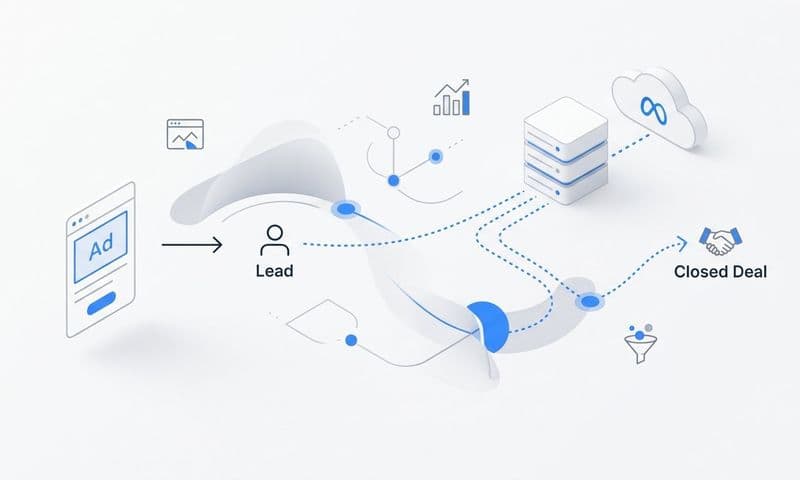
Connecting click IDs to CRM records: When someone clicks a Meta or Google ad, the platform appends a click ID to the URL. Capturing that click ID at the point of lead capture and storing it in your CRM is the foundational step that makes revenue attribution possible. When that lead eventually becomes a closed-won opportunity, the click ID in the CRM record can be matched back to the original ad, campaign, and channel. Without this connection, the revenue stays invisible to your attribution system.
UTM parameter preservation: UTM parameters work alongside click IDs to capture source, medium, campaign, and ad-level data at the moment of lead creation. The critical requirement is that this data is captured in your CRM at lead creation and preserved through every stage of the pipeline. If UTM data gets overwritten or lost when a lead converts to an opportunity, you lose the thread that connects the original ad to the eventual revenue outcome. A proper marketing attribution CRM integration ensures that source data survives the entire sales cycle intact.
Stripe and CRM revenue matching: For B2B SaaS teams, the final step is connecting your attribution data to actual revenue records. Integrating your Stripe or CRM billing data with your attribution system allows you to match subscription revenue, expansion revenue, and even churn events back to the original acquisition source. This is what enables true LTV-by-channel analysis and gives you a complete picture of which channels generate the most valuable customers over time.
Building a Revenue Attribution Report That Leadership Trusts
Having the right data infrastructure is necessary but not sufficient. The attribution data still needs to be structured into reports that answer the questions leadership is actually asking. A report that surfaces the right insights at the right time is what turns attribution from a marketing exercise into a business decision-making tool.
What to include in a revenue attribution report: The core metrics that belong in every revenue attribution report are channel-level revenue contribution, cost per acquired customer by source, multi-touch revenue credit across all touchpoints, and pipeline velocity by channel. Pipeline velocity is especially valuable because it shows not just which channels generate revenue but how quickly deals from those channels move through the funnel. A channel that generates fewer deals but closes them twice as fast may be more valuable than a high-volume channel with slow-moving pipeline. Reviewing the best attribution reporting software options can help you identify which tools are built to surface these metrics reliably.
CRM stage alignment and UTM taxonomy: The quality of your attribution report depends entirely on the cleanliness of the data flowing into it. Your CRM pipeline stages need to be clearly defined and consistently used so that attribution data can be mapped to each stage accurately. Your UTM taxonomy needs to be standardized across every campaign, ad set, and channel so that source data is consistent and comparable. Without this discipline, your attribution reports will have gaps and inconsistencies that undermine confidence in the numbers.
Aligning marketing and sales data: Revenue attribution reporting requires marketing and sales teams to share a common data model. Sales needs to understand why UTM data matters and how to preserve it in the CRM. Marketing needs visibility into what happens to leads after they enter the pipeline. When both teams are working from the same attribution data, budget conversations become grounded in shared facts rather than competing interpretations.
Reporting cadence and real-time decision-making: One of the most underappreciated benefits of accurate revenue attribution reporting is the ability to make budget decisions in real time rather than waiting for end-of-quarter reviews. When you can see which campaigns are generating pipeline and revenue as it happens, you can shift budget toward high-performing channels while deals are still in motion. Waiting until the quarter closes to analyze attribution data means you are always making decisions based on history rather than current performance. Teams that invest in marketing attribution tools built for B2B SaaS gain a significant edge in the speed and quality of these decisions.
The goal is a report that your leadership team can read in ten minutes and walk away from with clear answers about where marketing budget is generating the most revenue and where it is not.
How Cometly Powers Accurate Revenue Attribution for B2B SaaS
Building accurate revenue attribution reporting from scratch requires connecting multiple data sources, maintaining clean data pipelines, and building reporting infrastructure that most marketing teams do not have the engineering resources to sustain. This is the problem Cometly is designed to solve.
Cometly connects your ad platforms, CRM, and Stripe into a single attribution view. Instead of toggling between Meta Ads Manager, your CRM dashboard, and a spreadsheet trying to manually reconcile numbers, you get a real-time picture of which campaigns are driving pipeline and closed revenue. Every touchpoint in the customer journey is captured and mapped to actual revenue outcomes, not platform-estimated conversions.
Capturing every touchpoint: Cometly tracks the full customer journey from the first ad click through to the CRM events that mark a deal as closed. This complete view gives the platform's AI the enriched data it needs to surface meaningful insights about which channels and campaigns are actually converting to revenue, rather than which ones are generating the most clicks or cheapest leads.
AI-driven insights for smarter budget decisions: Rather than manually comparing attribution models and trying to identify patterns across hundreds of campaigns, Cometly's AI surfaces recommendations about which ads and channels are performing against revenue goals. This allows marketing teams to scale what is working and cut what only looks good in platform dashboards, with the confidence that comes from data connected to real revenue outcomes.
Server-side Conversion API integration: Cometly's server-side CAPI integration sends enriched, first-party conversion data back to Meta, Google, and other ad platforms. This improves the quality of the signals those platforms use for targeting and optimization, which means better ad performance over time. It also ensures that Cometly's own attribution engine receives clean, deduplicated event data rather than the fragmented, browser-limited data that pixel-based tracking produces.
Stripe revenue integration: By connecting Stripe data to attribution records, Cometly enables B2B SaaS teams to see not just which channels generate customers but which channels generate the most valuable customers. Subscription revenue, expansion revenue, and churn can all be traced back to original acquisition sources, enabling the kind of LTV-by-channel analysis that makes long-term budget allocation decisions far more defensible.
For teams that want to move beyond last-click guesswork and build reporting that leadership actually trusts, Cometly provides the infrastructure, the integrations, and the AI-driven analysis to make accurate revenue attribution reporting a practical reality rather than an aspirational goal.
The Bottom Line
Accurate revenue attribution reporting is not about tracking more data. It is about connecting the right data points across the entire customer journey so that every budget decision is grounded in actual revenue outcomes rather than platform-reported proxies.
The B2B SaaS teams that build this foundation gain a compounding advantage. They make faster budget decisions because they are not waiting for quarterly reviews. They allocate spend more confidently because they can see which channels generate pipeline that actually closes. And they have the data to defend those decisions in front of leadership without relying on impressions and click-through rates.
The path to accurate revenue attribution runs through clean first-party data collection, CRM integration that preserves source data through the entire sales cycle, server-side tracking that fills the gaps left by pixel-based measurement, and multi-touch attribution modeling that reflects how B2B buyers actually make decisions.
When all of those pieces are in place, you stop guessing and start knowing. And that shift changes how your entire marketing organization operates.
Ready to stop guessing and start connecting your ad spend to real revenue? Get your free demo and see how Cometly gives your team a single source of truth for marketing revenue attribution across every channel, campaign, and touchpoint.