
Every budget decision you make as a marketer depends on one thing: accurate conversion data. But there is a growing problem quietly undermining that data, and most teams only discover it when they start comparing numbers between their ad platforms and their CRM.
Ad blockers are no longer a niche tool used by a small group of privacy enthusiasts. They have become a standard part of how a significant portion of internet users browse the web, and the audience most likely to use them tends to overlap almost perfectly with the B2B SaaS buyer profile: developers, IT professionals, and tech-savvy decision-makers who are exactly the people you are trying to reach and convert.
When those users visit your site with an ad blocker active, the tracking scripts and pixels your marketing stack depends on often never fire. The conversion goes unrecorded. The attribution chain breaks. And your ad platform quietly optimizes toward incomplete data without any warning that something is wrong.
This article breaks down exactly how ad blockers interfere with your tracking, what data you are actually losing, how browser privacy changes are compounding the problem, and what modern infrastructure looks like when you build a tracking strategy designed to hold up against all of it. If you are a marketing operator who wants to understand the problem before solving it, this is the place to start.
How Ad Blockers Actually Interfere With Your Tracking Stack
To understand the damage, you first need to understand the mechanism. Ad blockers do not work by detecting ads visually or reading page content. They work by blocking network requests to known domains associated with tracking, advertising, and analytics.
These blockers rely on maintained lists like EasyList and EasyPrivacy, which catalog the domains of major tracking tools. The Meta Pixel, Google Tag, LinkedIn Insight Tag, and dozens of analytics providers are all included. When a user with an active ad blocker visits your site, their browser checks outgoing network requests against these lists and silently drops any that match a blocked domain before they reach their destination.
This means the pixel never fires. The session never gets recorded. The event never reaches the ad platform. And you never see an error in your dashboard because, from your reporting tool's perspective, nothing happened at all.
JavaScript-based analytics tools face the same problem. Tag managers like Google Tag Manager are also frequently identified and blocked, which means any tag deployed through them, including your analytics, remarketing pixels, and conversion tracking, can be neutralized in a single block. If the tag manager itself does not load, none of the tags inside it fire either.
The particularly dangerous aspect of this is the silence. There is no error thrown in your analytics dashboard. Your conversion rate does not show a red flag. Your session counts do not display a warning that a portion of visitors went untracked. The data that reaches your platform looks clean, because the data that was blocked simply does not exist in your system.
Most marketing teams only discover the problem when they start noticing discrepancies. Ad platform reports show fewer conversions than the CRM records. Revenue attributed to paid channels does not match what closed deals look like in Salesforce or HubSpot. These gaps are often written off as normal platform discrepancies, when in reality they are a signal that a meaningful portion of conversion events are being silently lost. Understanding fixing conversion tracking gaps starts with recognizing these silent losses for what they are.
For B2B SaaS companies specifically, this matters even more because the target audience skews heavily toward the demographic most likely to use ad blockers. You are not just losing a random sample of conversions. You are disproportionately losing conversions from the technical, privacy-aware buyers who represent some of your highest-value prospects.
The Real Cost: What Data You Are Actually Losing
When a conversion event goes untracked because a pixel was blocked, the consequences extend well beyond a missing row in your analytics report. The ripple effects touch your attribution models, your ad platform optimization, and ultimately the budget decisions you make based on that data.
Start with the most direct impact: conversion events like form fills, demo requests, and trial signups go unrecorded when the browser-side pixel is blocked. The ad platform never learns that the click it sent to your site resulted in a conversion. From the platform's perspective, that click was wasted spend.
This distorts automated bidding in a way that compounds over time. Ad platforms use reported conversion data to train their machine learning models. When conversions are systematically underreported, the algorithm optimizes toward the signals it can see, which may be clicks or impressions from audiences that are less likely to convert but also less likely to use ad blockers. You end up with campaigns that look optimized but are actually being trained on incomplete and biased data.
Attribution models suffer a different but equally serious problem. First-touch and last-touch attribution reports depend on browser-side data to connect a user's first interaction or final touchpoint to a conversion. When any step in that journey is blocked, the model either misattributes the conversion to a different touchpoint or loses it entirely. You may be crediting the wrong channel with driving a deal that was actually sourced by a different campaign or ad. Reviewing best practices for tracking conversions accurately can help you identify where these misattributions are most likely to occur.
This leads to poor spend decisions. If your attribution model consistently undervalues a channel because its touchpoints are blocked more frequently, you will pull budget from that channel based on data that does not reflect reality. You might scale a channel that looks strong in the data precisely because its audience is less likely to use ad blockers, not because it is actually performing better.
The problem is especially acute in B2B SaaS where buying journeys are long and multi-touch. A prospect might interact with a LinkedIn ad, read a blog post, attend a webinar, and then request a demo weeks later. If even one of those touchpoints goes untracked because of a blocked pixel, the attribution chain for that deal is broken. The model cannot reconstruct a complete path to conversion, and the channels that contributed early in the journey often get no credit at all.
What you end up with is a systematic undercount of performance across your highest-value touchpoints, a degraded optimization signal feeding your ad platform's AI, and attribution reports that are quietly steering your budget in the wrong direction. The data looks plausible, which is exactly what makes this problem so difficult to catch without deliberately investigating the gap.
Browser Privacy Changes Are Making the Problem Worse
Dedicated ad blockers installed as browser extensions are only part of the story. The tracking disruption marketers face today is broader than that, because privacy restrictions are now built directly into major browsers by default, affecting every user regardless of whether they have installed any additional software.
Safari's Intelligent Tracking Prevention, known as ITP, and Firefox's Enhanced Tracking Protection, or ETP, are active for all users of those browsers out of the box. These features restrict third-party cookies, limit the lifespan of certain first-party cookies set via JavaScript, and block cross-site tracking in ways that directly affect how pixels and analytics tools operate. On Safari, ITP can cap cookie lifespans to as little as 24 hours, meaning a user who clicks an ad on Monday and converts on Wednesday may not be connected to their original click at all.
This is not a setting users have to enable. It is the default behavior for a substantial portion of your traffic, particularly on mobile where Safari has significant market share. The scope of tracking disruption extends well beyond the audience that has deliberately installed an ad blocker.
Chrome's ongoing movement away from third-party cookies adds another layer. While the timeline has shifted over time, the direction is clear: the entire tracking ecosystem is being pushed away from browser-dependent methods. Third-party cookies, which underpin a significant portion of cross-site attribution and remarketing, are being phased out as a viable long-term strategy. A cookieless tracking solution is no longer a future consideration — it is an immediate infrastructure need.
These browser-level changes do not replace ad blocker usage. They stack on top of it. A user browsing on Safari with an ad blocker installed is affected by ITP and the extension simultaneously. A Chrome user who has installed a blocker is dealing with both the extension's domain blocking and Chrome's evolving privacy defaults. The sources of data loss compound each other, and the cumulative effect on attribution accuracy is significant.
For marketers still relying primarily on client-side pixels and third-party cookies, this trajectory represents a structural problem that will not get better on its own. The technical foundation that most marketing stacks were built on is eroding, and the gap between what ad platforms report and what your CRM records will continue to widen unless you address the underlying infrastructure.
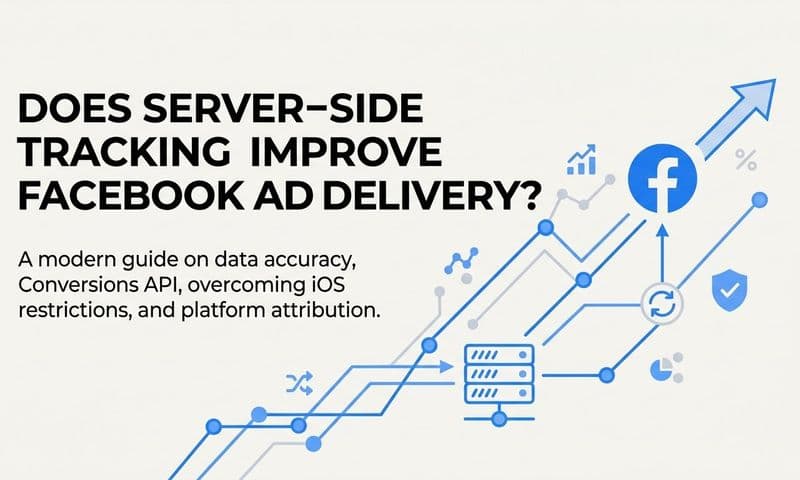
Server-Side Tracking and Conversion APIs: The Modern Fix
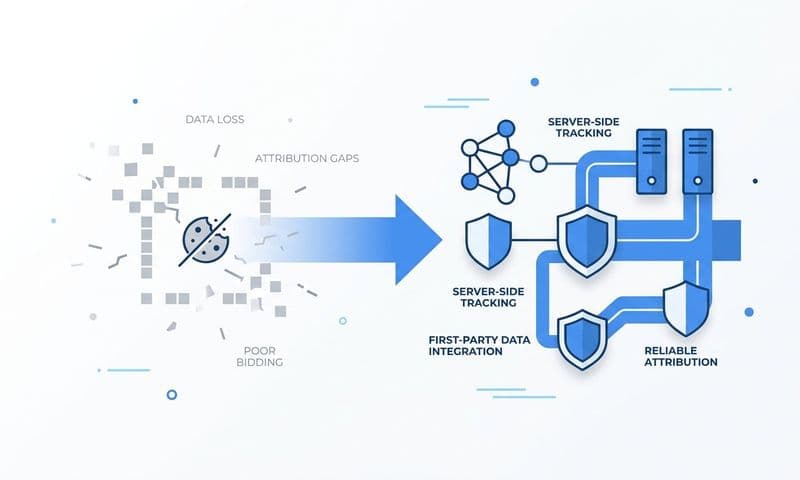
The reason browser-based pixels are vulnerable to ad blockers is straightforward: the tracking request originates from the user's browser, which is exactly where ad blockers operate. The solution is equally logical: move the tracking request off the browser entirely.
Server-side tracking does exactly this. Instead of relying on a JavaScript pixel in the user's browser to fire a conversion event, server-side tracking captures that event on your own server infrastructure and sends it directly to the ad platform or analytics tool. The request never originates from the user's browser, so ad blockers have no opportunity to intercept it. The case for why server-side tracking is more accurate comes down to this fundamental architectural difference.
This approach is not a workaround. It is increasingly the recommended implementation by the platforms themselves. Meta's Conversion API and Google's Enhanced Conversions are purpose-built server-to-server integrations that allow businesses to send event data directly from their backend to the ad platform, bypassing the browser layer entirely. Both Meta and Google treat these integrations as best practices and use the data they receive to improve ad optimization and attribution accuracy.
When you implement a Conversion API alongside your browser pixel, you create redundancy. If the browser pixel fires, you get that signal. If it is blocked, the server-side event still reaches the platform. The ad platform's machine learning model gets a more complete picture of which clicks are actually converting, which improves bidding, targeting, and overall campaign performance over time.
First-party data strategies are what make server-side tracking durable. When your business collects and owns the event data, rather than relying on a third-party script to do it for you, you are not dependent on browser permissions, cookie policies, or ad blocker lists. The data belongs to you, it lives in your infrastructure, and you control how it is processed and transmitted.
This is the foundation that makes tracking resilient against future privacy changes as well. As browsers continue tightening restrictions and third-party cookies become less viable, a first-party, server-side infrastructure does not become less effective. It is built on data you own and channels you control, which means it holds up regardless of what browser vendors or regulators decide next. Exploring the full range of server-side tracking benefits makes clear why this shift is worth prioritizing.
Implementing server-side tracking does require more technical setup than dropping a pixel into a tag manager. But for B2B SaaS companies running meaningful paid acquisition budgets, the return on that investment is significant: cleaner conversion data, better ad platform optimization, and attribution reports that actually reflect what is happening in your pipeline.
Connecting the Dots: Attribution When Tracking Is Incomplete
Server-side tracking solves the data collection problem, but it does not automatically solve the attribution problem. You can have a complete set of server-side events and still struggle to understand which campaigns, channels, and touchpoints are actually driving pipeline and revenue if those events are not connected to a coherent attribution layer.
Attribution in B2B SaaS is inherently complex. A single deal might involve multiple people from the same company interacting with different ads across different channels over a period of weeks or months. Connecting an ad click from the first week to a closed-won opportunity in the CRM requires stitching together data from your ad platforms, your website, and your CRM in a way that preserves the full sequence of touchpoints.
This is where the quality of your underlying event data becomes critical. Multi-touch attribution models, whether linear, time-decay, or data-driven, are only as reliable as the data they are fed. When that data comes from cookie-dependent browser signals, the model is working with gaps, inconsistencies, and attribution breaks caused by blocked pixels and expired cookies. When the data comes from enriched, server-side events tied to first-party identifiers, the model has a much more complete and accurate foundation to work with. Getting your attribution tracking setup right is what determines whether your models reflect reality or reinforce blind spots.
The practical implication is that server-side tracking and attribution are not separate problems. They are two layers of the same solution. Better data collection enables better attribution, and better attribution enables better decisions about where to allocate budget and which campaigns to scale.
This is the problem that Cometly is built to solve. By connecting ad platforms, CRM data, and website events through server-side infrastructure, Cometly gives marketing teams a single source of truth that reflects actual pipeline and revenue rather than the incomplete, browser-reported metrics that most teams are still relying on. You can see which ads drove which leads, how those leads progressed through the funnel, and which campaigns ultimately contributed to tracking closed won revenue, all in one place.
The ability to compare attribution models within a single platform also matters here. Different models tell different stories about which channels deserve credit. Being able to switch between first-touch, last-touch, and multi-touch views using the same enriched dataset lets you pressure-test your assumptions and make budget decisions with more confidence than any single model allows on its own.
For B2B SaaS teams running multi-channel acquisition, this kind of attribution clarity is not a nice-to-have. It is what separates teams that are guessing about performance from teams that actually know what is driving growth.
Building a Tracking Strategy That Holds Up in 2026
Understanding the problem is the starting point. Building a tracking strategy that addresses it requires a deliberate, phased approach that starts with an honest audit of where your current setup is vulnerable.
Audit your current tracking stack: Start by comparing conversion data across your ad platforms, your analytics tool, and your CRM. Look for systematic gaps: are there conversion types that appear in your CRM but not in your ad platform reports? Are session counts significantly lower than you would expect based on your traffic? These discrepancies are your signal that client-side tracking is losing events. Quantify the gap before you start fixing it so you can measure the impact of the improvements you make.
Prioritize server-side implementation for your highest-spend channels: You do not need to overhaul everything at once. Start with the channels where the data gap is costing you the most in terms of misallocated budget or degraded optimization. Implement Meta's Conversion API or Google's Enhanced Conversions for your top channels first, then expand coverage to LinkedIn and other platforms as you build out the infrastructure. Run browser pixels and server-side events in parallel during the transition so you can verify the improvement in match rates and conversion volume.
Pair technical tracking improvements with a proper attribution platform: Server-side events are more complete and accurate, but they still need to be interpreted across channels and connected to revenue outcomes. An attribution platform that ingests enriched server-side data, connects it to CRM pipeline and closed-won revenue, and surfaces AI-driven insights about campaign performance is what turns better data into better decisions. This is where tools like Cometly provide the most value: not just collecting the data, but making it actionable across every channel in your stack.
Build for durability, not just today's requirements: The privacy landscape will continue to evolve. Any tracking strategy built primarily on third-party cookies or browser permissions is a strategy that will require rebuilding again in the near future. First-party data collection, server-side event infrastructure, and Conversion API integrations are investments that become more valuable over time, not less, because they are not dependent on browser behavior that can change with a software update.
Your Next Steps Toward Accurate Attribution
Ad blocker affecting tracking is not a niche technical problem that only matters to engineering teams. It is a strategic risk for any B2B SaaS company running paid acquisition, because the data gaps it creates directly affect how budgets are allocated, how ad platforms optimize, and how confidently leadership can evaluate marketing performance.
The marketers who treat this as a data infrastructure priority will have cleaner attribution, better ad platform optimization, and more confident budget decisions. The ones who continue relying on browser-side pixels and third-party cookies will face a growing gap between what their dashboards show and what is actually happening in their pipeline.
The good news is that the solution is well-defined. Server-side tracking, Conversion API integrations, first-party data collection, and a proper attribution layer are the building blocks of a tracking strategy that holds up against ad blockers, browser privacy changes, and whatever comes next.
Cometly is built specifically for this challenge. It connects your ad platforms, CRM, and website events through server-side infrastructure, giving you a single source of truth that reflects actual pipeline and revenue. With multi-touch attribution, AI-driven campaign insights, and 70+ native integrations, it is the platform designed to help B2B SaaS marketing teams stop guessing and start knowing what is driving growth.
Ready to elevate your marketing game with precision and confidence? Discover how Cometly's AI-driven recommendations can transform your ad strategy. Get your free demo today and start capturing every touchpoint to maximize your conversions.