

You pour budget into paid campaigns, set up your pixels, and wait for the data to roll in. But a growing share of your audience is invisible to your tracking stack before they ever see your ad. Ad blockers preventing tracking is not a fringe concern for a small technical team to solve quietly. It is a structural problem that distorts your attribution data, inflates your perceived customer acquisition cost, and leads marketing and growth teams to make budget decisions based on incomplete information.
The scale of the problem has expanded well beyond users who consciously install browser extensions. Native privacy features built into Safari, Firefox, and other modern browsers mean that tracking gaps now affect a broad segment of everyday users, not just the technically savvy. If you are running paid campaigns and relying entirely on client-side pixels to measure results, you are almost certainly underreporting conversions and misreading which channels are actually driving revenue.
This article breaks down exactly how ad blockers interfere with your tracking stack, what data gets lost and why it matters for B2B SaaS attribution specifically, and what modern solutions exist to recover accuracy. By the end, you will have a clear picture of the problem and a practical path forward.
How Ad Blockers Interfere With Your Tracking Stack
To understand the damage, you first need to understand what ad blockers are actually targeting. Most marketers think of ad blockers as tools that hide banner ads. That is true, but it is only part of the picture. Modern ad blockers also block the tracking infrastructure that ad platforms and analytics tools depend on to record user behavior, attribute conversions, and report on campaign performance.
Specifically, ad blockers target browser-based pixels, third-party JavaScript scripts, and tracking parameters embedded in URLs. When a user visits your site after clicking a paid ad, your tracking setup typically fires a series of scripts in the browser: a Meta pixel, a Google Ads conversion tag, perhaps a Google Analytics snippet, and other platform-specific tags. These scripts send event data back to the respective ad platforms so they can record the conversion and attribute it to the correct campaign. Ad blockers intercept and suppress these requests before they can complete.
There are two primary blocking mechanisms at work. The first is list-based filtering. Ad blockers maintain regularly updated lists of known tracking domains, script URLs, and network request patterns associated with advertising and analytics infrastructure. When a browser request matches an entry on that list, it is blocked. The Meta pixel domain, Google Tag Manager, and many analytics scripts are well-documented entries on these lists.
The second mechanism is behavioral filtering. More sophisticated blockers analyze network requests in real time and look for patterns that resemble tracking behavior, such as requests that pass user identifiers or session data to external servers. Even if a script URL is not on a known blocklist, behavioral filtering can suppress it if it exhibits tracking-like characteristics.
The parts of your marketing stack most vulnerable to both mechanisms are client-side pixels from Meta, Google, LinkedIn, and other ad platforms, as well as JavaScript-based analytics tools like Google Analytics that execute in the browser. These tools were built on the assumption that the browser environment would cooperate. When it does not, the data simply does not get recorded.
The result is a quiet but significant gap between what actually happens on your site and what your ad platforms and analytics dashboards report. Users convert, but the pixel does not fire. Sessions occur, but the analytics tag never executes. Your data looks complete, but it is not.
The Real Cost to Your Attribution Data
When pixels are blocked, conversions go unrecorded at the ad platform level. The ad platform never receives the signal that a user who clicked your ad went on to complete a purchase, fill out a demo request form, or start a free trial. From the platform's perspective, that click generated no result. This causes systematic under-reporting of your return on ad spend.
Think about what that means in practice. A campaign that is actually profitable appears to underperform because a meaningful share of its conversions are invisible to the platform. You look at the ROAS figure and see a number that does not justify the spend. You reduce budget, shift it elsewhere, or pause the campaign entirely, based on data that was never complete to begin with. The campaign was working. You just could not see it.
The downstream effects on attribution models are equally damaging. Attribution models work by assigning credit to the touchpoints that contributed to a conversion. When those touchpoints are missing because pixels were blocked at key moments in the customer journey, the model assigns credit incorrectly. First-touch attribution misidentifies the true entry point. Last-touch attribution credits the wrong closing interaction. Multi-touch models distribute credit across an incomplete set of touchpoints, producing a distorted picture of which channels and campaigns are actually driving results.
For B2B SaaS companies specifically, this problem compounds in ways that are particularly costly. B2B buying cycles are long. A prospect might interact with your paid search ads, then see a retargeting ad on LinkedIn, then engage with a display campaign, and then convert on a direct visit weeks later. Each of those touchpoints is a data point in your attribution model. If ad blockers suppress the pixel events at two or three of those touchpoints, the model is working with a fundamentally incomplete record of the customer journey.
Longer sales cycles mean more touchpoints, and more touchpoints mean more opportunities for tracking events to be blocked. The compounding effect is significant. Attribution errors that might be manageable in a short e-commerce funnel become substantial distortions in a multi-week or multi-month B2B funnel where the path from first click to closed-won revenue involves many digital interactions.
The practical consequence is that marketing and growth teams end up making budget allocation decisions based on a skewed view of channel performance. Channels that rely heavily on pixel-based conversion tracking, such as paid social, tend to appear weaker than they are. Channels that are harder to block or that have alternative measurement mechanisms may appear stronger. The result is misallocated budget and missed growth opportunities.
Why Client-Side Tracking Is Losing the Battle
Client-side tracking has a fundamental structural weakness that goes beyond ad blockers. It depends entirely on the user's browser executing JavaScript. The pixel or analytics tag must load, run, and successfully transmit data to an external server, all within the browser environment. Any factor that disrupts any step in that chain breaks the tracking event silently and completely.
Ad blocker extensions are one disruption source. But they are increasingly not the only one. Major browsers have built native tracking prevention directly into their default settings. Safari's Intelligent Tracking Prevention (ITP) restricts how third-party cookies and certain scripts are used to track users across sites. Firefox's Enhanced Tracking Protection blocks known tracking scripts by default. These are not opt-in privacy tools for power users. They are default behaviors in widely used browsers, which means the tracking gap affects a broad population of ordinary users who have never installed an ad blocker extension.
This distinction matters because it changes how you should think about the scale of the problem. If ad blockers were only a concern for a small segment of technically sophisticated users, you might accept the data loss as a manageable margin of error. But when native browser privacy features extend similar protections to mainstream users, the gap in your tracking data becomes substantial enough to meaningfully distort campaign measurement.
There is also a second-order effect that many marketers overlook: first-party data signal degradation. Ad platforms like Meta and Google use conversion signals to power their bidding algorithms and audience targeting. When those signals are incomplete because client-side pixels are being blocked, the quality of the data feeding the platform's machine learning models degrades. The algorithm has less information to work with when deciding who to show your ads to and how much to bid. This means ad blocker-driven tracking gaps do not just affect your reporting. They actively reduce the effectiveness of your future campaign delivery.
The trend lines here are clear. Privacy regulations and browser privacy features are tightening, not relaxing. Relying on client-side tracking as your primary measurement layer is a structural vulnerability that will only become more pronounced over time. The question is not whether to address it, but how.
Server-Side Tracking and Conversion APIs: The Modern Fix
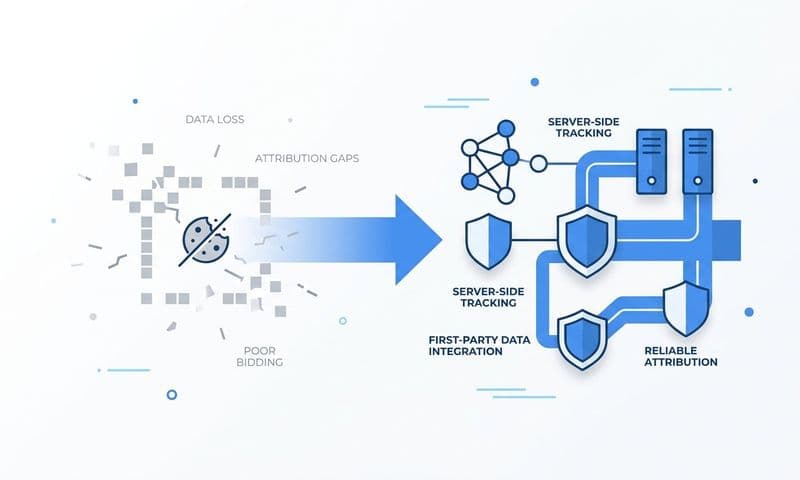
Server-side tracking represents a fundamental architectural shift in how conversion events are transmitted. Instead of firing a pixel in the user's browser and hoping the browser cooperates, server-side tracking sends conversion events directly from your server to the ad platform's API. The browser is not involved in the transmission at all, which means browser-based blockers cannot intercept it.
This is not a workaround or a hack. It is the direction that major ad platforms have explicitly moved toward. Meta's Conversion API (CAPI) and Google's Enhanced Conversions are server-to-server solutions built precisely to address the signal loss caused by blocked client-side pixels. Both are documented, supported solutions available through each platform's developer infrastructure.
Here is how it works in practice. When a user completes a conversion event on your site, such as submitting a demo request form, your server captures that event and sends it directly to Meta's or Google's API endpoint. The ad platform records the conversion and attributes it to the appropriate campaign, all without any browser script needing to execute successfully. Ad blockers operating in the user's browser have no visibility into this server-to-server communication and no ability to suppress it.
The recommended implementation approach is not to replace client-side pixels with server-side tracking, but to run both simultaneously. This hybrid approach, sometimes called redundant tracking, maximizes the number of conversion events captured. The browser pixel catches events when it can. The server-side API catches events regardless of browser conditions. Together, they produce a more complete signal than either alone.
A critical implementation detail when running both layers is event deduplication. When a conversion event is received from both the browser pixel and the server-side API, the ad platform would otherwise count it twice. Both Meta and Google provide deduplication logic based on unique event IDs. You assign each conversion event a unique identifier, include it in both the browser pixel event and the server-side API call, and the platform uses that ID to recognize and deduplicate the duplicate event. Without proper deduplication, your conversion counts will be inflated, which creates a different but equally problematic data quality issue.
Server-side tracking also unlocks a significant additional advantage: first-party data enrichment. Server-side events can include richer customer data than browser pixels typically transmit. Hashed email addresses from form submissions, phone numbers, CRM identifiers, and other first-party data points can be included in the server-side event payload. Ad platforms use this data to match the event to a known user profile with greater accuracy, which improves event match quality scores, strengthens lookalike audience modeling, and gives the platform's bidding algorithm better signal to optimize against. The result is not just better measurement. It is better campaign performance. For a deeper look at the advantages this architecture provides, server-side tracking accuracy is worth exploring in full.
Recovering the Full Customer Journey With Attribution Software
Server-side tracking solves the signal transmission problem. But even with server-side events flowing correctly, you still need a way to make sense of all the data across your marketing stack. This is where a dedicated attribution platform becomes essential.
A modern attribution platform stitches together data from multiple sources: server-side conversion events, CRM records, ad platform APIs, and website analytics. By aggregating signals from all of these sources rather than depending on any single tracking mechanism, it can reconstruct the customer journey even in environments where browser-based tracking is partially degraded. If a pixel was blocked at one touchpoint but a CRM record captures the lead, and a server-side event captures the conversion, the attribution platform can connect those data points and build a more complete picture of the path to revenue.
For B2B SaaS teams, the most valuable capability is connecting ad spend data to pipeline and closed-won revenue in a single view. Pixel-level tracking tells you that a click happened and perhaps that a form was submitted. It does not tell you whether that lead became a qualified opportunity, moved through the pipeline, and eventually closed as paying revenue. An attribution platform that integrates with your CRM can close that loop, mapping ad spend directly to the deals it influenced across the full sales cycle.
This matters enormously for budget decisions. When you can see that a particular LinkedIn campaign influenced a set of deals that closed at a certain average contract value, you have a real basis for evaluating that campaign's contribution. You are not relying on pixel-reported ROAS that may be understated due to tracking gaps. You are looking at actual revenue outcomes tied to actual spend.
AI-driven attribution analysis adds another layer of value here. When raw event data has gaps, which it will even with server-side tracking in place, AI can surface patterns across the available data to identify which campaigns and channels are consistently associated with high-value outcomes. Rather than treating incomplete data as a dead end, AI-powered attribution uses the signals that are available to generate reliable insights and surface recommendations for where to scale and where to pull back. This gives growth teams the confidence to make decisions even when the data is not perfectly complete, which in practice it never is.
Platforms like Cometly are built specifically for this use case. By connecting ad platform data, CRM records, and server-side events in a single attribution layer, Cometly gives B2B SaaS marketing teams a unified view of what is actually driving pipeline and revenue, independent of the pixel-level tracking gaps that ad blockers create.
Building a Tracking Strategy That Survives Ad Blockers
The practical question for most marketing and growth teams is: what do we actually implement? The answer is a layered approach that does not depend on any single tracking mechanism.
Server-side tracking as the primary signal layer: Implement Meta's Conversion API and Google's Enhanced Conversions as your foundational event transmission layer. These server-to-server connections are not affected by browser-based blockers and should be your primary source of conversion signal for ad platform optimization and reporting.
Client-side pixels as a supplementary layer: Keep your browser-based pixels running alongside server-side tracking. They will successfully capture events for users who do not have tracking prevention active, and they provide an additional data point that can improve event match quality when both signals are received. Think of them as a supplement, not the foundation.
An attribution platform for unified reporting: Connect your ad platforms, CRM, and server-side event data into a single attribution layer. This is where you translate raw event data into the business-level insights that actually inform budget decisions: which channels are driving pipeline, which campaigns are contributing to closed-won revenue, and where your spend is generating the best return.
Event deduplication deserves particular emphasis in this setup. When both client-side and server-side tracking are running simultaneously, you must implement deduplication correctly to avoid inflated conversion counts in your ad platform dashboards. Assign unique event IDs to each conversion, include them in both transmission paths, and verify that deduplication is functioning as expected during your implementation testing phase.
Regular data audits are also essential. Periodically compare the conversion counts reported by your ad platforms against the lead and revenue records in your CRM. Significant discrepancies between these sources are a signal that your tracking setup has gaps. Consistent reconciliation between ad platform data and CRM data is one of the most reliable ways to validate that your server-side implementation is working correctly and to catch any new issues before they distort your reporting for extended periods.
The broader principle is to build redundancy into your measurement infrastructure. No single tracking mechanism is reliable in every environment. A layered strategy that combines server-side events, client-side pixels, CRM data, and a unified attribution platform is far more resilient than any approach that depends on a single point of data collection.
The Path Forward for B2B SaaS Marketing Teams
Ad blockers are not a temporary nuisance that will fade as browser technology evolves. Privacy features in browsers are becoming more sophisticated, not less. The structural vulnerability of client-side tracking is a long-term reality that B2B SaaS marketing teams need to address as a strategic priority, not a technical footnote.
The core insight is straightforward: if your measurement infrastructure depends entirely on browser-based pixels executing correctly in every user's environment, you are building on a foundation that is eroding. Server-side tracking via Conversion APIs restores the signal that ad blockers suppress. A unified attribution platform connects that signal to real revenue outcomes. Together, they give you a measurement setup that is resilient to the tracking gaps that ad blockers and browser privacy features create.
The teams that get this right will have a genuine competitive advantage. They will make budget decisions based on accurate data while competitors are allocating spend based on incomplete pixel-reported metrics. They will feed their ad platforms better conversion signals, improving algorithmic performance. And they will have a clear, defensible view of which channels are actually driving growth.
Cometly is purpose-built to help B2B SaaS marketing teams achieve exactly this. It captures every touchpoint from first ad click to closed-won revenue, feeds enriched conversion data back to ad platforms to improve targeting and optimization, and gives growth teams a single source of truth for marketing performance that does not depend on any single tracking mechanism. If you are ready to stop making decisions based on incomplete data, Get your free demo today and see how Cometly can give your team the attribution clarity it needs to scale with confidence.